
Hoy is the second largest island in the Orkney archipelago. Mainland, where you’ll find Stromness with its cobbled streets and Kirkwall with its Cathedral being the largest. The population of Mainland is around twenty thousand, for Hoy around four hundred.
Hoy has two parishes, Hoy and North & South Walls. To the north in the parish of Hoy the island rises almost 1600 feet to the top of Ward Hill. A moorland landscape of hills and glacier cut valleys. Here you’ll find White tailed eagles and, in the valley of Berriedale, Britains most northerly ancient woodland. This end of the island gives Hoy its name, the Norsemen’s Haey, high island.

From the valley of Rackwick, where depending on the mood of the sea, the shore can be sand or a tumble of stone, a walk will take you to the Old Man, a 450 feet high red sandstone sea stack. Climbed by Chris Bonnington in the mid 1960s and televised live by the BBC.
Head south along the single track road and the land slowly starts to flatten, still dominated by moor but the hills are gentler, rolling across the land like a low swell on the sea. As you pass the lonely grave of Betty Corrigal, a story for another day, you leave the parish of Hoy and enter North Walls. A few miles further on at Lyness where the lifeline ferry docks, heather slowly starts to give way to agriculture, low lying fields of pasture standing in contrast to the moors above them.
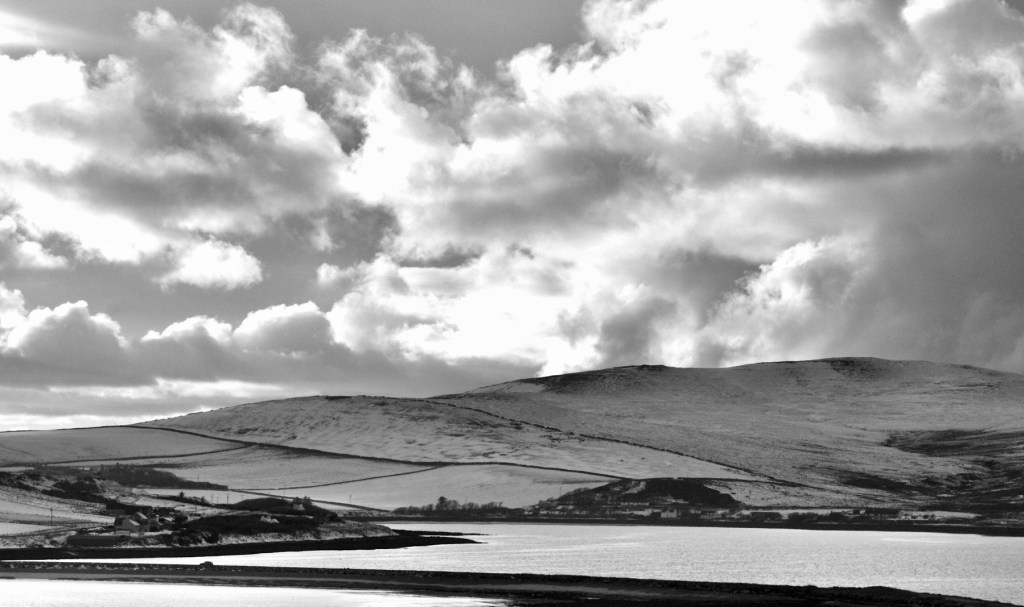
Carry on south and as you leave North Walls you’ll cross the Ayre, a now permanent causeway, onto the island of South Walls. Low lying and fertile, in summer a patchwork of greens and the gold of barley. Eventually you’ll reach the lighthouse at Cantick Head. To the south around four miles away you’ll see the coast of Caithness. By road from Rackwick to Cantick you’ll have travelled around twenty-four miles. The Norsemen also gave Walls its name, waas, a voe, a narrow sea inlet.

 A garden in Orkney