

The past couple of weeks have done their best to live up to Thomas Hoods poem of November, no sun -no moon – no morn – no noon – no dawn, etc, etc. Not quite true because we have had the Beaver moon and occasional days of sunshine but generally grey days and rain, with, over recent days, snow and hail thrown in for good measure. Yesterday brought storm Bert, wild seas and sheets of rain. Today though, looking out towards South Walls, the sun is starting to light the landscape, the sky a clear deep blue. No matter how grey or wild, there’s always a silver lining.
As mentioned in the previous blog, early month dry days allowed the meadow to be cut. Once dropped, before being raked into winrows, it was left for a few days for the winds to dry the grasses and flower stems. When we first cleared the field, with a view to reinstating a wildflower patch, so thick was the growth that the raked up winrows were more like berms, snaking chest high across the field, ready to repel seaborne invaders. Now, after a few Summers of nutrients being sucked up and not replaced, the seed-heads of once chest high grasses, even in the lushest spots, can barely tickle your knees. The winrows still snake across the field but are now shin high, not chest high.

The grasses, once raked up, are collected by the pitchfork full and dumped either at the edge of the low cliff or amongst young Willow coppice. Mini haycocks, left to slowly rot down, a home for mice and bugs. As I worked a Rock Pipit arrived, leaving his or her natural habitat of the shore below the meadow. Flitting from post to ground, picking up uncovered goodies too small for the human eye to see.

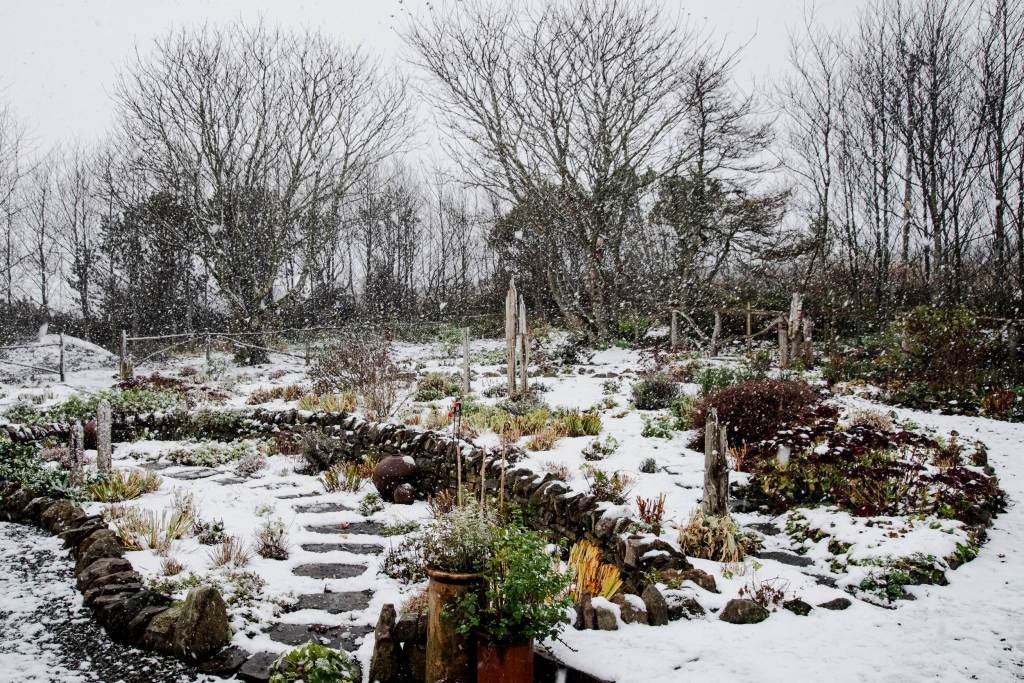
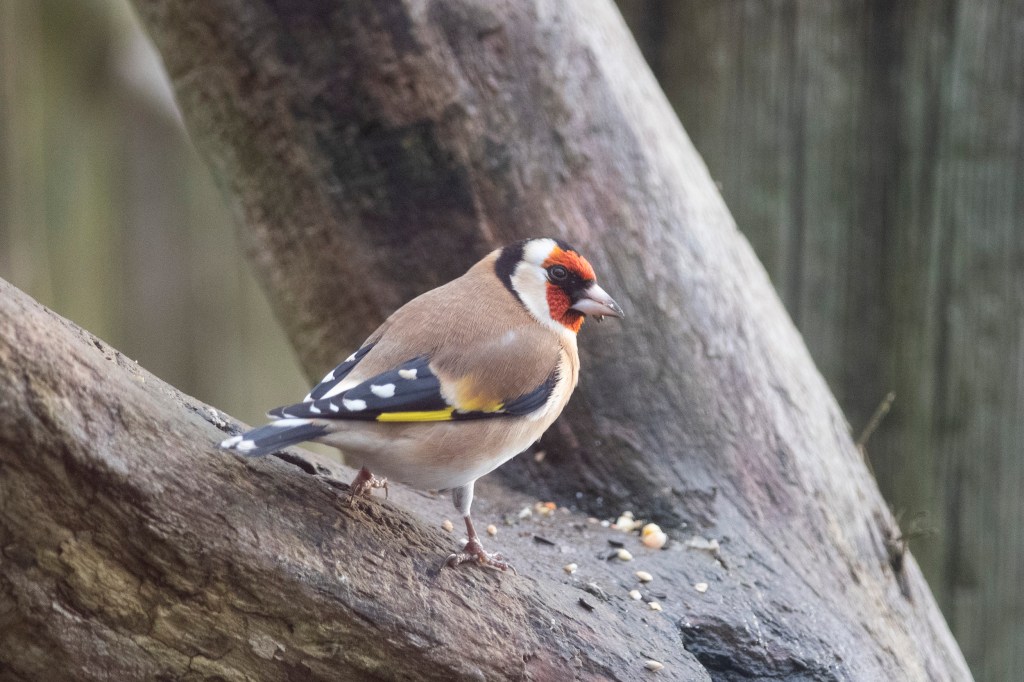
In the garden the last of the flowers have succumbed to the cold. The only plants still trying to put on a show are red Hesperantha’s, for us, they’re the last man standing. The cold, or perhaps just the time of year, has brought an influx of Goldfinches, one or two pairs breed here but in Winter, although numbers ebb and flow from one week to the next, we expect to count them in tens rather than in one’s and two’s. If I wore a watch, the birds that I could set the time by would be Starlings, they arrive mid morning, bathe, squabble, eat – rinse and repeat, and stay for the rest of the day, leaving, like clockwork, a half hour before sunset to roost in a thick stand of conifers at the edge of a nearby garden.

The snow didn’t last. By Thursday, although we still got the occasional flurry, only the hills at the North end of the island still had a cloak of white, the winds, swinging back from North to South, warming and losing their edge.

A favourite walk takes you from the farm of Snelsetter on South Walls, through a spot known as The Hill of the White Hammars, and from there along the coast of Cantick Head. It’s an area of coastal heath kept short by scouring Winter winds and the teeth of a flock of Shetland and Shetland cross sheep.

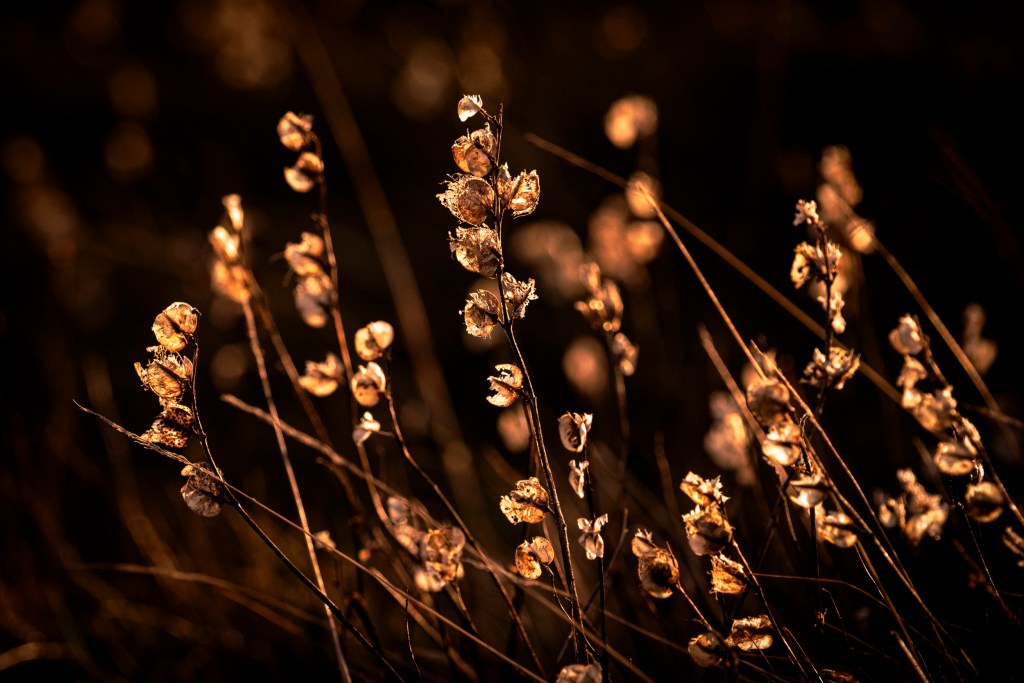
In Spring, the ground is bright with Yellow Rattle, a semi parasitic plant that feeds on the grasses, and along with the Winter nibblings of Sheep, together with the winds, helps keeps the sward short and allows wildflowers to flourish. In Summer it’s a tapestry of colour, alive with the call of Curlews and Lapwings, at this time of year the Lapwings are absent but the Curlews still call. The flowers are gone until Spring. The seed-heads of Rattle though are still visible, backlit by a low sun, shook empty by the wind.
Just off from the walk, in a field that in Summer is grazed by cattle, there’s what remains of a But and Ben house, a simple two room cottage. Only one gable remains, its hearth still intact, the coursed stone that would once have worn a coat of lime plaster, laid bare by the elements. Just beyond the house, on the heath itself, there’s the remains of a byre. If the light is low and angled just right, to the side of the byre the bumps and shadows of an old ridge and furrow system can be seen. The rest of the house is long gone, probably incorporated into a newer house, also now roofless and empty, that stands, as the crow flies, a mile or so away.


On Friday afternoon, before Bert blew in, I walked the route again, Snelsetter to Cantick, intent on photographing Grey Seals and their pups, a subject for next weeks blog. It’s dusk here now by 3pm and by 3.30 the sun has set. The seals, pups especially, are photogenic and I spent too much time and walked too far, getting back to Snelsetter in near total darkness, mental note to self, next time, remember a head torch.

 A garden in Orkney
Good morning Gary, A quieter one here after Bert stormed across the S. West too, bringing snow, unusual here especially in November, torrential rain and gales. Been incredibly warm too, not that I’m complaining about that! Fortunately I live at the top of a hill, so unlikely to be flooded, but of course this location makes the wind is pretty fierce! Looks a bit calmer for the next few days. One year the river Wey flooded and we saw swans swimming in the car park! Why the name “But and Ben?” Sounds like a comedy double act! Have a good week. M. x
LikeLiked by 2 people
Hello Margot, it has settled down here as well, a few wild days for the whole country. We didn’t get much snow but did get some hard frosts and wild winds, the winds are normal for this neck of the woods but the frosts are quite unusual for here. I’ve been saying all Summer that I must remember to insulate the water supply to my workshop, completely forgot, everything froze solid! On this weeks to do list.
But and ben does sound like a double act. The two rooms were known as the inner and outer, the but is the outer room, the kitchen/living space, the ben the inner room, sleeping space. From the Scottish Bouten and Binnen, outside and inside.
Have a good week.
LikeLiked by 2 people
I’m assuming that Bouten and Binnen are actually pronounced ‘booten and binnen’? It’s a standing joke among Americans that you can always tell someone’s Canadian because of the way they pronounce ‘about’. According to them, we all say ‘aboot’. That’s of course a testament to how many Scots came to Canada, but also that those who went to the US quickly lost their accents in America’s ‘melting pot’ culture. Here we call Canadian culture a ‘salad’, not a ‘melting pot’ because everyone keeps their original accents and customs, unlike the US.
Great photos as ever and so interesting to read about your flora and fauna. Look forward to the pictures of seal pups.
BTW when is shearing time for the Shetlands and crosses round your way?
LikeLiked by 2 people
Morning Penny, yes, ‘booten’. Out is ‘oot’ and as you say about is ‘aboot’. When I walk past or explore the many empty houses here I often wonder if the last occupants just upped and left for a new life in a new country, occasionally you’ll see a house where everything has been left behind, not just furniture, but linen and clothing, had they simply left with what they could carry for a new life in a new land, who knows.
Wherever we can we tend to upcycle and recycle rather than buy new, one of our favourite possessions is a simple locally made dresser, still in its original worn and faded paint, that came, in pieces, from a now collapsed house, rescued just before the roof fell in. There’s a good number of other pieces here as well, my workshop has an ever growing pile of cupboards, tables and kists, all on the to do list for wet winter days. If your library can source it you might like ‘Silent’ by Keith Allardyce, ‘Found’ by the same author is also good, close to my beach-combing heart!
I think shearing is late July, early August but I’m not a 100% sure, one day you pass by and they’re wooly the next they’re not 🙂 If you can see this in Canada, the sheep being gathered for shearing are Shetlands, filmed at the North end of the island. https://www.youtube.com/watch?v=iwdD98Clbeo
LikeLiked by 1 person
Thanks Gary! This shearer comes up on my YT feed regularly because I look at weaving and spinning videos a lot, but never watched before. I was wondering about timing of the shearing because my friends with a flock in Manitoba has had to shear earlier and earlier due to climate change. Will settle down tonight with a hot drink and watch.
I think I’d find your workshop pretty much like ours when we lived in Norfolk and were restoring a canal-side granary that was once owned by Oliver Cromwell. I was known for taking van loads of rubble to the ‘tip’ and coming back with a van even more loaded with old Victorian furniture in need of repair that people had discarded. As I type I’m sat next to a spice cabinet made from 1940s old school science benches from that very source.
Can’t find Keith Allardyce’s Silent, or Found in the library or either of the online used book stores (I also rarely buy anything new), but will see if I can arrange an interlibrary loan with one of the Nova Scotia libraries – they’re bound to have something by him. Thanks for the recommendation.
LikeLiked by 1 person
If those granary walls could speak, what a home to renovate. Down South I couldn’t drive past a skip without stopping and having a root through it, no skips here but I’ve been known to remove items from bonfires as they’re being built. Fortunately Jacqui has the same genes, this weeks joint project was an Alfred Wallace inspired 3 foot long whale cut from old sheet steel, mounted onto old boat coppering washed up by the tide, in a home made frame of driftwood. Cost nowt and we love it.
KA also did a couple of books on Lighthouses, if the library has them I would try them, Scotlands Edge and Scotlands Edge revisited.
LikeLiked by 1 person