
With progress on the rear garden well on its way, thoughts turned to the garden at the front of the house. A long narrow oblong perhaps ten paces deep by forty paces long.

We had inherited stone dykes that ran around three sides of the space. It should be said that in Scotland a dyke is a wall, in England a wide ditch. A friend remembers them being built, unfortunately despite being only a few decades old they hadn’t stood the test of time. With no through stones to tie the sides together and an infill of soil rather than packed stone, those that hadn’t already collapsed were well on the way.
The old dykes would be rebuilt and new dykes would be added. In a nod to local history one third of the space would become a Kailyard, a crofters vegetable garden, enclosed on all sides for shelter. Although in our case flowers, not veg, would be grown. The rest would become an oblong garden, split into two halves by a simple driftwood fence. A garden for a yet to be built extension.

Existing walls were dismantled. The stone, roughly graded into thicknesses, laid out in rows along the ground. Long stones suitable for ties were put to one side. Anything roughly triangular was thrown into a separate pile, these would be the ‘pennies’, the upright top stones that cap the finished dyke. A favourite job, there’s a rhythm to the work, a steady progress as the day goes on. A knowledge that if done well the dyke will long outlive its builder.

‘A’ frames were made of scrap timber and fastened to old fence stabs driven into the ground. Having never built a dyke before moving to Orkney, but since then having built them here and there all over the island, the early lesson you learn for a brand new dyke is to spend time running out strings between frames.
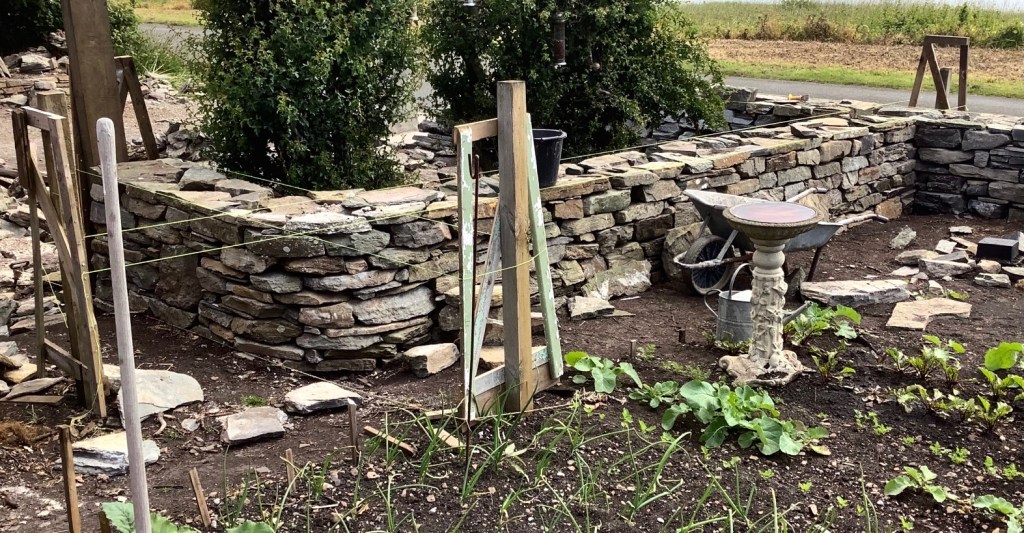
The frames keep you on track with the profile of the wall as it is built but before a stone is laid they also help visualise the finished dyke. A top string pulled tight between frames tells instantly whether the dyke should be level or allowed to slope to follow the camber of the ground.

We built them in 2020. Lockdown year. Since then they’ve mellowed. The newness already weathering away. Wrens have nested in a cranny. Wood mice live in the lower storeys. Stand still in the kailyard and they’ll run around your feet, picking up seed spilt from bird feeders that hang from a Rowan.
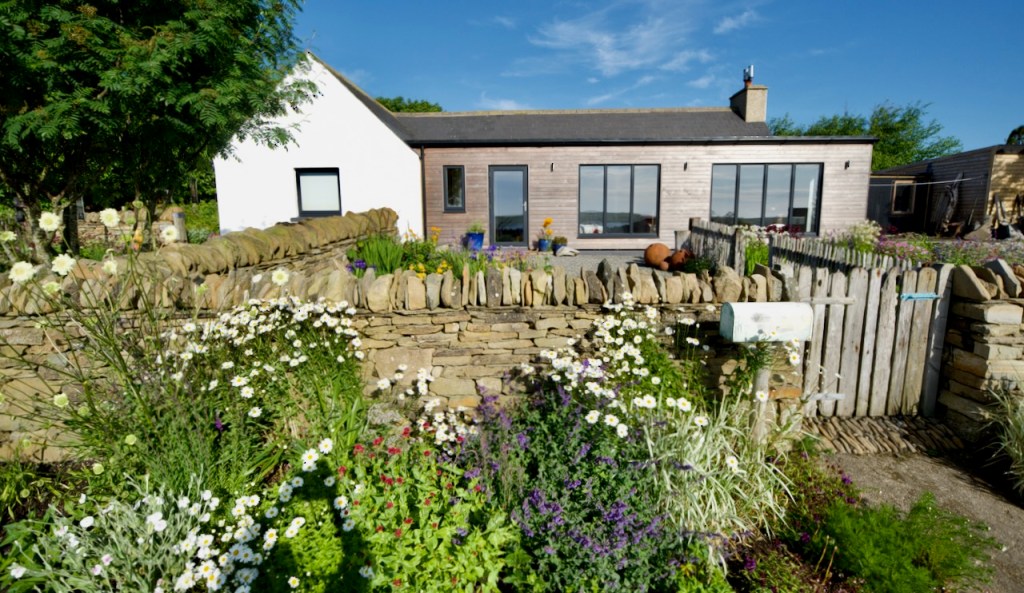
 A garden in Orkney
The dyke loooks amazing Gary, can’t believe you’re not a pro. I love walled gardens, they’re so safe and warm, for critters, humans and plants. They look beautiful too., especially using the stone of the area. Love the warm yellow of cotswold stone.
LikeLike
Thank you Margot, I can’t imagine the garden without them. Very time consuming but well worth it.
LikeLike