
On Sunday we started to plant Rowans up on the moor at the back of the house. A bright still day with an occasional shower, warm enough in a fleece with a backup coat hanging from a fence post. Small hardy trees that cope well with exposure they’re seen dotted here and there on the moors and hills of Hoy, sometimes in small copses, often alone, a single bird sown tree giving a scale to the open landscape. They have a mythology as long as your arm, to the Celts the Travellers Tree, a tree to guide you home. To the Norse the tree that saved Thor from drowning, the tree from which the first woman was carved. In Scotland the Witch Tree, a tree planted close to the house was said to ward off evil. The branches of the Rowan were believed to make the best dowsing rods. My favourite comes from greek mythology, Rowans spring up where the feathers of Eagles fall.

The trees came free of charge as part of a Carbon Neutral Islands scheme. A project that aims to see six Scottish islands become carbon neutral by 2040. In total over 4000 trees were supplied to homes on the island. A mixture of species, some suitable for gardens and some grown from Orkney stock that were recommended for more open land and environmentally sensitive areas. We asked for a few bird cherry and common alder for the area around the house together with dog rose to dot here and there at the edge of the meadow but the bulk of our order was for native stock, mostly Rowan with a few Downy Birch and Aspen thrown in for good measure.

The Rowans were for the highest part of our plot, an exposed spot of ankle high heathers that, unlike the moor lower down the slope, is unaffected by wide shallow peat cuts that have stripped the earth down to stone. The soil higher up is still deep and dark, a good spot for young trees to put down roots and anchor themselves against the inevitable gales.

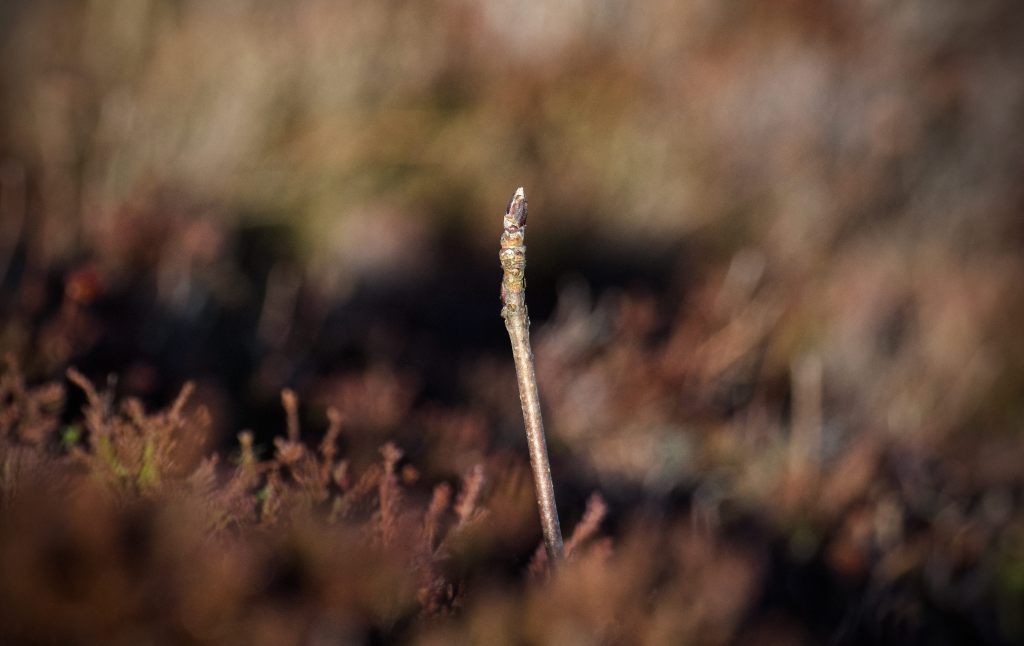
Getting them up there was awkward, a builders trug in each hand with four trees to the trug. Narrow twisting ginnels cut by rainwater are everywhere, hidden by the heathers, waiting to catch a foot and put you on your knees. Planting though is easy, chop out a square of heather, dig the hole, drop the square of heather into the bottom of the hole, chop it up with the spade, back fill while adding the tree. The trees were knitting needle thick and knitting needle high, canes were used to mark them but no support is needed for trees so small. Tree guards weren’t used, they would most likely end up gale scattered all over the island.
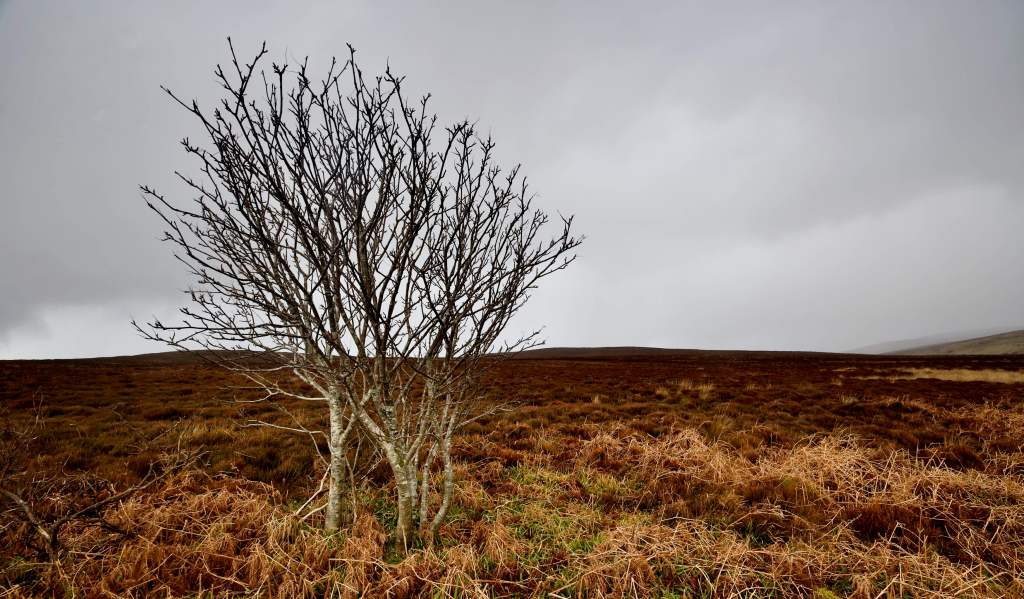
By the time they were in, the sun was dipping below the hills to the west. A hen harrier had passed by, a male stonechat, with orange breast and white dog collar, had kept me company, flitting from fence wire to heathers and back. With the trees supplied by the CNI scheme and with seedlings from our own moorland edge tree the hope is to have a small loosely spaced woodland of around a 150 Rowan planted this year. With luck they can live for 200 years, we’ll tend them and see them start to grow but will be long dead by the time they mature. A decade or so from now they’ll start to flower and bear fruit, pollen and nectar for bees, berries for passing birds.
 A garden in Orkney
What a fantastic scheme. And what back breaking work. You are certainly looking to the future as they say the best time to plant a tree is 20 years ago.
Love Rowan, so many myths from our Celtic past, I’m Welsh, so beautiful to look at and so good for wild life.
LikeLiked by 1 person
Enjoyed reading your blog Gary, look forward to the next episode. We are currently planting native trees down the edge, curtesy of free tree scheme, rowan, birch, some Ash and Oak we’d transplanted from the bottom orchard. Tony has just cleared the bramble patch we used for our home wine making and is going to plant a mini copse there. Our problem is the Blackthorne that just pops up all over. We definitely are planting for the next generation now.
LikeLike
Hello you two, lovely to hear from you. You are right I think we are planting for the next generation, although in Orkney with some species only managing a few inches a year possibly the generation after that. Saying that we grow a Canadian tree here, Red Alder, as a shelter belt, the Usain Bolt of the tree world, five years in and they are already taller than the house. Jacqui sends her love, if you are ever in Orkney the kettle will be on.
LikeLiked by 1 person