
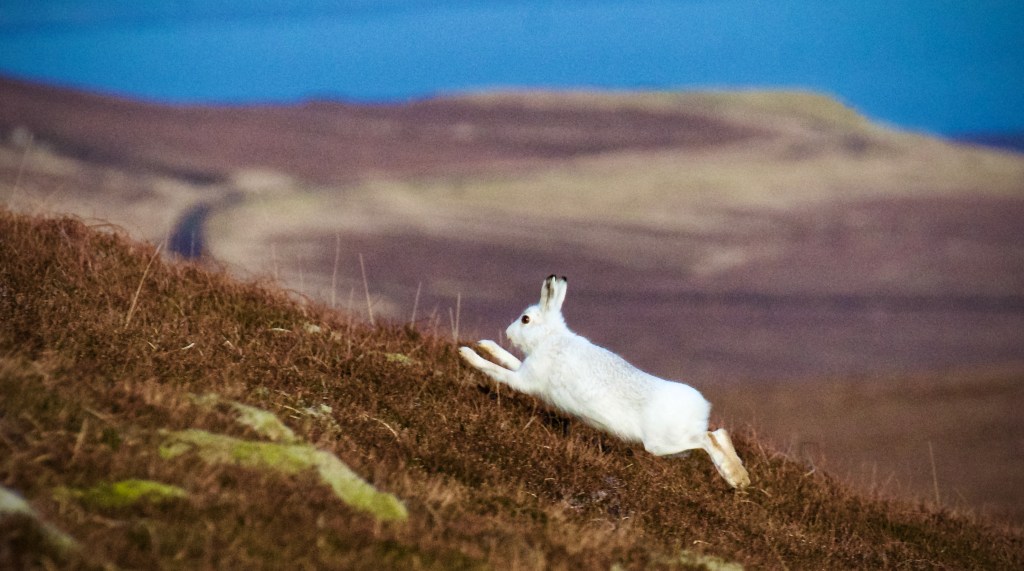
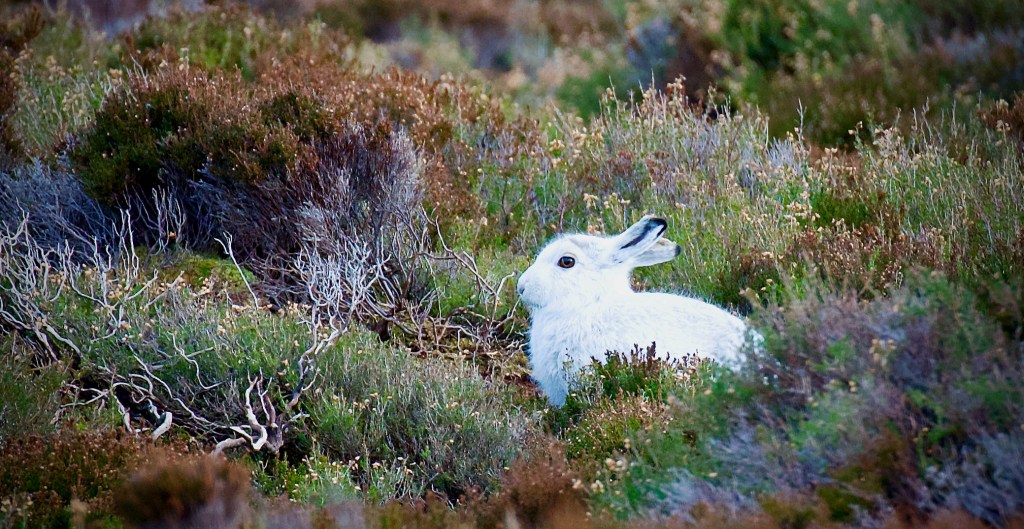
In Orkney, Mountain, or Blue, hares, are found only on Hoy. Although native to the uk they aren’t native to Orkney. It’s generally believed that they were introduced to Hoy and a few other islands, probably for sport, in the late nineteenth century. Although, just to muddy the waters, there’s a record from 1529 that tells of white hares being caught by dogs. However they arrived they have over time become absent from other islands in Orkney. The Brown hare, introduced to the UK by the Romans, is also found in Orkney but is absent from Hoy. The hares turn white in winter, clean as snow beneath and blue-grey on top, the colour of gun smoke.

The landscape here is perfect for them. Look at Hoy on google earth, zoom out and you’ll see a predominantly brown island, fringed here and there with green. The brown is moor and heath, mostly high ground. The green is lower lying, the small percentage of the land, usually close to the shore, that generations of crofters have “broken”, taking it from moor and heath for either grazing or harvest.
To label the moors as just brown though is unfair, in spring wet spots are dusted white with cotton grass, in late summer heathers light the slopes purple. For the rest of the year the moors remind me of a Harris Tweed, from a distance a monocolour but up close the details are revealed, the reds and oranges of mosses, the silver greys of lichens. Dozens of species sit amongst the heathers, from creeping willows to carnivorous sundews. All going unnoticed until they are almost stepped on, a rich and hidden tapestry of colour and life.

There are no foxes here and with year round protection from hunting, the hares only natural threat comes from above. After an absence of almost 150 years White tailed eagles returned to breed on Hoy in 2015, Golden eagles have also recently returned to the island, raising chicks in a nest whose location remains a tightly kept secret.

With little snow in Orkney at this time of year the hares stand out like sore thumbs, an easy spot for both human and eagle. Occasionally you’ll find a group of bleached bones, usually on the top of a small mound, perhaps the spot where an eagle ate its meal of hare. Predation is natural though and they seem to be doing very well, a recent walk of only a couple of miles brought a tally of thirty-one hares. Dressed in winter white all were tucked down low on west facing slopes, ducking the wind, making the best of the late afternoon sun.
Hares aside there are many other species that are well suited to life on the hills and moors of Hoy. Red throated divers nest on remote lochans and in summer fly directly over the house, a beeline from moor to bay. Hen harriers are a given here, a rare day if at least one isn’t seen floating low over the land. Occasionally a harsh kek-kek-kek will give away a soaring peregrine. Twite nest amongst the heathers, often called the northern linnet. In winter they form loose flocks, feeding on seed heads and bouncing away in flight every time you put a camera to your eye. Snipe are flushed from wet spots, small and fast, zig-zagging off into the distance. Red grouse cause a heart skip as they burst away from under your feet, sometimes a pair, sometimes a covey – a leash of birds. In Scotland the old collective term for three or more grouse.
 A garden in Orkney
If Orkney hares are as fast as the snowshoe hares we get here, then I have no idea how you managed to get your lovely pictures. Did they trip one of your trail cameras?
I’m sure you’ve read it, but I’m currently immersed in George Mackay Brown’s For the Islands I Sing. I borrowed his poetry anthology at the same time, but I wasn’t so impressed by his verse. Thought the autobiography might give me some background while I wait to get to the top of the wait list for the John Rae book.
BTW, I mentioned to a Norfolk (UK) friend that I’m striving to get Farewell to Stromness ‘under my fingers’. He tells me he met Peter Maxwell Davies when visiting his peer from college, David Drinkell. The world is so small……
LikeLiked by 1 person
Morning Penny, top speed is around 45mph, I used a dslr with a zoom lens, the autofocus on modern cameras can comfortably keep up with them. They tend though to run directly away from you, if there is ever a market for pictures of hares backsides disappearing into the distance I’ll have it cornered.
GMB’s collected works for me is hard work, well thumbed but not read from cover to cover. Beachcomber, Rackwick and the like, short and sweet, they put you in the landscape, a lot of the other stuff is lost on me. I enjoy his books though, I can’t think of one I haven’t read, he also gets respect for having one of the best epitaphs….
LikeLike
Fabulous! What wonderful creatures and how extraordinary they look in the landscape.
LikeLiked by 1 person