
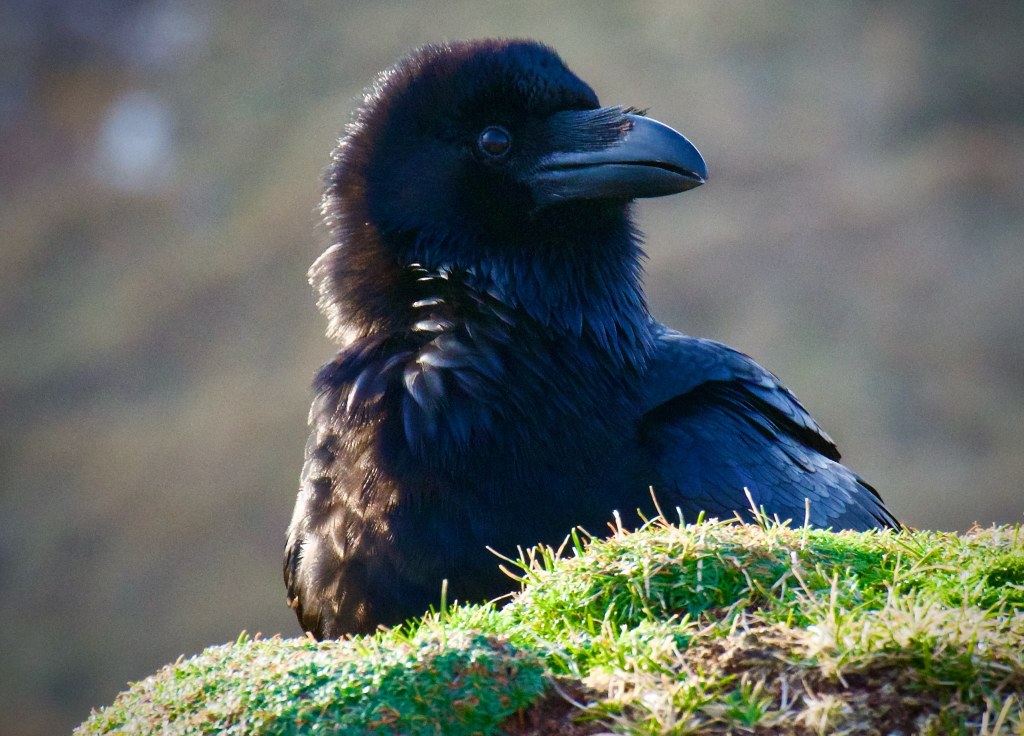
A few miles from here there’s a steep sided geo where every spring for the last four years I’ve watched a pair of Ravens rear a brood of chicks. It’s an area of coastal heath, wind scoured in winter, in late summer lit blue with the flowers of devils bit scabious. Apart from a distant wind turbine, the tallest things for miles are the lichen silvered posts of old stock fencing.
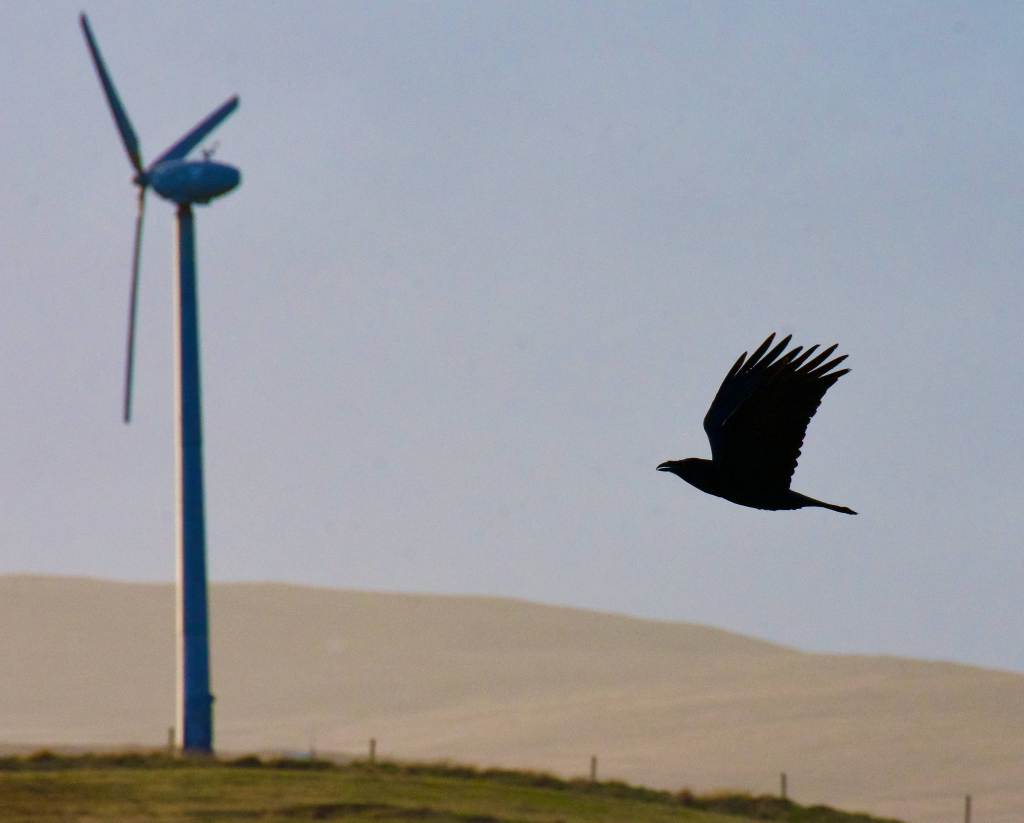
The geo is wide and deep, a half moon bite from the surrounding land. At the bottom is a beach of wave rounded cobbles. In November Grey seals haul out there and give birth to doe eyed pups. In summer the beach is just about accessible. At one end of the geo the fall is less steep, with care and dry ground beneath your feet and with hands free to grab newly regrown tussocks of grass, you can get down to the shore and sit for a while.

The nest sits on a narrow ledge at the steepest end of the geo. Built almost entirely of seaweed, every year winter storms wreck it and every year the birds tirelessly rebuild it, carrying kelp stems up from the shore and collecting a lining of wool from fleeces caught on stock fence.

As you approach the geo, a check on the nest can be made with binoculars. Once closer it’s lost from sight until you are directly above it. There’s a narrow cleft in the cliff, perhaps a footstep wide, that, like a squint in the wall of a church, gives a limited, and in the case of the nest, a slightly vertigo inducing view of proceedings. A fortnight ago the nest was lined but empty. A week ago four eggs had appeared, a clutch in progress but no sitting bird. A long lens on my camera snapped the eggs into focus. Two days ago, as I approached the site, binoculars showed tail feathers and a tucked down head. A bird sitting tight on a full clutch of eggs, time to turn away and leave them be.
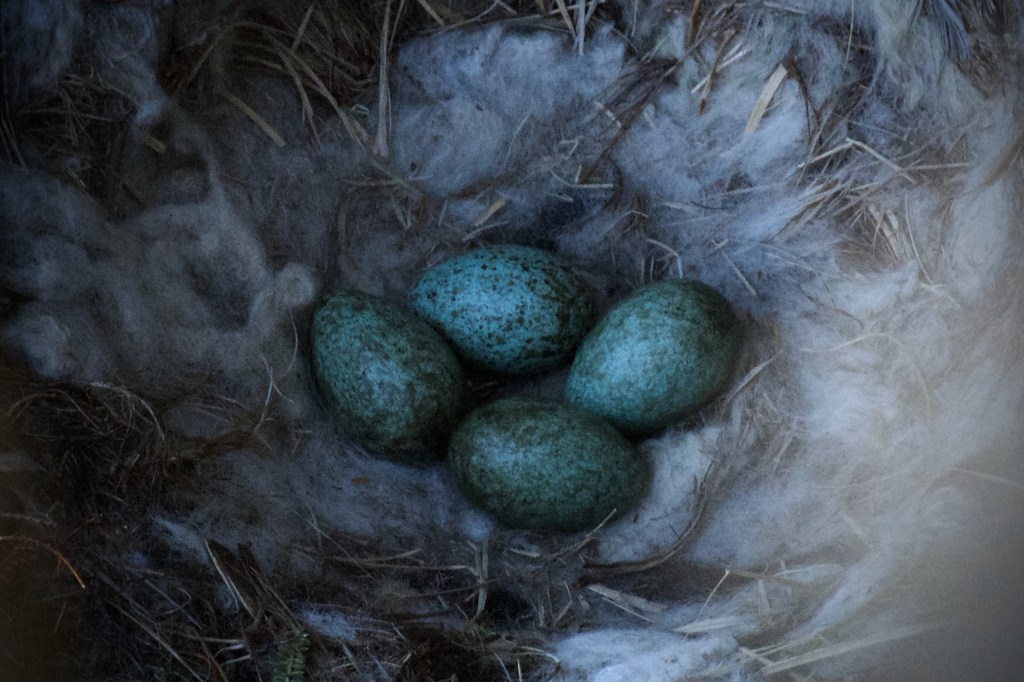
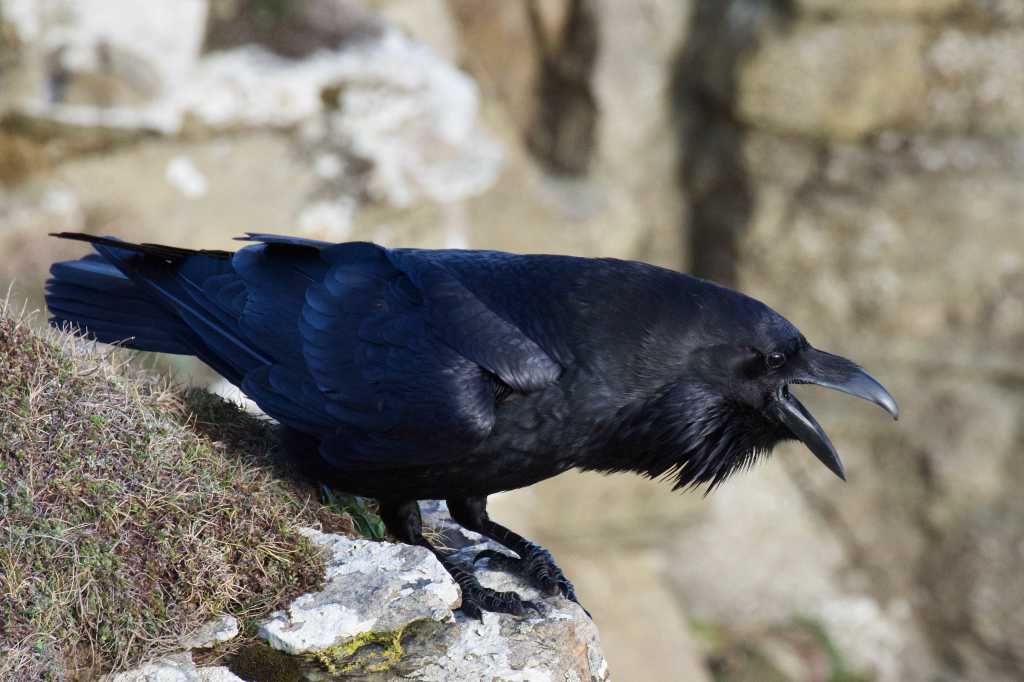
The eggs hatch in 21 days, the same incubation period as a domestic hen, after that, another forty odd days before the chicks have fledged and left the nest. If the nest is successful, later in the year adults will be seen on the headland with youngsters in tow. With luck a Raven can live for fifteen years but winters are hard and the attrition rate for young birds will be high. I’ve watched this pair for four years and have no idea if they are old or young but next year will look out for them again, checking the nest for signs of rebuilding.
 A garden in Orkney
Two posts in a row! Never seen a raven’s nest before – beautiful colour eggs.
Yesterday’s post was interesting too. Any idea what sheep breed those are? They look like Welsh Mountain – certainly not Scottish Blackface anyway.
BTW what happened to the trees on Orkney? Was it the bronze age cutting for smelting or clearing for agriculture? Perhaps there never were very many?
LikeLike
Hello Penny, I think the trees started to disappear around 4-5000 years ago as the land was first cleared and settled, once gone grazing and a change in climate seems to have stopped woodlands and scrub re-establishing, saying that Hoy does have the most northerly ancient woodland in the UK.
https://www.orkney.com/listings/berriedale
I think the ewe might be a Cheviot or a Cheviot cross.
LikeLike
Thanks for that link. Gives me a much better idea of what the builders of Skara Brae would have seen (and eaten – I noticed the rowan berries and kecks). And I’m sure you’re right about the Cheviot – bigger and sturdier than a Welsh Mountain sheep.
Just on the last few pages of Searching for Franklin. Much less about John Rae in it than I’d hoped and far more about how to eat fellow humans than a vegetarian likes to read!
LikeLiked by 1 person
Down here, on the cliffs of Portland, you get peregrines and ravens nesting, not usually near one another! I’ve seen peregrines feeding each other, mid flight. Fantastic.
LikeLiked by 1 person
I love the colour of those eggs. I need to look up the meaning of ‘Geo’ to improve my understanding of your description.
thanks
Graeme/Girders
LikeLiked by 1 person
Hi Graeme, good to hear from you.
https://en.wikipedia.org/wiki/Geo_(landform)#:~:text=A%20geo%20or%20gio%20(%2F%C9%A1,bedding%20planes%20in%20the%20rock.
LikeLike
Thanks Gary, i love a bit of physical geography knowledge.
LikeLiked by 1 person
I really enjoyed reading this and also the comments that followed, I shall wait with baited breath to see if the ravens return next year.
LikeLiked by 1 person
Morning Pauline, fingers crossed. Beautiful birds when seen close up.
LikeLiked by 1 person