

The garden is being put to bed. Sunday and Monday past brought gales and heavy rain, the winds gusting locally to 85mph. Our first real storm of the Autumn. A timely reminder that, in our exposed spot, if we don’t start to cut back hard, the gales will do it for us. Shredding all before them.

Garden wise, if not quite weather wise, it has been a good summer. Under Jacqui’s care most plants have thrived, losses have been rare, few and far between. Despite the gales some plants are stubbornly hanging on. Sedums are still attracting the odd bumblebee and despite taking a battering, will be left alone until the bees have gone. Ditto anemones and hesperantha’s, both of which, along with a few other hardy souls, are still putting on a show.
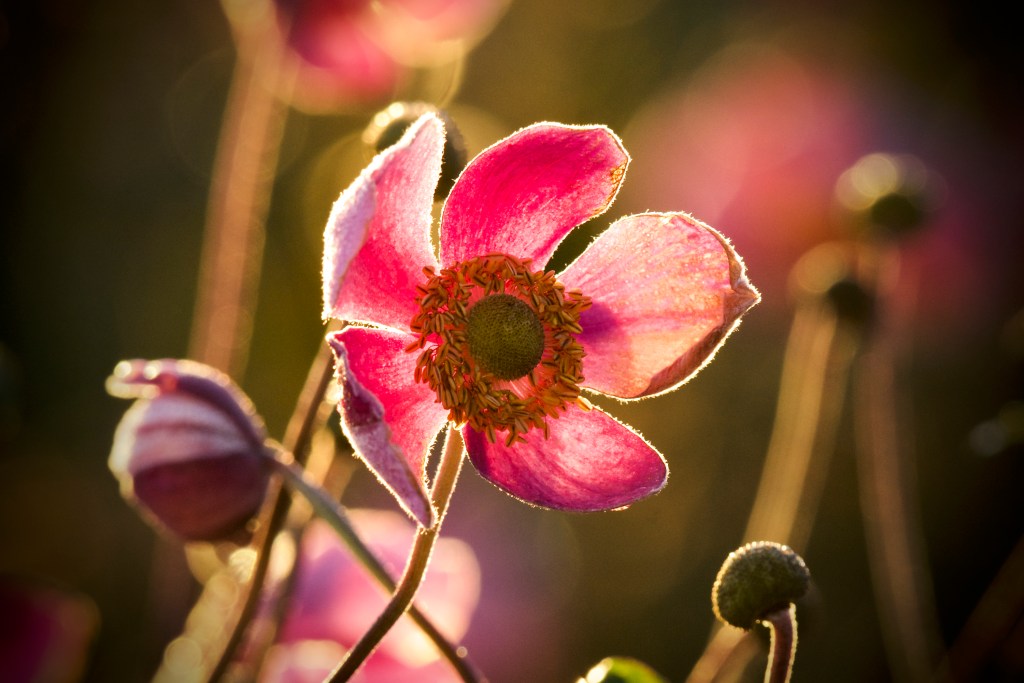
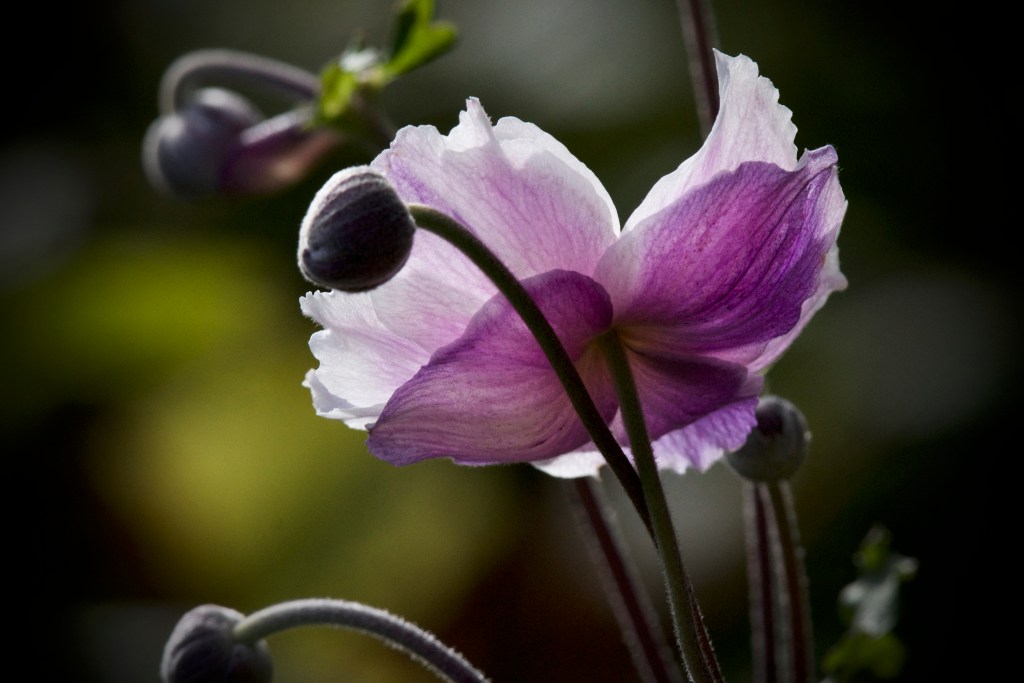
The sun is literally setting on the garden. Even before the clocks went back the garden was losing its light by 4pm, the sun lost below the hills to the west. In a few short weeks, courtesy of our tucked down spot, it will dusk here by 3pm.
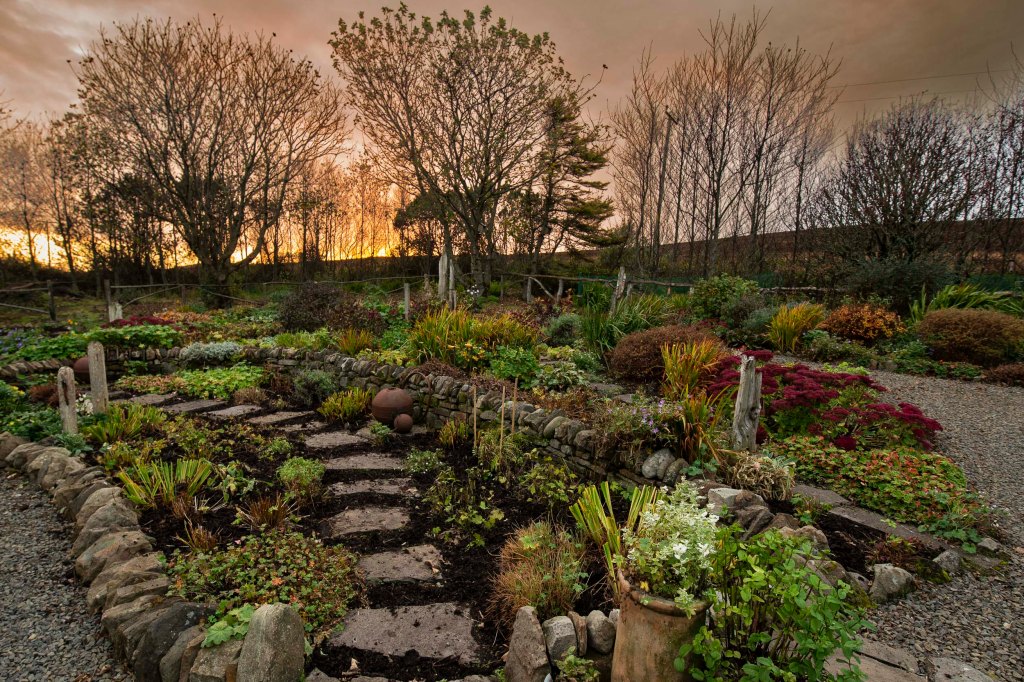
As plants are cut back and bare soil is exposed, the garden is being given a dressing of muck. It’s the time of year for wriggly tin compost bins to be emptied and refilled. As jacqui tackled wind blown foliage, I turned last years compost, two well rotted bays made into one. A wood mouse got a brief eviction, sleek and brown, running past my foot into a newly filled bay. Safe until this time next year. The soil doesn’t get much of a dressing, come spring, the last thing you need in a spot like this, is over-fed leggy young growth that will be flattened by the lambing winds, mid-May gales. The bins themselves are made from old fence stabs along with scrounged roofing from a tumbledown byre. Free apart from a few hours of time. Tucked away in a hidden corner they do the job, but it’s fair to say that they are best viewed on a dark moonless night…

With the exception of rear garden Sycamores, who are still partly clothed on their sheltered sides, the trees have lost their leaves. Most are left where they fall but we rake them from stone chip paths and scoop them from a ditch that encircles the garden and rushes rainwater from moor to sea. Forget the ditch and sooner or later you’ll wake to a pond. Time is then spent, usually in the driving rain, rodding a pipe that runs beneath the road. Clearing the leafy blockage and allowing the new pond to gurgle away, back on its journey down to the shore.

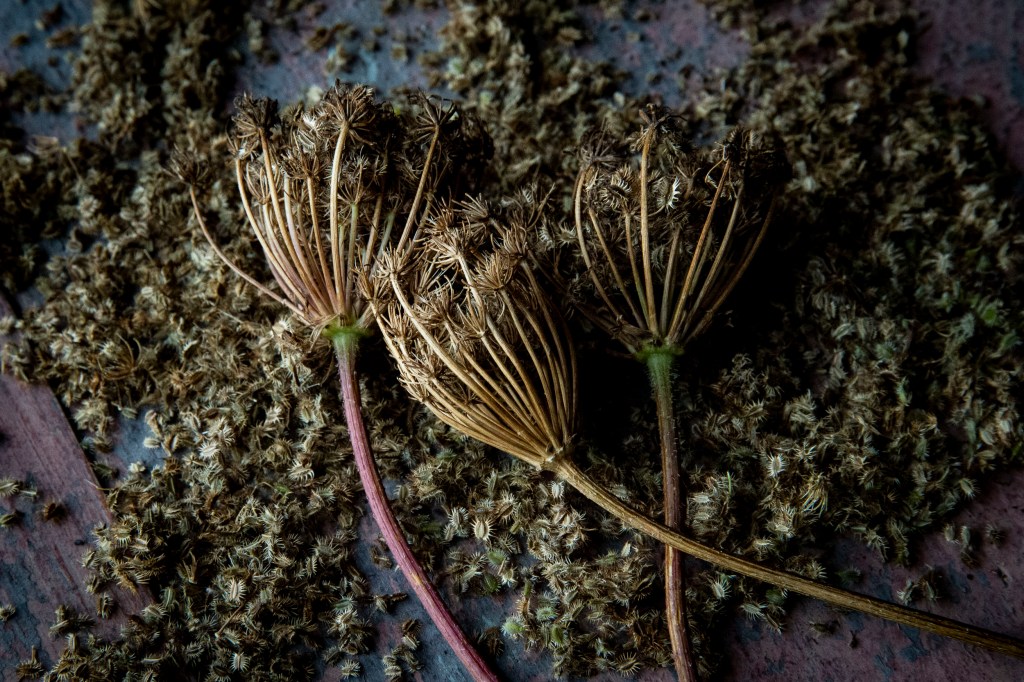
Wild carrot seeds are being collected. Their parents were sown as part of a home made wildflower mix, covering bare earth at the top of the meadow. Yarrow, ox-eye, white clover, knapweed and others, whatever we had, all mixed in a bucket with seed from a half dozen native grasses. The rest are being left to self sow but we have plans to spread the wild carrot along the edges of the shelter belt, the seed will be stored through the winter and sown in cold frames in spring.
Blackbirds are back in the garden, absent since our breeding pairs left in mid august. Their arrival coincided with the first sightings of Redwings and Bramblings, the former, in the wider landscape, are being seen in flocks of many hundreds, the latter, seen closer to home, are arriving in small groups, ten or twenty at a time, picking at bird seed cast beneath shelter belt trees. All are visitors from Scandinavia, moving south for the winter.

October pretty much draws a veil over the garden, a few plants will cling on, patches of bright colour lasting well into November. We were told when we moved here if we lasted a winter we would stay. I never quite got that, Orkney is beautiful in sun or storm. The landscape though will replace the garden now. More time will be spent walking the cliffs and the moors, beach-combing is a given. Workshop projects, on hold for the summer, will be started. A website for a work from home idea will finally get built. Dark evenings will allow the dancers to be seen at normal-o-clock, last night I photographed them at 9pm. Summer is missed but winter is embraced, a time to catch up and make plans.

The blog will continue, but for a while, perhaps less about the garden and more about the wildlife, the landscape and the shore.
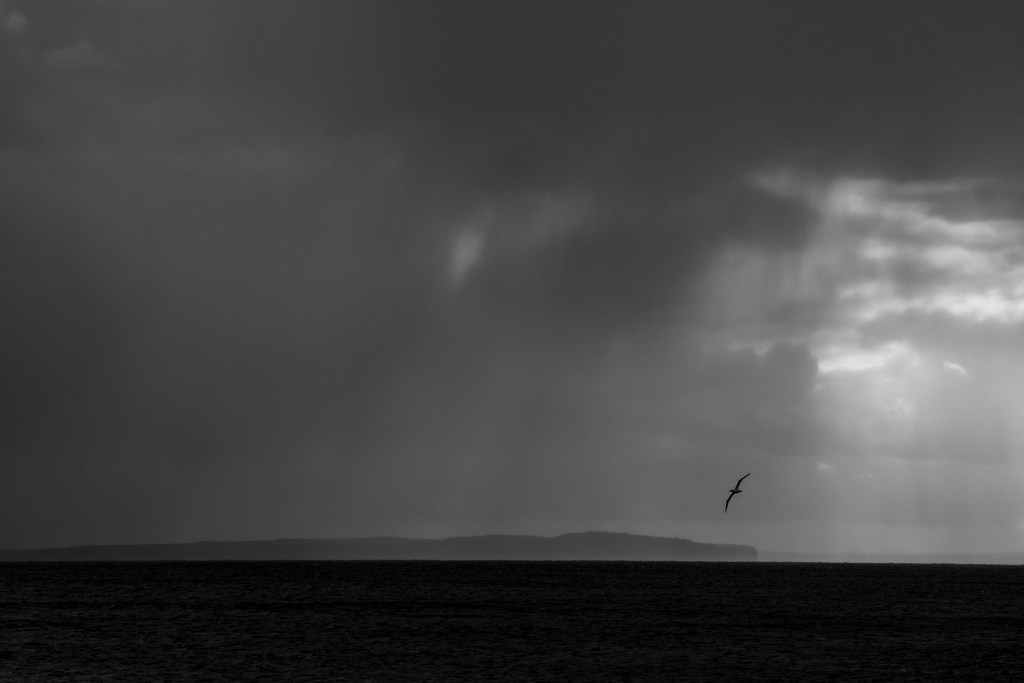
 A garden in Orkney
The blog will continue, but for a while, perhaps less about the garden and more about the wildlife, the landscape and the shore
I look forward to that!
BTW you seem to have endless species of the genus Small Brown(ish) Birds. My urban garden only gets bushtits, sparrows (brought in by early white settlers), juncos, the odd brown creeper, chickadees and a lot of red headed finches. I guess the many different habitats and open countryside surrounding you encourage SBB diversity more than here ‘on the edge of the fast disappearing temperate rainforest’, to quote from the local writer Douglas Coupland (no relation).
LikeLiked by 1 person
Hello Penny, yes we seem to have a lot of what twitchers would call LBJ’s, little brown jobs. Worst are the Warblers, some are common, some are once or twice a year rarities, all without fail are greenish yellow and from a distance, to me at least, look identical. The best guide is their song but unless they are staying to breed they tend not to sing…..
I had a google of the species you mentioned, the nearest we have to your Bushtit is our Long-tailed tit, your Brown Creeper is a doppelgänger for our Tree creeper, ditto the Chickadee, our Coal tit. At a glance a Red headed finch might just pass as a male Redpoll. We’re very lucky to have a range of habitats within a stone or two’s throw. Moor, garden, meadow, ponds, shore and bay. I think the species count of birds seen from the garden but not necessarily in it, is around a 110. Probably higher if I could accurately identify Warblers 🙂
Google also tells of The Great Bear Rainforest and the Spirit Bears, what a thing to have on your doorstep, but sadly disappearing? To climate change or logging?
LikeLiked by 1 person
Re; ‘fast disappearing’: The amount of old growth rainforest left by 2021 was about 40% of the 25 million hectares that was here when the first white settlers arrived in the 1890s. The old growth has been logged for export, mostly as raw logs for building, but also for Drax to make into pellets to keep English toes warm.
In the past 25 years we’ve lost 16 million acres of forest (mostly second growth) to pine beetle infestation caused by our warming climate – not cold enough in the winter to kill them anymore. 2.84 million hectares of forest (both old and second growth) burned in 2023. This year’s total is expected to be even higher.
350km from Vancouver as the crow/float plane flies (there’s no roads to get you there), since 2016 we have an 6.4 million hectare area of protected, mostly old growth in the Great Bear Rainforest. It’s protected by an agreement between the Province of BC and an amalgamation of Coastal First Nations. Because none of the land in BC was ever ceded to ‘the Crown’ by the FN, there’s been many decades of legal battles by umpteen BC FN bands and their allies to get sovereignty over what was taken from them. In the past couple of decades they’ve been consistently winning their cases.
This year The Haida Nation have also been given stewardship of their own land after many decades of legal battles and several physical ones. That means the few old growth trees left there are also protected. Great 10 min piece from CBC here to explain what that means and show how beautiful these 150-500 year old trees are. Haida Nation reclaims stewardship of its lands | CBC.ca.
Sorry, rather a long screed, but I’m passionate about saving old growth forests and about giving sovereignty over their lands to FN. I suspect many Scots will understand this……….
LikeLiked by 2 people
Hi Penny, I hadn’t thought of the forest fires, it looks like a perfect storm, the only silver lining is that the first nations are winning when it comes to rightfully claiming back what was taken from them. Hopefully they’ll keep winning. Thank you for the link.
Drax is madness, cut down old growth forests thousands of miles away and then sell it to the public as environmentally friendly. I used to live near Drax PS, when the idea was being ‘sold’ to the public I’m pretty sure the push was that the timber was a by-product of the Canadian timber industry “if we don’t burn it it will be wasted”, pure BS.
LikeLiked by 1 person
Good morning Gary, landscape and wild life is my cup of tea! I always felt a bit of a fraud writing on a veggie blog, my terrace garden vegetable beds are totally secondary to my creating a space for wild life.
In the garden yesterday with fuschia still in full bloom as well as other flowers like salvia, I had bees foraging, so mild. In fact so mild and so wet my sedum, which I always leave as long as possible, was rotting on its stems and had to be cut right back. Another casualty, a large and vigorous solanum seems to have been brought down by ivy gone feral and which I’d ignored, I like ivy, and alas has brought down part of a trellis it was holding up!
Already planning replacements of course! The sparrows are loving the woody mess left behind, and which I will leave till Spring, so not all bad!
Big envy over those compost bins! Hating this hour back rubbish!
Have a great week. Margot xx
LikeLiked by 2 people
Hi Margot, I agree, wildlife first. I think the days of our bumblebees are numbered, Jacqui is leaving anything that is still in flower for the few bees that are still on the wing but Thursday is forecast to bring more gales. Hopefully there’ll be plenty of queens already in hibernation. Our sedums are also just about over, it always surprises me that they grow up here. Ivy is a rare thing here but, going off on a slight tangent, I did discover a small nettle seedling a few years ago, another rarity locally, I transplanted it to the edge of a group of trees where it’s slowly but surely establishing itself. The story locally is that you’ll only find nettles where night-soil from outdoor loo’s was used, more than a ring of truth as they like rich soil.
Have a good week.
LikeLiked by 1 person
Hi Gary, your garden is looking good and ready for a winter rest. We are still enjoying a good bit of colour from flowers, leaves and berries. The runner beans and the tomatoes were cut down a week ago and the last drops are being enjoyed. The crazy winds knocked back a lot of the autumn flowers, asters, helenium, fuschias etc, but it was saddest to see the end of the Hesperantha, or most of them. The bird life on our piece of the Beauly Firth is building up to its normal autumn levels. Down at Redcastle we saw three or four hundred geese out on the sandy mudflats and I hope they stay with us all winter.
LikeLiked by 1 person
Morning Geraldine, yes it’s the time of year for putting everything to bed, we’ve still got some colour, front gardens still have catmints and geraniums in flower but every day now is a bonus, oddly our hesperantha’s will probably be last man standing, they seem to be the hardiest plant we have when it comes to salt laden gales, it must come down to the individual variety. Lots of geese here as well, we saw the first Blackcaps this week, half apples on sticks are proving to be a magnet for them.
Have a good week.
LikeLike