
The solstice, for us, dawned grey but bright, an almost monochrome start to the day. As the day moved on winds increased to gale force, the lifeline inter-island ferry managing a single early morning trip. With more wind to come tomorrow, with the exception of a medical emergency, it will be Monday now before anyone can leave or return to the island. Previous days have brought much of the same, spells of relentless rain and seemingly daily gales. Yesterday though brought a brief lull and the chance of quick trip to mainland to stock up on supplies.

Despite the wild weather, today marks a turning point, a harbinger of better things to come. The word Solstice comes from the latin, sol – sun and sistere, to stand still. For the rest of the month, at sunrise, the sun literally will stand still, rising at 09.05 on the same compass point, but at sunset, the days will slowly lengthen, by a few seconds at first but then by a minute here and a minute and a half there. By the first days of January the sunrise will also be earlier, the sun slowly tracking back eastwards. By the end of January the gloom will be behind us, in a few short weeks we’ll have gained two hours of light, spinning towards June and the seemingly endless daylight of the Simmer dim.
At this time of year, for a few weeks through December and January, on those rare clear days, we get to see the sun rising in the Offing. The distant point on the sea where the view is lost to the horizon. The word coined the phrase “in the offing”, describing a returning ship coming into view.
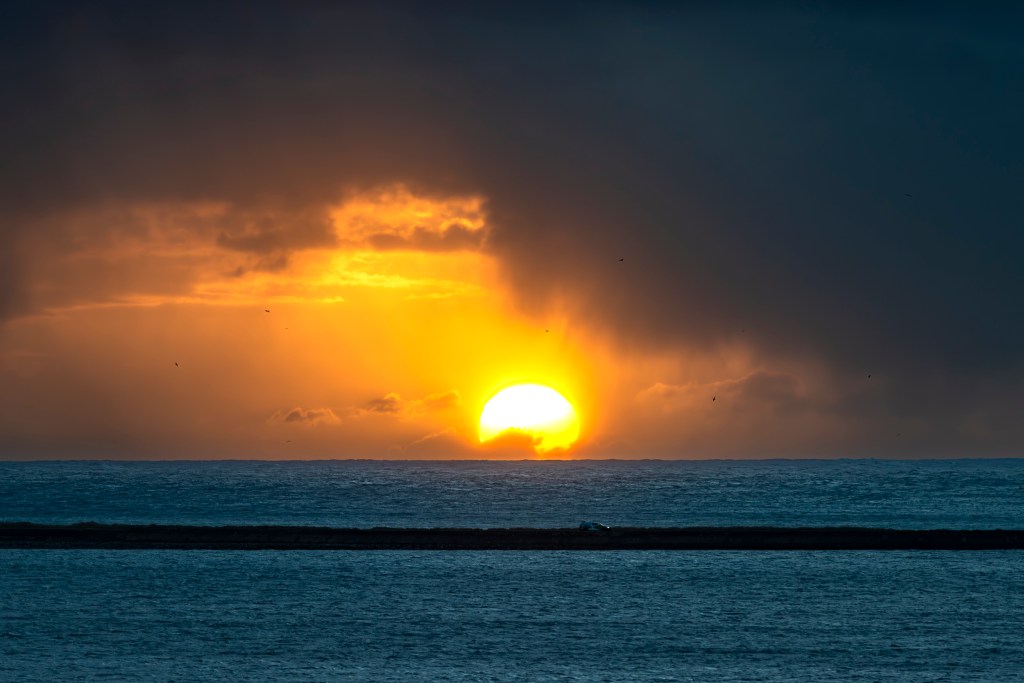
For the rest of the year the island of South Walls hides the sunrise. The island lies low in the sea and in the right light and with a little, or perhaps a lot, of imagination, it becomes one of the Orcadian poet and author, George Mackay Browns, whales – “sleeping in a silent ocean of time”.

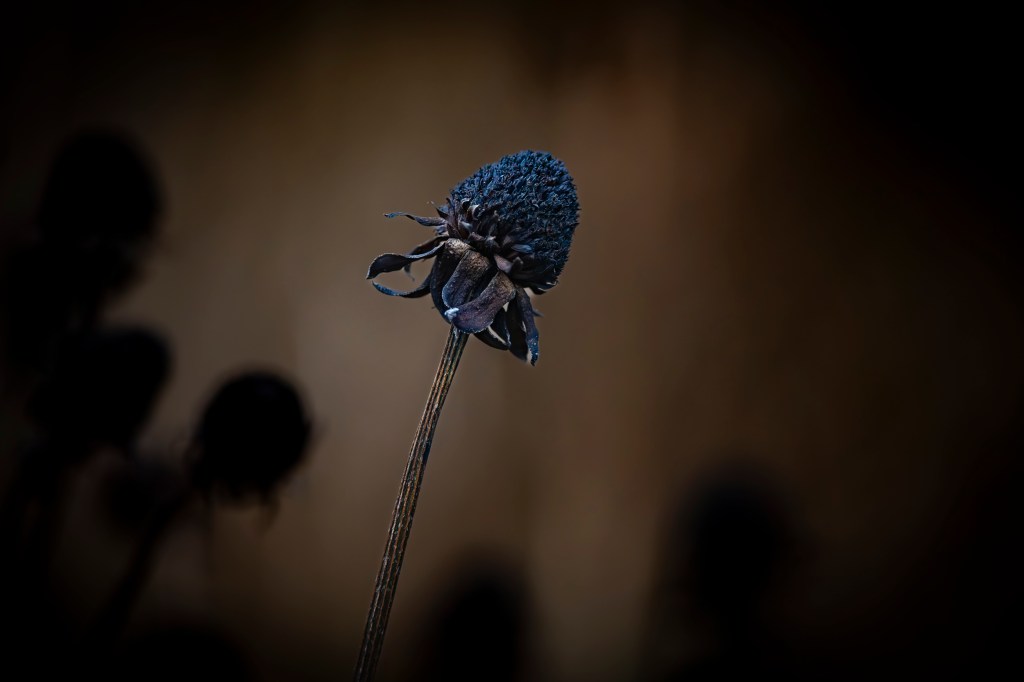
In the garden, Jacqui cuts back most of the plants before the gales do it for us but here and there, in sheltered spots and on stronger stems, seed heads are left be. In the lee of a dry-stone dyke Hydrangea flowers have turned crisp as brown paper, nearby Rudbeckias are a deep blue-black, as if dipped in ink. Others that were also deliberately left haven’t fared so well, Moor Grasses that lit a front garden with sprays of straw-gold seed heads have finally succumbed to the winds, their broken stems scattering the ground like randomly thrown pick-up sticks.

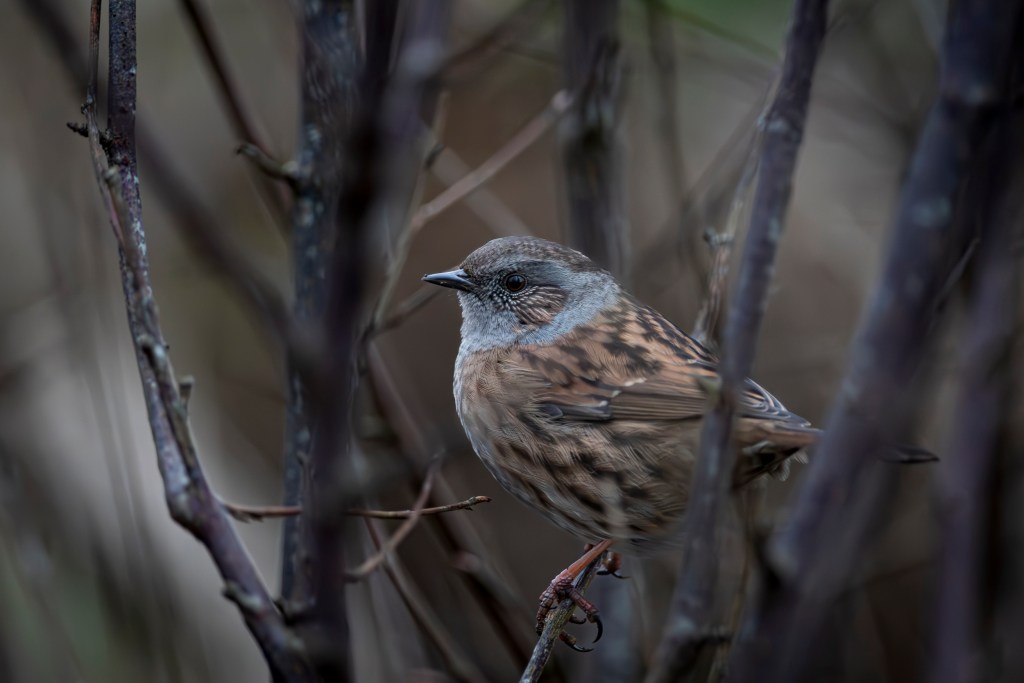
The weather has brought an influx of finches to the garden, a mixed flock of perhaps sixty birds, goldfinch, greenfinch and chaffinch, are here most days. At the moment they’re getting the full fairground waltzer experience, clinging to feeders that spin and swing in the wind. Other birds are less easily seen, in a new willow coppice planted close to the shore, Wrens are occasionally glimpsed, a brief view of a bright eye and a cocked tail as they go about their business, searching grasses and bracken for hidden goodies. Closer to home, Dunnocks, who in Spring will lay pale blue eggs in a cup of moss, flit among shrubs and undergrowth at the edge of the garden. As a child they were hedge sparrows but in reality are no relation of our house and tree sparrows. They belong to the accentor family. They get their common name from dun, brown, but their posh or Sunday name is Hedge Accentor. Of that family they’re the odd one out, all the other species preferring mountainous regions and altitudes of 1000m or more.

Another favourite wren haunt, is a boundary ditch that runs from the top of the meadow to the shore, six feet deep and never designed to carry water. A crofters Ha-ha, designed to keep livestock either out or in. Stock fence and barbed wire have made its original purpose redundant but now, overgrown with bracken and briar, along with the wrens, it’s also a perfect home for stonechats and reed buntings and others. The bracken at this time of year is the colour of burnished brass, it’s our marmite plant, tolerated in ditches and under trees but due to its invasiveness and smothering habit, unwelcome anywhere else.

At this time of year calm spells are grabbed with both hands. Last week, after a day or two of rain, I took a walk close to home, along a nearby headland that has views across the Pentland Firth towards the Caithness coast. It’s the year round home of a group of shaggy coated cattle who seemingly shrug off the worst that the weather can throw at them. Normally they ignore you, too busy feeding to pay much attention, but occasionally a beast will walk over for a nosey. They appear harmless but are semi-feral, so caution and common sense says put a fence between you and them. Environmentally they have a strong and positive impact. A few animals are spread over many acres, their grazing keeps the sward short and allows wildflowers and orchids to flourish, their feet will also push seeds into contact with the soil and create small areas of poached earth, bare ground where seedlings can germinate.

With the sun setting at not much after three, an afternoon walk usually involves walking home in near darkness. Last week, after checking geos for newly cast up driftwood, time was spent photographing the sea, lit by the last few minutes of afternoon light. The photographs were taken out of curiosity, to see how a new camera, if a 10 year old camera can be new, would cope in low light. The results were better than expected. Despite the gloom each image was tack sharp, the out-takes let down not by the camera but my rusty timing, more often than not the breaking spray was captured either too soon or too late.

By the time I set off home it was just about dark. In the orange afterglow of sunset, the cliffs of Dunnet Head on the Caithness coast, some ten miles distant, were pulled close by a telephoto lens. Its lighthouse, built in 1831 by Robert Stevenson and dwarfed by the cliffs it stands on, has a beam that, on a clear night, is said to be visible from 23 miles away.

 A garden in Orkney
Fabulous photos of fantastic skies, Gary, especially liked “South Wells.” It’s a magical place where you live.
The Winter solstice does feel like a turning point, no wonder our ancestors celebrated. I imagine them huddled around their fires glancing anxiously at the skies waiting for the sun to appear again and bring life to the earth.
Wishing you and Jacqui and all plot 29ers a happy Mid-Winter festival and a peaceful and healthy new year.
BRACE!
Margot xx
LikeLiked by 1 person
Hi Margot, it’s wild again today but already it feels like you’re moving forward, in the garden bulbs are already popping up and I noticed some poppy seedlings last week, it won’t be long before we see courting Ravens rolling and falling in display. Spring will be here in no time.
Ditto to you and yours and all ex plot 29ers, have a peaceful break and a happy new year. x
LikeLiked by 1 person
Hi Gary, So lovely. Your story telling is great, weaving a tale from land to sea. I love your photographs too. What a joy. I admire your fortitude in such a solitary place. All the best for a cosy Christmas. Sue
LikeLiked by 1 person
Thank you Sue, another wild one today but flat calm tomorrow. All the best to you and yours, have a good one.
LikeLike
Great writing and images. Loved visiting Scotland a few years ago, including Dunnet Head which was enshrouded in heavy fog. The Orkneys were a favourite. There’s a strength to the plain rugged landscape surrounded by rolling seas, with every view somehow more majestic and brave than the one before…
LikeLiked by 1 person
Thank you, Orkney does get under your skin. If you visited between April and September you would have probably encountered a Haar, a sea fog. They roll in whenever the weather warms and are very localised. Many a Summers day here comes with a background soundtrack of the low rolling boom of a distant foghorn…
LikeLiked by 1 person
Visited in May and enjoyed every minute, including the sea trek from John O’Groats to Orkney (where my uncle’s family was from). We loved our blustery visit at Skara Brae and the Neolithic village at Skaill House. We definitely had our fair share of the Haar! 😏
LikeLiked by 1 person