
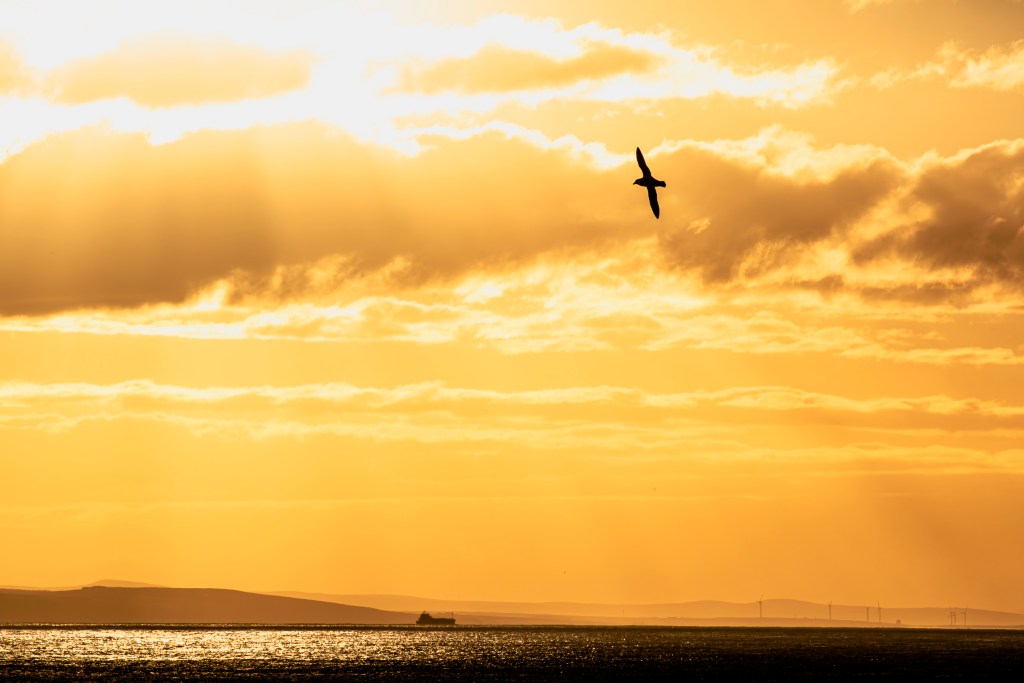
February has, so far, brought unseasonably dry days. We’ve had the odd spell of driving rain and the usual shower-sun-shower, rinse and repeat. But generally the days have been dry though often bitterly cold. Today, as with recent days, there’s a straight off the sea south-easterly, a cutting wind that goes through you rather than around you.

There are stirrings of life in the garden. Snowdrops are just starting to put on a show. At the moment, flower wise, they’re few and far between. Green spears of new growth are everywhere but it will be another week or two before the greenery is topped with nodding white bells. The Goldfinches that arrived earlier in the winter are still here, ditto Greenfinches and Chaffinches. There’s not quite the four and twenty Blackbirds required to bake a pie, (in reality they were probably Rooks), but again they are counted in numbers, one, a last years youngster given away by a beak that has yet to turn to adulthood orange, meets you at the shed door each day, following you inside to pick up titbits that are dropped as feeders are filled up.

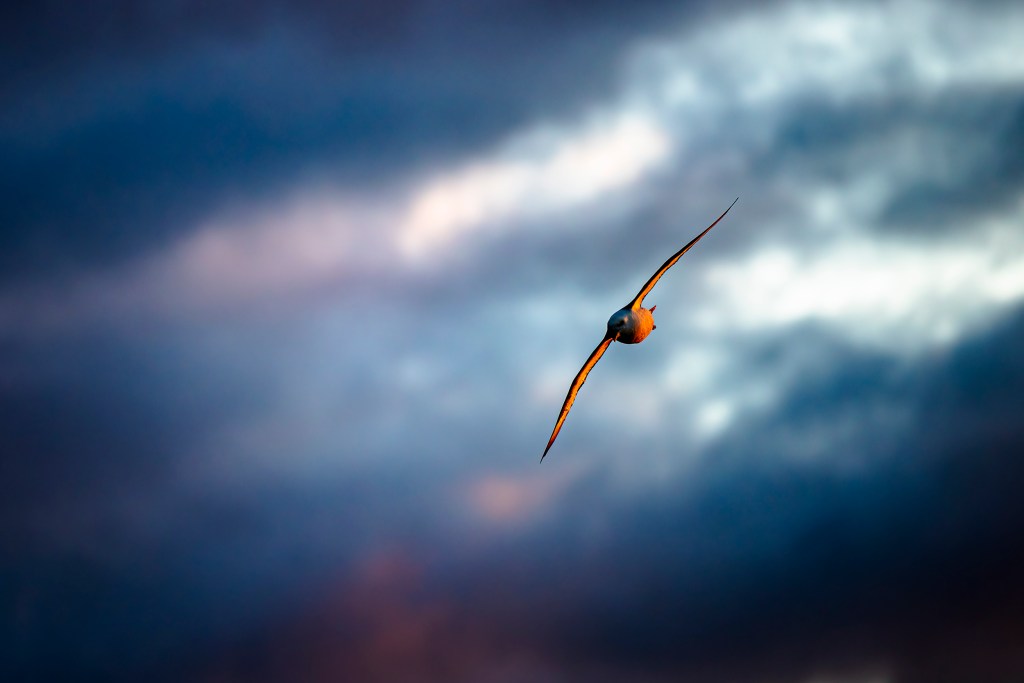
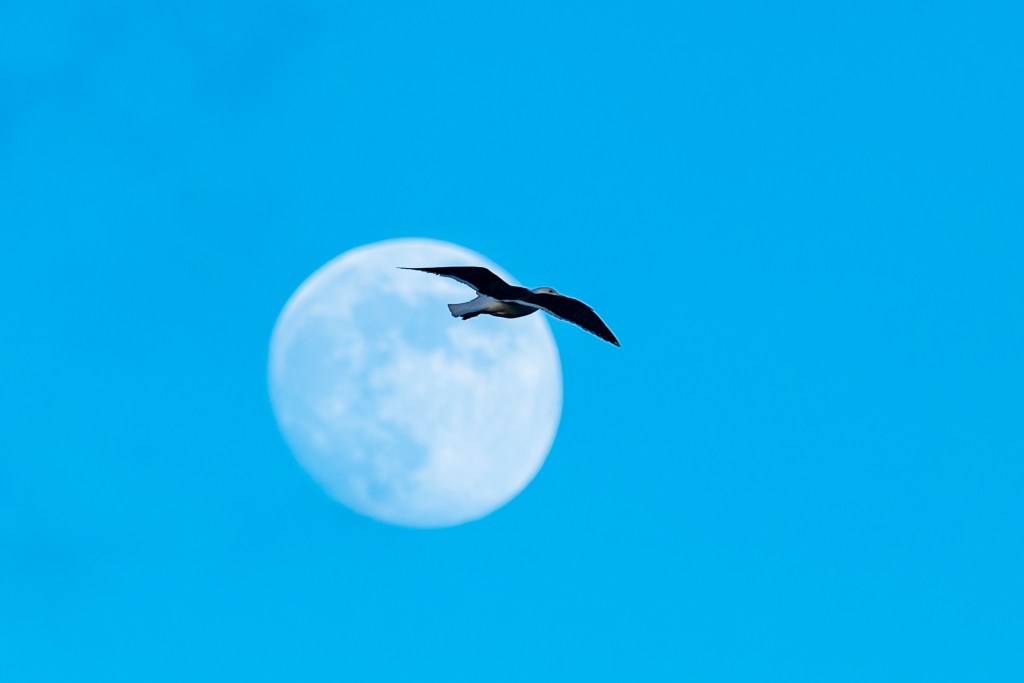
In the wider landscape, after a few months of absence wandering the seas, Fulmars have returned. At the end of January we saw one or two and wondered if a storm had driven them temporarily to the coast, but numbers have since swelled and now, on any headland or clifftop walk, they’re a regular companion. They’re awkward on terra firma but are masters of their airborne environment, however blowy the weather, they ride the winds effortlessly, gliding past on set wings.
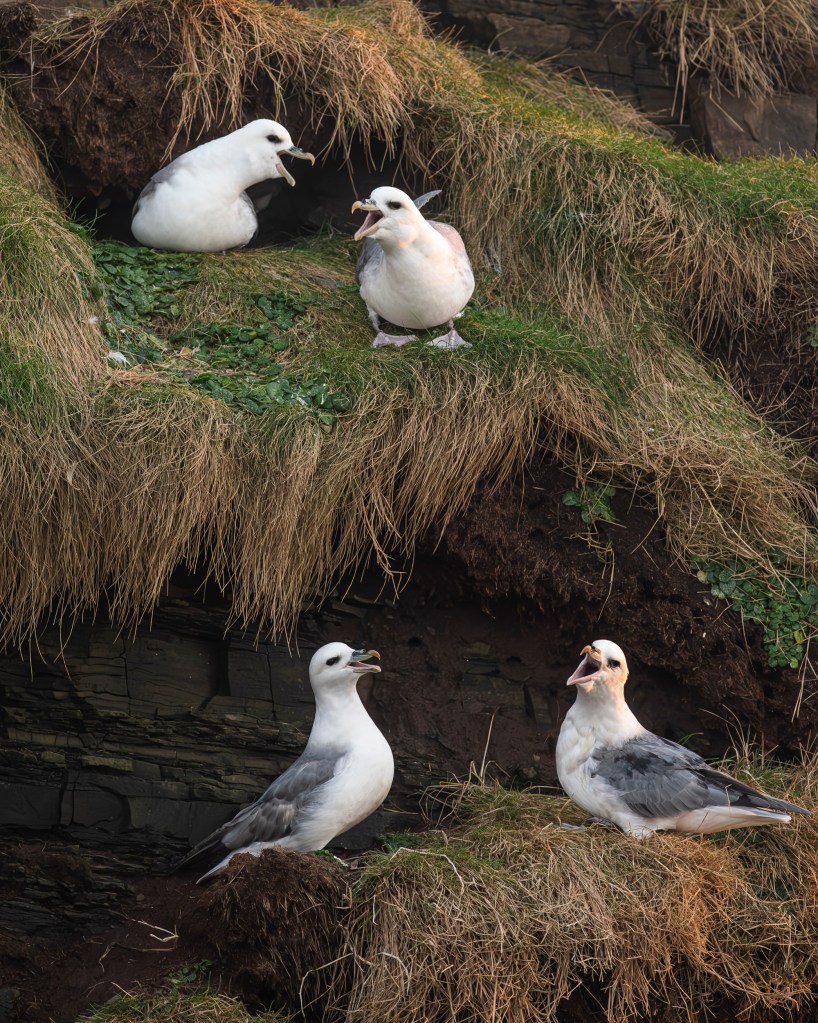
The Fulmars nest wherever they can, some on towering cliffs, others, like the birds closest to home, on a low cliff that in reality is more a vertical grassy bank. A favourite spot to see them is close to Snelsetter on South Walls. There’s a sea stack called The Candle that in early medieval times was topped by a small hermitage and was a home to Christian monks. The monks probably didn’t know the Fulmar, the birds didn’t spread into Scotland until the 19th century, but where men once prayed Fulmars now nest. They generally get along, nesting in close proximity to each other but now and then, as small territories are reclaimed, a loud and guttural squabble will break out.
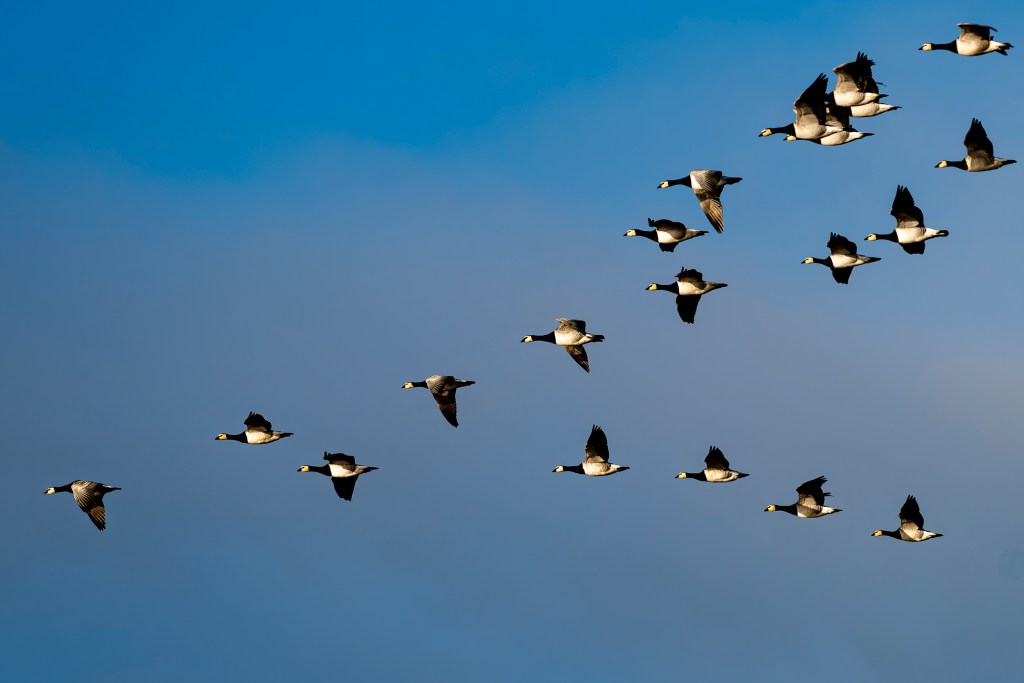
As some birds arrive others will soon leave, following an irresistible and instinctive urge to move on to pastures new. A favourite winter visitor is the Barnacle Goose. Smaller than the now resident in Orkney Greylag, they have striking black and white plumage and get their name from a medieval belief that they hatched from similarly marked Goose Barnacles. Before migration was understood, an easy enough two plus two makes five, especially if you only saw the birds in winter and never saw them nest. In autumn I was lucky enough to see them arrive, skein after skein, heard long before they were seen. They roost on the small island of Switha and I watched, in the half light of dusk, as each skein, at around a half mile distant, dropped from height to sea level, approaching Switha at wave height, like aircraft intent on avoiding radar. They’ll leave soon, back to Greenland to nest and rear young. A bird that in Orkney marks both the arrival of winter and the coming of spring.
Another favourite visitor is the Wigeon, rare summer breeders whose numbers in autumn are boosted by thousands of Icelandic, Scandinavian and Russian birds. They’re a bird of coasts and marshes and on Hoy we see them mostly in sheltered bays. Usually by the dozen or two but occasionally in rafts of many hundreds. As with most duck species the females are feathered for concealment when sitting eggs, all mottled browns and greys, without binoculars, and at a distance, they’re easy to misidentify. Not so the males who sport a chestnut head with a tell-tale mohican streak of creamy yellow. Add in a pink breast and silver-grey body and you have a bird that, binoculars or not, can’t be anything but a Wigeon.

Oystercatcher numbers are also up. They’re here all year, but we see a rise through winter and spring, courtesy of visiting Norwegian birds They spend their days feeding on fields of sheep shorn pasture, prodding and poking the wet earth with long, carrot coloured, bills. They’re usually in the company of curlews and gulls and obligatory for grassland here, large flocks of starlings. Oystercatchers were once seen as only a bird of coasts, but during the last century they started to breed inland. When we lived in Yorkshire they were just as much a bird of moor and dale as they were of the shore. In Orkney they’re the Skeldro or the Chaldro, a scolder or teller off. An apt name for a bird that if you wander too close to its nest or young, will scold you constantly with a shrill and distinctive high pitched peeping.

February also brought the Snow moon, so called because in Northern hemispheres Februarys full moon often coincides with snow. To the Celts it was the storm moon, but my favourite comes from native Americans, the Bear moon, the time when cubs are born.
 A garden in Orkney
Morning Gary, Such evocative writing as usual, so many phrases that I feel are carefully crafted with rich words. What an amazing, thrilling photograph of the Fulmar in flight against the dark sky. Here in the Midlands, the weather is about to change with raw, grey cold hopefully to be replaced by showery sunshine. Perhaps a quickening of growth will be the result, together with a rise in human mood. I’ve promised some writing for our allotment site website, but I’m procrastinating – you’ve inspired me. Thank you Sue
LikeLike
Morning Sue, the Fulmars are a favourite, sit quietly in the right spot and they pass by almost within arms length.You feel you could reach out and touch them.
It looks as if your weather is improving while ours takes a step back, bitterly cold again today with gales tomorrow & wednesday. The upside is the days are getting noticeably longer, it’s light here now before 7 and not dark until 6pm. The door to Spring is definitely open, if only a crack.
Go for it with the allotment site!
LikeLike
Good morning Gary. Bitter winds and endless, grey, dreary days here way down South. Promise of warmer weather can’t come too soon.
My garden is full of heliobores and bright yellow crocus coming up in my tubs, no snowdrops, they don’t like my garden! The Hazel is still glowing with yellow catkins, looking gorgeous against the sky. At the end of Feb the garden will have to have a major hair cut, small suburban gardens don’t really lend themselves to large trees.
A male blackcap has been feasting on the apples I’ve put out for the blackbirds. I’ve now got saucer feeders and the birds seem to prefer them, especially the dratted pigeons!
No sightings of snow moon alas, too cloudy.
Have a great week and wishing us all warmer weather!
Margot.
LikeLike
Hi Margot, bitterly cold here as well with gales now forecast on and off until Saturday, roll on Summer!
We tried Hellebores here for the first time this year, so far so good, we’ve got cream and dark purple varieties and are hoping that they will hybridise and spread. No Hazel but I can’t see why it wouldn’t grow, we really should try a few now we’ve gained some shelter from Alders and Willows.
I’ve just been asked to do a major (chainsaw) prune and tidy in a garden that hasn’t been touched for years, I’m like a child in a sweet shop, wondering what will turn up, I’ve already spotted Wild Garlic and will bring some home to plant under our young trees.
Pigeons are a pain here as well, every day brings around 60 Rock Doves, they’re good in a way because they hoover up any seed dropped from feeders but it means we can’t put seed on the ground anymore, if we do it’s like a visit from feathered Locusts, everything is gone within minutes. Lots of Blackbirds but no Blackcaps, we see the latter in late Autumn and Early Spring, I assume they must first be on the move South and then returning North to breed.
Have a good week.
LikeLiked by 1 person
Totally agree with Sue about the fulmar in flight at night being thrilling. What a photo! How long did you have to wait to catch that?
Thanks for giving me a foretaste of the bird life I shall see on my arctic bus journey – fulmars and barnacle geese can all be seen in Arctic Canada apparently.
I’m working my way through Vancouver Public Library’s books about the flora of arctic regions and this one might interest you: The Treeline by Ben Rawlence. He starts his expedition in Scotland, the place where he first became interested in wild places and what made them as they are now. The history of the tree (or lack thereof) landscape there is fascinating. Given the native tree replanting happening in Orkney, it’s a hopeful sign for rewilding 400 years hence 🙂
Lots of opportunities to see the Mkwa Giizis (Bear Moon) here for the past three weeks, as it’s been very cold and clear.
Stay warm,
Penny
LikeLiked by 1 person
Hi Penny, the Fulmar was pretty easy, they follow set looping flight patterns, a bit like the cars on a child’s scalextric, it was just a case of waiting for the sun to drop lower than the bird so that the bird would be lit from underneath. There are sometimes many dozens in the air at once, all following their own invisible pattern, it always impresses me that they never collide.
I had a quick google of the birds of Tuktoyaktuk, for birds of the shore and sea you’ll see a good number of species that are also seen here in Orkney.
Thanks for link, the book is on its way. Tree growth is odd here in Orkney, our own small patch of moorland had been ungrazed in living memory but until we planted them it had no trees beyond 25 metres or so above sea level, bird sown Rowans lower down but as soon as the ground climbs higher, not a single tree, ditto on my neighbours patch, ungrazed for a similar period of time but not a single tree except the ones he has planted. As a an experiment to try and stop an area of soil erosion we planted Red alders at the highest point of our patch, six years on they seem to be thriving in ground that is more stone than soil, Rowans, planted in better ground but just as high up, are also fine.
What I have seen though, now that it has been cleared of decades of built up thatch, are rowan and bramble seedlings appearing in the meadow. I think if grazing and mowing were to stop tomorrow trees would establish at close to sea level and, probably over many centuries rather than decades, would then slowly spread into higher ground as the scrub and new trees gave shelter to the next generation. I think your 400 years might be about right 🙂
The Snow moon brought clear days here as well, rapidly down hill since then!
Gary
LikeLiked by 1 person
The Treeline book will confirm all you’ve just said about your experience of tree planting on Hoy. I found the part about the biology of Scots ‘granny pines’ so moving I shed a tear. I’ll say no more so I don’t spoil it for you. My comment about 400 years is drawn directly from his research on Scottish forest rewilding.
But don’t read it the later sections of the book before bedtime (like I did last night). The story of his visit to northern Siberia’s reindeer herders and the Russian Arctic Research Institute Arctic and Antarctic Research Institute — AARI was so scary it kept me awake.
LikeLike
Thanks Penny, on tenterhooks now but very much looking forward to receiving and reading the book.
LikeLiked by 1 person
Hi Gary I tried to reply to your message on your other blog but for some reason it wouldn’t post.
I read about the lynx, so sad at least they managed to recapture all but one. The water table on our land is quite high due to being so close to the river but its only wet if we have a very prolonged period of rain. It is very heavy with clay though. We still have the silver birch you gave us many moons ago. The older we get the harder it is to plant trees. Tony is currently recovering from a very badly strained muscle in his neck probably brought on by clearing a 6 foot wide bramble patch down the length of the bottom orchard. He forgets he is nearer 80 than 70. Our gardening is now about maintenance achieved by the ride on mower, flower and veg patches are shrinking and more grass appearing which makes it easier for us, we’d hate to have to leave here because of the garden!!!! We still enjoy it too much
LikeLike
Hi Pauline, wordpress occasionally has a mind of its own, at the moment it won’t allow me to add a like to anyone’s comments.Technology!
I know what you mean about tree planting, we avoid bare root trees altogether now and use rootrainers instead, the trees are smaller when they go in but get established so much quicker than bare root and they only need a trowel not a spade. We can also get them posted up here, nigh on impossible for bigger trees.
Tell Tony he needs a walk behind flail mower for the brambles 🙂 we bought an ex council one years ago and it has been brilliant for clearing ground, Jacqui calls it the “munching machine”
We’re lucky that the bulk of our land is moor, apart from adding some diversity with copses of native trees, which up there are plant and forget, the moorland doesn’t need any maintaining. There’s a meadow at the front but that just needs a mow with a power scythe in Autumn and a rake off, as you say the last thing you want to do is move home because of the garden, like you we’re future proofing as much as we can.
x
LikeLiked by 1 person
Thanks Gary I’ll start googling. 👍
LikeLike