

As March draws to a close, it feels as if the door to Spring, ajar for a while, has finally been thrown open. It’s still early days, weeks yet before the garden is full of colour but changes are seen daily now, buds are swelling, catkins are open, birds absent since autumn are returning to the garden. With the arrival of british summer time, dusk today will fall well after 8pm. As with February, March brought little in the way of heavy rain or severe gales, the days that spanned the first day of spring were especially beautiful, bright and flat calm.

It’s an unwritten rule here though, that you can’t have a spell of sunshine without an inevitable haar, an all enveloping sea fog that brings with it a background noise, the low rolling boom of a distant foghorn. Warm days brought a few, each drawing a veil over the land, stealing the view and washing the colour from sea and sky. But a haar is also a good thing, forming when warming air moves over a cool sea, rare in the winter, they too are a sign of spring.

So far we’ve only seen one queen bumblebee, a buff tail, rescued half dead from a bare patch of soil and given a sip of sugary water before being placed on the open flowers of a Ribes. We watched as she revived, shivering and vibrating to generate heat, I checked back a while later and she was gone. She was flying too early but as we move into April we’ll see other queens coming out of hibernation. At the moment there’s a limited menu, there are bulbs in the garden and celandines in the shelter belt but the best early bee magnets here are Ribes, flowering currants. We inherited a few that flower pink, all had gone feral at the edge of the moor, and have since added white flowering icicle. They strike easily from cuttings and offspring from both are now dotted here and there, a half dozen in the garden, more at moorland or shelter belt edge, wherever there’s a space.

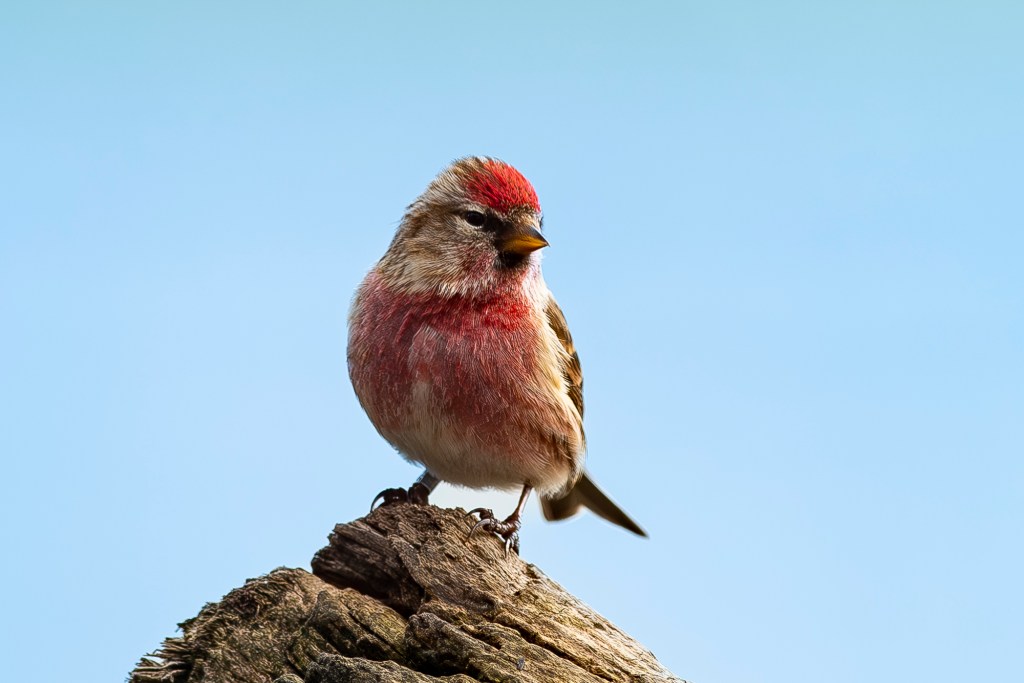
The first of the Siskins and Lesser redpolls have arrived, both are small and feisty, taking on all comers at hanging feeders. They punch well above their weight. They’ll stay for the summer and at the moment both can be counted on the fingers of one hand, before too long we’ll count them in tens.
In late Autumn a male Great tit arrived, a rare bird for this neck of the woods. We expected him to move on but he has stayed, claiming a (house sparrow) nest box and calling for a mate. I’ve a feeling he’s in for a lonely summer.

Other birds are singing of spring, a pair of Robins have claimed a nest box that’s hidden amongst the lichen covered boughs of an old garden edge Rowan. The male standing guard and singing a warning to a second pair who have claimed a box fastened to the trunk of a Sitka spruce.

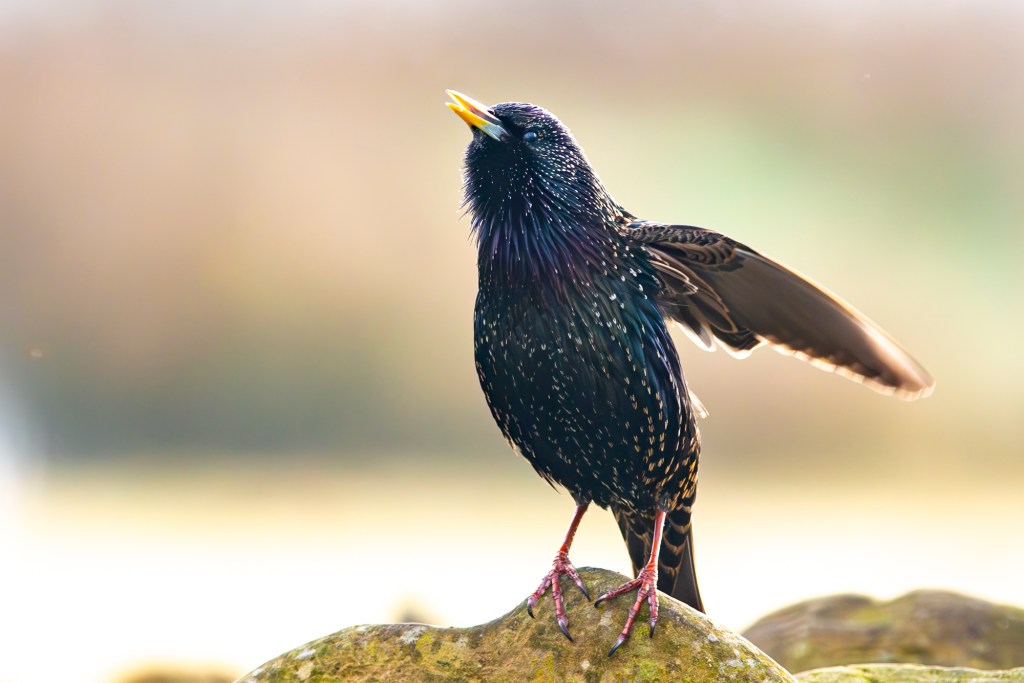
A Starling has decided a cleft in a stone dyke would be an ideal des res, in his case though not so much a song, more a collection of squeaks and whistles.
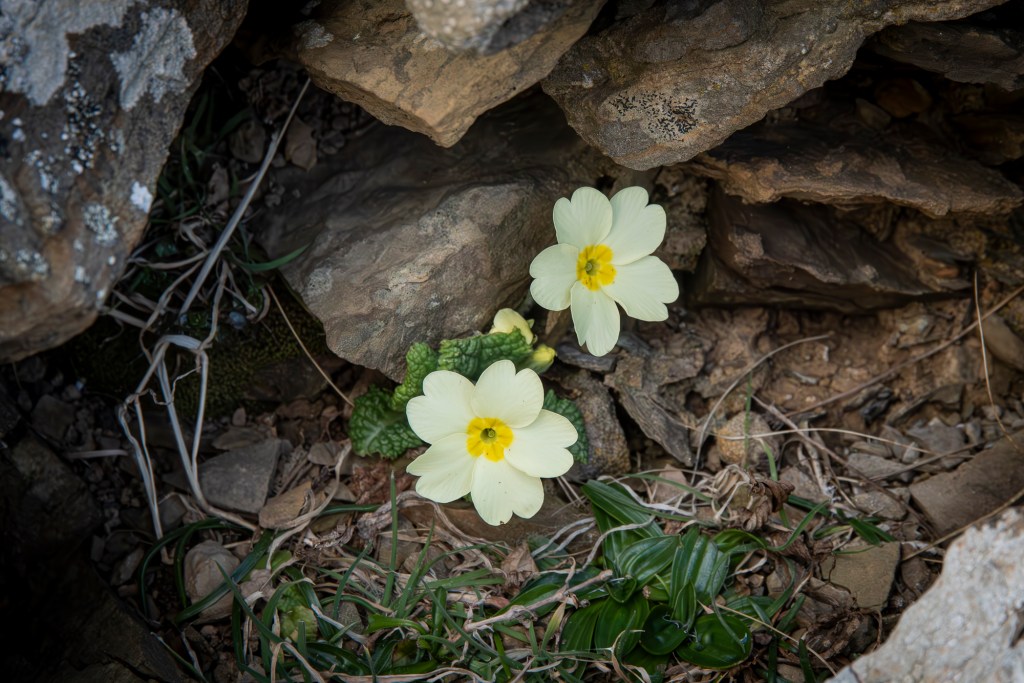
In the wider landscape the first primroses are being seen. One day last week I walked a circuit from the farm of Snelsetter, cutting first across grass fields and then coastal heath, before returning back along the cliffs. In a few weeks the grasslands and heath will be bejewelled with yellow rattle and spring squill. At the moment that’s hard to imagine, it’s an exposed spot and after a winters scouring by salt laden winds, the land has yet to turn green. For now a landscape of bleached grasses, lichened fence stabs and a well worn sheep track. The hardy sheep that graze the headland use their common sense, the track leads to a sheltered hollow, on cold winter nights when I’ve been along there to photograph the aurora, I’ve shone a head torch into the hollow and seen dozens of eyes shining back at me.

The Primroses were growing amongst cliff edge scree, a dusting of creamy yellow. Tucked down low, like the sheep.
From the track that leads to Snelsetter I’d seen two flocks of Barnacle geese, each of a hundred or more. They were on pasture that in summer will be a home to cattle. All were head up and alert, as if waiting for a sign. It was a surprise to see them, the previous weeks had seen skeins of them fly north over the house, we’d assumed they had all left. Later, as I cut across the heath, I heard them start to yap, taking to the air as one, sounding like distant hounds on the scent of a fox. The first skein passed way to my right, the second skein came low, directly overhead, so close that you could fill the viewfinder with just a couple of birds.

They were heading due north, to the tundra of Greenland, where they’ll nest and rear young in a summer even shorter than ours. From where I stood, our house was also due north, as the goose flies perhaps four or five miles distant. Jacqui was in the garden, splitting plants for a garden gate sale, and I wondered if, in a few minutes time, Jacqui would also see them. She did, one skein out over the bay, the birds that passed to my right. The second skein, still flying low, went directly over the house.

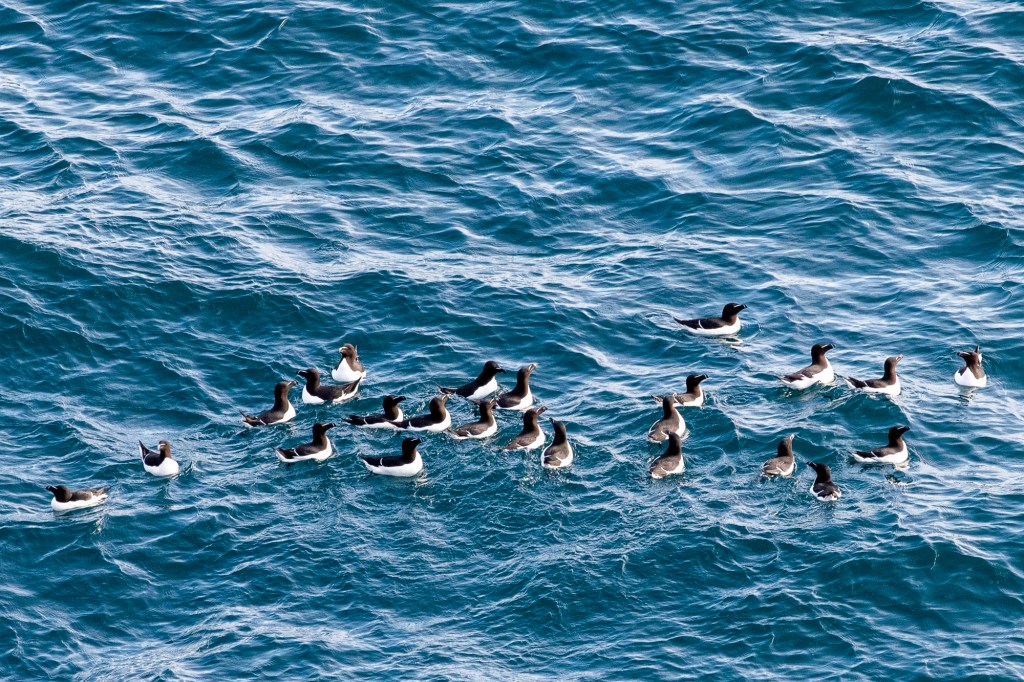
Watching them leave felt like saying a goodbye to winter, a confirmation of the arrival of spring. As I headed home, another confirmation, a small raft of Razorbills bobbing on the swell, returning to the cliffs after a winter at sea.
 A garden in Orkney
what a lovely post as ever. Where I live, on the edge of a Bedfordshire town, the cast of birds is much smaller than yours, we have red kites, the most spectacular, but for the rest, magpies, sparrows, a few blackbirds and the ubiquitous wood pigeons are all that have shown themselves of late. We used to have robins, but a neighbourhood cat saw off the last pair that were trying to nest in my garden. As for other wildlife, even though I’ve done my best to create a hedgehog-friendly garden, I’ve not seen any for several years now. So sad. There is a small wood nearby, though, and I’ve been honoured to see pairs of barking deer when I’ve been walking early in the morning.
keep up your posts, they are so uplifting to many.
LikeLiked by 3 people
Thank you Christine, I was lucky enough to see the first Red kites that were released at Harewood House in Yorkshire way back in 1999, after visiting a bride to be I got a free tour in the Head keepers landrover and they appeared on cue, he also tried to show me a pair of Goshawks that were nesting on the estate but they were a no show that day. The kites have been such a rare success story. There are hedgehogs here, not native to Orkney but probably introduced in the last century, we see them now and then, always by accident and often way out in the wilds. We don’t see many Wood pigeons but have Rock dove’s instead, they’re like feathered locusts, if we put seed on the ground it is literally gone in seconds, beautiful birds but crikey can they eat.
LikeLike
Fantastic photos! The white-flowered flowering currant is lovely. I have only the common Ribes sanguineum, but that’s very beautiful too. They are yet to flower – I live in Finland. So lovely to see how the spring advances in Orkney.
LikeLiked by 1 person
Happiest country in the world! Lucky you!
LikeLiked by 1 person
Dear Gary, I particularly loved the description and photos of the contrasting styles of the starling and robin. Also the fact that you and Jacqui saw the same geese, but from different locations. So much depth in your writing that I need to re-read it several times. Thank you Sue
LikeLiked by 1 person
Fantastic to see Spring waking up again. Lots of celandines and primroses everywhere and some bluebells in sheltered places. Birds definitely more active and I’ve been able to sit in the garden and listen to my blackbird in the early morning. He ticks me off if I’m late with his apple!
Love the sound of the geese’s wings which you can sometimes hear when they fly over and it’s quiet enough.
But generally its been a bright, very dry Spring with bitter winds. Hoping that ***£$% wind will drop soon!
Have a good week. xx
LikeLiked by 1 person
Hello Margot, an apple a day for the blackbirds here as well, we put two halves out on iron spikes close to the kitchen window, we had hoped they’d also pull in waxwings but no reports of them in Orkney this year.
My favourite “swisher” is the Raven, if there’s a haar you can hear them fly over even when you can’t see them.
The weather here is glorious at the moment, clear skies and light winds, almost Tee shirt weather, so far it looks as if it will last well into next week, very unseasonable for this neck of the woods, also very dry, trees in pots waiting for new homes are having to be checked daily.
Have a good, and hopefully warmer, week.
LikeLiked by 1 person