

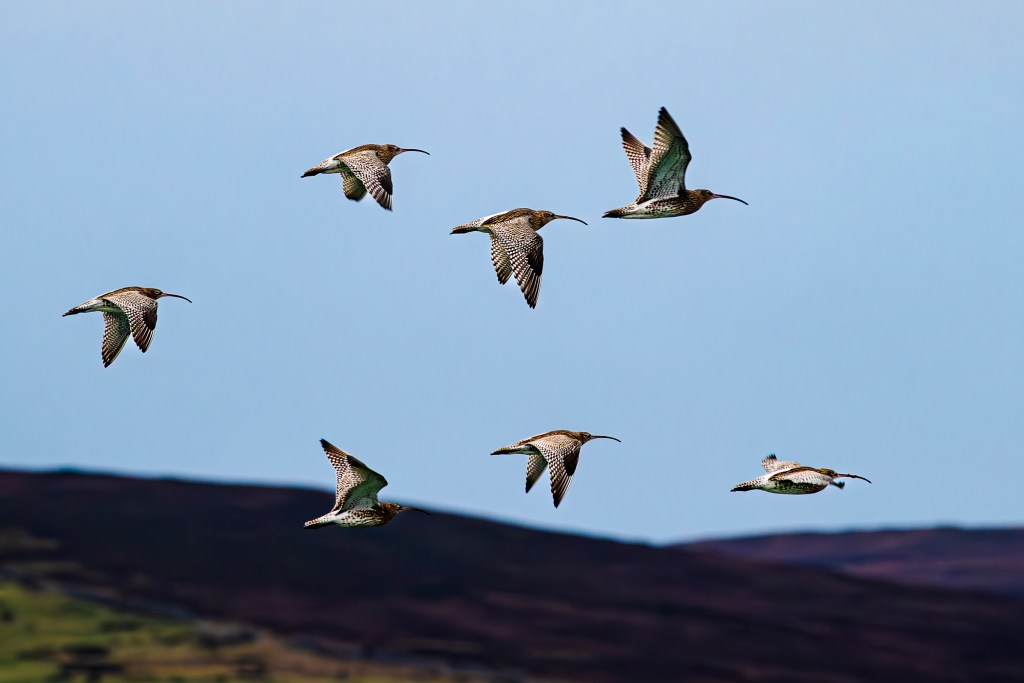
With our unseasonable dry spell continuing, most of the past week was spent in other gardens. Like many islanders, when it comes to earning a crust, we wear more than one hat. One day you’re selling plants, another day antiques online, the next might be gardening or dry-stone walling. This week, for me, it was gardening, cutting and planting a double screen of grey willow for a new garden a few miles away. We don’t go mad, working part time, happy to work to live rather than live to work, enough to keep the wolf from the door. With willows planted, on Friday, while Jacqui prepped some plants for sale, I took myself off on a favourite walk, to the valley of Heldale. Walk half a mile along the road and then follow a stone track up into the moors. At first, as you leave the road, there’s a flat landscape of mixed habitats, Grasses and Heathers and wet spot Rushes. It’s a home to breeding Greylags (pictured top) and Curlews. At this time of year, the male Curlews rise over the ground like Larks, soaring upwards before falling leaf-like back to earth, marking their territories with a haunting bubbling call.
As the track climbs higher, heather wins out. To your left though there’s a shallow valley, a place where native willow scrub thrives. The willows are rarely more than head high, chastened by the winds. They never leave the valleys, there’s an invisible growth line that’s never crossed. Tucked among them are dozens of bird sown rowan, silver barked and leafless, buds just starting to thicken.

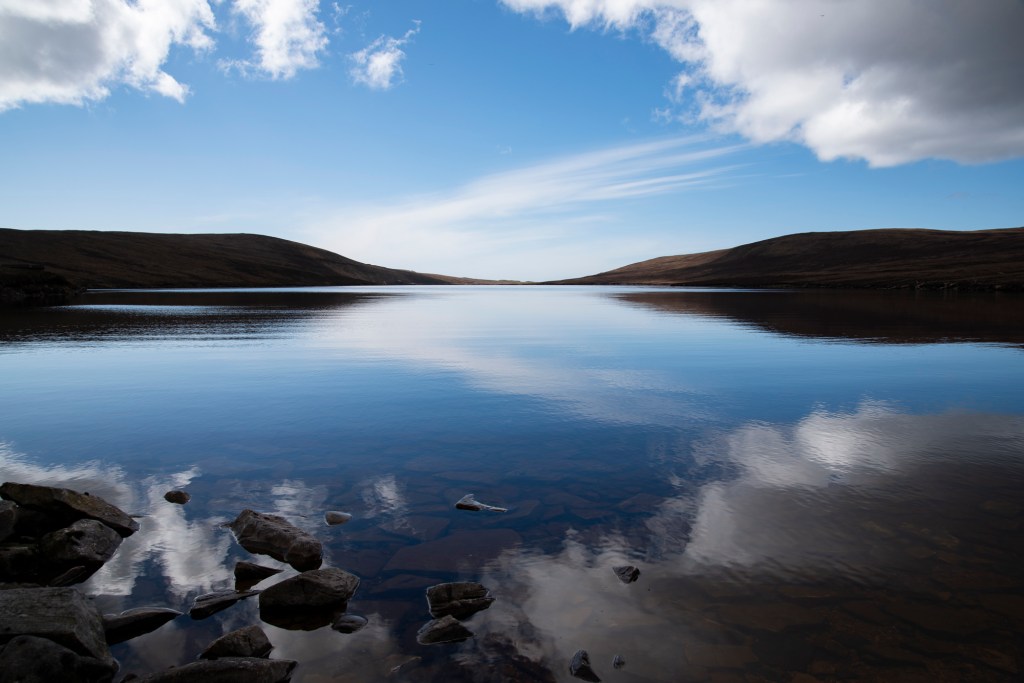
After a mile and a half or so, you rise a crest on the track and a natural reservoir, Heldale water, comes into view. A wide ribbon of silver in a landscape of browns and greys. Supplier of potable water to this end of the island. Out on the water, too distant to photograph, were the black shapes of a dozen Bonxies, Great Skuas, newly arrived from a winter in Spain or Africa.
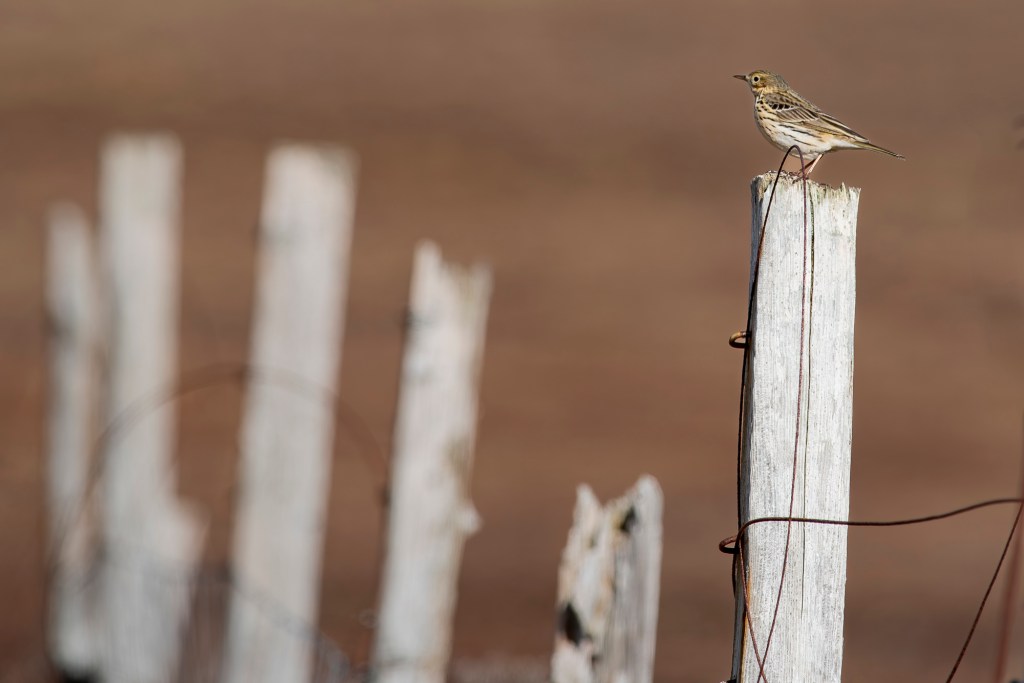
To the North-west of Heldale there’s Bakingstone hill. I wanted to see Eagles and Mountain hares and close to home there’s no better spot. I cut up from the reservoir, following a fence line that had long lost its purpose, bleached stabs and rusted wire, only useful now to the Meadow pipits who keep a lookout from the post tops. It’s not much of a climb, but despite our dry spell the ground is boggy and soft, making the going far harder than it should be.
As expected, Mountain hares were seen in numbers, most are wary, scutting away at the first sight of man. One though sat up on hind legs and watched as I passed by, if a hare can look wise, he or she did. As with all the other hares seen that day, he or she wore a piebald coat, the Spring moult in progress, half winter white, half summer brown.

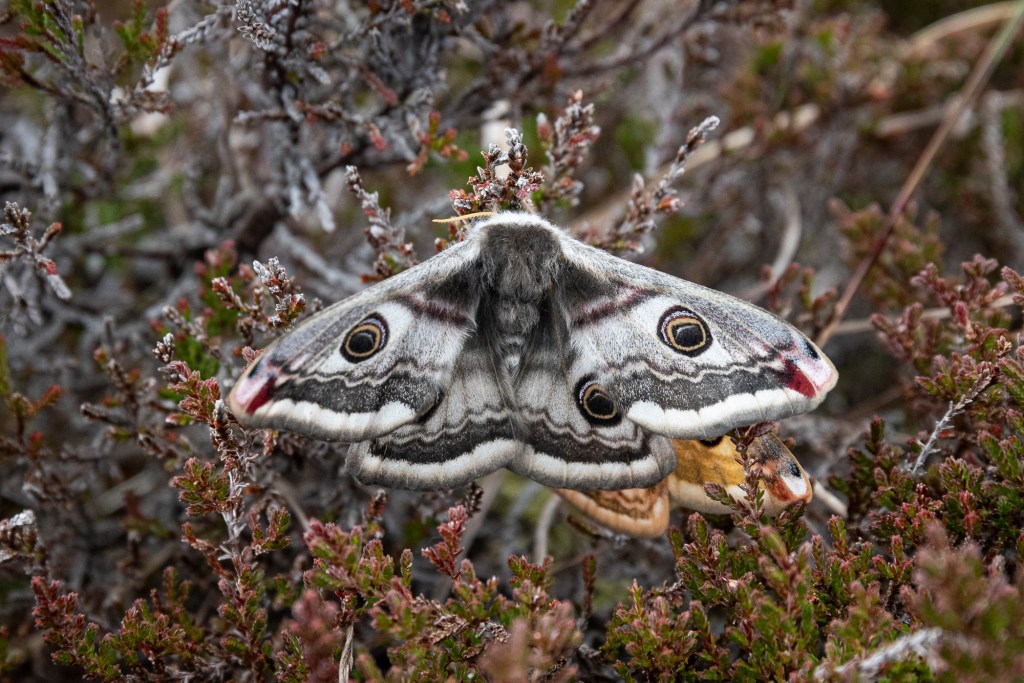
At this time of year Emperor moths are seen. As I climbed higher I saw males on the wing, brightly coloured fast fliers that at a distance are easily mistaken for butterflies. The females are larger and paler, a bluish-grey, and unlike the males they fly only at night. Tucked down amongst the heathers they are almost impossible to spot, given away only by amorous males who are drawn to the females by pheromones. Follow the male and you’ll find the female. Eggs are laid in April and May and the caterpillars, after a summer of munching on heather, will spin a silk cocoon and overwinter close to the ground, they’re the UK’s only native silk moth.

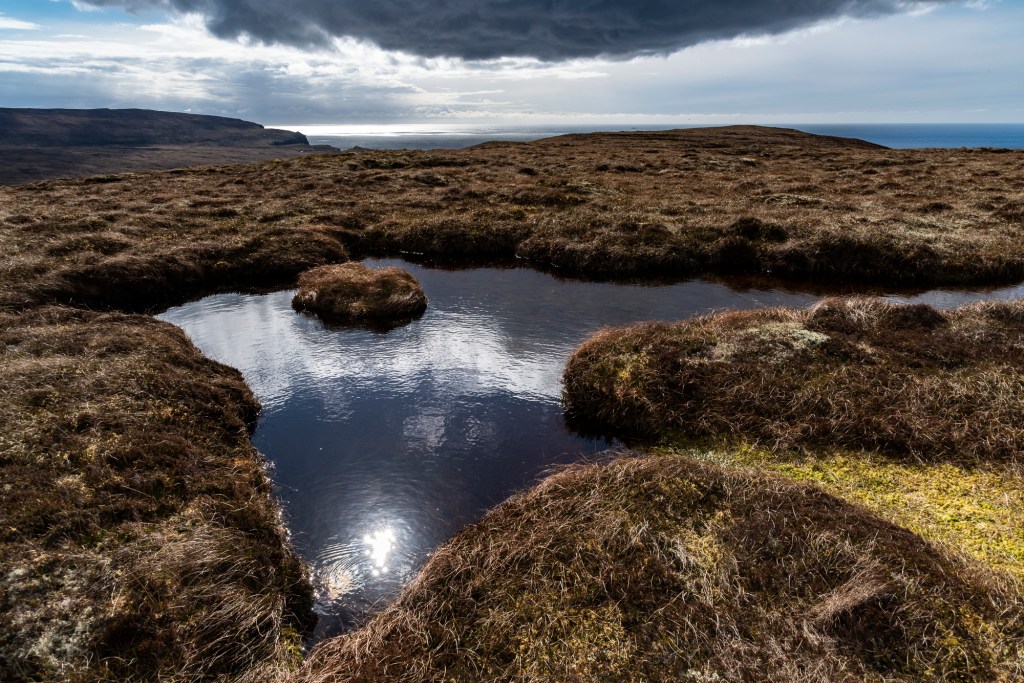
At the top of Bakingstone the ground plateaus and dries out, yet to green up heathers are crunchy underfoot. Here and there are pools of bright water, homes to whirligig beetles that constantly skate and circle. A shimmer of silver upon the skies reflection. To the west there’s the glitter of a sunlit sea. To the North, nothing but open moor, low hills, shallow valleys and countless lochans. The silence, on a still day, is deafening.
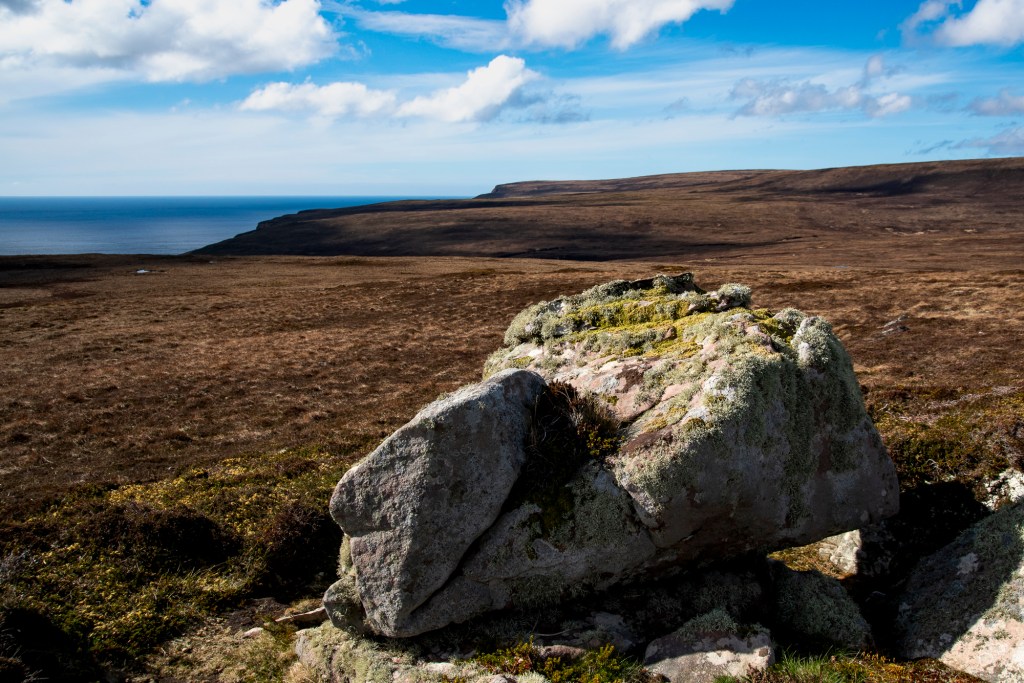
At the end of Bakingstone there’s a rock, dropped by a passing glacier, that’s big enough to show up on an OS map. A good place to stop and eat a chocolate bar before setting off home. The rock is covered in a mini forest of brittle lichens, silver greys and soft yellows, each of them decades or perhaps centuries old.
To sit on the stone and crush the lichens would be an act of vandalism, so I sat on my coat on the heathers and realised, after a while, that I was being watched. The watcher given away by a bright eye and a pair of long furry ears.

I went home via the waters shore. From the ridge a steep, and careful, foot sideways descent that occasionally needs the reassurance of grabbed handfuls of heather. As the ground levelled out more hares sprung from their forms, none of them pausing, each showing a clean set of heels. To the West, way up high, soaring on the updrafts, I saw three broad winged specks, white tailed eagles, the hares nemesis, a pair and a single bird.

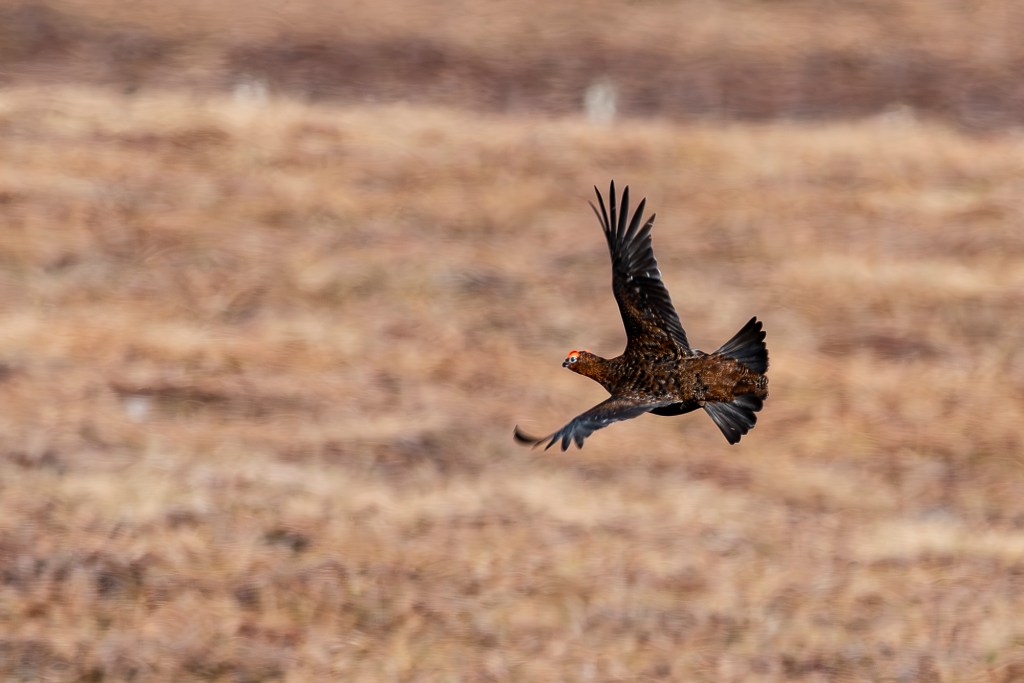
In addition to the hares and eagles, I’d hoped to see Hen harriers and Red grouse. For the former a sighting is pretty much a given here, at home they’re a bird seen almost daily, either hunting the shore or quartering the moor beyond the back garden. Red grouse are here but are much more often heard rather than seen. As luck would have it the Harriers were absent that day but a few dozen yards from the track that would take me home, a pair of Grouse flushed from under my feet. A glimpse of a brief few seconds, all sunlit red and ginger-black, curling away at fence post height.
 A garden in Orkney
Good morning Gary,
At last RAIN! Quite a lot too so, as HipOp looming I’m busy doing loads of planting/weeding/pruning. Replacing tired lavender in a hedge today and planting out salvia. achillea, dahlias.
I love hares, lucky you, get them down here, if you know where to look.
Have had a crow coming into my garden, hanging onto my squirrel proof feeder and looking absurd! Yesterday I noticed a nest in a tree on a very busy road close by so I guess s/he has done a reccy and noticed the pigeons scoffing and decided to join them.
Lovely walk and some fab pictures of the landscape.
Hoping for some rain for you too.. Have a good rest of week. Margot
LikeLiked by 2 people
Hi Margot, a little bit of overnight rain here but not much, we need a good downpour or two, send some this way. We’ve managed to get Salvias to grow here, Turkestanica is a favourite but we have to treat it as a biennial, if we sow late summer we get flowers the following year but they are very short lived here and don’t manage a second winter. S.Caradonna also does well and so far is proving to be long lived despite our usually wet winters.
We’ve got the “Odd couple” here, a carrion crow and a hooded crow who have paired up and have a nest a few hundred yards away. Both have learnt to lift a fat-ball feeder off the branch and drop it to the floor so it pops open and releases the goodies. They bred here last year as well, their offspring are easy to spot, a random mix grey and black, not quite hoodie, not quite carrion crow.
I’ve been back on the moors today, seen lots of mountain hares again, they seem to be doing very well, in Orkney they’re unique to Hoy but other islands do have the Brown hare, Hoy doesn’t. Also heard the first Cuckoo!
Have a good week.
LikeLiked by 2 people
Those Emperor moths are beautiful! Apparently we have them in the east and also the Yukon, but sadly not in BC.
My Mirabilis jalapa (AKA 4 o’clock plants) have germinated well in the cold frame and as soon as the night time temperatures rise above 8C I shall plant them out. I grow them every year as they only bloom in the evening through to sunrise, with the most heavenly scent. I love to sit out in the backyard and watch the various moths that come to feed on the flowers.
Rain needed here too Gary and Margot! There’s already 15 wildfires burning in BC 😦
LikeLiked by 2 people
Heathland on fire here in deepest Dorset, Penny.Scary.
BTW Go Sharp Elbows! x
LikeLiked by 1 person
Hello Penny, I had to google Mirabalis, I had a quick look at their needs on the RHS site, we would also have to treat them as annuals, a white form is on next years seed list, they sound just the thing for moths. It reminded me of a wildflower we used to grow in Yorkshire, Meadow Salsify aka Jack go to bed at Noon, it literally did, closing its flower heads by midday.
Lots of new life in the cold frames, ironically the only one that isn’t showing yet is native foxglove, normally you show them compost and they grow like grass.
Wildfires are a big fear here, an island of 35000 acres and 90% of it moorland, often over deep peat and most of it unreachable except by foot or quad, we need rain. I hope they get your fires under control, Fire weather was one of the best and worst books I’ve ever read, we’re all sleepwalking into a catastrophe.
LikeLiked by 1 person
If you can get two colour varieties of Mirabilis, I highly recommend it. It has a kind of incomplete genetic dominance system so that the next year’s plants are chimeras – different branches of the same plant have different colours on. The second year flowers can also hybridise to be white with yellow stripes (if you also grow yellow ones). I initially bought mixed pink, yellow and white colour seeds and have saved my own ever since – I’m constantly fascinated to see what the flowers will be next year.
LikeLiked by 1 person