
Our dry spell came to an end on the weekend past. After weeks of barely a drop of rain, a period that has seen burns run dry and ponds shrink to a third of their size, the heavens finally opened. The Saturday was dreich, one of those days when the cloud clung grey and heavy, hard to tell where sea ended and sky began. A day to be inside looking out. The early hours of Sunday brought a slight change. High winds with accompanying rain, blattering against windows and skylights, loud enough to disturb your sleep.

Since then normal Orkney service has resumed, bright days and showery days, much more akin to a summer in the far North of Scotland. In the garden it also continues to be all change. The last of our camassias are fading to seed. The blues went over first, a later flowering cream variety whose name is long forgotten, is just about done, only a handful of spires have tight, yet to open, buds.

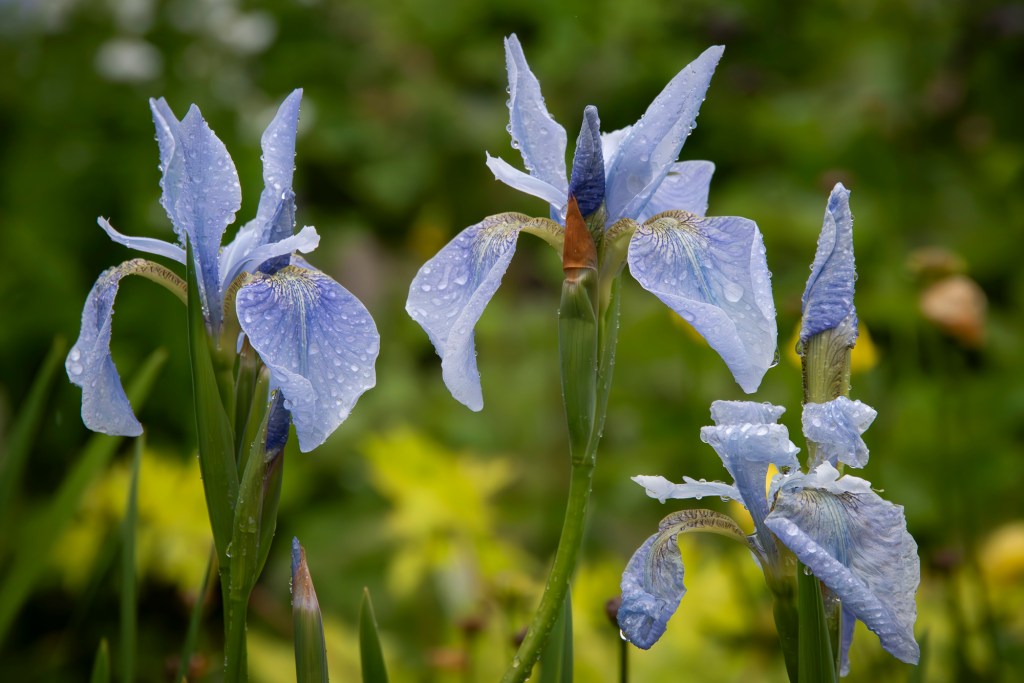
As the camassias fade others take their place. Spears of iris sibirica have unfurled this week, once open, their broad egg shaped sepals make perfect wide landing strips for bumblebees. As with the camassias the blues open first, of the half dozen varieties we grow silver edge and paler perry’s blue, (pictured top) are probably equal favourites.
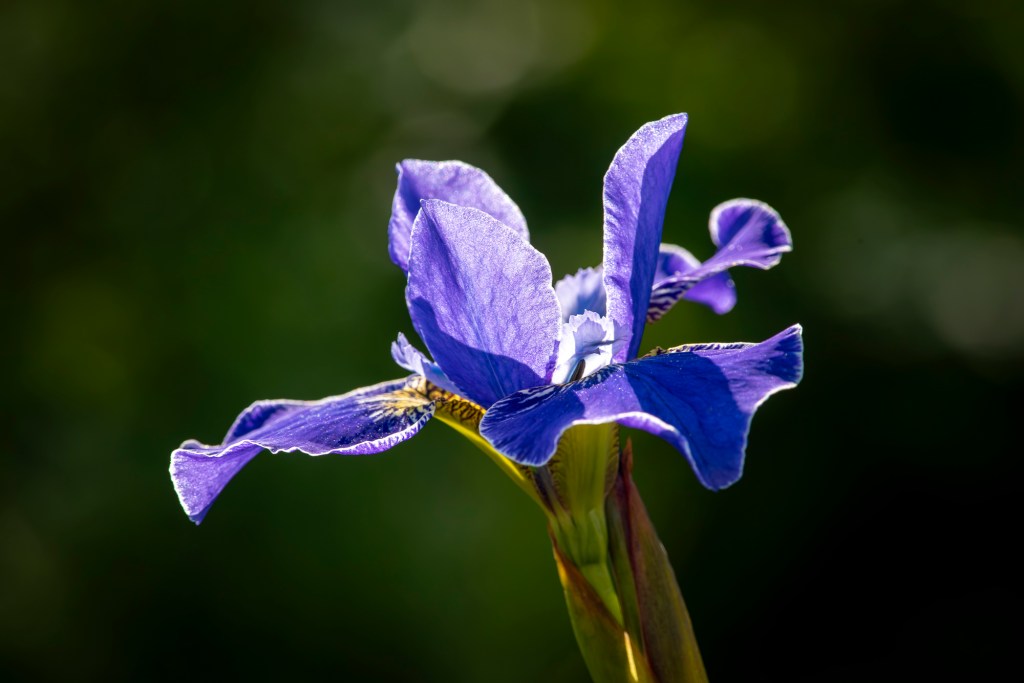
The first bottle brush spikes of red hot poker fiery fred are lighting up the rear garden.It seems a little bit early for them, for us they’re a plant that is more associated with late summers hotter colours, crocosmia’s and day lilies and the like. Perhaps it’s down to our dry spell.

A plant that doesn’t need bright colours to make a statement is euphorbia robbiae, the wood spurge. A perennial that as its common name suggests, is a lover of shade. The individual flowers are nothing to write home about but as a clump, it’s a different story. Dozens of small lime green flowers that are held above darker foliage come into their own, a plant that every garden should have. Saying that, for us it has proved to be temperamental, thriving in the back garden only in the shade cast by this low slung house. Jacqui, ever the patient gardener, has persevered and a second, this time front garden clump, that has been planted in the shade of a dry-stone dyke, is very slowly but very surely, establishing itself.

Hostas do well here and despite a healthy population of slugs, they remain pretty much hole free. The largest we grow is sum & substance, a variety that for us, grown in the shade of a couple of sycamore trees, by summers end will comfortably reach waist height. Each individual leaf, of bright yellow-green, measures perhaps eighteen inches in length and at this time of year, when backlit by a late evening sun, shows off a simplicity of curves and lines that any sculptor would be proud to emulate.

Sticking to the yellow-green theme, but this time with wings not roots, Siskins, a bird that when we moved to this garden was a rarity, but has since become a common summer visitor, have young in their nests. We’ve yet to see a youngster out and about but the parents are on invisible zip wires now, from feeder to nest, nest to feeder, rinse and repeat. A sisyphean task. Tame is the wrong word but they’re very tolerant of people, while Greenfinches and Goldfinches scatter if you stray too close to the feeder, the Siskins will pause, give you a glance, and then carry on as before. Sometimes, as feeders are topped up, they’ll sit a few feet away. A Siskin thought bubble would probably read “come on get on with it, there are hungry mouths to feed”.

 A garden in Orkney
What a pleasure to read your garden news as the rain hammers my windows here on a smaller island some 800 miles east. As it happens, this weather front came directly east from North Atlantic which adds to the feeling of sharing the same thing – literally. Camassias and Siberian irises are yet to bloom, well actually the first Camassia cusickii is just opening its first flower. Lovely to see the bees and the birds living around you.
It would have been great to see the long sunny spell in Orkney! I did see quite many lovely days when I was there; once in September and another time in April, a lovely time there with daffodils and lambs and spring sunshine.
LikeLiked by 2 people
Hi, yes we’re back to a normal Orkney summer, this week has a forecast of sun, rain and midweek gales. We were happy to share our rain with you 🙂
We first visited in the 1990’s in June, we stayed for the month and had one single day of rain. The next visit, I think in September, brought constant rain and gales and seas so rough you daren’t leave your seat on the ferry. We were definitely spoilt on that first visit.
Lots of lambs here at the moment, the dry spell was a huge bonus for farmers whose sheep lamb outdoors.
Have a good week.
LikeLike
Hooray! Rain here too and my garden has turned from being very well behaved, thanks to some judicious watering, to a wilderness! Well not quite. Having been told on GQT that slugs and snails wouldn’t be too much of a problem this year, I have found this to be a bit optimistic as a-munching the little bliters go! My white climbing rose is busy flowering as is the briar rose and the other climbing roses are full of buds. Blue geraniums are sprawling and the promise of flowers is everywhere. My blackbird must be rearing a second brood as it departs with its beak full of the suet nuggets it loves. My favourite month is here! Have a great week. xx
LikeLiked by 2 people
Hi Margot, finally back to normal for us, sun yesterday, showers today, gales and rain tomorrow, a typical Orkney summer 🙂
Baby blackbirds here as well, already fending for themselves so as with you I think ma & pa will have another clutch hidden away. Lots of Finch babies as well but the 1st prize for cuteness goes to baby Wrens, I’ve seen two today, hatched from a nest hidden in a hollow sleeper cum gatepost.
The slugs are behaving themselves here but Tis the season of the midge now, they’re not too bad, certainly not like the Highlands but I got a few bites today, ditto Jacqui who is on “paint the Forth Bridge” duty with weeding, by the time she finishes at one end of the garden it’s time to start again at the other…
Lots of Geraniums out here along with Catmints which have started to flower this week.
x
LikeLiked by 1 person
A wren’s nest, how lovely. Daughter has a Robin’s nest in her garden and I am so envious.
Don’t talk to me about the Forth bridge! I live in a Victorian house……:(
LikeLiked by 1 person
Hi Margot, Robins here as well, they’ve taken up a couple of open fronted nest boxes, the parents are run ragged, youngsters look like they’ve been dipped in cocoa.
Victorian house – start at the bottom, work to the top, repeat. 🙂
LikeLiked by 1 person
Thanks for the name of that lovely pale iris. It’s now on my wish list.
You’re so right about Euphorbia robbiae being a must for every garden. I’ve grown it from seed and planted it in my volunteer kerb/curb bulge three times now and every time someone has dug it up and made off with it!
Your comment about midge season reminded me to check on the status of my Yukon and North West Territories trip this morning. It might be in the balance due to only 16 people having committed by the closing date (they have space for 24). They will likely go ahead with 16, but if someone has to drop out…. I guess that’s one of the risks for a company doing tours exclusively for the over 65s – health issues can make things a bit more uncertain.
Glad you and Margot got some rain. We desperately need it here all across the North from NE British Columbia, through Alberta, Saskatchewan and Manitoba. So many people evacuated in the huge swath of out of control wildfires. The army are using fleets of their helicopters to reach folks cut off by the flames as it’s too smoky for airplanes to fly.
Here’s a short CBC news clip from last night;
Military evacuation flight out of the wildfire zone | CBC.ca
I thought the view of landscape they’re flying flying over might interest you, Gary.
LikeLiked by 2 people
Hi Penny, I found that link desperately sad, the new normal for so many, the tip of the (melting) iceberg. Leaving behind houses and pets and livestock must be so worrying and heartbreaking.I hope they get rain.
It is a beautiful landscape, we haven’t been on a plane for decades but when they invent human teleportation we’ll be along. Have you seen the Last Alaskans? It’s hard to get your head around the episodes that show trapping but the people and the landscape for me made addictive viewing, far removed from the usual reality cum soaps that you see about people in the wilderness.
The perry’s blue is a firm favourite. I suppose having a plant nicked three times shows a good taste in plants, a small silver lining 🙂
I really hope the trip goes ahead, we’re both crossing fingers for you.
LikeLiked by 1 person
Oops sorry, I’m afraid we’re so used to wildfire evacuations here I didn’t consider that it might be upsetting to non-Canadians.
I haven’t seen The Last Alaskans (the only TV we get is CBC). The trapping still goes on here in BC and presumably other provinces and territories too. Living ‘in the old way’ as it’s called here, running sets of trap lines and living, i.e. camping, in the wild as you rotate visits to them all, is still done – there’s about 1500 trappers still working.
I’m currently reading this book, in which she tells of all the changes she’s seen to the arctic way of life – like she says, she was ‘born in the stone age and grew up in the space age’:
Inuvialuk Elder Rose Kirby’s memoir to be published
Hope Jacqui’s crossed fingers don’t interfere with her hard work in the garden ;). It’s looking wonderful, even in the rain!
LikeLiked by 1 person
Well deserved praise has been passed on, J says thank you 🙂
The T’interweb can be a wonderful tool, secondhand book is on its way, Illinois thrift store to Orkney, snail mail. £6 for the book, £8 for postage, ETA, the end of June.
LikeLiked by 1 person
So glad you’ve found a copy! I love ThriftBooks but had no idea they sent things outside North America.
BTW while searching for where Rose Kirby’s home is, I came across a piece about John Rae which says that the war with France was the reason ships started diverting to Stromness for water supplies rather than using the English Channel. Guessing that was probably how Rae was recruited to work for the Hudson’s Bay Company (which closed last week after 355 years) and eventually 3 of every four people working for HBC was Orcadian.
John Rae’s Search for the Franklin Expedition | The Canadian Encyclopedia
LikeLiked by 1 person
Hi Penny, I knew about the ships diverting but hadn’t realised that at one point 3 in every 4 of the HBC staff were Orcadians. The well is here https://www.orkney.com/listings/logins-well
Our first home in Orkney, on South Walls (which for some decades has been linked to Hoy by a modern tarmac causeway) was the Watterinhoose, Watering House, we lived in the 1880 incarnation but there’d been a previous house on the same site, it sat near a burn and was the spot where sailing ships anchored in Longhope Bay took on their water, the only thing we ever found that gave any hint to the age of the site was a piece of building stone inscribed with 18th century graffiti.
https://en.wikipedia.org/wiki/South_Walls
LikeLiked by 1 person
Thanks for both those links. The picture of the commemorative stone at the well site is fascinating and I loved this quote in the Wiki piece ‘Its south coast is gnawed at as if by a rabid dog’.
I was looking yesterday to see how long the trip from Kirkwall/Stromness to Halifax, Nova Scotia (likely his first Canadian port of call) would be compared to the weeks of sailing if must have taken John Rae. The answer is 17 hours, but you’d have to fly into Toronto (that part takes 14 hours going via Inverness and Amsterdam) and then fly again (or take the train for 30 hours) back east to get to Halifax. I think he’d be astounded by the speed.
Re Orcadians, my very English husband says that they’re (quote) ‘The reason Canadians are so civilized. They understood the importance of co operation in tough times’. Most of them ended up in the Red River Settlement, a place now called Winnipeg. Having spent the first ten years of my life in Winnipeg, I can attest to the emphasis schools and communities placed on learning that attribute.
LikeLiked by 1 person
I liked the rabid dog quote, I’ll look at the South Walls coast in a different light from now on 🙂 I’ve been on there today repairing a dyke, not on the coast but I had a great view of Cantick Head and the island of Switha, on a beautiful warm day it’s not a bad office. I’ll award myself a few days off and then there’s another dyke to rebuild in Longhope itself.
It’s hard to imagine taking weeks, or even months, to get somewhere that is only a few thousand miles distant, the risks they took, so many ships must have left to be never heard of again.
Your husband is a wise man, in the twelve years we’ve lived here that is our experience, children and community come first and, friend or stranger, someone will always help you if you’re stuck.
LikeLiked by 1 person