
Our early June ‘normal service is resumed’ weather reset has continued. The past two weeks brought a true mixed bag, sunshine and showers, occasional gales, and on Friday through Saturday, almost biblical rain. One of the first, and best, things that we did when we started to make a garden here, was to dig a ditch to pick up the water running off the moor at the back and divert it around the garden. At the moment, after the weekends rain, it’s a mini river, rushing peaty brown water from moor to sea. After a three month dry spell an upside of the rain, combined with summers warmth, is that it has brought the meadow to life.
Most of the ground that came with this wee ex-croft house is moor but to the front, between house and sea, there’s a small field that had once been pasture. Not grazed or mown within living memory, it was thick with Soft rush and waist high grasses but potentially ripe for meadow making. For a perennial meadow, the field turned out to be pretty much perfect, dry in some places, wet in others, and topped with poor and thin soil. Once the ground was cleared we mowed hard in Spring and Autumn, adding home grown plugs of native plants that should have been here but weren’t.

An area thick with damp loving rush got plugs of Ragged robin, a plant that likes to keep its feet wet. The rush is still there of course but the regime of mowing weakens the rush and allows the ragged robin to hold its own, freely self seeding and spreading.

A member of the silene genus, its flowers have a look of closely related Red campion, albeit on a bad hair day.

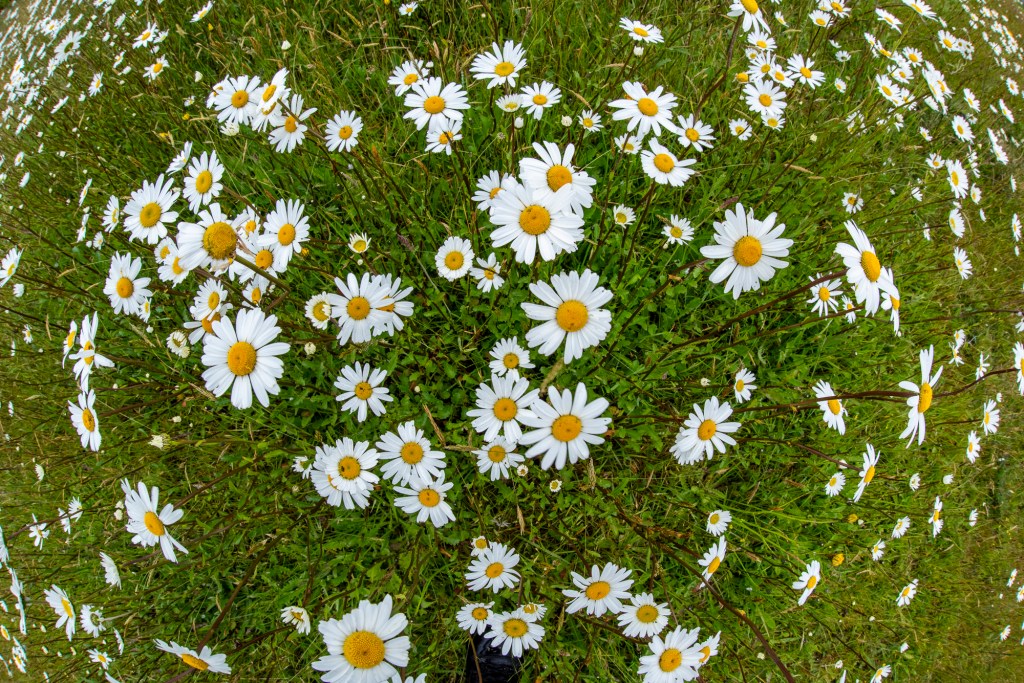
A friends house along the way takes its name from the daisies that once grew along the verges here, so for drier spots Ox-eyes were a given. They’re a doddle from seed and once planted self sow easily. The picture below was taken with a fisheye lens, the deliberate millefleur paperweight look might have been better without my boot toe, bottom centre 🙂
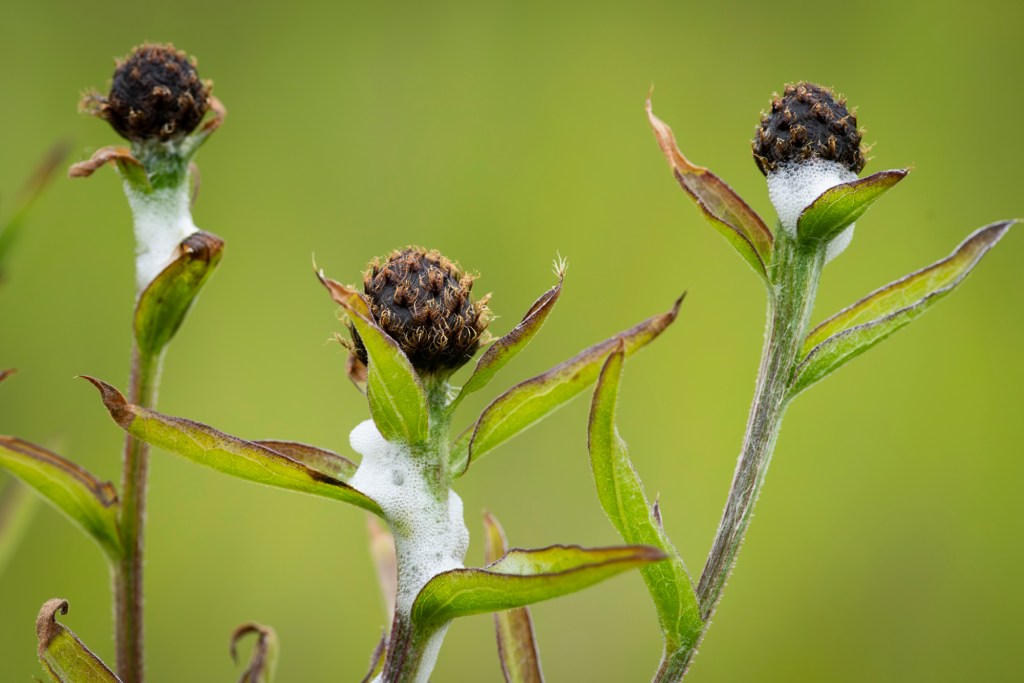
Plugs of other species have also been added, Common knapweed and Yarrow have both established well. The knapweeds are a favourite food plant of the appropriately named spittlebug, a tiny sap sucking nymph of the Common froghopper that hides itself from predators in a foam of bubbles – Cuckoo spit. This year it seems that every knapweed has them, each yet to open ‘hardhead’ bud that gives the plant its alternative name, has a side dressing of soapy froth.
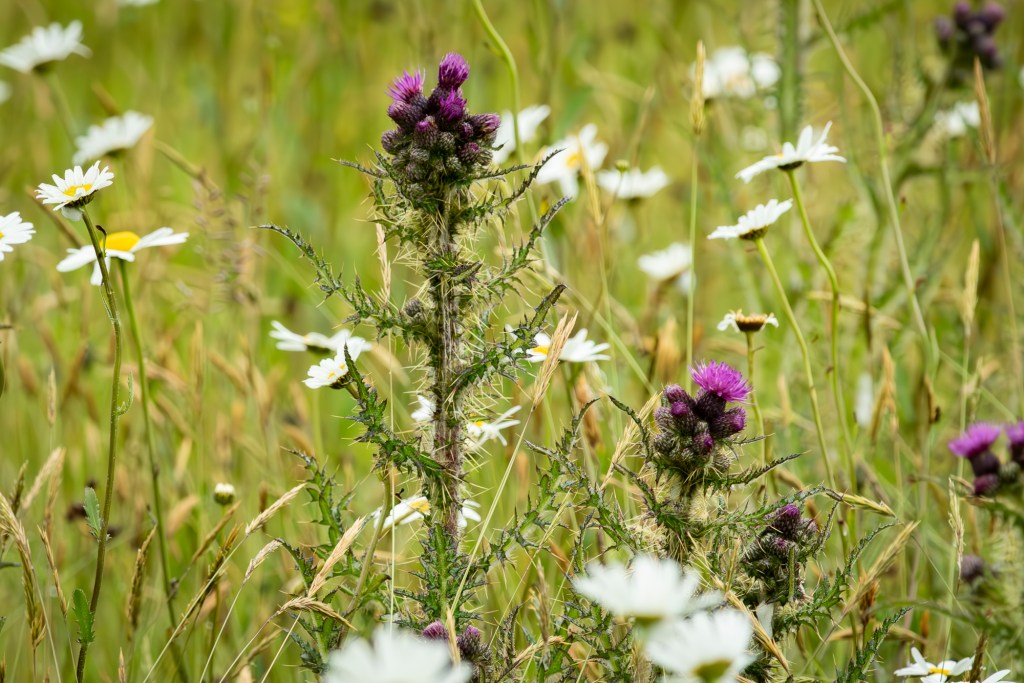
As some plants were being reintroduced many others returned without help, either from the fields own seed bank, woken by warmth and light, or carried here by the winds. Wind borne biennial Marsh thistles arrived in year two, they can be invasive but are perfect bee and insect food, like the yet to flower Scotch thistles that have also turned up, they’ll be thinned only if they get out of hand. Both are covered in long sharp spines that show no respect for gloves, the porcupines of the meadow.
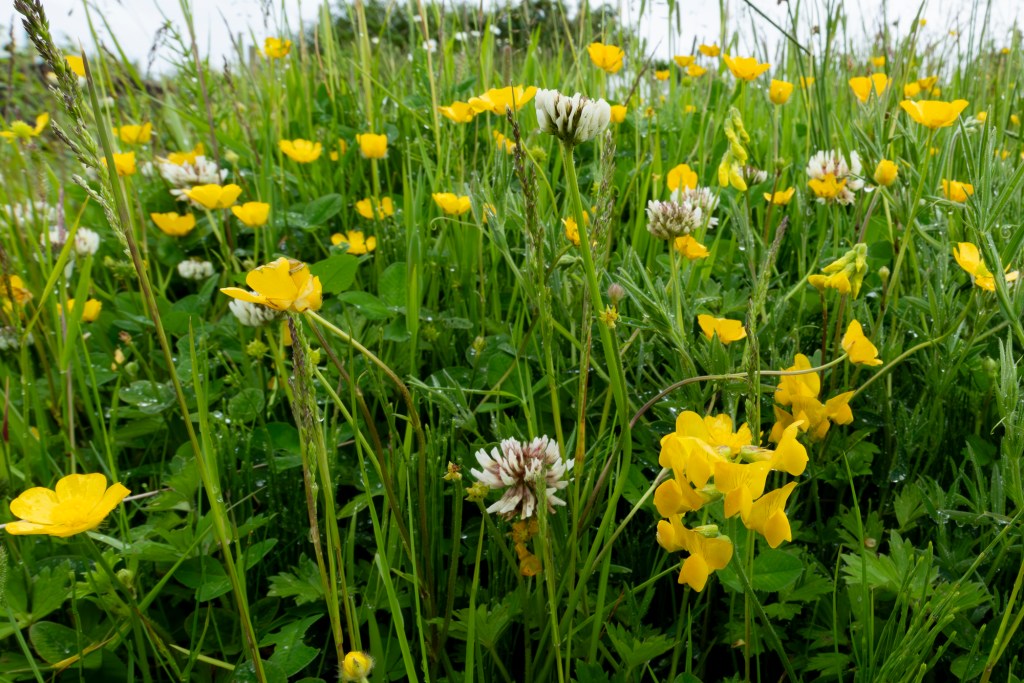
While most plants stretch upwards, showing off their wares to passing bees and butterflies there are also low level lurkers. A home made mix of native grasses with added ground hugging white clover and birds foot trefoil seeds, sown on a bare bank, has grown well. As with the rest of the meadow Creeping buttercup has inevitably introduced itself to the mix, an invasive plant that is a pain in the garden but welcome elsewhere.
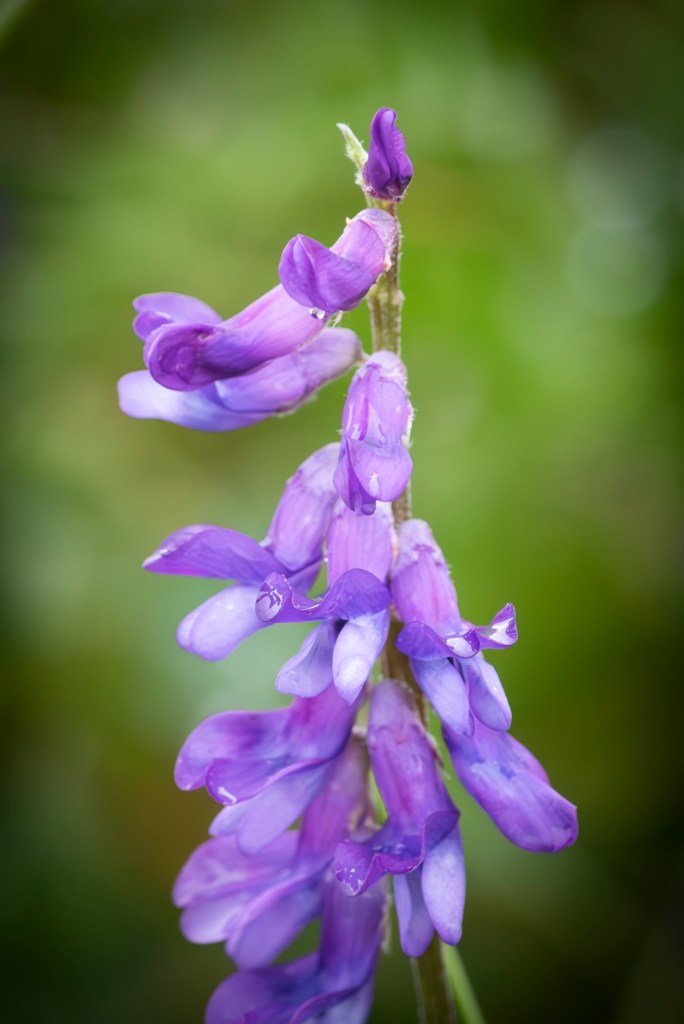
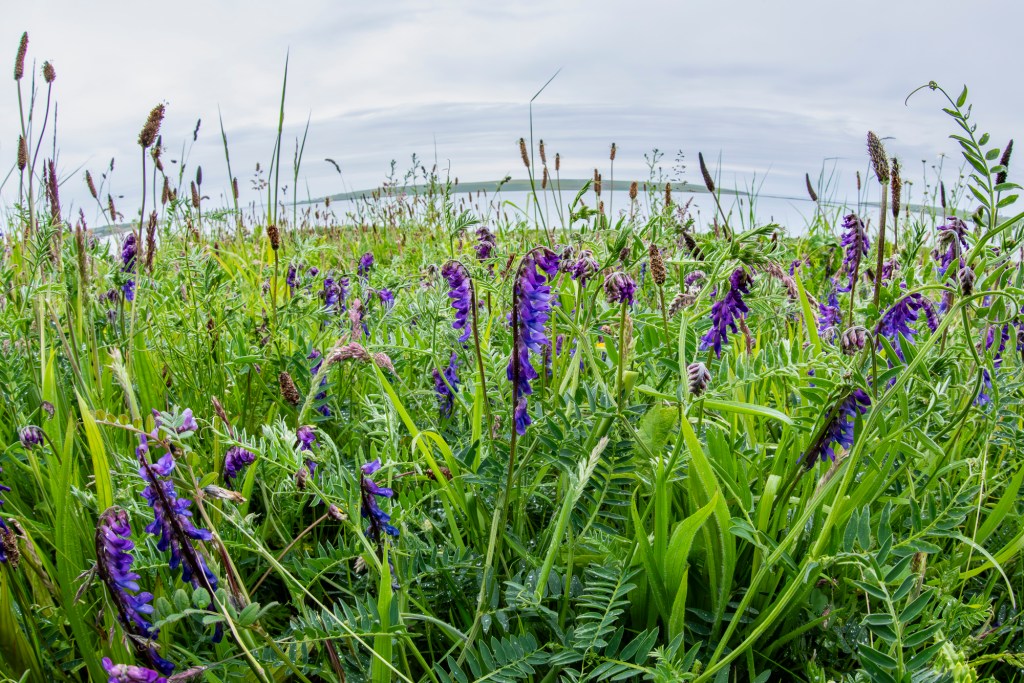
A wildflower that is equally happy at both ground or eye level, although for the latter it needs a handy shrub or fence to climb, is tufted vetch. A member of the pea and bean family that spreads by seeds cast from tiny black pods. Also known as the Cow vetch. It was believed in the 19th century that a cow grazed on vetch would be more easily wooed by the bulls advances.
A surprise arrival for this year is Common cotton grass, as its name suggests it’s not a rare plant, at this time of year the moors here are dusted white with countless seed-heads, bobbing and swaying in the breeze and giving movement to the land. There are three species of Cotton grass in Orkney and the surprise is where it’s growing. The common variety likes the wettest spots, happy in standing water. In the meadow it has popped up, after one of the driest Springs on record, in what is probably the driest part of the meadow. As with most of the plants pictured here, I photographed it just after rain. Once used for stuffing pillows its normally fluffy seed heads were sodden but still beautiful. I hope it spreads.

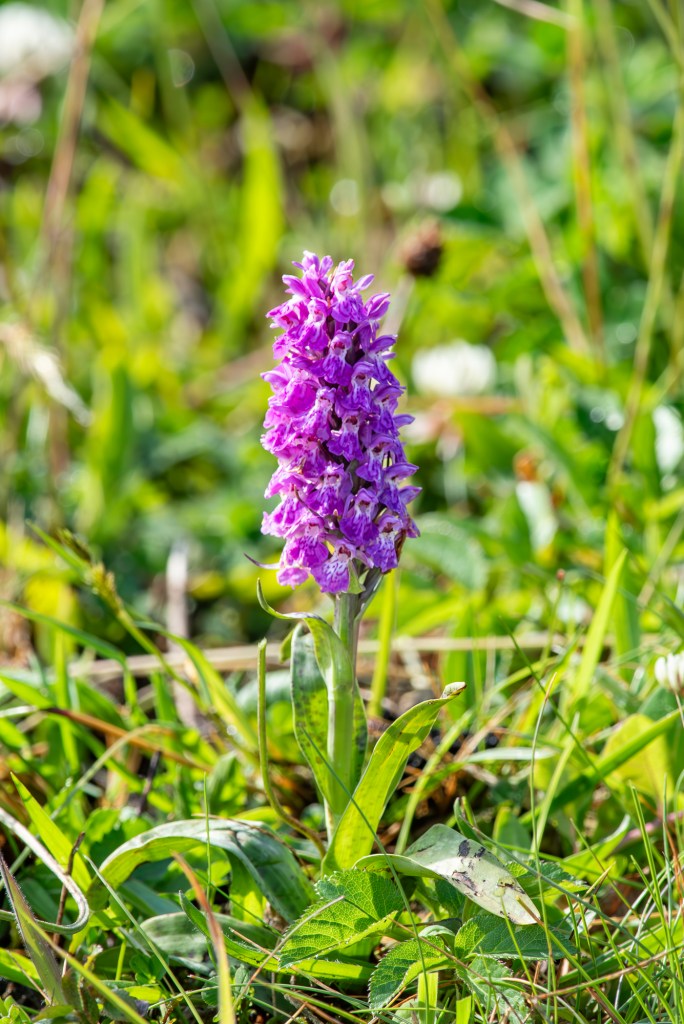
The one species we really hoped would appear, is the Orchid. A plant that is almost impossible to introduce unless specific fungi, with which they form a symbiotic relationship that allows seeds to germinate, and then seedlings to develop, are already present. Last year a single Northern marsh orchid appeared, this year there are three, from seed to flowering takes three to five years, the new meadow is four summers old. With 21 species of orchid in Orkney, fingers are crossed that others will pop up as time goes on.
 A garden in Orkney
‘Red campion in a bad hair day’ 🙂
Had to look that one up as I remember ragged robin as Lychnis flos-cuculi (as opposed to Silene). My things have changed since the last century….
Love the picture of the Northern Marsh Orchid – such a lovely colour. Looks like it has the leaf blotches like its cousin the common spotted orchid (though I found online that the two often hybridise). I remember seeing fields awash with common spotteds in South Yorkshire. Again that was last century, but I hope that hasn’t changed.
Well done creating such a vibrant meadow. I can guess that must have involved a lot of backache!
LikeLiked by 1 person
Hi Penny, that’s how I remember it, apparently the name changed in 2024, it seems to be an ongoing thing.
We’re really hoping that the Orchids spread, lots of them up here especially on the coastal heath, as you say they hybridise like mad and a definite ID can be difficult. I hope that the ones in South Yorkshire are still there but if they were outwith a reserve I fear they may not be, I was thinking the other day how I would see Corn Buntings as I walked to junior school, now they’re nearly all gone. I wonder how can the next generation mourn the loss of something they’ve never seen, ditto wildflower meadows, if they are gone already, how can you miss them, so sad.
The meadow was hard to clear, too wet for anything heavier than a walk behind power scythe and so much thatch to get rid of it was unbelievable, but worth all the hard work in the end 🙂
You might like this https://www.theguardian.com/artanddesign/2023/oct/15/a-brief-atlas-lighthouses-end-of-world-remote-jose-luis-gonzales-macias
I picked a copy up on Ebay, there’s a page or two of text per Lighthouse but once googled some of the stories that the book touches on are so interesting.
Have a good week.
LikeLiked by 1 person
Thanks for the book recommendation, Gary. I’ve requested a copy from the library. You’re right about interesting light house stories, there’s a reason why so many feature in ghost stories and I’ll be sure to look some up when the book arrives next week. This story’s from last month at one of BC’s most remote lighthouses:
Investigation underway after on-duty lighthouse keeper dies alone, west of Prince Rupert, B.C. | CBC News
I’d never considered how much today’s young people are missing because they’ve never seen the wealth of flora and fauna abounding when we were young. Doubtless our grandparents said the same about us – well mine, probably not, as I come from a long line of Londoners (London, UK) who hated the countryside!
Your comment re the possible loss of spotted orchids sent me searching online to see if Butter Bumps still boom on Potteric Carr (as in’ When on Potteric Carr the Butter Bumps cry, people of Balby say summer is nigh’). Apparently the bitterns are still there, so some things remain the same 🙂
LikeLiked by 1 person
Hi Penny, there was a case in 1800 where a light keeper died and his unfortunate colleague was left alone, with the corpse, on a rock in the Irish sea for four months, Smalls lighthouse. Since then, until automation, the rules were changed so that rock based/uninhabited island lighthouses had three keepers on duty. A hundred years later all three keepers were lost on the Flannen isles, lots of mystery and myths but the true cause is believed to be a freak wave that washed the men from the island.
Potteric Carr, that takes me back. There was a Butter Bump here on a reserve in Orkney for a few months, almost certainly an accidental blow in. I remember getting great views of them at other Yorkshire reserves, at Fairburn Ings (a rare upside of mining subsidence)and also at Blacktoft Sands.
Thunder and lightening here at the moment with stair-rod rain, definitely back to our normal weather 🙂
LikeLiked by 1 person
Good morning Gary, How wonderful to have done that re-wilding and how rewarding! Ox-eye daisies have been fantastic here, masses and masses on the verges and roundabouts and, on the chalky banks of a relief road that was built about 10 years ago, masses of common spotted orchids. I have also seen a bee orchid at the local bird reserve, so fabulous. In my garden the feverfew, clematis, fuschia, sweet william, nasturtiums and all are all flowering furiously! But the highlight of my day so far has been big daddy blackbird feeding big baby blackbird up close and personal on my garden path. So tame I do worry about cats but have plenty of small trees, shrubs, trellis they can dive into. Enjoy the rest of your week Margot xx , .
LikeLiked by 2 people
Morning Margot, we made the mistake of adding a few Ox-eyes to a border, they looked great but wow can they spread! All now dug up and put along the verge where they can spread to their hearts content, in the meadow they’ve gone mad and look really good, it has been well worth the effort.
I love to see Orchids, in some places here they hybridise freely so ID can be a challenge, there’s a handy local online wildflower group that can be turned to if needed. Verges here are only mown once a year and there’s a policy to avoid cutting roadside verges at all where orchids are in flower, a good thing.
As with your plot the garden is going mad, so many things in flower it’s hard to know where to look.
We’ve been watching juvenile Blackbirds trying to master the art of eating half apples that we put out on iron stakes near the kitchen window, so interesting to see how they watch and learn from their parents.Some parents are sitting or feeding second clutches, a few adults. around with worms in their beaks.
Very warm here yesterday, bright but cooler today.
Enjoy your week x
LikeLiked by 1 person