
June ended as it began, days of bright and breezy weather with occasional bouts of heavy rain. The Solstice weekend, when you secretly hope for a stunning sunrise or sunset, brought a thick haar on the Saturday and on the Sunday, after a monochrome start to the day, thunder and lightning with cloudburst rain. I wonder what the first settlers to Orkney would have made of it, the people who built Maeshowe and the Ring of Brodgar, to mention just two of many Neolithic sites that dot these islands, waiting patiently for a sunrise and getting thunder and lightning instead. Probably that in the eyes of whichever gods they worshipped, they were definitely in the bad books…

In the garden the high winds and rain have been shrugged off. You learn quickly in Orkney to be preemptive with staking, a task that Jacqui starts in early Spring and continues as plants grow, tweaking and re-tying anything that is wide or leggy.
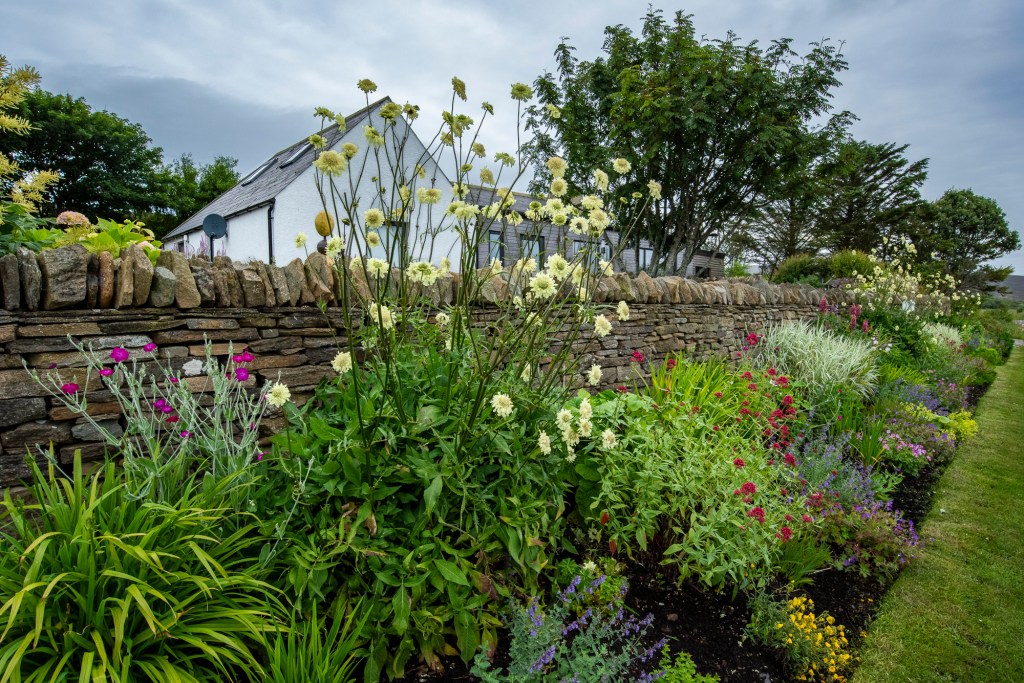
Some plants though don’t need support, Cephalaria gigantea, the Giant scabious, is one of them. It lives up to its moniker, comfortably reaching eight feet in height, at least half of which is a lattice of thin green stems topped with creamy-yellow pincushion flowers. We dot them everywhere, a few are in the guerrilla garden, pictured above, a roadside verge beyond the front garden dry-stone dykes. Part ours but mostly the county councils, a home for spare plants, waifs and strays from the garden proper. Last week the cephalarias shrugged off a 50mph southerly, flower stalks bending almost flat before springing back up.

A couple of other favourites that look far more wind delicate than they are, grow at the other side of the dyke, in the still very exposed front gardens. One of them is ligularia Rocket. As with the cephalaria it’s another plant that lives up to its name, shooting spires of yellow flowers, held on inky-black stems, to a height of six feet or more. A bit of a damp lover that needs space to look its best.

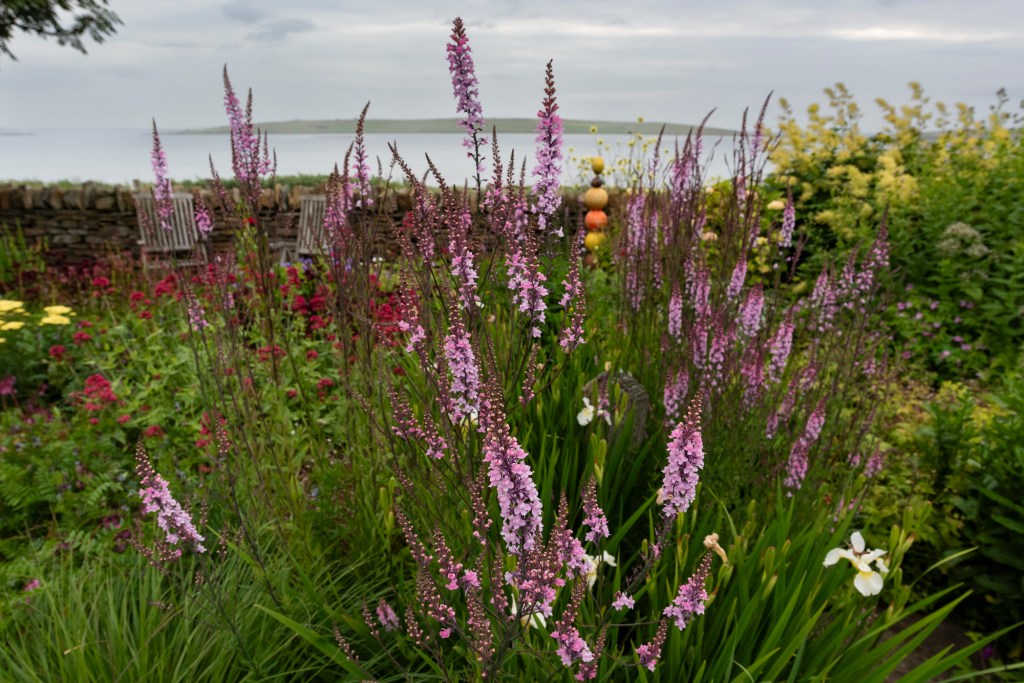
The other is linaria purpurea Canon went, a member of the toadflax family. Not quite as lofty as the ligularia it seeds freely, is as tough as old boots, and is pretty much left to do its own thing. It’s also a perfect bee magnet.
While some plants reach for the sky others are happier at a lower level, a white aquilegia that came as a gift uses others as a support, relying on catmints and geraniums to hold its flowers aloft. It never had a label but it might be Munstead white. The lady who gave it is no longer with us so much more important than a name is to keep it going, young plants grown from seed collected last year are doing well. One of those plants, like the cephalaria that originally came from my fathers East Yorkshire trackside allotment some 45 years ago, and has been split and re-split ever since, that you really don’t want to lose.

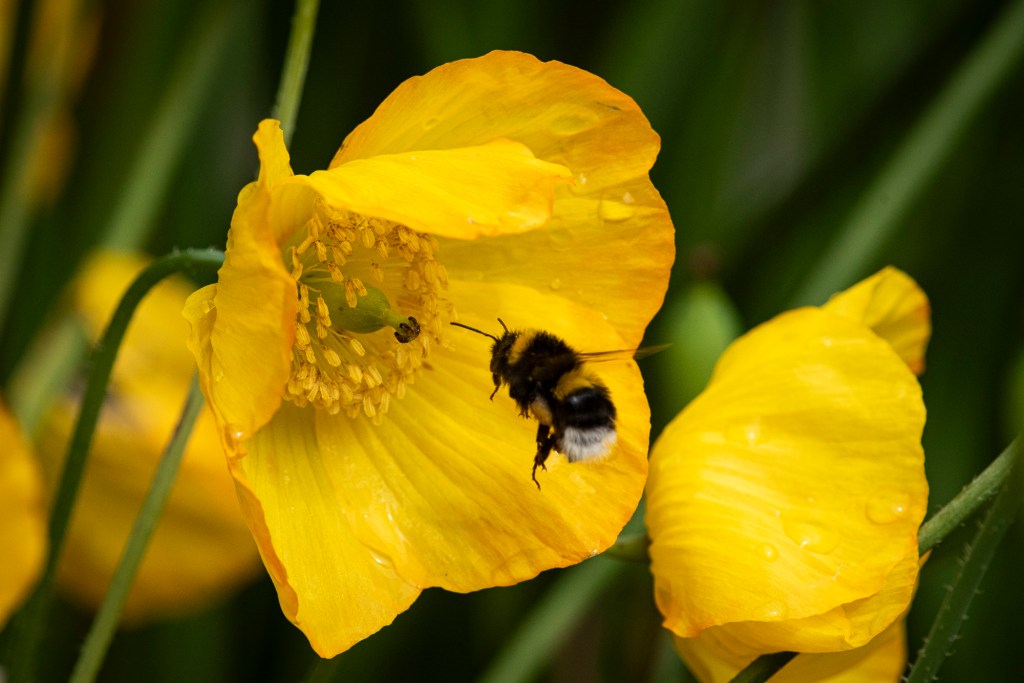
Bees are busy in the garden, I watched a small Bumblebee, a Common Carder, feeding on Lupins. A deep flower and a small bee don’t go well together. The bees technique for reaching into the depths of the flower was impressive, land on the lower petal and push down hard with your legs, opening the flower and gaining your reward. A reverse bench press for bumblebees.

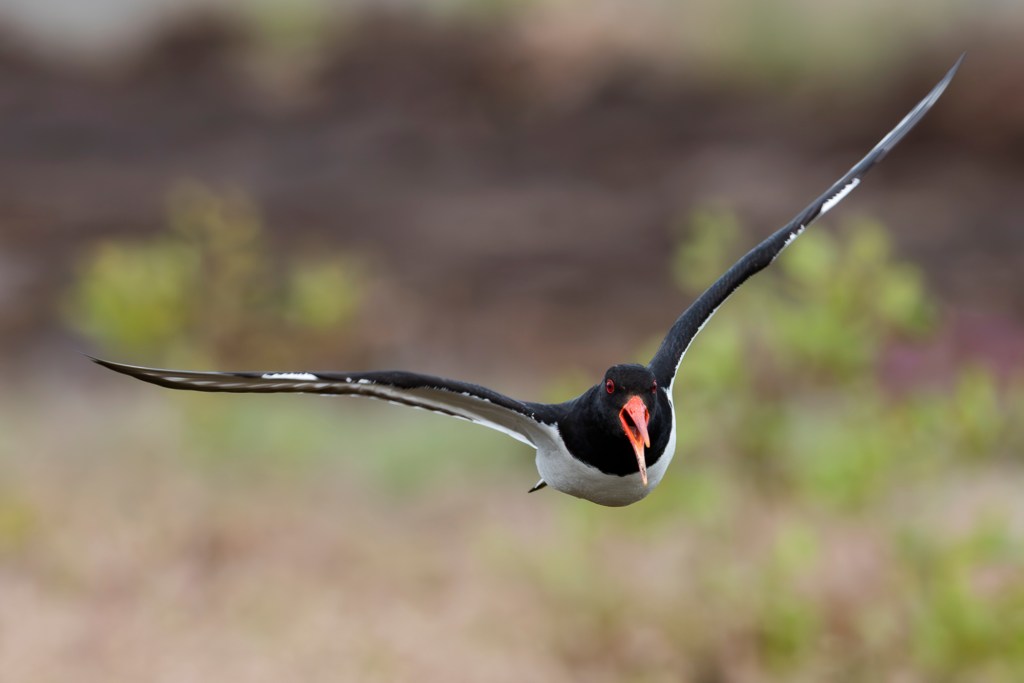
On the moor beyond the garden, Oystercatchers tuck their nests amongst the heathers and grasses. This year, on the small patch of moor that came with the house, at least three pairs have reared young, a fourth nest was lost early on to a Raven, spotted leaving the scene of the crime with an egg held firmly in beak, food for his or her family. The youngsters are out of the nests now and are carefully watched over by ever anxious parents. One day last week I walked up to check on young Rowans planted last year. I kept my distance but one parent still buzzed me, pleeping loudly and coming in at head height until the intruder, after checking the rowans, jumped the boundary fence and carried on into the hills.
Climbing higher, up through the old peat cuts, the settlement of Longhope on the island of South walls came in to view. A picture was taken of a Mountain Hare with the village as a convenient backdrop. A 600mm lens compressing perspective and pulling the three mile distant houses closer, just over the brow.

In the UK, moorland is sometimes much maligned, often seen as a desolate treeless waste. The reality is very different and internationally Scotland holds around 75% of the worlds heather moorland. Some species are unique to the moor, one is the Large Heath butterfly. Once so common that before the moors of Englands North-west were drained for agriculture, it got its own local name, the Manchester Argus. Now extinct in many parts of the UK they’re still a common sight on the moors here on Hoy. Easy to spot, as I walked further on into the moor I must have seen a couple of dozen, and hard to photograph. They fly fast and low in a direction that seems to be governed purely by the wind, briefly settling every twenty yards or so before lifting off again. Eventually patience paid off and the photograph below was taken. There are three subspecies, at least two of which I’ve seen in Orkney. This one, with its blue-grey colouring, is ssp scotica.

 A garden in Orkney
Fantastic photos! And lovely to read about the tasks, weather and nature.
LikeLiked by 2 people
Thank you Saila.
LikeLike
Another excellent blog Gary. Those borders look gorgeous and I’m sure the council and passing motorists enjoy yours and Jaquies hard work. We’ve had a drive over the Yorkshire moors we absolutely love the drive from Pickering over to Whitby, there were small patches of Heather beginning to show. Back home again today to see what is flourishing or not in our garden. Thankyou for another descriptive blog on your idyllic life in Orkney, love to Jaquie x
LikeLiked by 2 people
Hi Pauline. Thank you. I love that drive over the moors, the heathers here are just coming into flower, for a few brief weeks the low hills at the back of the house are literally purple. Very sunny here today, rain tomorrow. Jacqui is spending every dry day in the garden at the moment, trying to keep up with weeding and pruning, it looks a picture, all down to her passion & hard work. Love to you both x
LikeLiked by 1 person
Happy (belated) Canada Day! I missed your new post yesterday due to all the festivities going on all over the city.
Your roadside border looks lovely. Great to have a place for garden waifs, strays and overages that also benefits the local passers by. In fact the whole garden is a testament to the work and care you and the Head Gardener have put in. I’m awed by what you’ve both achieved. Please tell Jacqui I think her staff and plant management skills are both superlative 😉
Below is a Vancouver Public Library event that I would have loved to attend, but it was in Mandarin. See what I mean about how Scotland has influenced Canadian culture?
The Scottish Enlightenment and Our Time 蘇格蘭啟蒙的當代回響. Thursday, June 26on June 26, 2025, 6:30pm–8:00pm.
On which subject….I’ve just finished this book:
Follow The Flock: How Sheep Shaped Human Civilization Book By Sally Coulthard, (Kobo eBook) | Indigo
It has a chapter chronicling the several centuries of highland clearances that were done to make way for sheep. I discovered that in the 1820s, 750 inhabitants of both Barra and Rum were loaded (mostly unwillingly) onto ships and sailed to the Cape Breton region of Nova Scotia where they were dumped with no provisions. Sometimes with only the clothes on their backs.
Next few books (after the one on lighthouses you recommended) will be a dive into Adam Smith and David Hume…..
LikeLiked by 2 people
Hi Penny
You should have gone to the event, nodding wisely at suitable intervals and taking notes. Within no time at all it would be around the neighbourhood that you spoke fluent mandarin!
Head gardener/Under gardener, if you’ve ever seen the Two Ronnies clip, admittedly about class but equally applies to head/under gardener situation, I’m the one who says “I know my place” 🙂 On a serious note I’m genuinely proud of what J has achieved. On poor thin soil, in a spot surrounded on three sides by open moorland, with the sea to the front and just to add to the fun, regular lashings by salt laden gales, she really has created something special, easily a match for our much more sheltered, and much kinder climate and soil, garden that we had down in Yorkshire. I’ll take credit for the Dykes and the meadow but no Jacqui, no garden.
Orkney got off much more lightly than some other island groups did during the clearances, just one instance on the island of Rousay, mostly in the valley of Quandale. We went a few years ago, lots of history, Midhowe tomb (one of 15 on Rousay) is close by and the settlement itself dates to the bronze age. Nearly two hundred years later, the valley is still empty of people.
I tried to find the book, only popping up so far on American Ebay at an “Ow much!!” price, on my saved searches alerts 🙂 It looks like a good read. One will pop up here sooner or later. The other one, from thrift books, should arrive this week.
Favourite lighthouse backstory in the book is number 19.
https://www.beinghumanfestival.org/news/landscapes-change-archaeologies-rousay-clearances
https://rousayremembered.com/quandale/
LikeLiked by 1 person
Thanks for the links, Gary. The Rousay Remembered one is chilling and has some great photos of the vast human-free landscape.
Sally Coulthard is actually from Yorkshire and it shows in her writing:
Books | Sally Coulthard | Author & Columnist | Yorkshire
I found a UK based company selling a used copy of that book, which is titled in your country ‘A Short History of the World According to Sheep‘ for 6.99 pounds. Not sure if $13Cn equivalent qualifies as “Ow much!!”.
Re Scots and our Chinese population, this, started by Toddish ‘McWong’ (as he calls himself) has always been a feature of Vancouver’s huge Chinese New Year parade:
Twenty-Five Years of Gung Haggis Fat Choy: A Fusion Feast Celebrating Diversity | Ricepaper Magazine
Just a word of warning, don’t try going to Mr McWong’s Gunghaggisfatchoy website like I did this morning – it’s been hacked and is unsafe according to Microsoft.
I’m afraid my neighbourhood (just east of Chinatown) would know I was faking it if spotted at a Mandarin based event, as they know I’ve been struggling to learn basic Cantonese for a couple of years and the two spoken languages are completely different. I don’t really have much of a language aptitude sadly and 廣東話好難gwong2dung1 waa2 hou2naan4 (Cantonese is hard).
You should both be rightfully proud of what you’ve achieved in that beautiful garden. Kudos to the dry stone wall/dyke builder and the garden boss he looks up to 🙂
LikeLiked by 1 person
Hi Penny, I found a secondhand book, it didn’t occur to me that it might have a different title over here, less than a tenner inc postage, no need for me to lay down in a dark room for a week 🙂
Out of curiosity I had a quick google of Coulthard, a name from my (original) neck of the woods. North English/Scots, a herder of Colts.
The original Mandarin link fortunately wouldn’t work, I assume blocked by wordpress, love the name though!
Good luck with the Cantonese, I struggled with basic French.
Ps, past history aside Rousay is beautiful with a thriving community, smaller but very similar to Hoy, we could have happily settled there.
LikeLiked by 1 person
Hi Gary, Love your “guerrilla garden” what a great idea. So dry here, I see you’ve had rain and my poor garden needs some. Mindful of water shortages, I water carefully and sparingly but an amelanchia and an old fashioned rose, both planted in the Spring, need lots of water this first year at least. Also how nice to see bees in your garden. So few in mine it’s really alarming. My lavender hedge is usually loud with their buzzing at this time of year, but nothing, just a very few bumblies. I do have more hover flies than last year though, which is good as my garden has suffered a massive aphid invasion.My buddleia has got that horrible virus carried by aphids.The RHS is so worried its asked everyone to notify them to monitor the spread. Didn’t know whether to cut back the diseased branches so I did half and half and have got flowers, but the leaves look horrible. Sorry rather a negative post but climate change and its implications is quite scary. Have a good rest of week. Margot xx
LikeLiked by 2 people
Hi Margot
The Guerrilla garden was originally a ditch, we piped it and then filled it in with subsoil from a foundation, to say it’s such poor soil, and it’s also so open to straight off the sea Easterlies and southerlies, it has done really well.
We’re getting more than our fair share of water at the moment, the upside is that some newly planted Red Alders that looked completely dead after our four month drought (too far away for a hose), are sending multiple shoots up from the roots, they won’t grow as single trunk trees now but I’m sure multi-stemmed versions will look just as nice. I’d written them off, mother nature said otherwise.
So many reports from up and down the country about a lack of bees in gardens, we don’t have as many as in our first garden here because there are no neighbouring gardens and the moor, although it has bees, isn’t really a bee rich environment but they are certainly here in good numbers. Lots of butterflies as well at the moment, they seem early this year.
Fortunately no aphids here but as the garden matures we are seeing more hover flies. We have a single buddleia, the threat here isn’t aphids but wind burn, I’m sure though that if plants survive the first year here they learn to toughen up, when we first planted it, it scorched off, this year, and last, lots of flowers, no scorching (so far).Ditto with a hydrangea, terrible in the first year, a picture of health ever since. I googled the buddleia problem, possibly caused by aphids that are normally seen only in glasshouses, perhaps warm enough now for them to survive outdoors. GW is very scary, as a species we’re sleepwalking into it.
Sun & heavy showers today, wild windy and very wet tomorrow.
Have a good week x
LikeLiked by 1 person