

For Orkney, today excepted, which is grey and dreich, the past two weeks have been unseasonably dry and hot. Days that have brought mostly blue skies and light winds. I wrote a while ago that the front gardens were standing room only, now it’s the turn of the rear garden. A small oasis, beyond which are thousands of acres of open moor, that owes its existence to a thin shelter-belt of wind filtering Alders and Sycamores. At the moment plants are tucked shoulder to shoulder, barely a gap to be seen.
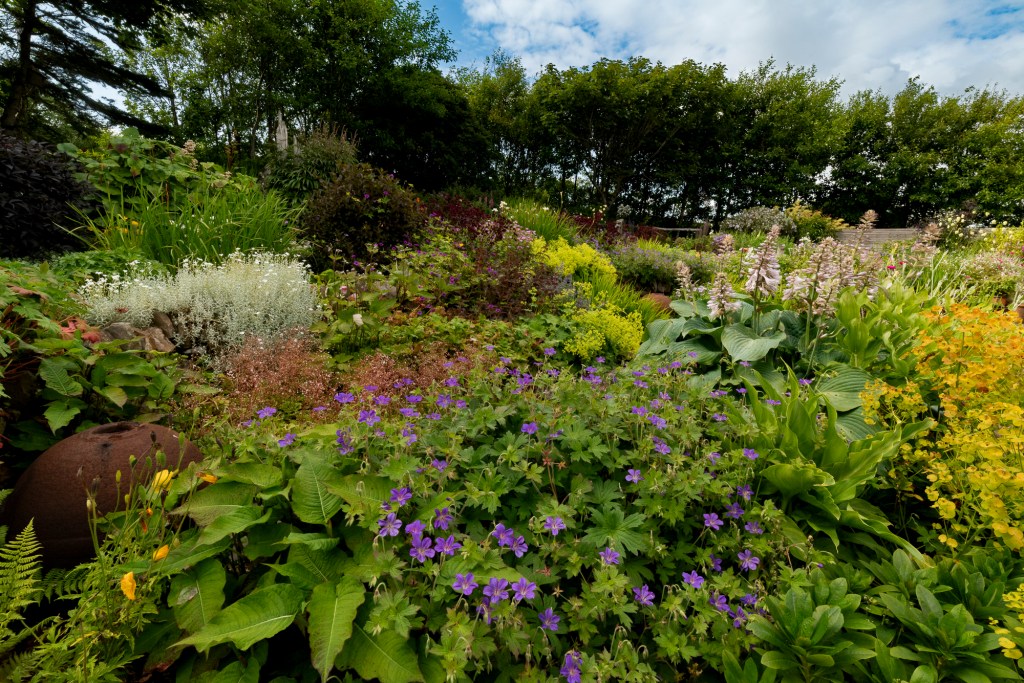
Thanks solely to J’s efforts, it is a garden that in Summer is ever changing. This week has seen Japanese Anemones at their best. Given their preference for damp soil and (mini heatwave excepted) cool conditions, they’re an ideal plant for this Northern garden. A favourite is September Charm, that despite its name flowers like clockwork in early July. It’s a member of the buttercup family and like its wilder cousins, can be a bit of a spreader.

Three years ago we planted Anemone Bressingham Glow, a smaller, more compact variety. As is often the case here with new additions, it sulked for a year before deciding that Orkney wasn’t that bad after all.

Trollius are another buttercup family member that do well here, we grow a couple of varieties, one is bomb proof Europaeus, mentioned in an earlier blog it flowers for us in May and June. The other is July flowering Golden Queen, an unusual dark orange variety whose colour gives no hint of its buttercup DNA.

A plant that looks far too exotic for Orkney is the Daylily, Hemerocallis – from the Greek, day and beautiful. They are just starting to flower here and literally do what it says on the tin, flowering for a day or so before yielding their petals to the rain or the wind. For us a variety called Stafford is always the first from the blocks, throwing up multiple buds that collectively will last for a month or so. When backlit by the sun it glows with the heat of the day, a furnace-yellow centre, cooling outwards to dark red petals.

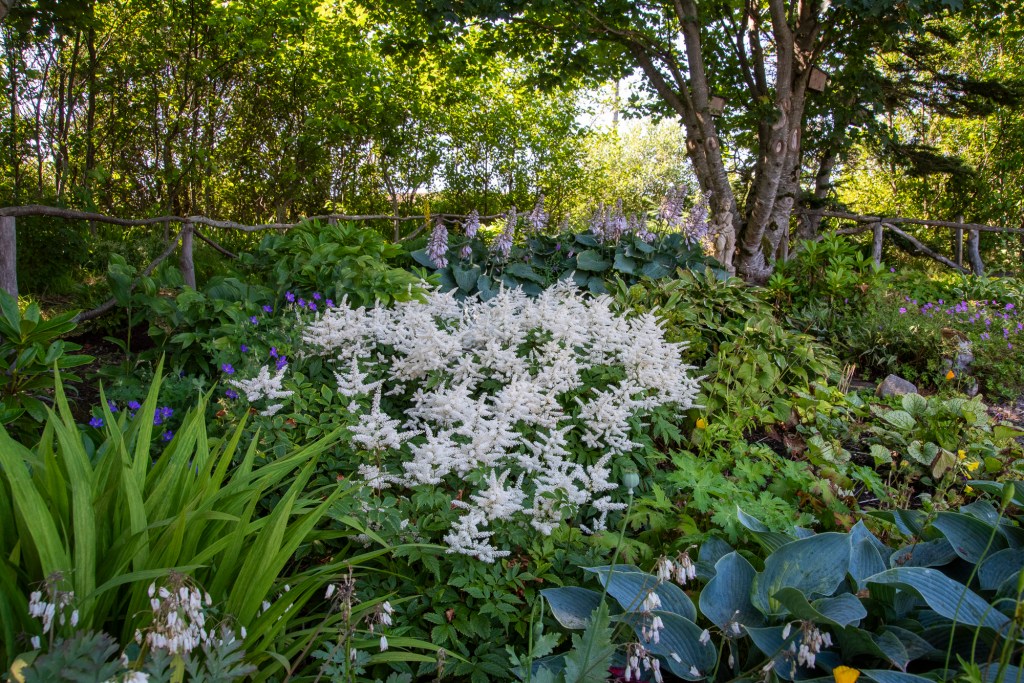
In a back garden shady spot, a plant that would wither in the sun but grows well in the shade, has also come into its own this week, a white Astilbe. We’ve had it for years, both here and in previous gardens, and its specific name is long forgotten. In the photograph below only the multi-trunked Sycamore was here before us, all the other trees are Red Alders, planted between four and seven years ago. It seems that in little more than the blink of an eye a small woodland has been formed. Beyond the simple driftwood fence there’s a work in progress, the new woodland floor is slowly maturing, the thickening leaf litter dotted with plugs of foxglove and red campion. Despite its small size, each Autumn and Spring, migrating Woodcock are drawn to it like moths to a flame.
We’ve tried a few red hot pokers here and most successful by far has been Kniphofia Fiery Fred, whose rockets of orange at this time of year sit well in back garden semi shade. An alternative name is the torch lily, and at dusk or on a grey day, they literally do light up the gloom. They’re a good foil for the cooler blues of geraniums and catmints, but on a clear day look best not in the shadier back garden but at the front, against the blues of sea and sky.

It has been a good year for breeding birds, a pair of Wrens reared a family in an old hollow gate post. Robins have reared broods in open fronted boxes knocked together from offcuts of old ply. House Sparrows, again in homes made of ply, are on brood number two, with time yet perhaps to squeeze in brood number three. A bird that when we first moved here was a rarity in the garden, fast forward a few years and with the addition of the basics, food, shelter and somewhere to nest, it seems every bush or tree has its own cluster of newly fledged youngsters.

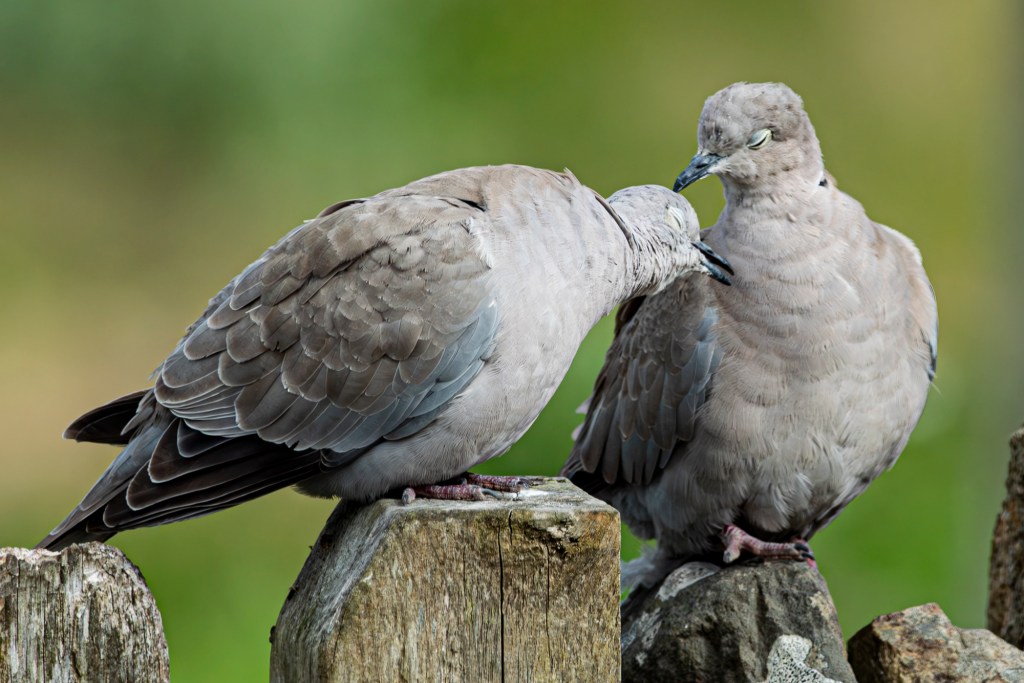
Whichever the species, parent birds are run ragged from dawn to dusk, finding food for never full bellies. Collared Doves are a garden favourite, gentle birds that first bred in the UK, in Norfolk, in 1955. So successful was their colonisation that in 1962, a mere seven years later, the first Collared Dove was recorded in Orkney. A few days ago I watched a pair of adults atop a stone dyke, each gently preening the other, having some us time after the kids had finally flown the nest.
 A garden in Orkney
Dear Gary, What a contrast to the middle of winter! Beautiful writing as always. Wonderful photographs. Thank you. Sue
LikeLiked by 1 person
Thank you Sue, hard to imagine that in a few short months we’ll be down to six hours of daylight and a very empty garden!
LikeLike
Good afrernoon Gary, Love the orange pokers against the blue sea, gorgeous! Well, the good news is the bees have finally found my lavender hedge and were most indignant this afrernoon as I brushed passsed them. Their buzzing is one of the most iconic sounds of summer for me. The bad news is, we’ve been promised proper rain here and have had an egg cup full so far! Eagerly I look at the storm warnings, and pah! I have a beautiful dark pink Asiatic lilly in a pot outside my kitchen and it has been magnificent this year, every stem must have a least half a dozen big fat flowers. Mind you its had lots of TLC by way of seaweed feed. Am wondering if you’ve got any Tamarix in your seaside garden, can’t see any. I’ve got a lovely, graceful one in my front garden, in flower now and the bees love that too. Have a good week and let’s hope we both get some rain! Margot xx
LikeLiked by 1 person
Morning Margot, we tried lavender here, probably a bit optimistic, a 50p supermarket cruelty case, bought bone dry and half dead. It came back to life and lasted a couple of years before winter wet killed it. As you say the bees love them, I think we might do what you’ve done with your lily and try them in pots.
We got some rain yesterday, getting the opposite to you forecast wise, they said light drizzle, a millimetre or two at most, it came down like stair rods!
No Tamarix here, I don’t think I’ve seen them in Orkney, I remember seeing hedges of tamarix in Cornwall, literally alive with bees. I wonder if wet winter feet would be the issue here.
Lots of Meadow Browns here at the moment, highlight of the week was spotting the first Damselflies on the ponds we dug.
Have a good rest of week x
LikeLike