
Today it’s wild, high winds with a mix of sunshine and horizontal rain. All courtesy of storm Floris, currently tracking his way across Scotland. We’ve had the warmest July ever recorded in Orkney, ditto June, Floris is a reality check, a reminder of what Autumn will likely bring.

With or without Floris, by this time of year it feels as if Autumn is lurking in the shadows. The nights are drawing in, the seemingly endless daylight of the simmer dim already a memory. In the meadow the Ox-eyes, that in June turned the field white, are fading to seed. It’s now the turn of Cats ear to be dominant. The meadow on a sunny day is lit golden-yellow by their flowers. They’re heliotropes, turning their faces to track the sun, starting the day facing East and ending it facing West. A member of the Hawkbit family, when we first cleared the meadow they needed no reintroduction. Springing to life from the fields slumbering seed bank, growing as thick as grass.

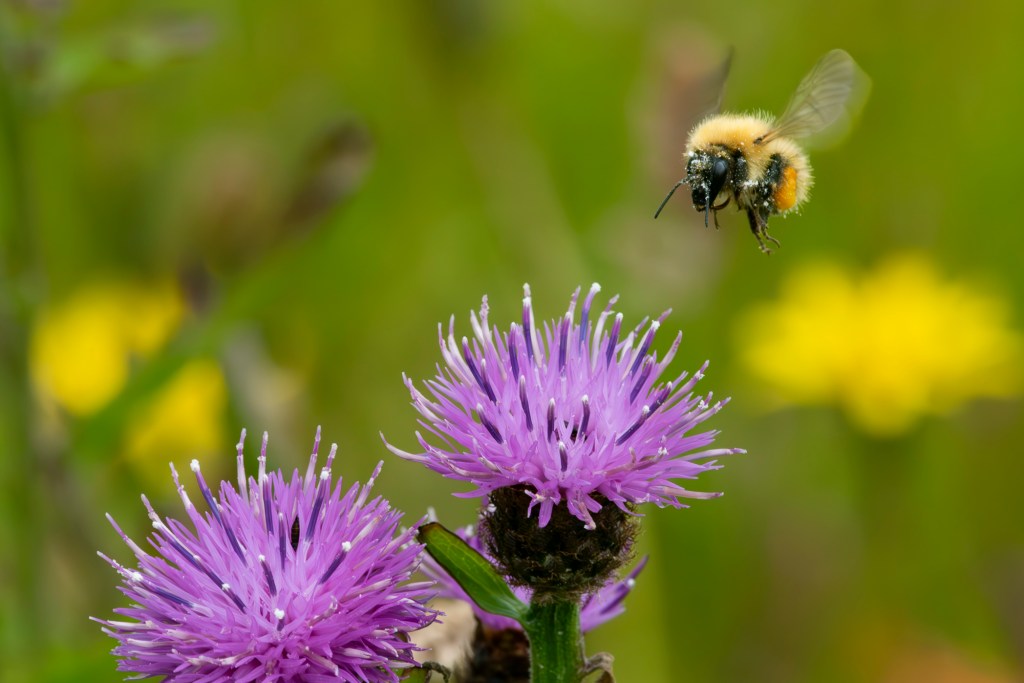
It’s also the time of year for less dominant late summer wildflowers to put on a show. Common knapweed is a favourite, aka ‘hardheads’ – a great bee and butterfly plant. Reintroduced via home grown plugs, they’ve established well. Unlike the Ox-eyes and Cats ears, who seem set on world domination, they’re happy to mingle with others. Their purple-pink flowers noticed not from afar but up close, as you brush past them.
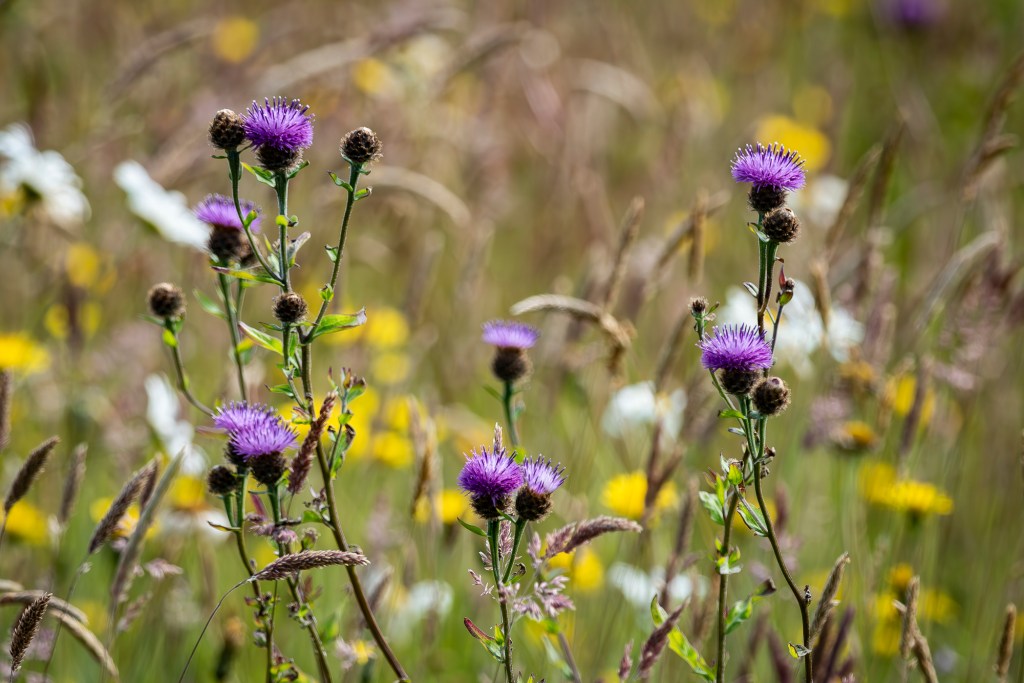
Another harbinger of Autumn is the Devils bit scabious, named for its stubby “bitten off by the Devil” root. Up here they’re more a plant of coastal heaths, the clifftops at this time of year are literally bejewelled with their blue pom-pom heads. At home they’re slowly establishing. Year on year the grasses have grown shorter, sucking up what little nutrients the ground had and weakening themselves in the process, in contrast the Devils bits have gained ground, reintroducing themselves as conditions turn in their favour.

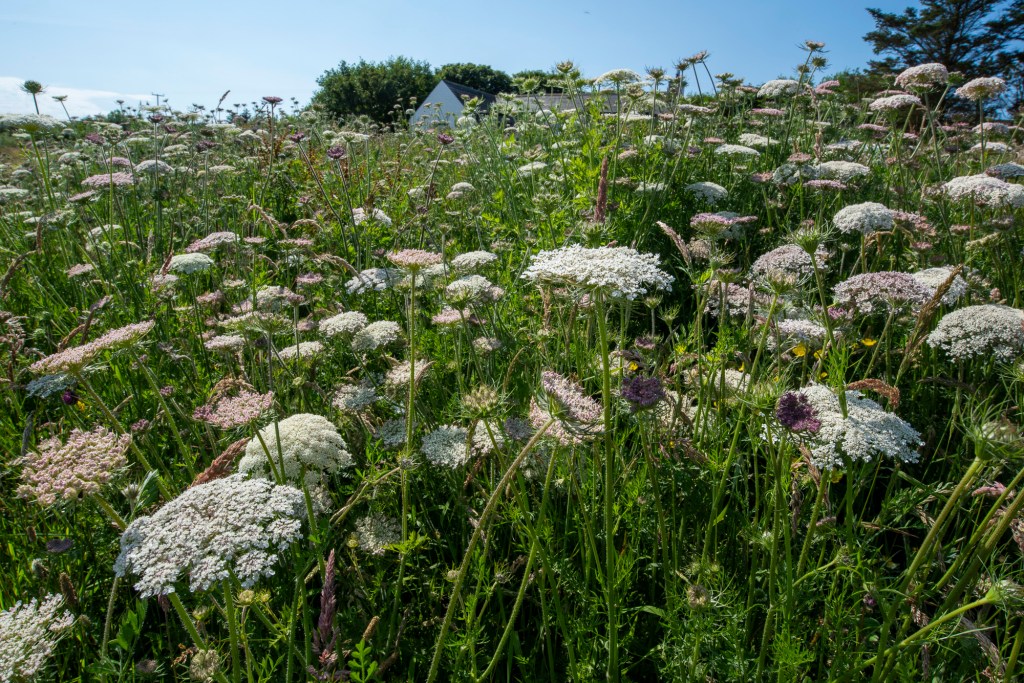
The only part of the meadow where Ox-eyes and Cats ear, at least for the moment, aren’t dominant, is a spot close to the house. The ground is new, a bank of subsoil imported from a friends building plot just along the way. Once rotavated and cleared of stone, the bare earth was sown with a mix of native grasses plus whatever wildflower seed we had, almost as an afterthought I added wild carrot to the mix, a biennial, whose root as its name suggests, gave us the cultivated carrot. As with all biennials, sowing in year one gives flowers in year two. They didn’t quite get the memo, nothing in year one, as expected, but also barely a flower in year two. This year though brought an explosion, a sea of large white umbels, occasionally tinted pink. In the garden we treat them as annuals, sowing in cold frames in late Summer, planting out to flower the following year. In the wild they’re a plant of chalk grasslands and drier soils, not suited to Orkney and her winter wet. I’ve a feeling that for the meadow at least, this is their swan-song. Beautiful while they last.
A carrot family member that is much more at home here is Wild angelica. Legend says that Angelica came here with the Norsemen, the Vikings who started to settle here in the late 8th century. In a nod to this a local distillery adds Angelica to Kirkjuvagr gin. The distillery is based in Kirkwall, the Orkney Islands capital, the Northmen knew it as Kirkjuvagr – Church bay.

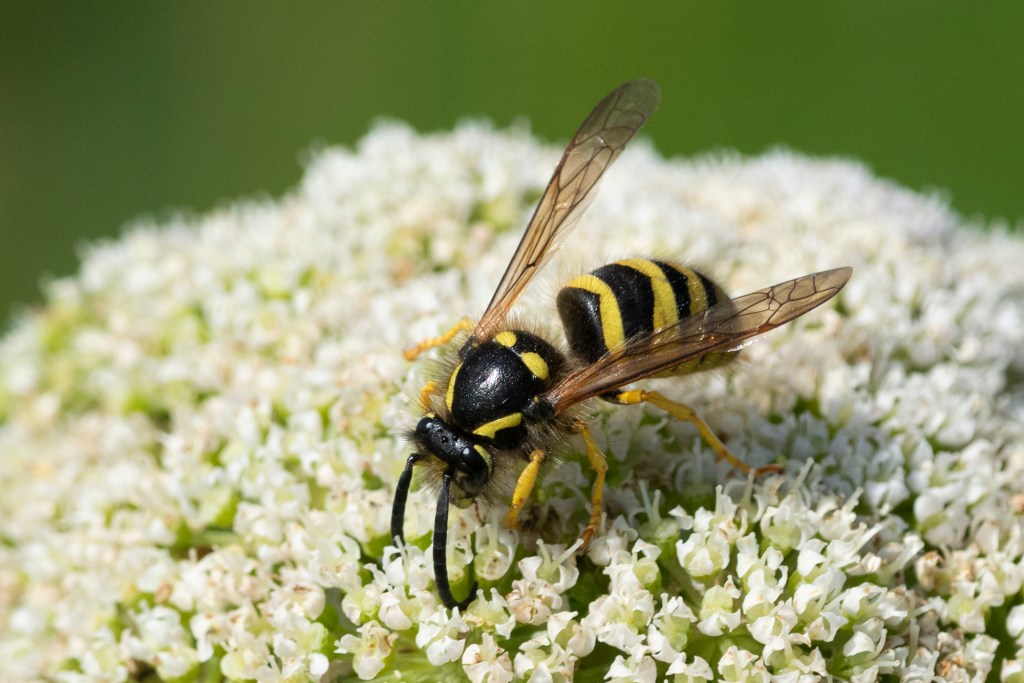
In the meadow it’s a great insect plant, attracting everything from beetles to butterflies. They’re a particular favourite of both Wasps and Red Admirals. I’m happier getting closer to the latter rather than the former. Both were photographed last week, sipping on the Angelica’s energy giving nectar.

At the bottom of the meadow, close to the shore, three ponds were dug, each filling naturally with run off from the hills. The ground there is peaty, black as coal. A ‘soup’ of life was added, bucket fulls of mud and brown water, collected from a flooded peat cut, after that the ponds were pretty much left to their own devices. The ‘soup’ immediately brought tiny shrimp like invertebrates, whirligigs turned up within days, diving beetles within a few weeks. Wet and Rushy areas close to the ponds were planted with Coastal willow, salix hookeriana. In Summer Reed buntings nest among them, tucking their nests low, amongst the rushes and grasses that grow in the Willows shade.

This summer, for the first time, Damselflies are being seen over the ponds. Like the Scabious mentioned above, they’re tarred with the same brush, this time the Devils darning needle. It is said that if you fall asleep near a pond, damselflies will alight on your face and sew your eyelids together. The one below is the appropriately named Blue-tailed damselfly. Their eggs will hatch as nymphs, who will live an underwater life. Two years from now, providing my eyes haven’t been stitched together because I fell asleep near the ponds, I might just get lucky and see a nymph crawl from the water, bursting from its skin and becoming a Damselfly.

 A garden in Orkney
Lovely meadows! How interesting about the wild carrots. Here they thrive, but it is indeed a chalky island with former chalk quarries.
LikeLiked by 2 people
Hello Saila, it will be interesting to see if the seedlings can survive the winter wet and the slightly acid soil. They’re on a slope so perhaps they might be OK, fingers crossed.
LikeLike
Morning Gary, What a beautiful creature that blue-tail is! I live close to a bird reserve and sometimes I get dragonflies hovering in an annoyed fashion over my bird bath! Glad you seem to have survived the big storm, comparatively OK. Had big wind here but little rain, while my friend 5 miles down the road had massive rain all morning. To add insult to injury they have no garden, they live in a flat! My Tamarix continues to look so ethereal and lovely and to be an absolute bee magnet, while they largely ignore the buddleia next to it. Yes, my garden looks very “gone over” too but its been so dry I’m not surprised. I’m making a note of flowers that need little water, sedum for instance happily taking over, and planting only new potatoes and French runers next year and perhaps tomatoes in pots near the house. Watch next Summer being the wettest ever! Margot x
LikeLiked by 2 people
Hello Margot
I’m hoping Dragonflies come next, like you we’ve had them over the garden, although not the birdbath! Not yet seen them on the ponds. The storm wasn’t the worst we’ve had but was very out of season, the ground here is carpeted in green leaves, literally torn from the branches.
Our one Buddleia has proved to be a butterfly magnet but the bee magnets of the moment here are catmints, literally abuzz with bumblebees.
The garden survived the storm with little damage but as with your plot it’s also starting to look very gone over, I think our rain, after a three month drought, came too late. Feels almost Autumnal.
We gave up our veg plot for an island solar panel scheme and I must admit neither of us really miss it. I never thought I’d say that as we’ve grown veg all our lives. I’ve been offered a free to take away polytunnel so who knows, in due course maybe a few toms and salads.
You are right, go all ‘mediterranean’ and you’ll be building an Ark 🙂
x
LikeLiked by 1 person
Hi Gary, Jacqui and all.
Back from Yukon and North West Territories on Monday, with the obligatory cold (caught despite being masked on the plane home).
Your meadow looks beautiful and I love the pictures that make me feel like I’m sat in the grass peering out at flower height. I can almost smell the earth, the greenery and hear the insect buzzes.
Sadly, I didn’t get to swim in the arctic Ocean/Beaufort Sea, as the weather was too bad for the little plane to fly to Tuktoyaktuk on all of the days we were in Inuvik. I really wanted to see the landscape above the treeline 😦
However, it was very interesting to be in 24 hour daylight and to see the way tiny Inuvik repurposed it’s old hockey arena into a community garden full of burgeoning raised beds. All that sunlight really promotes growth!
I did an entire book of small watercolours, none taking longer than 20 minutes (as that was the length of our ‘rest stops’) and many were actually done on the bus as the bus bounced for hours on the dirt roads of the Dempster and Alaska Highways. You asked if I’d let you see some of them, Gary. I can photograph a couple and send them to you if you tell me how to achieve the sending part.
LikeLiked by 2 people
Hi Penny, a shame about the weather for the plane but so glad that the trip went ahead, I remember you saying that one cancellation would scupper the whole trip. Both very much in envy, the coach journey in itself must have been wonderful.
I had a google of the hockey arena, what a great idea, to bring fresh veg in must cost an arm and a leg. I had a look on their FB page as well, looks like a real community spirit.
Hope the cold doesn’t linger!
We’d love to see some watercolours – agardeninorkney@gmail.com
LikeLike
Total journey was 2,700cm on a big bus with suspension, windows with glass in and seats with springs, unlike the unknown distance (due to milometer being one of the many, many broken things) on this kind of bus:
Member’s Vehicles | Edmonton Antique Car Club
And an eyewatering 5048km flying – my contribution to the fast melting of all the glaciers in the St Elias Range of Yukon Territory 😦
You’re right about the the fresh veg costs! Plot in the old hockey arena costs $35 p.a. Your yearly compost and manure needs are included in that price. Veg up there is double the cost in Vancouver. Here’s the flyer for the only store in Inuvik if you’re interested.
Our Weekly Flyer is here! Curious to see what’s on SALE? Here’s a sneak peek! Visit https://www.northmart.ca/flyers to see all our weekly deals! | NorthMart Inuvik | Facebook
If you decide to go for the polytunnel, I’ll Iook forward to hearing what you can grow. Perhaps you can use some of your solar electricity to heat it and extend the season?
LikeLike
Morning Penny, it’s hard to get your head around those distances, as the crow flies that road distance is Orkney – Lands end, return home and then go again. Not sure we would like the Winters 🙂 but in summer the vastness must be awe inspiring.
The $35 a year is a bargain. There are a few community plots in Orkney, on Hoy the school has a Polycrub and there’s another in Longhope that anyone can use. There’s also a community food hub here, once a fortnight a couple of pallets of veg and packets/tins arrive, part of an island initiative to stop the food ending up in landfill.
A new Polycrub is more than I plan to spend on my next van (Orkney is where cheap old vehicles from England come to spend their last years before the salt air eats them) If I take the polytunnel we’ll probably grow a few salads and toms, now the house is done we’re both looking for new things to do, J has recently started selling wildflowers and a few perennials online so I’ve a feeling it will mostly become a home for trays of seedlings.
I’ve seen a grand total of one of those buses (or something very similar)in the UK, in a field, a glamper not a runner, on the link I noticed the owners names – a coincidence!?
We won’t heat the tunnel but the solar is proving brilliant, far better than expected.
I’ve yet to see one of these blow down – the frames are fish-farm pipe, my van is old and needs to go but maybe in a few years…
https://www.polycrub.co.uk/
LikeLiked by 1 person
Hi Gary, Amazing what you have created with the ponds – reed buntings nesting! The photo of the damselfly is fabulous. I love the title of your piece. Best wishes Sue
LikeLiked by 1 person
Thank you Sue.
LikeLike