

For the past couple of weeks I’ve been working with a friend, fitting a weatherproofing skin of timber cladding to his new build house that sits just along the way. The weather was kind and for Orkney, as for most of this year, unusually dry. Of the fifteen days that we spent on it, we saw perhaps a half hour of rain. Tiring work but with moor and low hills to the back, and with the bay to the front, it wasn’t a bad office. As the days passed subtle changes were noticed, the moor slowly turning from brown to purple as Heathers came into flower. The island of South Walls, a mile or so distant, an evolving patchwork of greens and gold as grasses were cut and cleared and Oats slowly ripened in the sun.

In the garden changes are also afoot. In Orkney we don’t get an Autumn where trees are clothed for weeks in lingering yellows and reds. As Summer draws to an end, leaves fade quickly, at first from bright to dull green and then, when a salt laden gale swings in, crisping brown overnight. As if scorched by a man with a blow lamp. What the trees can’t give though, perennials can, it’s the time of year for yellows and reds to show their hand. Crocosmias are a favourite, they grow well here and need little in the way of care. We’ve got the usual eye catching suspect of traffic light red Lucifer, a tall plant that looks good at the back of a border, but prefer the smaller species that sit and mingle with others. A favourite is C.Pauls best yellow, a compact variety that is said to be a spreader but for here at least, is pretty much well behaved.
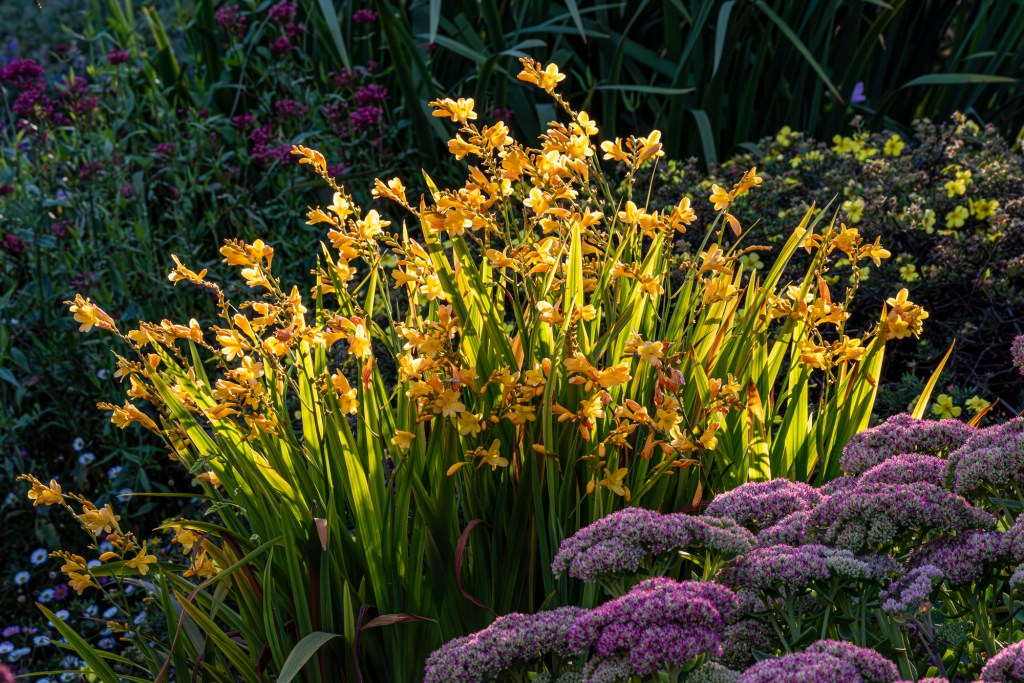
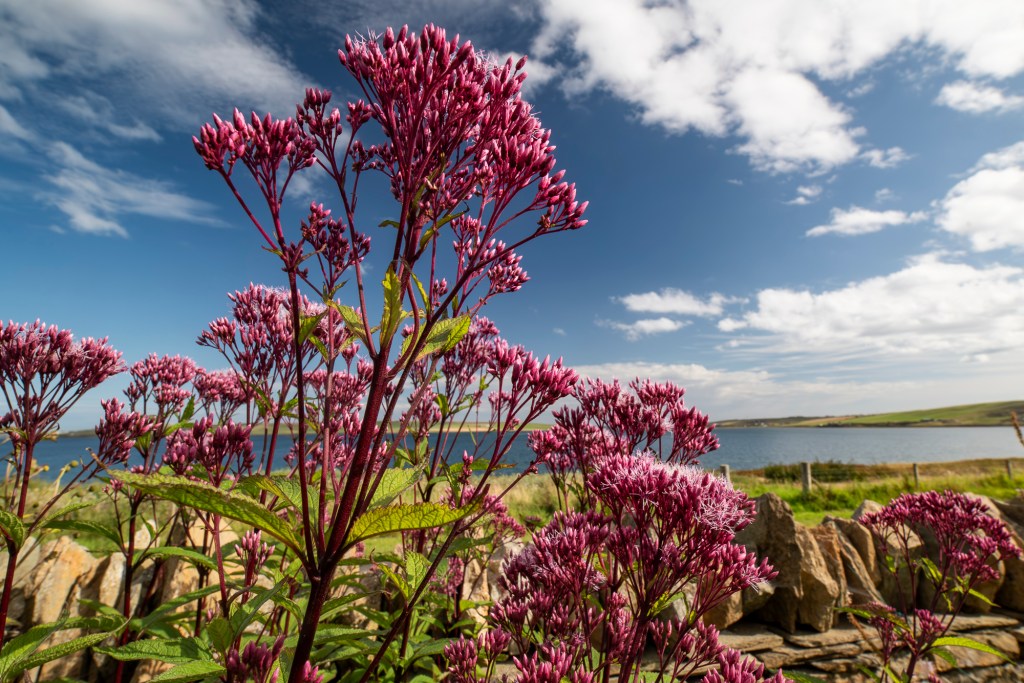
A late summer species that we tried, and failed, to grow in our old garden in Yorkshire is Eupatorium, the Joe-pye weed, On light sandy soil they first sulked, then succumbed to mildew, and then promptly died. Up here they thrive, no sulking or mildew in sight. A favourite is little Joe who despite the name, can reach a leggy five feet.
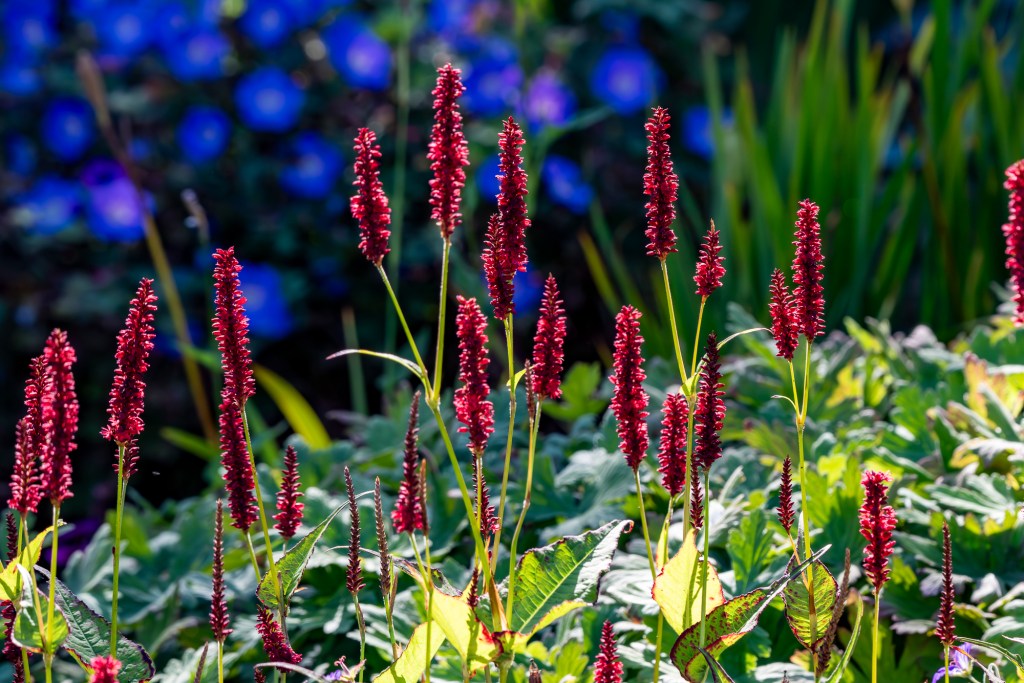
Persicaria’s are another late Summer favourite that are doing better here than they did down in Yorkshire. They’re a member of the knotweed family and in times past some varieties were used as a flea repellent in bedding, earning the name “arsesmart”, which I assume means that the skins reaction to the plant was actually worse than the flea bite. The largest we grow is P.Polymorpha, a tall (and wide) mid-summer flowerer that as with Crocosmia lucifer is better at the back of a border, ours is fading now, plumes of white dimming to soft pink seed heads. As polymorpha fades, others are just getting into gear, P.taurus, a much more compact and pretty much bomb proof variety, has flowered this week, its dark crimson bottlebrush flowers look best either early or late in the day, lit by angled light.
If we had to choose a favourite red for this time of year Taurus would get a double thumbs up. A favourite yellow is a split decision, for Jacqui it’s a toss up between C. Paul’s best yellow and Lysimachia ciliata firecracker (pictured top). Lysimachias belong to the primula family and have a long history. The genus gets its name from King Lysimachus, successor to Alexander the Great, who is said to have calmed a mad Ox by feeding it Lysimachia – livestock escapees are a fact of life here, the next time I meet a Bull wandering down the road I’ll know exactly which plant to reach for 🙂 My thumbs up for a favourite yellow would be Rudbeckia goldsturm, aka Black eyed Susan, one of those dead easy from seed plants that looks good wherever you put it.

Others help with the Autumn feel by fading gracefully, their job done for the year. One is Hosta Sum & substance, whose once bright leaves were recently crisped and mellowed by storm Floris. It will fade now, from pale green to yellow and by October, to a soft marmalade orange, there’s a real beauty in its slow decay.

Birds are coming and going, the Blackbirds that have graced the garden for the Summer, rearing cocoa brown youngsters that are drawn to half apples like moths to a candle, have gone off to pastures new. In Autumn new birds will arrive from the North, bringing with them their Redwing and Fieldfare cousins, eager to strip Rowans of their berries. As the blackbirds have left, Starlings have returned, pretty much absent for the past few months they’re back from pasture and shore, ready to cluster on feeders, doing what Starlings do, eat, squabble, rinse and repeat. The bird below is a this years youngster, newly moulted into adult plumage but given away by the jet black beak.

I probably really need to get out more but a recent sight that made me smile was a mouse turning over gravel, or boulders if you’re mouse sized, to get at seed dropped on a path from a Niger feeder. I’d first spotted him weeks ago, a tiny just out of the nest youngster with a slice missing from one ear. With no sense of danger, straying, in mouse terms, far from the safety of a dry-stone dyke home, I’d wrongly assumed that his days were numbered.
We’ve christened him Wing nut.

 A garden in Orkney
Hi Gary Brilliant!! ‘The genus gets its name from King Lysimachus, successor to Alexander the Great, who is said to have calmed a mad Ox by feeding it Lysimachia – livestock escapees are a fact of life here, the next time I meet a Bull wandering down the road I’ll know which plant to reach for 🙂 ‘
Regards to Wing nut, long may they survive. I love the Taurus photo. Sue
LikeLiked by 1 person
Hi Sue, thank you, I really hope Wing nut lives long and prospers 🙂
Have a good week.
LikeLike
Hi Gary, Autumn has blown in with some much needed, but heavy, rain and not so welcome big winds. Noticeably colder and darker in the mornings and evenings. My Hibiscus is still flowering, what a “good value” small tree it is, flowering from June till the end of September usually, white with ponk centre. Looks like Sedum in your picture? Splendid plant thriving in our long hot dry Summer and now gently coming into flower for any late butterflies. Have had a couple of humming bird hawk moths in the garden, very exciting! My piicaria, red type, is a bit of a spreading thug but had to have some water, was turning brown in the hottest part of the garden. Do you listen to Room 101? Stephen Mangan was on and put Autumn into Room !01. Made a powerful case. I like Autumn but could see what he meant! Have a good week. Margot
LikeLiked by 2 people
Hi Margot
We finally got rain here as well, a good overnight pour with showers today, prior to this over 20 days with barely a spot. High winds but very mild.
I think Hibiscus would like our damp soil but not our salt laden winds. Floris did quite a bit of scorching, shelter belt leaves are already starting to brown and fall.
Yes lots of Sedums here, as you say a great Bee and butterfly plant, we’ve got quite a few different cultivars and all need to be split yearly otherwise they flop over at the first hint of a breeze, very hardy though. I envy you the Hummingbird Hawk moths, we’ve seen Poplar hawk moths here, no Poplar trees but they’re happy with Aspen & Willow to munch on.
I didn’t realise room 101 was still on the go, I think the last time I saw it Paul Merton was hosting it. Even though we don’t really get an Autumn, or a Winter in a traditional sense, I couldn’t put it in the room, I quite like the shorter wilder days, I always look forward to the return of dark nights, good to see the stars and the Milky way again. Supposed to be a great Aurora night up here tonight, the skies have cleared so just about to go out with the camera. Fingers crossed.
Have a good week x
LikeLiked by 1 person
Hi Gary,
What is that lovely blue flowering plant behind the Persicaria please? Is it Geranium Johnson’s Blue? Andy and I were just talking about putting something blue in amongst our red/yellow dominated fall colours and that particular blue in your photo is eye popping.
We do have a hibiscus, which is mauve and like Margot’s blooms July through September, but a nice blue would would contrast with our Rudbeckias better.
Hope you saw the aurora. Supposed to be so strong they’ll be able to see it as far south as Oregon tonight.
Penny
LikeLiked by 1 person
Hi Penny, yes it is, it’s dotted everywhere here, sun and semi-shade, a really reliable plant. Another favourite blue is G.pratense Black beauty, great stem colour and impressive clusters of ‘cranesbill’ seed heads but flowering wise it may just be a bit early for your needs.
Not a spectacular show with the Aurora here, we were a bit unlucky with low cloud to the North but great to see it nonetheless. What was also lovely to see was the Milky way to the West, after our “simmer dim” it’s so good to see the night sky again – although I might not say that in December when it’s dark by 3.30 🙂
LikeLiked by 1 person