

As summer drew to a close and astrological Autumn officially began, our weather for the most part stayed settled and dry, warm bright days that brought a swan-song flush of butterflies to the garden. Most numerous were Red Admirals and Painted Ladies, both of whose grandparents, or perhaps great-grandparents, had started their migration to Britain in the early months of the year, carried on the winds from North Africa. For both species the garden is a pit stop, somewhere to fill up with fuel before reversing the journey of their forebears. The Painted Ladies will return to North Africa, the Red Admirals to either Africa or continental Europe. Epic journeys for such seemingly delicate creatures who tip the scales at around 1 gram.
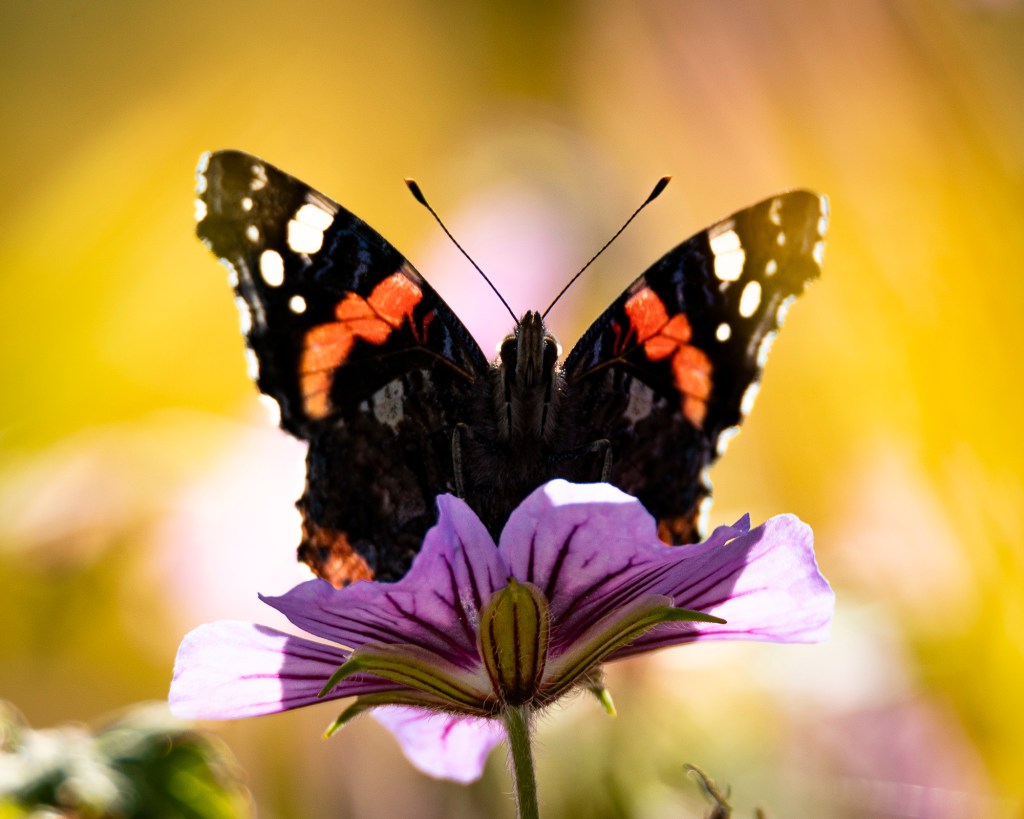
In the garden, Sedums are at the top of the list of the butterflies favourite plants, closely followed by geraniums and catmints. Sedums allegedly hate wet feet but in this winter-wet garden they grow so well that they need to be divided at regular intervals. Recently they’ve been given a new moniker, Hylotelephium, for us though they’ll always be sedums, old dogs and new tricks…

It’s the time of year for Hesperantha coccinea to come into its own. Like the butterflies it hails from Africa and looks far too exotic for this Northern garden. It wears the same bright colours of the sedums, crimson-red flowers that are held aloft on lush sword-like stems. A plant that despite its exotic looks shrugs off the worst of our salt laden October gales. In the garden it’s usually our last man standing, often flowering through to late November. Jacqui has been planting spares along the length of the guerrilla garden, a strip of council verge dug and planted with waifs and strays from the garden itself.

As well as the butterflies we’ve had an influx of birds, most notably Goldfinches, a charm of thirty or so dancing in on the breeze. A mix of adults and youngsters, the former looking all bright and shiny, living up to their alternative name of the seven coloured linnet, the latter are a bit more faded, like old denim, not quite fully moulted into their bright coats of many colours.
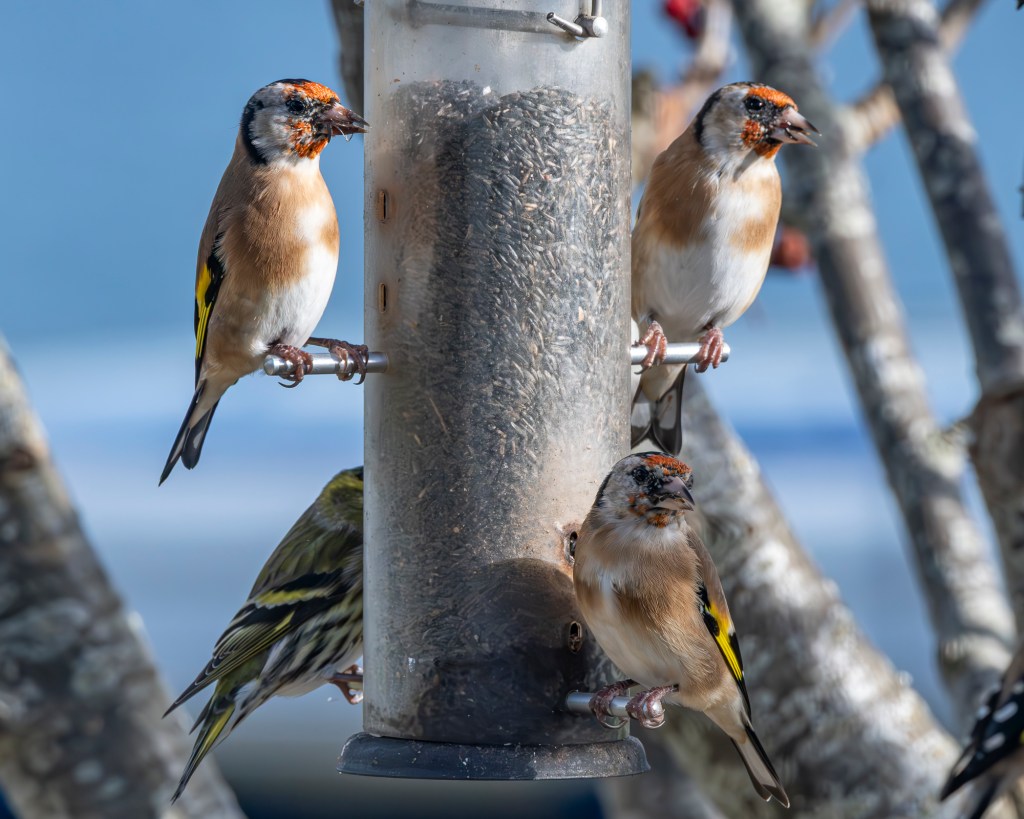
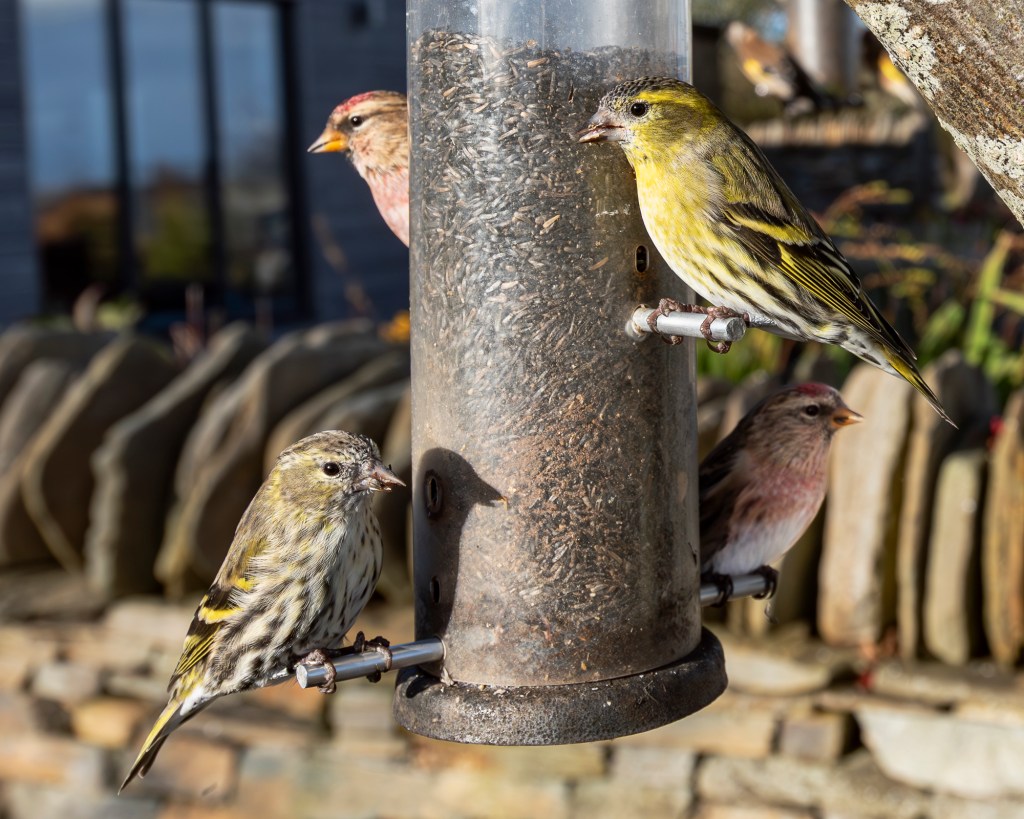
Dining alongside them are Siskins and Lesser Redpolls, birds that arrive here in late Spring, staying for the Summer to rear youngsters in secret nests before moving on again in the Autumn. Their numbers are thinning already, soon they’ll be gone. For the photograph below I set a camera and tripod within a couple of feet of a feeder, tripping the shutter with a remote release. At first the birds were wary of the one-eyed, three legged interloper, (the camera & tripod, not me), within fifteen minutes it became a handy perch, somewhere to await a turn on the feeder.

Though the garden will last a while yet, the meadow has gone over. Once a tapestry of colour, now a field of sun bleached grasses and seed heads. Dotted here and there are single bright flowers, Cats ears that didn’t get the memo. A few weeks from now we’ll mow it all down and rake it off, a favourite job that’s best saved for a bright sunny day.

A sure sign of Summers end was the arrival of Amy, our first named storm of the Autumn. She arrived on Friday afternoon, cancelling ferries and the community bus, spooling up to her maximum strength on Saturday evening. In Orkney you can see, and sometimes feel, the weather coming. Friday dawned still and bright but there was a change from previous days, an oil-slick sky and a damp chill to the air. Lunchtime brought whitecaps and spindrift to the bay, by mid-afternoon the view was stolen by sheets of grey rain. Despite her strength she passed by the garden without much incident, no damage bar a moor-edge lodgepole pine, left at an angle, roots half in and half out of the peaty black ground. This afternoon I’ll walk the shore at Snelsetter, checking Geo’s for driftwood cast up by rolling seas, Amy’s silver lining.
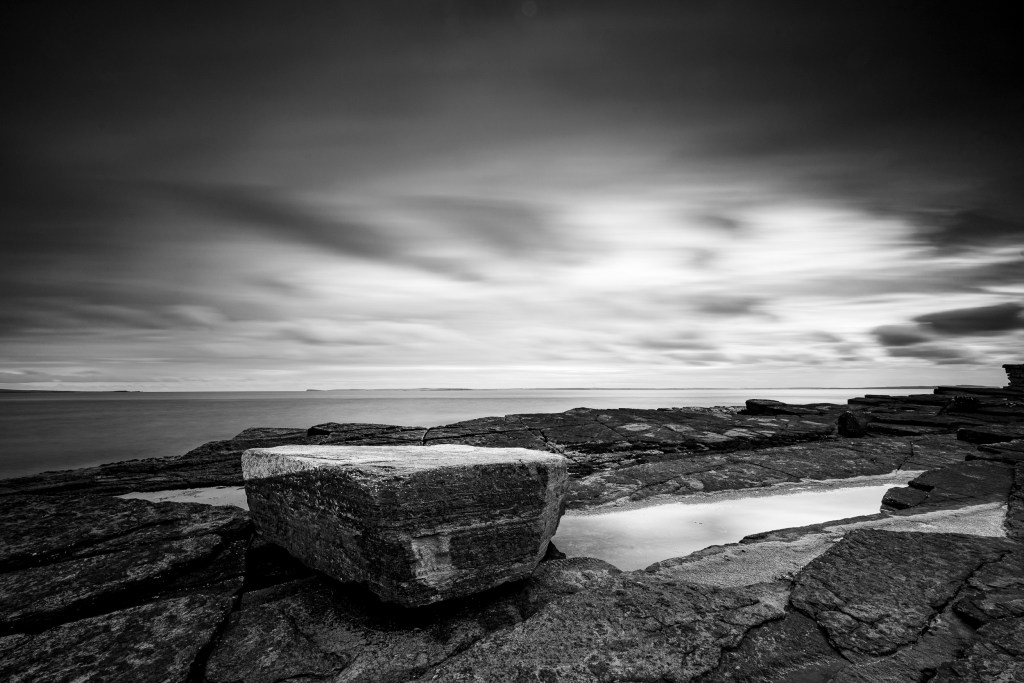
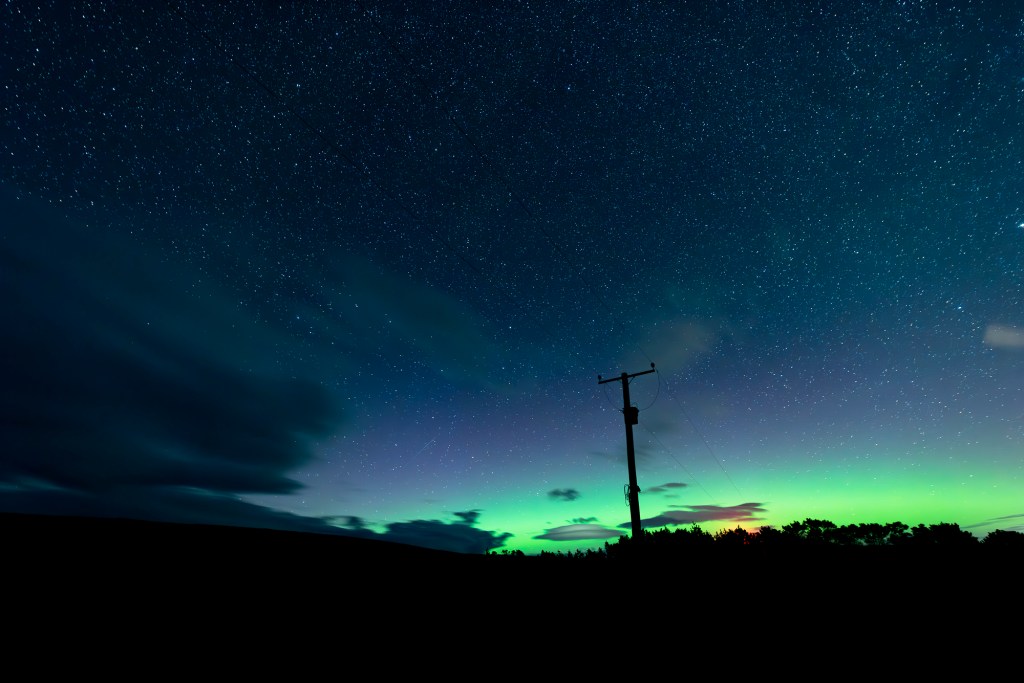
A welcome upside of Autumn is the arrival of darker nights, with the twilight of the simmer dim a distant memory night skies are once more as black as moleskin. The Milky Way, pictured top, is visible again, it rises to the West, conveniently over the house, an easy picture from the garden gate. It’s also the time of year when the mirrie dancers might put in an appearance. So far we’ve had teasers, an Aurora app pinging an alert of weak green glows rather than spectacular shows. The photograph below is my first sighting of the season, taken on a breezy September night from the moor beyond the garden.
 A garden in Orkney
That picture of the bird on your camera is hilarious!
I love Hesperantha coccinea and have had two of them over the years, neither of them planted by me, but I assume germinated from bird dropped seed. Sadly the red, nor the pink one survived more than 5 years. We’ve just put up the bird feeders and they’re all very crowded, so perhaps I shall get another H coccinia gift this year 🙂
I had no idea your butterflies migrated that far. Our monarch butterflies (or what’s left of them) migrate almost 5,000km, but I’m pretty sure they’re larger than Painted Ladies or Red Admirals.
The aggressive rufous hummingbirds (2-5g) who we sometimes get as garden blow ins on their 6,500km migration, bully our now native Anna’s hummingbirds (only 15% of whom bother to migrate anymore) off the feeder, but I can’t begrudge them during such an epic journey.
Incredible picture of the milky way. Such a vivid reminder of how small our worries and concerns are in the wider scheme of things.
LikeLiked by 1 person
Hi Penny
I missed a shot of a bird peeking out from inside the lens hood, I caught the focus on the edge of the hood and not the birds eye, grabbed shot rookie mistake 🙂 The Siskins especially are very tolerant of people, a bird of the forest I wonder if they simply don’t see enough of us to have that inherited fear, the same when we see Waxwings, you can stand within a few feet of them.
How butterflies of any species manage those distances is amazing, I wonder what percentage make it, so much must depend on wind strength and direction. There’s evidence that some Red Admirals are starting to over winter here due to warming temperatures.
I read up on the Anna’s Hummingbirds, looks like a warming climate along with gardens full of nectar giving plants, nectar feeders and nest-boxes has changed their migration behaviour. All good apart from the warming climate. Our Bullies are Starlings but I like them, they have character! Google tells me that the genus name for Rufous hummingbirds translates to light or flame carrying, after looking at a photograph I can see why.
I know we’ve said it before but Carl Sagan really did sum it all up in that one sentence.
LikeLike
You and I were wondering the same thing re butterflies and migration. I’m sure Hoy must be one of the necessary refueling stops for them on route, but I couldn’t find any data on migration losses of your visitors. Monarch Watch, who monitor the monarch butterfly population reckon 20% die, but that’s a bit of a guestimate based on tagging. More here if you’re mathematically inclined:
Monarch Watch » Blog Archive Monarch Population Dynamics: Issues of scale – Monarch Watch
Re Anna’s, they make wonderful expandable tiny nests out of cobwebs plus drier lint, lichen, human hair (among other things). Here’s a video of one being built – it’s at 5:40 in the video.
He created a hummingbird paradise in his backyard – YouTube
Your English naturalist was spot on when he gave the rufous hummers their Latin name. The Mexicans call all humming birds ‘joyas voladoras’ – flying jewels, but the rufous being the fastest flier can flash it’s iridescence way more than most.
Funny you should mention Carl Sagan – my second favourite science writer*. I reread his book Carl Sagan – The Demon-Haunted World: Science as a Candle in the Dark last month. Here’s a free PDF copy if you’re interested. All his 1995 predictions have come true in North America 😦
Interesting to hear Red Admirals are now starting to overwinter. Wonder if that will cause an increase in numbers or if the concomitant loss of habitat and food plants caused by the climate heating will make things worse?
*Richard Feynman is my favourite, especially ‘The Pleasure of Finding Things Out’. Free here;
The Pleasure of Finding Things Out
LikeLiked by 1 person
Hi Penny
20% seems so low, I would have hazarded somewhere around 80%, especially when the wind, both strength & lack of it, must play such a factor, I think I may be underestimating the butterflies powers of flight and endurance.
Those nests remind me of Long-tailed Tit nests, beautiful domes of moss and hair and spiders webs, I remember finding one as a child, nearly 60 years later I can still clearly see it in my minds eye.
I’ll download book, I haven’t read it, we’re going to hell in a hand cart.
I think many, many more losers than winners, Some species will adapt quickly and benefit, others though will need decades or centuries, circumstances will overtake them and they will just run out of time, others (Polar bears?) will have nowhere to go. The upside is that for nature it’s a change not an end, look at the regrowth at Chernobyl as a small example, nature is doing fine there, there’s no void with no life, just no people. If you haven’t read it Cal Flynn islands of abandonment is worth a look.
I’l download Richard Freeman as well, thanks for the links. Both free as well, that warms the cockles of my tightwad Yorkshire heart!
Already mentioned it to Margot, saw Seven Whoopers Swans yesterday, highlight of the week. Such beautiful birds.
LikeLiked by 1 person
Hi Gary, Glad you survived the storm without too much damage. Big winds here too, but it’s always wind here so we are used to it!
Gorgeous birds you’ve got. I’ve a robin busy policing the bird feeders. I was watching him on one and he was swivelling his head making sure there were no blue tits/sparrows etc daring to come near. I’ve tried telling him there’s enough food but he just doesn’t listen…..
Sedums for me too and welcome colour/nectar at this time of the year tho loads out too, slavia, fuschia, nasts, marigolds, cyclamen. It’s so mild here. Most plants/shrubs/grass seem to have recovered after that beast of a Summer. No doubt I’ll see more empty patches as we go deeper into Autumn.
Just had second cataract done so it really is, “a bright sunshiny day!”
Enjoy your week. xx
LikeLiked by 2 people
Morning Margot, I have to confess that as long as no one gets hurt or has property damaged I quite like the storms in Orkney, with ferries cancelled and no chance of being outdoors its nice have a chill out enforced on you, catch up with a book etc. Tiresome if the storm lasts for 3 or 4 days though!
Our feeder bully boys are Starlings, garden-wise they’re few and far between at the moment, still happy feeding on pasture with Curlews and Oystercatchers, good news for smaller birds who rely on the feeders a bit more.
Sedums are an Autumn mainstay here, we’ve even got a candy floss pink variety that looks a lot better than it sounds 🙂 Asters are still out and Black-eyed Susans are still looking good. I saw seven Whooper Swans yesterday, no photo, I was on a Byre roof, beautiful birds.
Enjoy the brighter days!
x
LikeLike
I can’t seem to “like” but I can reply. Bright light is good, the spotlight on housework, not so much!
LikeLiked by 1 person
Hi Margot
Housework is for rainy days, long may the sun shine 🙂
Like button is very temperamental, mine was off for a couple of weeks once – technology!
LikeLike
Hi Gary, Such a wonderful capture of the change of season. Thankyou. Sue
LikeLiked by 1 person
Thanks Sue, a beautiful time of the year.
LikeLike