

It’s hard to believe that the Solstice is here. We have barely noticed that winter is already halfway through. Spring is spinning towards us. Although the short days have never bothered us, for the first time since we made Orkney our home, the winter gloom has passed by unremarked. For the next few days the sun will rise at just after 9, setting again at a quarter past three, after that the days will slowly but surely lengthen. Decembers weather has been as expected, mild, wet and often wild but we’ve had bright crisp days as well and, just the once so far, a sprinkle of snow that gave the islands hills a dusting of icing sugar.

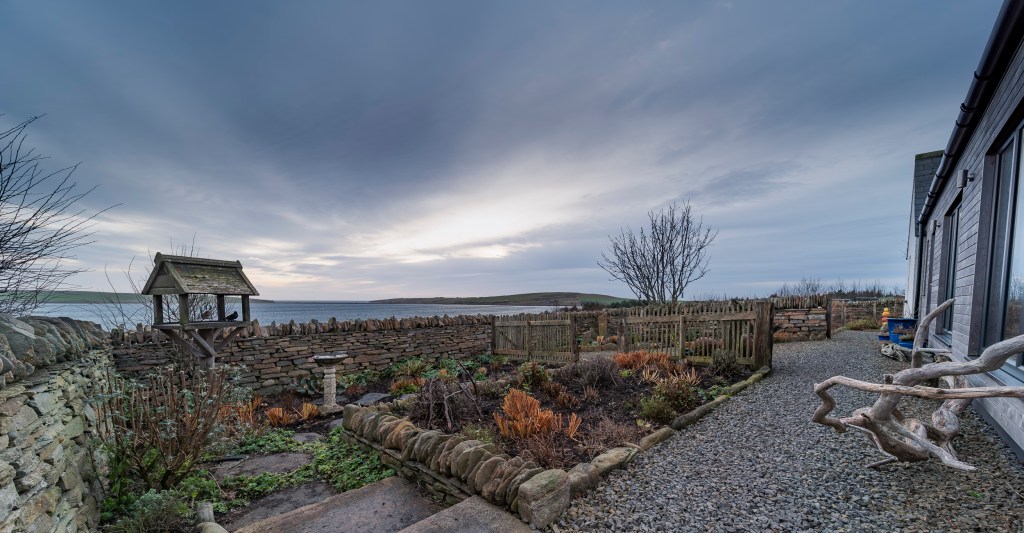
Weather permitting, Jacqui has been busy putting the garden to bed. In our old garden, some 400 miles or so further South, many of the plants were left to over winter. Up here most, if not cut back, will turn to mush. A combination of rain and and salt laden winds soon puts to bed any thought of picture-perfect frost whitened seed heads. It doesn’t mean though that the garden is bare, just pared back, waiting for warmth and longer days.
Not all plants though get the winter memo. A Himalayan poppy has decided that now is a good time to flower. Meconopsis do well here, they prefer cool, moist and slightly acidic soil, a perfect fit for a garden at the edge of a peat moor. They normally flower in late May, throwing up tall green stems topped with short lived electric blue flowers, this one though is a few inches tall and despite flowering blue in Summer, is a shade of soft mauve-pink.

In addition to cutting and clearing, Jacqui has also been splitting and potting on anything that has outgrown its space. Some of the new plants go into cold frames, others will over winter in old fish boxes collected from the shore. In summer, once well rooted, they’ll be sold online or at the garden gate.

Garden birds are coming and going. We’ve seen an influx of Greenfinches this week, a flock of perhaps forty birds. They vie for feeder space with winter resident Goldfinches and, after a few fisticuffs, both sides have come to an unwritten truce, sometimes the greenfinches dominate the feeders and the goldfinches get to pick up the dregs dropped on the path, sometimes the roles are reversed, the goldfinches get the feeders while their olive green cousins slum it on the gravel.

Two other closely related species that are here in numbers are Rock doves and Collared doves. The former are avian hoovers, arriving daily at dawn to clean up anything and everything. They remind me of Black Friday shoppers, all rush and sharp elbows. Once sated they lurk for a while along fences and dyke tops, just in case more food is put out.

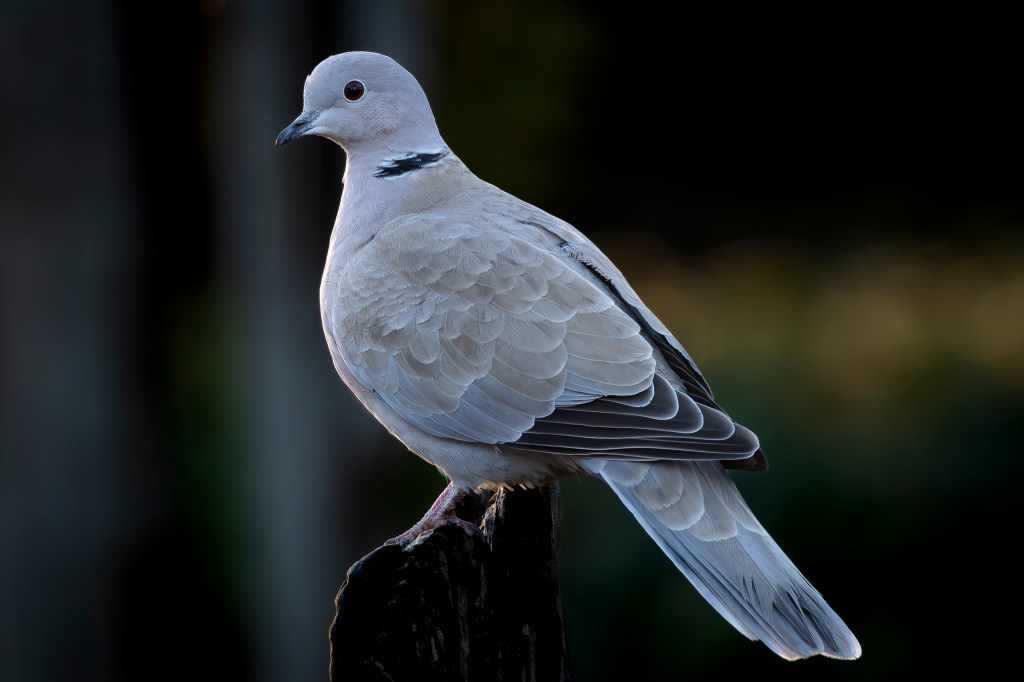
The collared doves in contrast to the rush-rush Rocks are gentle souls, they’ve multiplied here year on year, we started a few years ago with four, last week gave a count of thirty-odd. Now that the trees are bare, once hidden nests can be seen, a thin and often precariously sited platform of twigs that somehow stands up to our inevitable curve ball Summer gales.
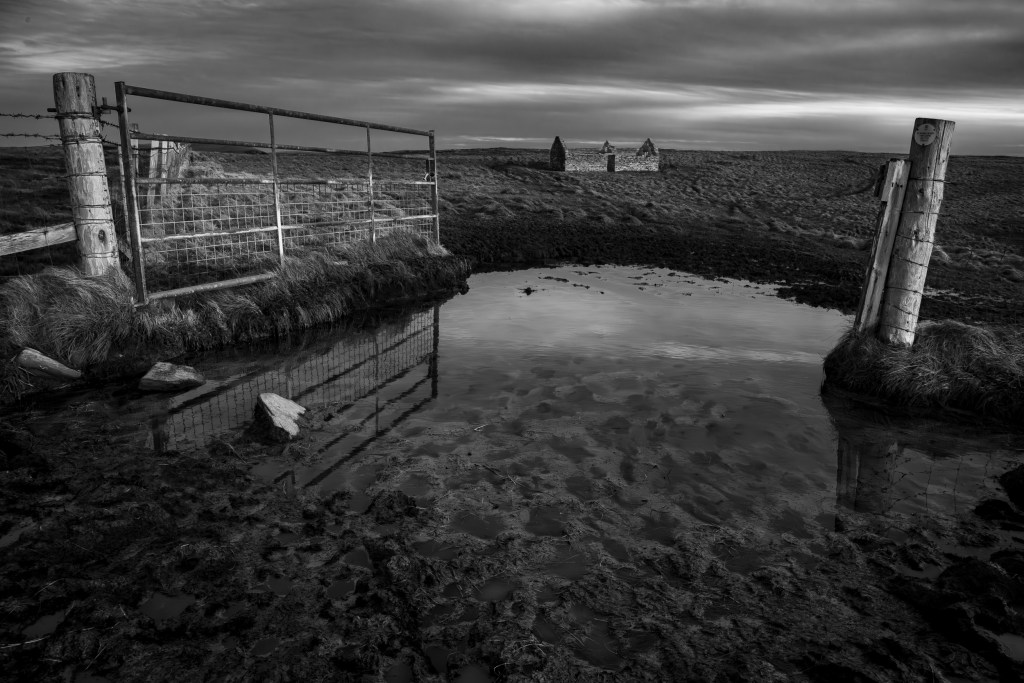
We’ve had our fair share of rain and in the wider landscape the ground is sodden. At this time of year hardy Shetland and Shetland cross sheep are put out on a South Walls headland. Part of an environmental scheme that helps keep the sward short and allows low growing wildflowers, including the elusive Primula scotica, to thrive. At a bottleneck gate, where they funnel from one area of heath to the other, the ground is poached to mud and a temporary pond has formed, a true test for just how waterproof your boots really are 🙂
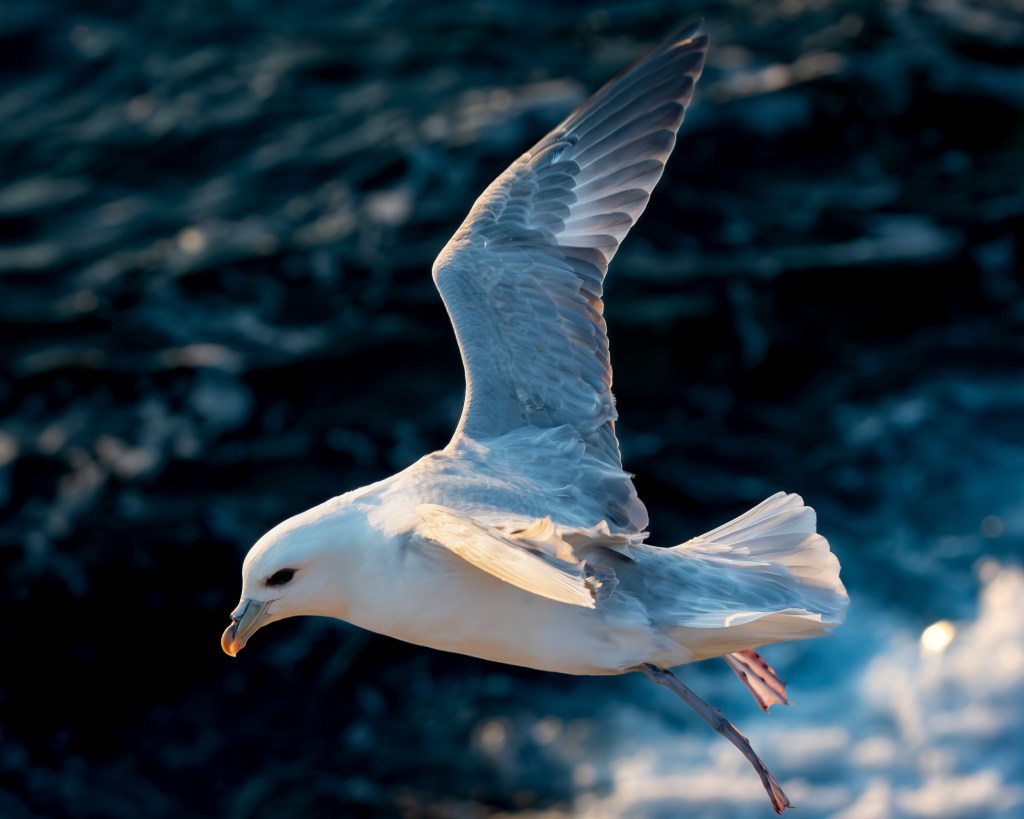
A sure sign that Spring isn’t too far away, is the return of Fulmars to the cliffs. One day last week, not far from the temporary pond, I watched them rise and fall on the up-draughts. They’re pelagic birds, nomads of the sea, returning to land only to breed, laying a single egg in May in a scrape of a nest that the same monogamous pair could have used for decades. With a stiff easterly coming in off the sea, the birds were riding the wind, perhaps just for the joy of it. They’re of their own world, seemingly oblivious to ours and come so close that you can almost reach out and touch them. To do so though would be like breaking a spell.
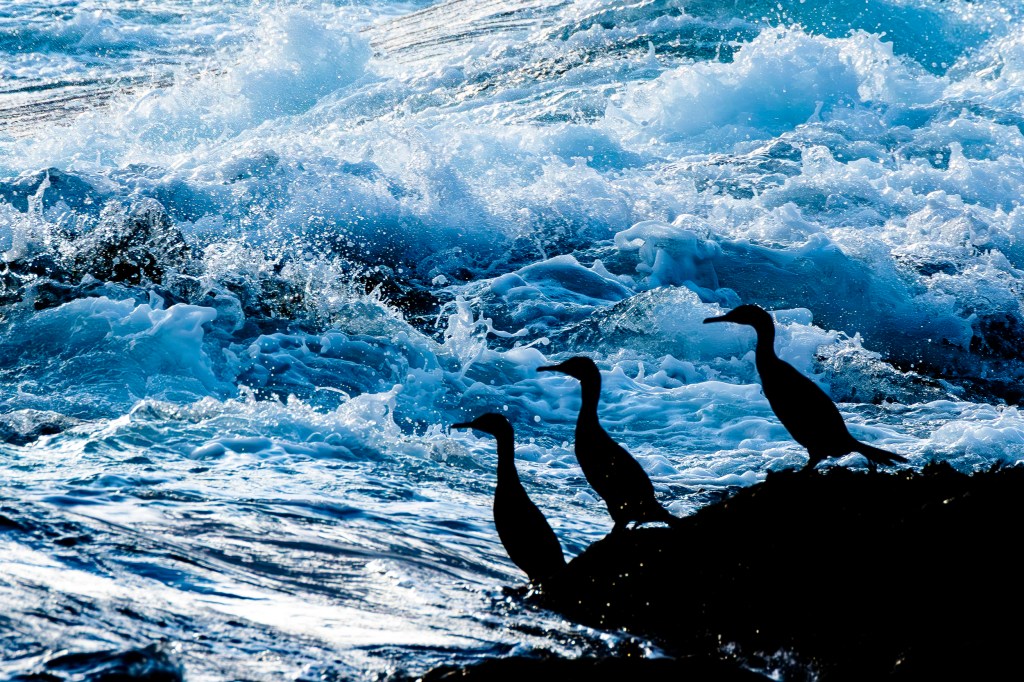
Below the fulmars wings, there are steep sided geo’s and rocky shores. On a day where a cauldron of surf seethed and boiled, courtesy of a recent gale, I watched three Shags, each seemingly plucking up the courage to enter the water. In the end they went in together, bobbing like corks in a washing machine, dashed to and fro by the surf and like the fulmars above them, perfectly at home in their world.
 A garden in Orkney
Lovely blog and photos. I admire your optimism.
LikeLiked by 2 people
Thank you Martin.
LikeLiked by 1 person
Great photos as ever, Gary! They and your writing give me such an insight into Orkney life through the seasons.
Also very interesting to see a picture of shags. It sent me down a rabbit hole internet search because I had a poem line ‘too large for cormorant or shag’ stuck in my brain. Though I knew what cormorants look like (we have them here in the west coast), I’d never seen a shag, till now.
Heaven knows why I remember that poem (it’s Flannan Isle by Wilfred Gibson) and where I ever came across it, but perhaps it’s that fascination with lighthouses that I know you share. You’ll perhaps remember the first verse?
THOUGH three men dwell on Flannan Isle
To keep the lamp alight,
As we steered under the lee, we caught
No glimmer through the night.”
Happy Solstice to you!
LikeLiked by 1 person
Hi Penny
I hadn’t seen the poem but had read books on the Flannans, pretty sure I’ve seen at least a couple of films loosely based on the Lighthouse keepers loss as well. I had a google and as with many mysteries in those days, it looks like a little bit of artistic licence was added, a suggestion that the men may have become birds, or maybe Selkies. A fun fact from google tells that the poem was used in an episode of Dr Who in 1977.
We get Shags and Cormorants here but the Shags are much more numerous, I’ll have to post a photo of them in breeding garb, in Spring their feathers gain an emerald green sheen and their crests become much more noticeable, a real transformation, as an aside the Ravens that I write about are well practiced Shag egg thieves!
Best wishes to you both, and a belated happy Solstice!
x
LikeLiked by 1 person
My husband pointed out that the Flannan Isle poem actually says ‘ bigger than guillemot or shag’, not ‘cormorant or shag’. He says I’ve probably conflated it with the Ogden Nash poem that goes ‘The common cormorant or shag, lays its eggs in a paper bag’!
Would love to see a shag in breeding plumage if you ever manage to snap one.
LikeLiked by 1 person
Hi Penny, you must have imprinted Cormorant in my mind, I read it through and still didn’t see Guillemot 😊 A Shag in breeding plumage is on the to do list, I’ll also keep an eye out for Bears with buns.😉
LikeLiked by 1 person
I love to read about all the things you notice, and look at the incredible photographs. So enjoyable. How incredible to have a Meconopsis in flower now!
LikeLiked by 2 people
Thank you Saila, that is very kind and very much appreciated.
The meconopsis is either very early or very, very late! I’d love to know why it’s pink and not the usual blue.
Best wishes for Christmas and the New Year x
LikeLike
Fulmars are wonderful aren’t they and that last photo of the Shags in shadow is just lovely.
Way down South was very excited to see Long Tailed Tits in my garden and I spotted a primrose in flower under a shrub!
Just wanted to say how much I’ve appreciated your news from afar and the brilliant photos over the year.
Happy Pagan Mid-Winter Festival to you and Jacqui and best wishes for a happy, heathy and peaceful 2026
to you both and to Penny too.
Margot x
LikeLiked by 2 people
Morning Margot
I could watch Fulmars for hours, the way they fly is so effortless, real masters of the up-draughts. I envy you the Long-tailed tits, they’re rare here, we’ve seen them just a handful of times in twelve years. We still have Great tits in the garden, a year since we first saw them, with reports from other gardens as well they must be breeding somewhere on the island.
No primroses but snowdrops and muscari are just peeping through. I was in a garden earlier in the week, so overgrown you can barely see the now empty house, and there in a corner was a huge and in flower Castor oil plant, it looked so odd and exotic for this time of year and this neck of the woods.
A genuine thank you for tuning in to the news from afar and for your comments on the photographs.
Best wishes for 2026 from both Jacqui and myself – peace and happy gardening!
x
LikeLike
xx
LikeLiked by 1 person
And best wishes to you too, Margot. Yesterday I actually made lunch for two pagans who celebrate Yule.
Let’s hope for a boring and uneventful 2026!
LikeLiked by 1 person
A “boring” year? Wouldn’t that be lovely?
x
LikeLiked by 2 people
Hello Gary,
your photos are stunning and have been a delight throughout the year – so uplifting and they make me look at the birds and countryside round here in a different light. I learn a lot from your commentary and from other responses, so thank you all
Val
LikeLiked by 1 person
Hi Val, welcome and thank you for your kind comments, genuinely appreciated.
Best wishes
Gary
LikeLike