
At home, in winter, Grey herons are a common sight on the shoreline of the bay. On good days they stand tall, long necked and elegant, statue-still. On bad days, like today, when the winds are gale force and the rain horizontal, they cluster, hunched and wet, in small groups in a sheltered corner, close to a burn that rushes peat-brown water from moor to sea.
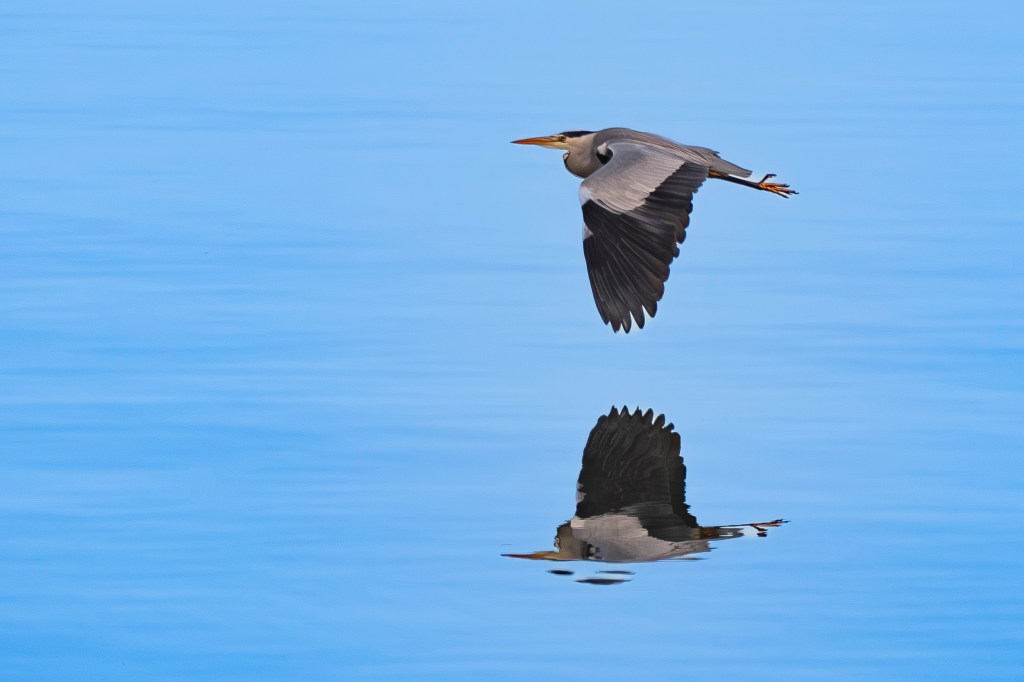
On a clear and bright December afternoon, I watched a heron hunting close to the Ayre, a causeway that links Hoy to the island of South Walls. A narrow strip of tarmac that separates bay and open sea. Up here herons are wary of people, more often than not taking to the wing at the mere sight of a distant human. The bird watched me warily, as I quietly approached, through a bright yellow eye of jaundiced frogspawn.
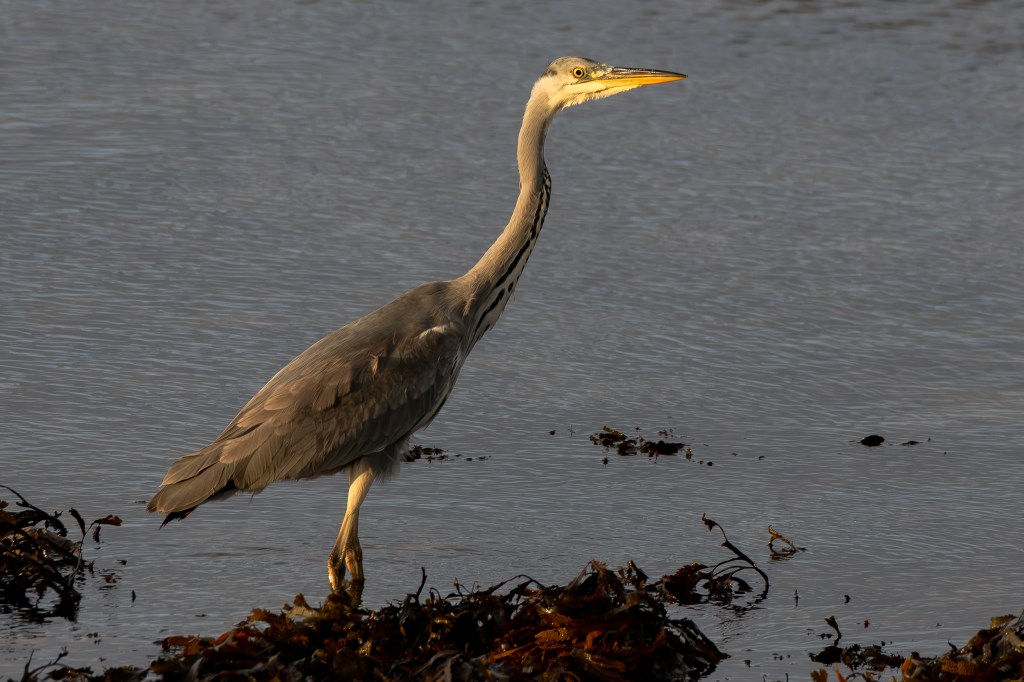
I expected him or her to lift off, accompanied by a vocal and complaining craak, heading for pastures new. The bird though stayed put, knee deep in the shallows, amongst drifting floats of air-filled bladderwrack. I sat down, the bird stood motionless, eyes off me and back in the zone, looking forward and down, studying the water with a hunters intent. Eventually patience, for both bird and photographer, paid off, the heron struck, a fluid snake-like strike with a dagger of a bill. Barely registering a splash on the surface of the bay.
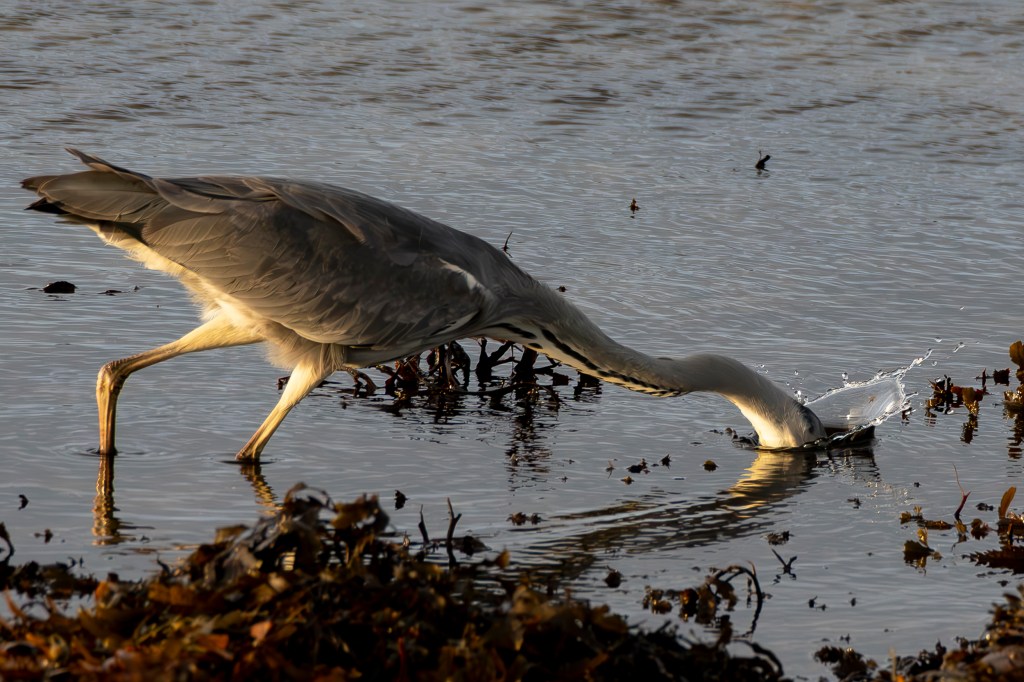
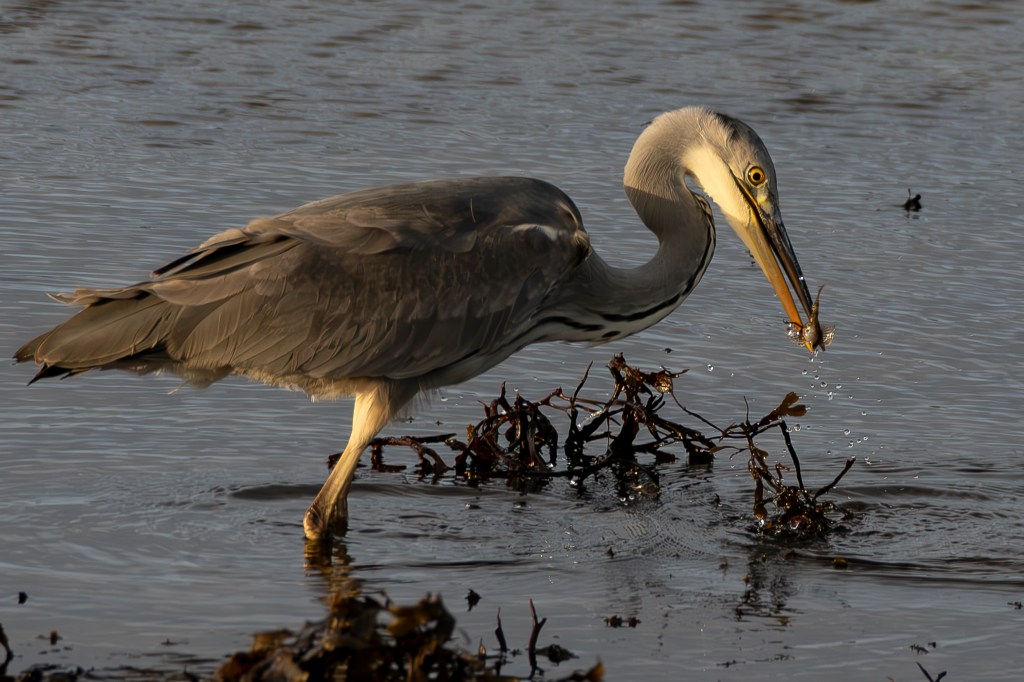
Its prize in the end, was an unlucky Blenny, a small bull-headed fish whose pop-out eyes look far too big for its body. Common in rock pools and shallows, they’re seen throughout the UK.
I stood up, pushing my luck and edging closer. The bird took flight. In the air they’re all extremities, all wings and neck and legs. A jumble of oversize parts, out of scale for the body they’re attached to. A heron is around the same size as a Whooper swan, an adult whooper weighs in at around 10kg, a grey heron, despite its similar size, is, at less than 2kg, a featherweight in comparison. They were once served up in medieval banquets, if you were hungry and fond of heron, you wouldn’t want to be last in line in the serving queue.
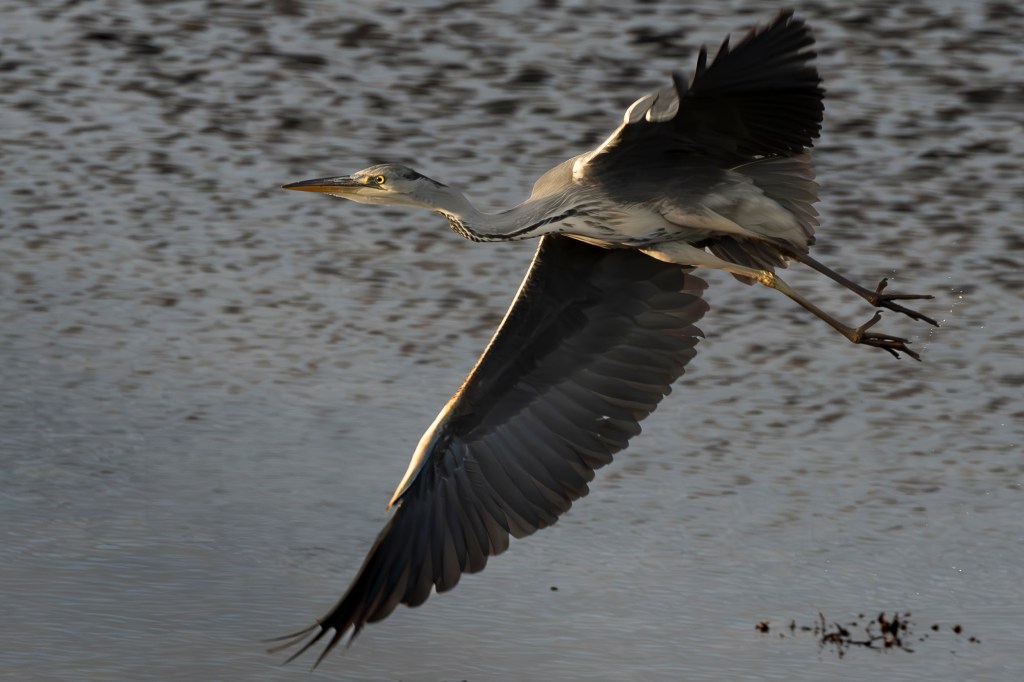
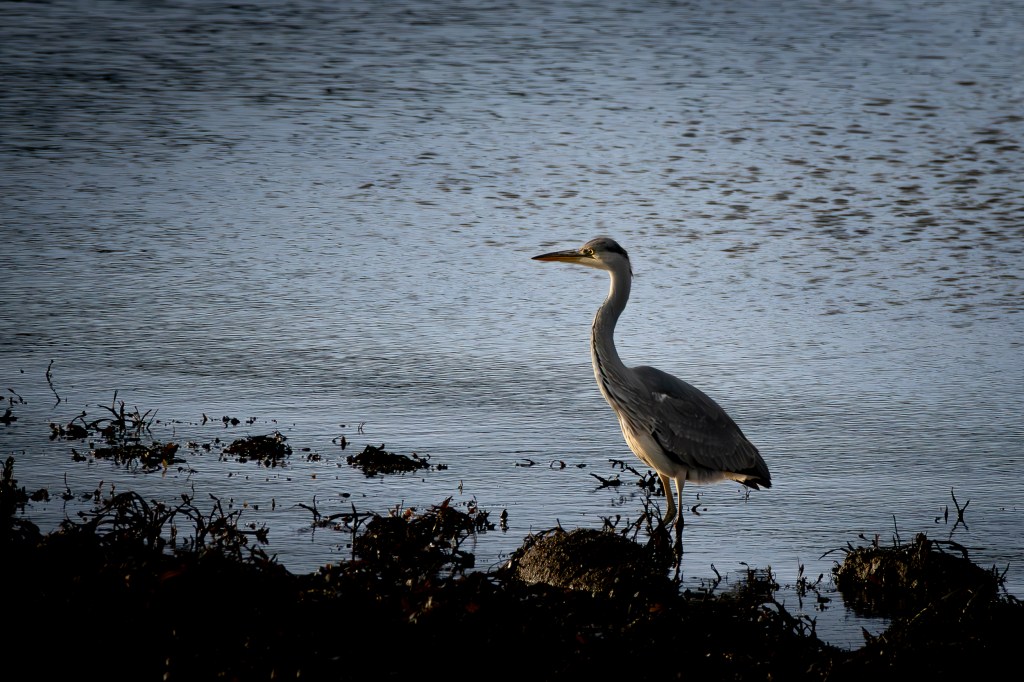
The bird flapped lazily away, landing a hundred yards or so distant. The light was fading and he or she picked a lucky photo-friendly spot. The only piece of shore still lit by the last, dying rays, of a midwinter sun.


Gary, I loved your detailed description of the heron, just after you’d pushed your luck. In praise of patience and just looking very closely – skills which we need reminding of in a ‘flipping of attention’ world. Thank you. I hope you’re surviving the storms ok and beginning to see a little bit more light. Sue
LikeLiked by 1 person
Thank you Sue, as a species we really need to step back, take some time to just pause and look.
I think we’re now on day 9 (or 10) of unbroken gales and rain 🙂 No change for at least the next few days, the upside is that the days are noticeably lengthening. I’m missing my long moorland walks and J is missing the garden, snowdrops are just peeping through the earth, but we’re catching up on books we never got around to reading. A silver lining.
LikeLike
Hi Gary I’ve commented before on how different your summers and winters are. Obviously you knew this before you moved north. In some ways the differences are very attractive. An English friend who lives in Malaysia hates the lack of seasons. However, it must take a certain emotional robustness to hunker down indoors for periods of time. I’m glad to hear you can observe the lengthening day. All the best Sue
LikeLiked by 1 person
Good morning Gary, Great photos of the Heron. I once saw one swallowing an eel- took a long time and was such a bizarre watch! Down here we have all the relatives, if I can call them that! Herons, Eegrits, Great White and Cattle and my favourite , Spoonbills, seen in Poole Harbour but now coming further South and seen on my local rederve. Wild, wild weather here, huge winds and mega rain which has meant flooding everywhere, fields underwater and rivers bursting their banks. Had a hospital app yesterday and MAJOR STRESS with trains either cancelled or delayed and roads closed. More rain coming too. Had a lovely male Blackcap on a suet feeder and that Robin bully didn’t chase it off! Result. In fact, close up the blackcap seemed a very chunky wee thing and probably the robon didn’t fancy its chances. Did I tell you this before? Can’t remember, rain has addled my brain! Have a good rest of week. xx
LikeLiked by 1 person
Morning Margot
The weather is awful at the moment. I’ve lost count of how many on the trot days of gales, and rain, we have had, 9 or 10 with more to come. Lots of days without ferries. When the estate agent told us that Orkney got 364 days of sunshine a year I feel he may have been lying 🙂
I’ve seen a Great white egret here, a blow in on a Southerly gale, I watched through binoculars as it took itself back South to the Caithness coast. Glossy Ibises are probably the most unusual, I didn’t see them but there were two in Orkney earlier in the year. With a warming climate I expect it will be only a matter of time before Egrets are a common sight up here.
It hadn’t occurred to me till you said it, but yes, smaller birds seem to leave Blackcaps alone. They are chunky, almost hunch-backed!
Hope the stress didn’t last, and that the flood waters recede. I have family in Yorkshire who have been flooded out in the past, it must be awful for people whose homes are affected.
Roll on Spring!
x
LikeLike
An Estate Agent lied! Heavens to Betsy! x
LikeLiked by 2 people
When we first started to look at moving here, we viewed a house on the island of Sanday. The agents listing had one photograph, the front of the house, and described it as ”in need of renovation”.
When we got there we opened the front door and had a beautiful view of the open fields beyond the house. The entire back wall was missing, he should have described it as “open plan” 😁
LikeLiked by 1 person
A light and airy property with exhilarating, uninterrutpted views across the wild landscape.
LikeLiked by 1 person
With that description Margot, I would have bought it! 😉
LikeLike
🙂
Fortunately for you Gary, I am not an estate agent!
LikeLiked by 1 person
Incredible picture of the heron and it’s reflection, Gary! I’m going to assume that was intent not happenstance. Looked up to see how many species of heron’s you have in the UK – answer, lots.
Though there’s lots of heron species found in N America, there’s only one in the BC Lower Mainland – Great Blue Heron. See them a lot around the shoreline here. They look and sound as I assume pterodactyls would have when taking flight. Checked out the call your Grey Heron would be making. Yours are clearly more refined 😉
LikeLiked by 1 person
Hi Penny, it was intentional, before our spell of ongoing gales and rain swept in we had a flat calm day, barely a ripple on the bay, park your bum at the bottom of the meadow and see what passes by, a great way spend a few hours.
Great blues are a very rare visitor, or more accurately a rare blow in, to Orkney. I think herons would sit very nicely in a Jurassic landscape
Loved Sea bean. The gales here have brought driftwood, and possibly other treasures!, to the bay closest to home, it needs to stop blowing and raining so I can get first dibs 😁
LikeLiked by 1 person
If you find the storms have washed up anything interesting, I hope you’ll take pictures and let us all see – especially if there’s a sea bean!
LikeLiked by 1 person
I will, I now live in hope of finding a Sea bean, this man has found two.
https://www.orkney.com/news/beachcombing17
Groatie buckie’s are also prized up here, I’ve yet to find either but is seems the buckie’s can be found far more easily if you know where to look, I would prefer a sea bean 😉
https://www.stromnessmuseum.org.uk/collections/objects/z525
https://www.beachcombingmagazine.com/blogs/news/the-hunt-for-groatie-buckies?srsltid=AfmBOoqWqO-XOrLluEQDQLpZhYil3v3nxEHAFk5wHehloyqv1xRQz1s2
LikeLiked by 1 person
Splendid pictures and words about your encounter, the patience on both your parts. I understand animals can feel something about humans and whether they are trustworthy. I wonder if your moving in slowly, close enough at the beginning that he could take in aspects of you that he wouldn’t have at a distance, and then your becoming small and still (sitting down), were the things that kept him from flying up as quickly as is typical. Are you always testing these human-animal relationships?
My daughter always had an incredible ability as a child to observe wild animals patiently and quietly, and she had many experiences of them approaching her.
LikeLiked by 1 person
Thank you Joanna.
I can’t remember where I heard or read them, but for nature the words “tread lightly with good intent”, have always stuck with me. I find that to walk at an angle, crossing the animals path rather than walking directly towards it, works well, perhaps the animal thinks you’re passing by, just sharing the space for a while. It’s a technique that works well with our Mountain hares. Sitting down always helps, when I stood up and moved closer to the Heron it flew off but didn’t go far, just enough distance to feel comfortable again with my presence.
I hope your daughter kept her love of nature – I’m sure she did, sixty years have passed but I can still, for example, vividly remember seeing my first Goldfinch as child.
LikeLiked by 1 person
Yes, she is truly the naturalist of the family; it’s always surprising the things she notices on our walks and hikes; I know she has helped me to pay attention.
And she became a veterinary surgeon and acupuncturist 🙂
LikeLiked by 1 person