
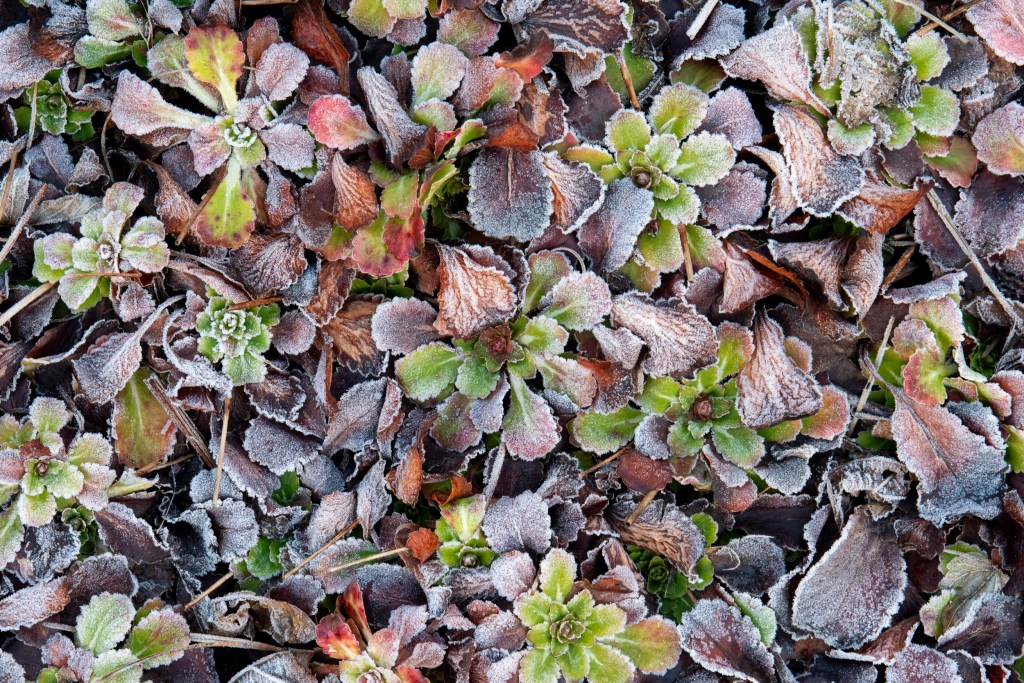
In Orkney, March ended pretty much as it began, breezy and wet. The early weeks of the month also brought what were probably the last frosts of the winter, just hard enough to sugar-coat the newly emerging leaves of London pride, a plant whose latin name saxifraga urbium, literally translates to stone breaker of the city – one of the first plants to colonise London bomb sites in WW2.
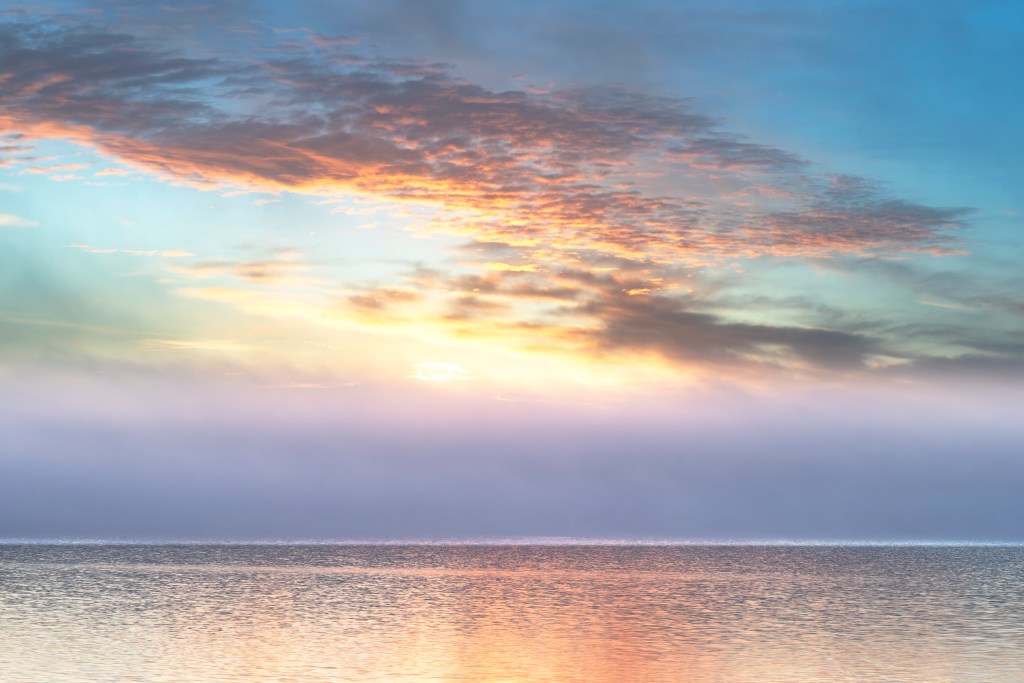
We had rain and gales aplenty but also some rare bright and beautiful days, blue skies and flat calm. Days that make you forget the wet and the wild and forgive Orkney of the worst that she throws at you. A sure sign of better days to come was the first haar of the year, they form when warming air passes over a cooler sea. A soft low blanket of grey-white that stole the sunrise and hid neighbouring islands from view.
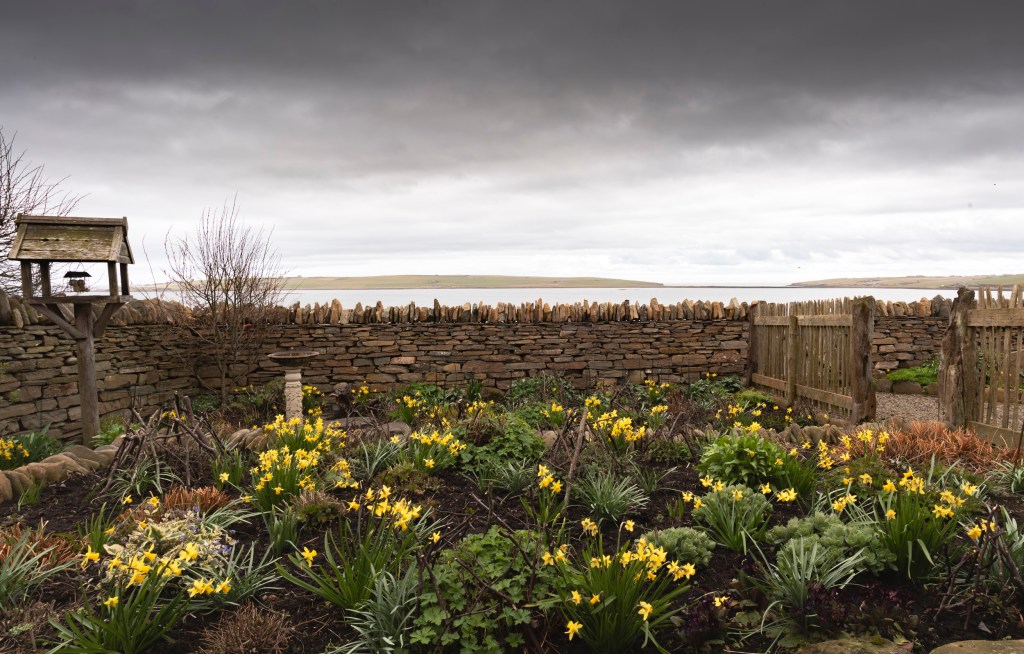
In the garden the cupboard is still pretty much bare, snowdrops have faded, tete-a-tete daffodils have taken their place, swapping white bells for citrus yellow trumpets. It will be some weeks yet before the gardens dark earth is lost beneath foliage and flowers. Gardening in Orkney is a slow burn start.
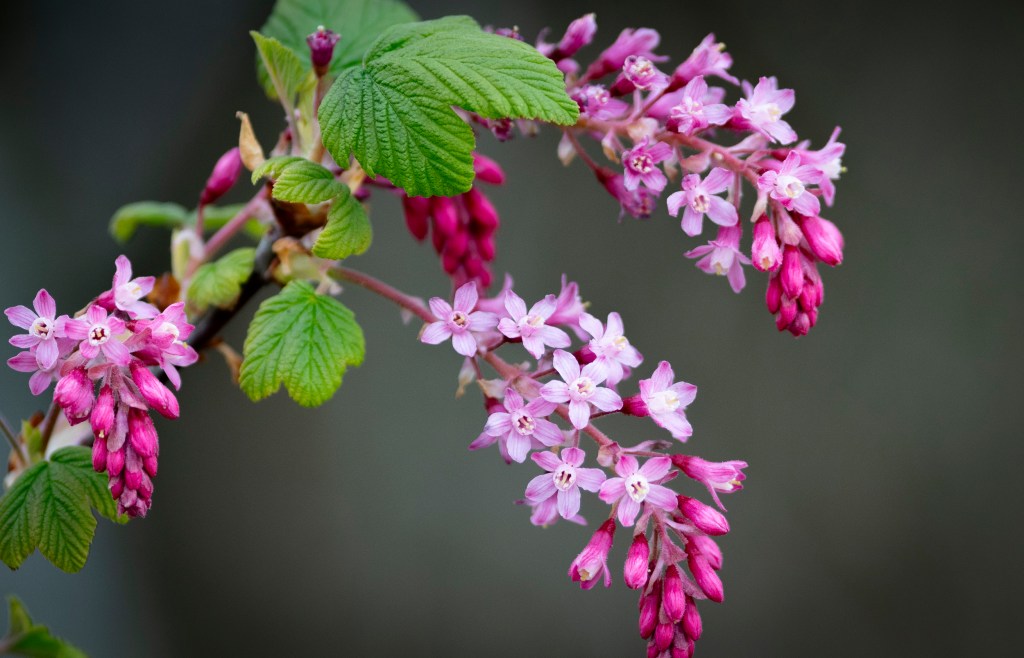
In the back garden, the first of our Ribes are in flower. We grow white and pink varieties and of the two, the pink is by far the hardiest, tough enough to grow not just at the edge of the garden but beyond the shelter-belt, on the edge of the moor. The pink was already here, a single overgrown shrub whose offspring, via cuttings, are now dotted wherever there’s a space. A magnet, and a life saver, for early flying bees.
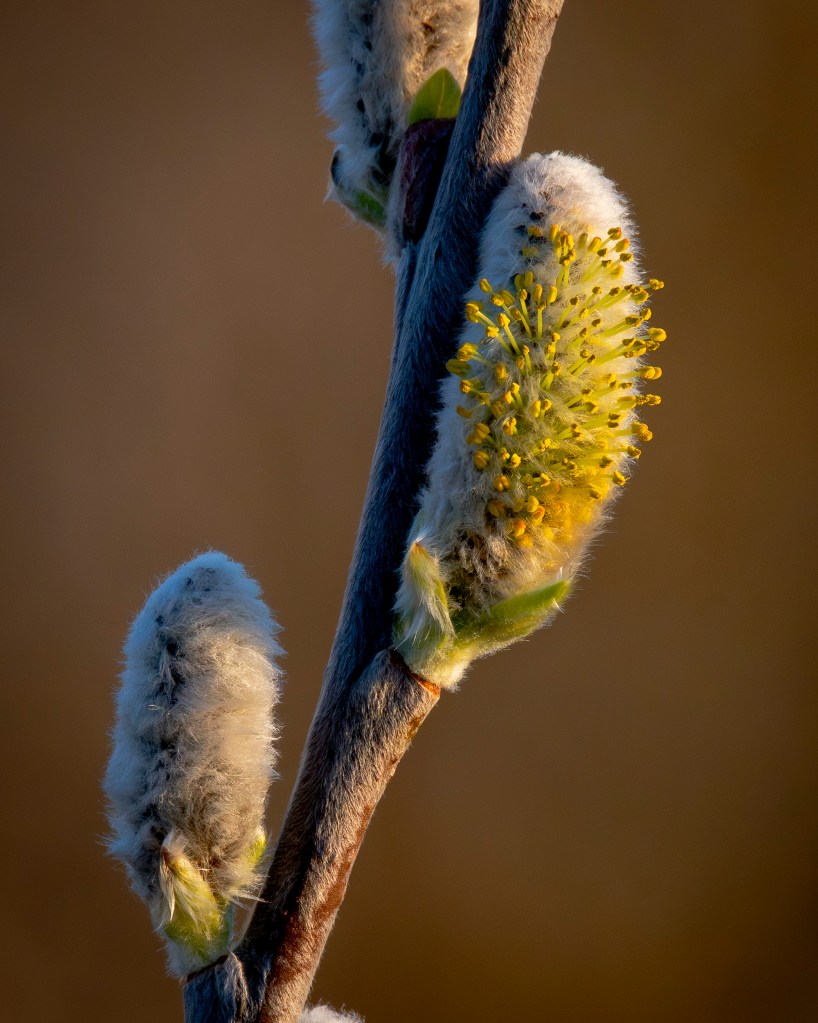
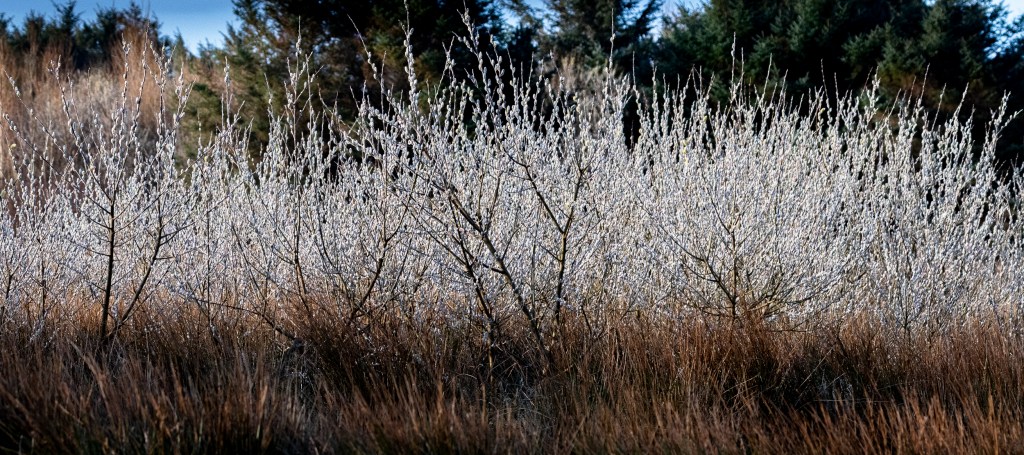
Beyond the garden, close to the shore, a willow coppice, planted three years ago on a patch of ground that never dries out, has come into its own. Each cutting has reached at least head height, many are ten feet or more, all are adorned with hundreds of catkins, plump and white, as soft as lambs wool. From a distance, especially when backlit by the morning light, they glow like cherry blossom, white against dark, just the look we had hoped for. As March turns to April the catkins, as per the photo at the top of this page, will flower, bursting open, morphing from white to lime green. Next will come silver-grey leaves that in Autumn will fade to a soft orange-yellow. One of those trees that never stops giving.
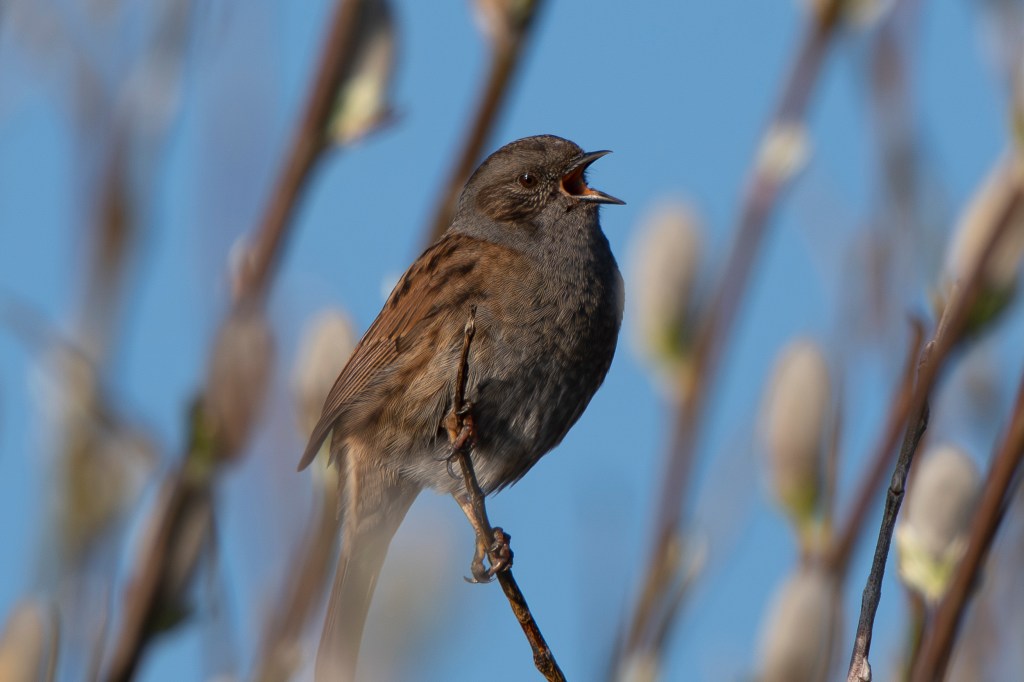
As the willows have grown and thickened, birds have been drawn to them, long-beaked woodcock lurk beneath them, hiding amongst leaf litter and sedge, coming out at night to probe turf in the meadow, leaving behind the tell-tale daylight sign of ground dotted with hundreds of holes. This year a pair of Dunnocks have made the coppice their home. They’re hard to spot as they flit from low branch to low branch but the male, as I witnessed one morning last week, will occasionally rise to a loftier perch and sing a claim to his territory.
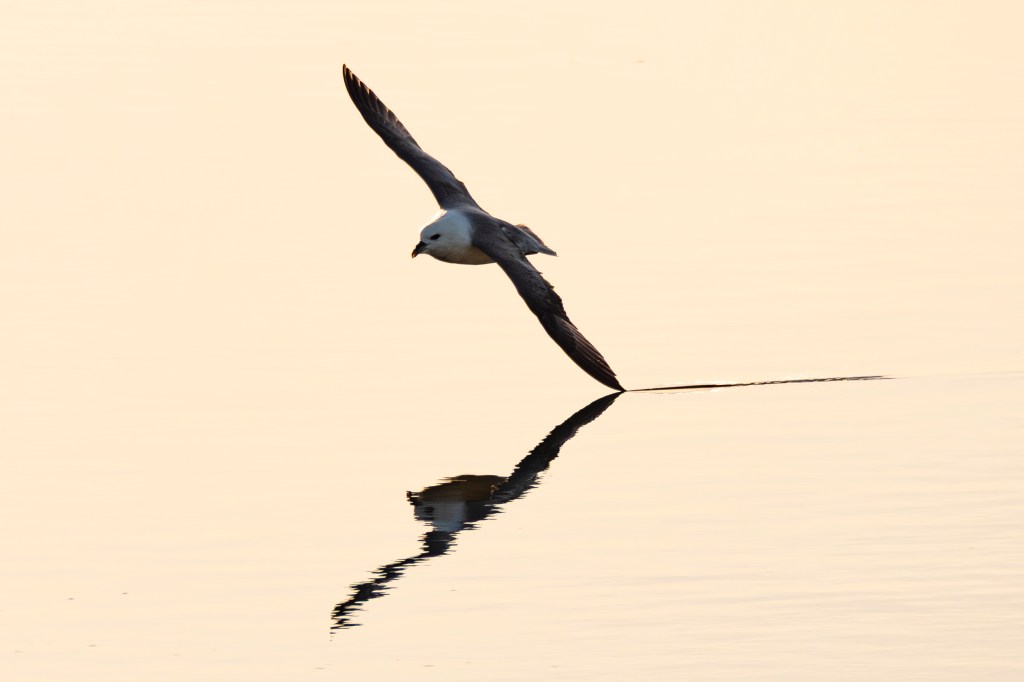
When we’re gifted flat calm days, one of my favourite things is to walk to the top of the low cliff beyond the willows, to a vantage point where flat ground falls quickly away to a beach of sea worn stone. A hidden spot, thick with ankle-snagging bramble and wild rose. The best time is just after sunrise, as the birds begin to stir for the day and the bay, untroubled by a breeze, is as still as a pool of mercury. Patrolling Fulmars, who nest on the low cliff, fly water-skimming figures of eight, occasionally cutting the bays surface with the lightest touch of a wing tip.
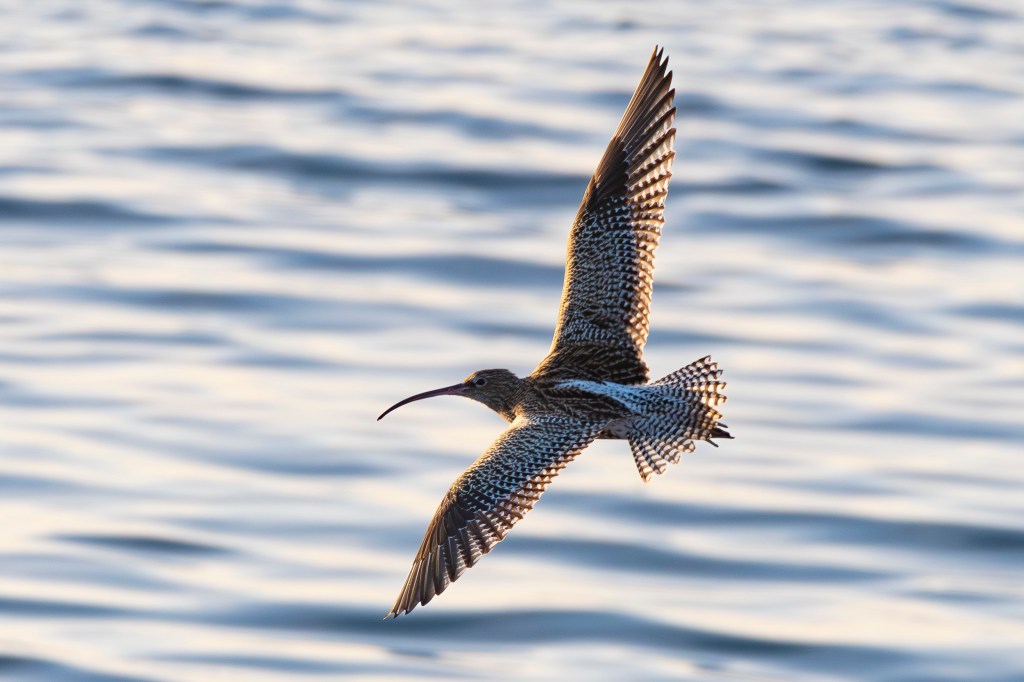
In March I managed a half dozen mornings, a clear and flat calm hour or two where, as the sun climbed higher, the warmth on your face rose as if controlled by a dial. There’s no real aim but to just watch and listen, to see the day come to life. Shore birds come and go, bright-billed oystercatchers and diminutive redshanks dash past, following the tides edge at zero feet. Curlews rise from a shore of sandstone and bladderwrack, complaining loudly of your presence.
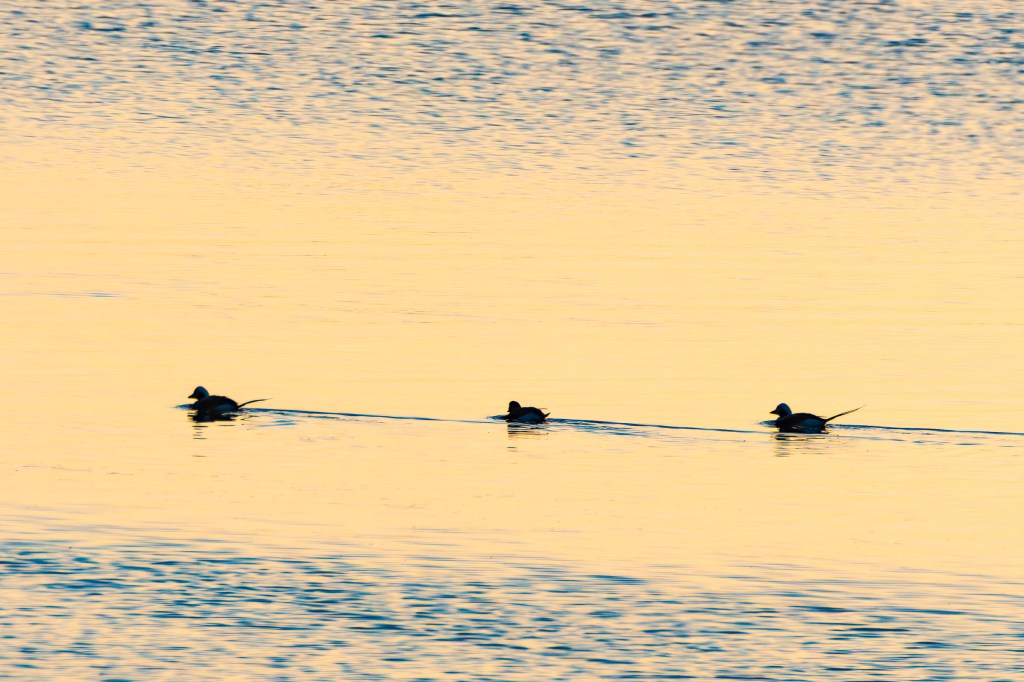
Out on the bay, there’s a trio of Long-tailed ducks, a male and a female followed by another male – tail end Charlie. He’s tagging along, hoping she may elope with him. Soon, elopement or not, all three will leave to spend the summer in the high Arctic.
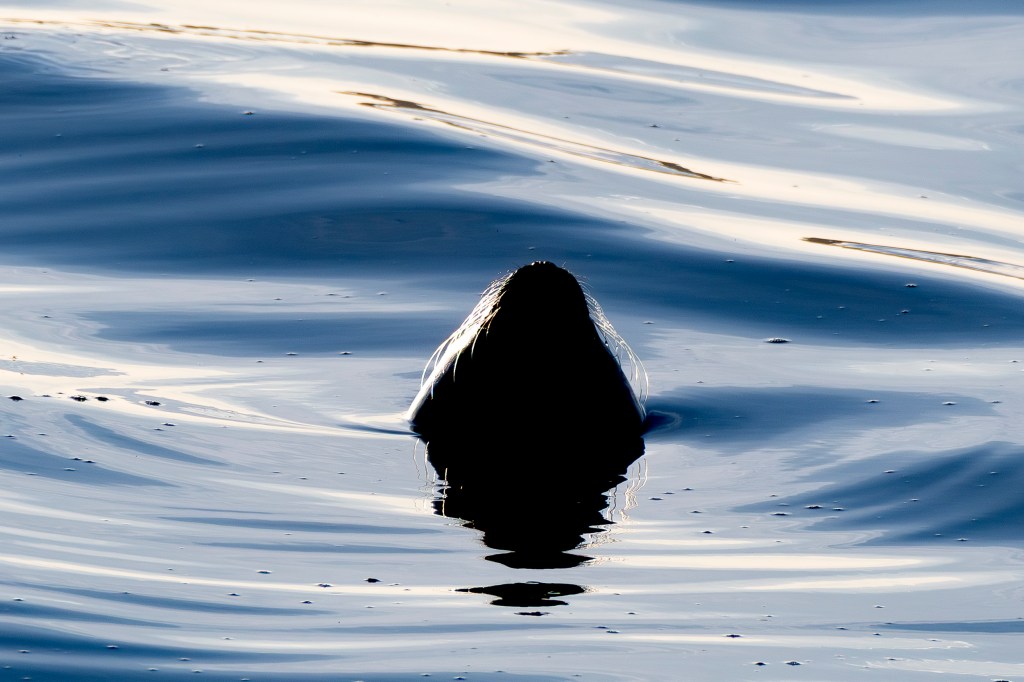
As the day wakes the ducks and the waders come and go, but the one abiding thing is a bob of Harbour seals. There are around twenty in total, a number that give or take one or two, has been pretty much constant in the seven years that we have lived on this side of the bay. Perhaps it’s the number that this small body of water can comfortably sustain. Most days they’re either hauled out on the rocks, taking a siesta, or out swimming in the shallows but occasionally, when the tide is neither ebbing nor flowing, you’ll catch one bottling, sleeping upright in the water, just chilling, at peace with the world.


What a great spring story, moments with nature, ending with a seal chilling. Thank you for this.
LikeLiked by 1 person
Hi Saila
Thank you, that Seal has the right attitude to life!
LikeLike
Morning Gary, This edition of the blog is full of goodies as usual. I love the description of the willow, planted by you with patience – white against dark, but several appearances – ‘never stops giving’. And a woodcock too. The picture of the fulmer is stunning. I love your morning dawn visits – ‘no real aim but just to watch and listen’. I did that in spring for an hour in an Exmoor wood – superficially sitting doing nothing. ‘Three’s a crowd’ – often seen with mallards but Long-tailed ducks raises the bar!
Thank you. Sue
LikeLiked by 1 person
Hi Sue
The Willows have proved to be brilliant, locally they’re said to originate from the gardens of Balfour Castle on the island of Shapinsay, they’re a North American/Canadian species that has naturalised in Orkney, probably brought over to the UK by a victorian plant hunter.
I love that hour or two, as with your woodland there’s nothing better than switching off and tuning in to the wildlife and the landscape. Although as we move towards the “Simmer Dim” when it’s light at 2am – it will be “post sunrise” not “at sunrise” 😉
I felt a bit sorry for tail end charlie, hopefully he’ll find a mate in the Arctic!
LikeLiked by 1 person
Gary, Not often said methinks “they’re a North American/Canadian species that has naturalised in Orkney “
The difficulty of sitting for an hour just watching is similar to the difficulty of meditation. The impulse to do something is really compulsive. A useful challenge to resist it.
Light at 2am – amazing.
Sue
LikeLiked by 2 people
Morning Sue, we do have a few of the human species that have moved here from North America, one couple from Alaska, Orkney must feel positively tropical ☀️
Providing I’m not in the garden and as long as I’ve got a comfy spot and I’m warm I can sit and watch wildlife or the land & sea without too much compulsion to move on or do something else, the morning one is dead easy because there’s a deadline – breakfast. Meditation would have me beat, I can’t imagine being able to zone out completely from your surroundings, I think I would start to twitch!
Light at 2am – there’s a healthy market in orkney for blackout blinds, especially if your house faces East.
On a serious note the simmer dim is wonderful, no night, just a couple of hours of twilight before the sun rises again. The birds never sleep, their calls become a 24 hour background track, it more than makes up for our six hour December days.
LikeLike
That picture of the fulmar is incredible. I can’t imagine how long you must have waited to get that shot.
Those tailed ducks are handsome birds – Visited the Cornell site so I could get a close up look.
Just sitting and watching/listening was my favourite part of camping on BC’s wilder islands. I really miss that stillness. Stanley Park, a forest peninsula in the ocean at the western edge of the city, used to provide the same early morning opportunities to see birds and seals, before it became so busy with tourists.
I read that Orkney is getting a lot more tourism these days, so I hope your wonderful wildlife doesn’t get affected by it.
LikeLiked by 1 person
Hi Penny
The Fulmar is a favourite, one of those half luck/half anticipated shots, I do wonder if it’s accidental or do they do that just because they can, like hanging your arm out of a car window just to feel the breeze on your skin.
The LTT’s are quite vocal, you always know when they’re on the bay! https://www.british-birdsongs.uk/long-tailed-duck/?type=flight-639
Orkney has seen a big increase in tourism, mainly driven by cruise ships, 208 are booked for this year alone. No affect on the islands but on mainland Kirkwall is best avoided on days where there can be up to 7000 passengers disembarking, there’s often two or three ships arriving on the same day. It also means that popular spots can be impossible to access for visitors who have travelled up from South, places that require admission need to be booked weeks in advance as the cruse ships block book them for tours.
Out on the islands we’re pretty much unaffected, there’s a limit to how many cars the inter island ferry can carry, a few people in cars and campers arrive and head off to Rackwick bay and the Old Man of Hoy and there’s a quite a few foot passengers who visit Scapa flow museum and the nearby Naval cemetery, for the latter it’s often a pilgrimage to a family grave, there are sailors of all nationalities buried there. In all of my walks last year I met the grand total of two visitors on the coast, out on the moors the footprints I see are usually mine from a previous walk, I’ve yet to meet anyone else up there! Like your wilder islands you can still find stillness here, and I dare say on many parts of Orkney mainland. We’ve learnt not to go to town for our shopping on a cruise ship day 😉
LikeLike
Those ducks make quite a noise!
I have the port cruise ship arrival/departure dates on the calendar, but there’s rarely a day here early spring to late fall when there isn’t at least two or three of them docked downtown, with others arriving on the same tide behind them. A four ship day (like on May 16th) means 11,382 tourists. I avoid biking downtown, in the parks or along the coastline and beaches from late March on as the tourist numbers make it too dangerous, but was taken by surprise this year as they’ve now started arriving in February for the first time. I could tell where the huge numbers of wobbly cyclists on hire bikes were from, as they were pedalling towards oncoming traffic on the left side of the bike path and shouting at locals to get out of their way 🙂
Glad you’re not afflicted by the Curse of the Cruise Ships on Hoy! Long may it remain so.
LikeLiked by 1 person
Hi Penny, we do get off lightly on the islands, the only thing I would wish for is that hire car companies start installing a reverse gear in their vehicles.
Drive on single track road – see oncoming vehicle – ignore adjacent passing place – freeze like rabbit in headlights 10 metres beyond passing place – discover car has no reverse gear – wait while local vehicle reverses 100 metres to next available passing place 🙈
Tongue in cheek of course, it might be their first experience of driving on a single track road. Definitely makes the route From Lyness to Rackwick interesting 😄
LikeLiked by 1 person
Waving to you from 🇫🇷 heading way down South. Love ❤️ France, haven’t been here since before Lockddown. Gorgeous pics, especially heera and duckies wuckies! Such a sea! Xx
LikeLiked by 1 person
Morning Margot, enjoy your holiday!
xx
LikeLiked by 1 person
🙌🏼 thanks so much for recommending my LightWriters blog. I love the Orkney light and sea and the catkins, early blooms, and ribe are wonderful. It’s May 1st, and our Canadian prairies are in a very sloww—ww wakeup mode. 😴 I felt right at home and loved visiting Orkney (sadly it was only for a day after crossing the restless rolling sea from John O’Groats). I included a photo of Orkney in an evening mist as we departed those rugged lovely shores (see my “Alba Songs” chapbook: https://5wise.wordpress.com/2012/07/07/ae-selkie-song/)
LikeLiked by 1 person
Hi, my pleasure. That sounds like the passenger only ferry, an interesting ride on a rough day!
After a long Winter it feels that Summer is literally around the corner here, after six months of slumber the past week has brought a welcome explosion of growth. Long may it last ☀️
LikeLiked by 1 person