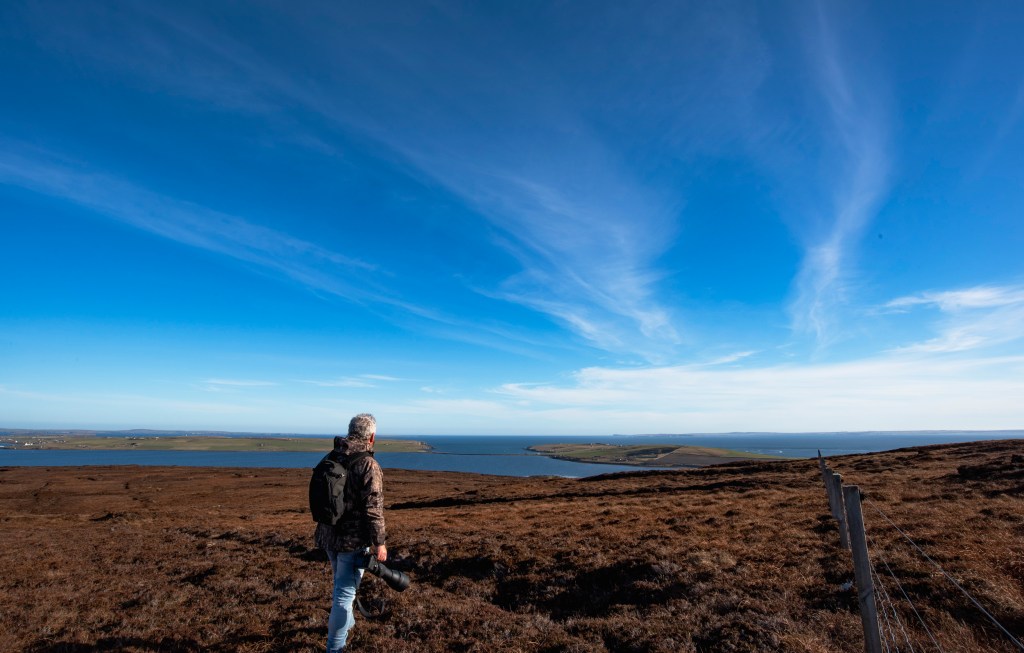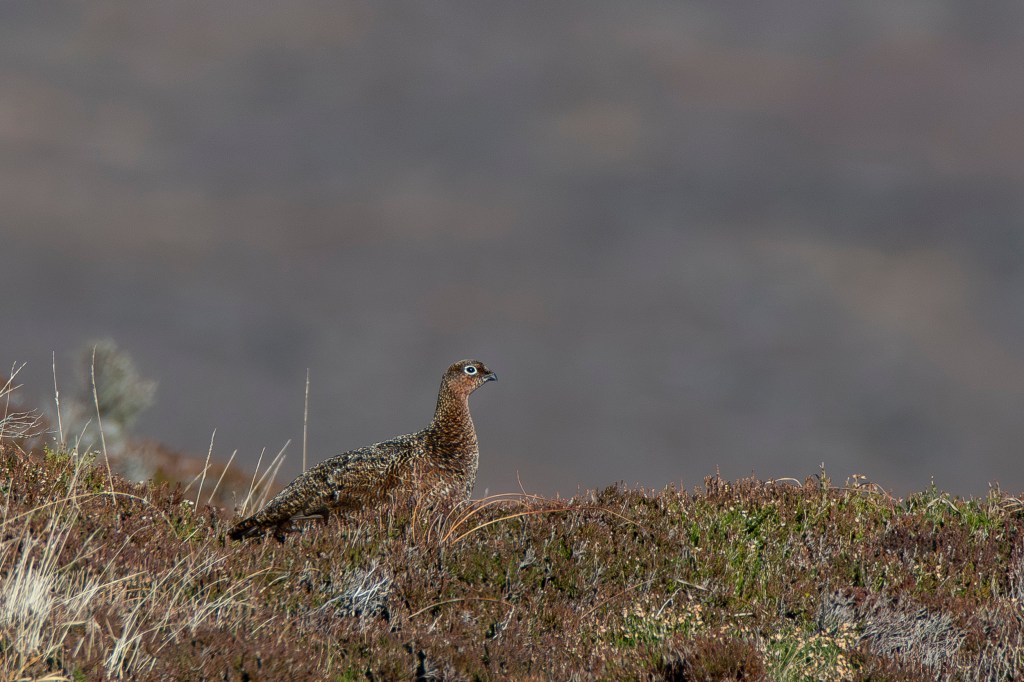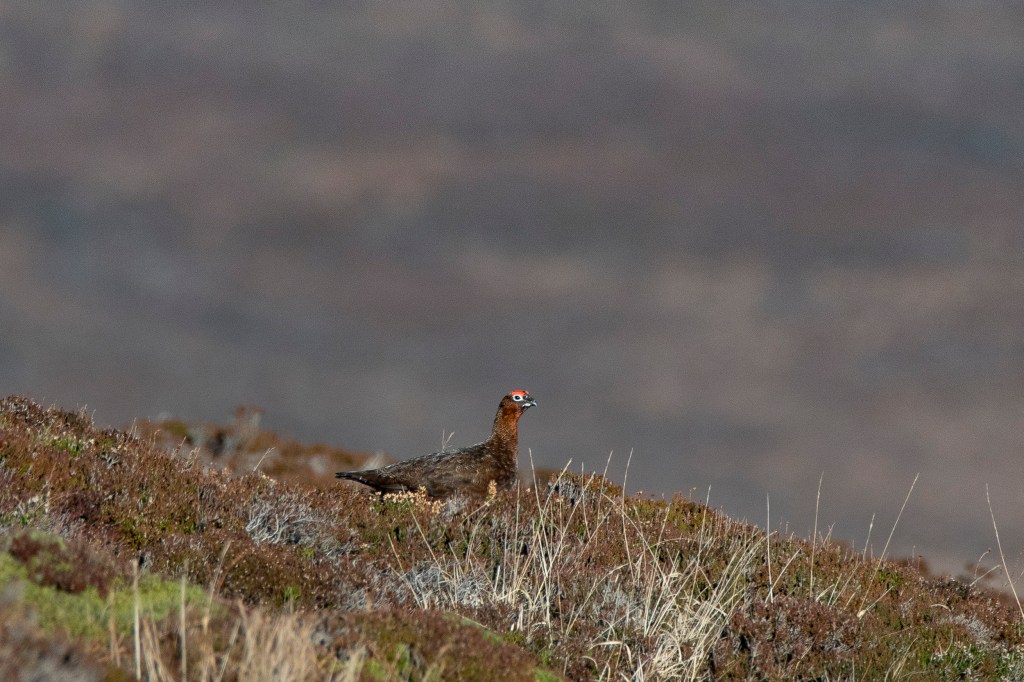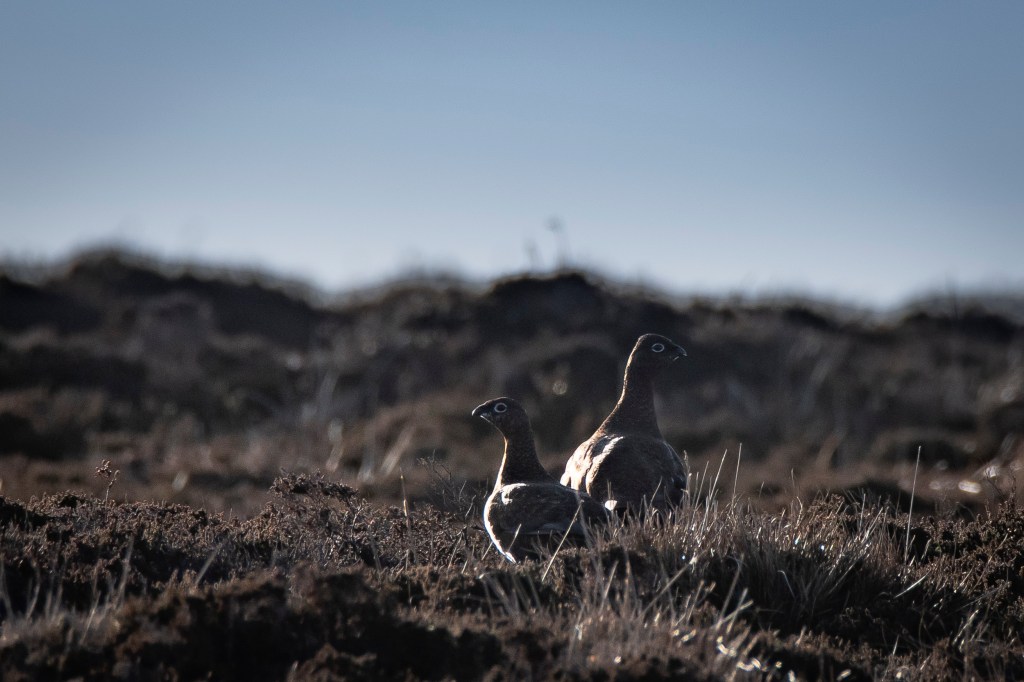
December the 21st.

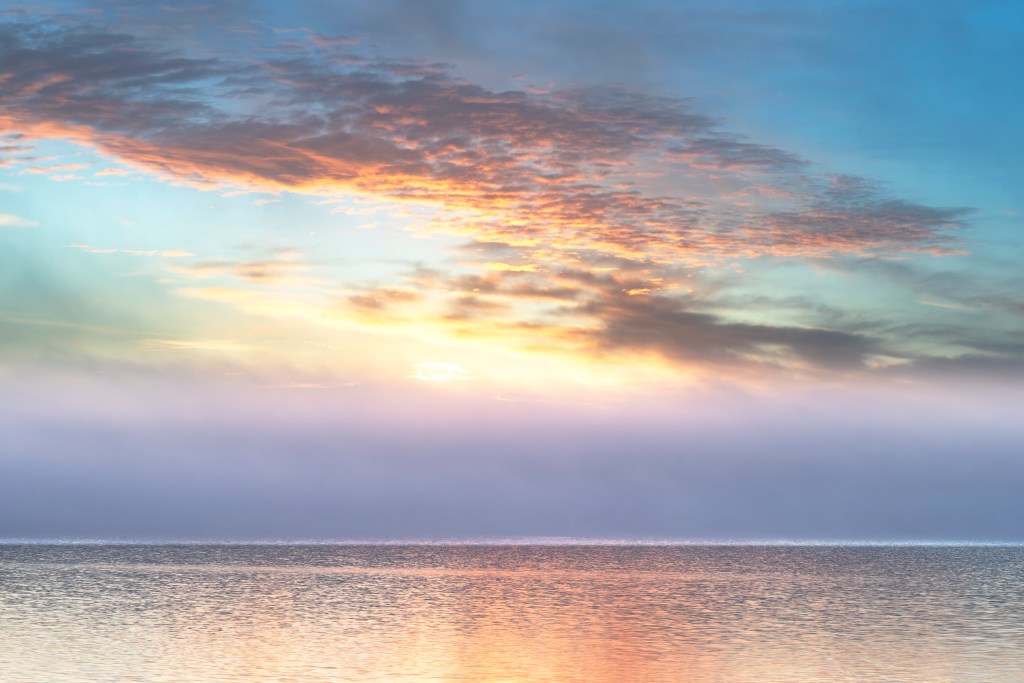
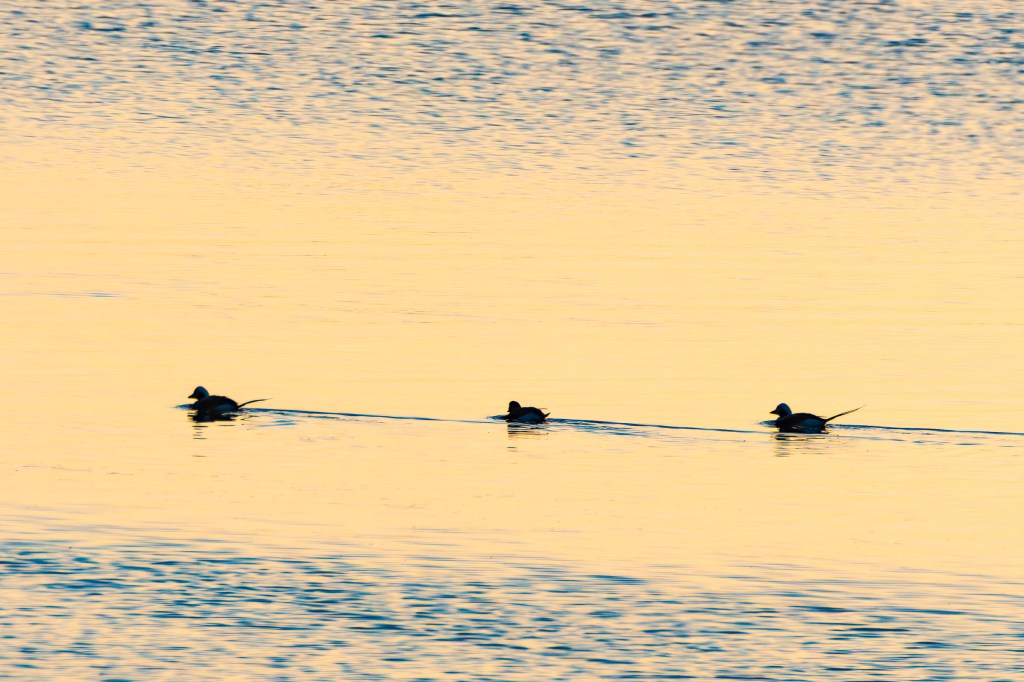
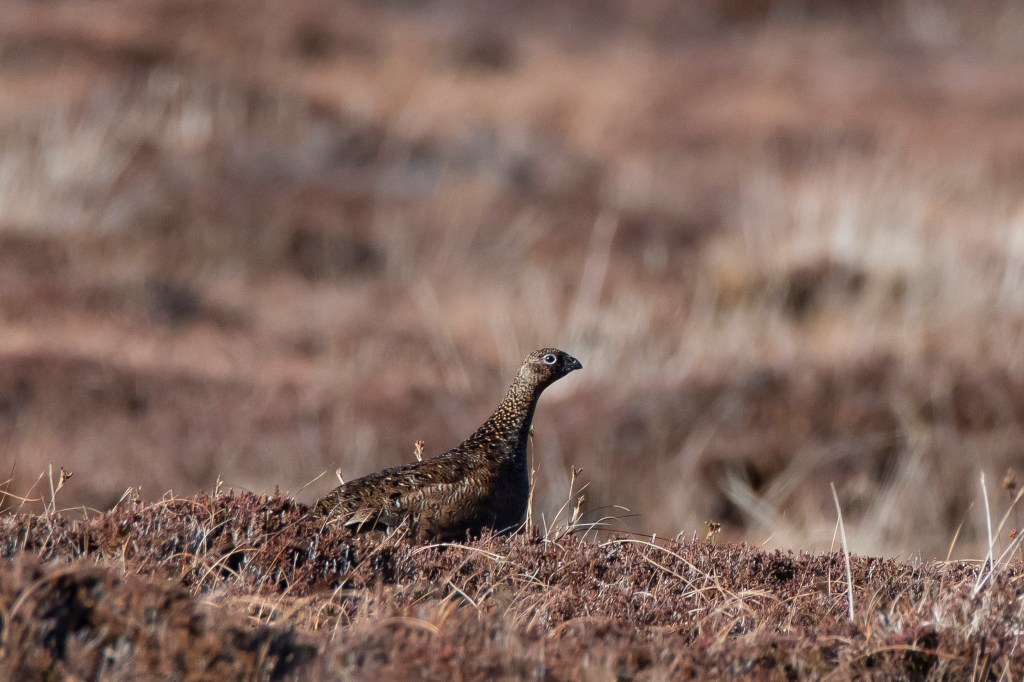
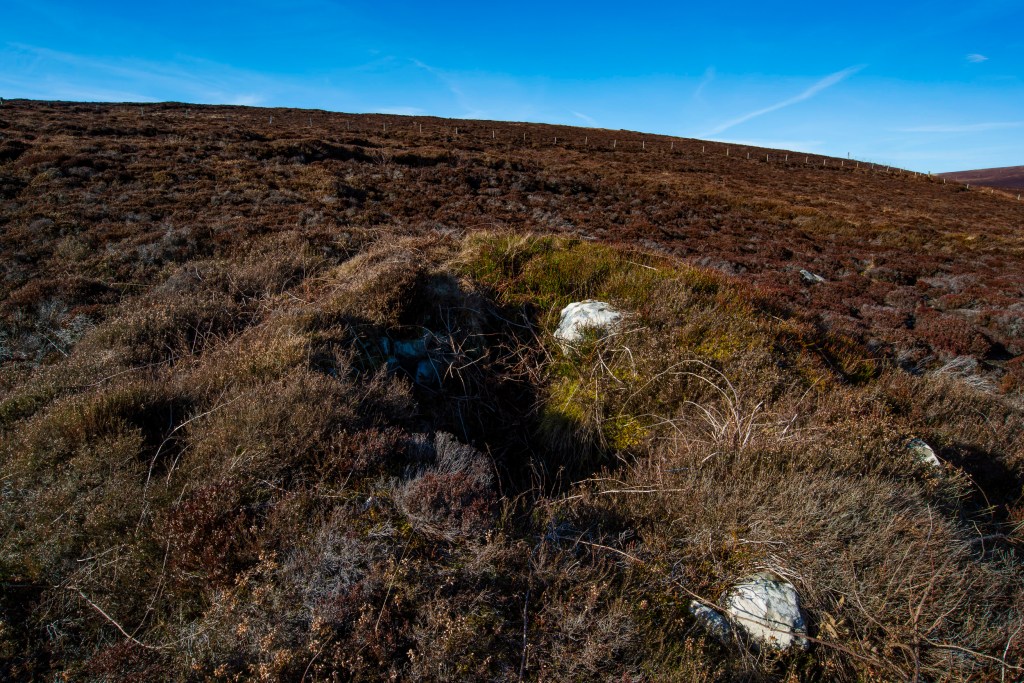
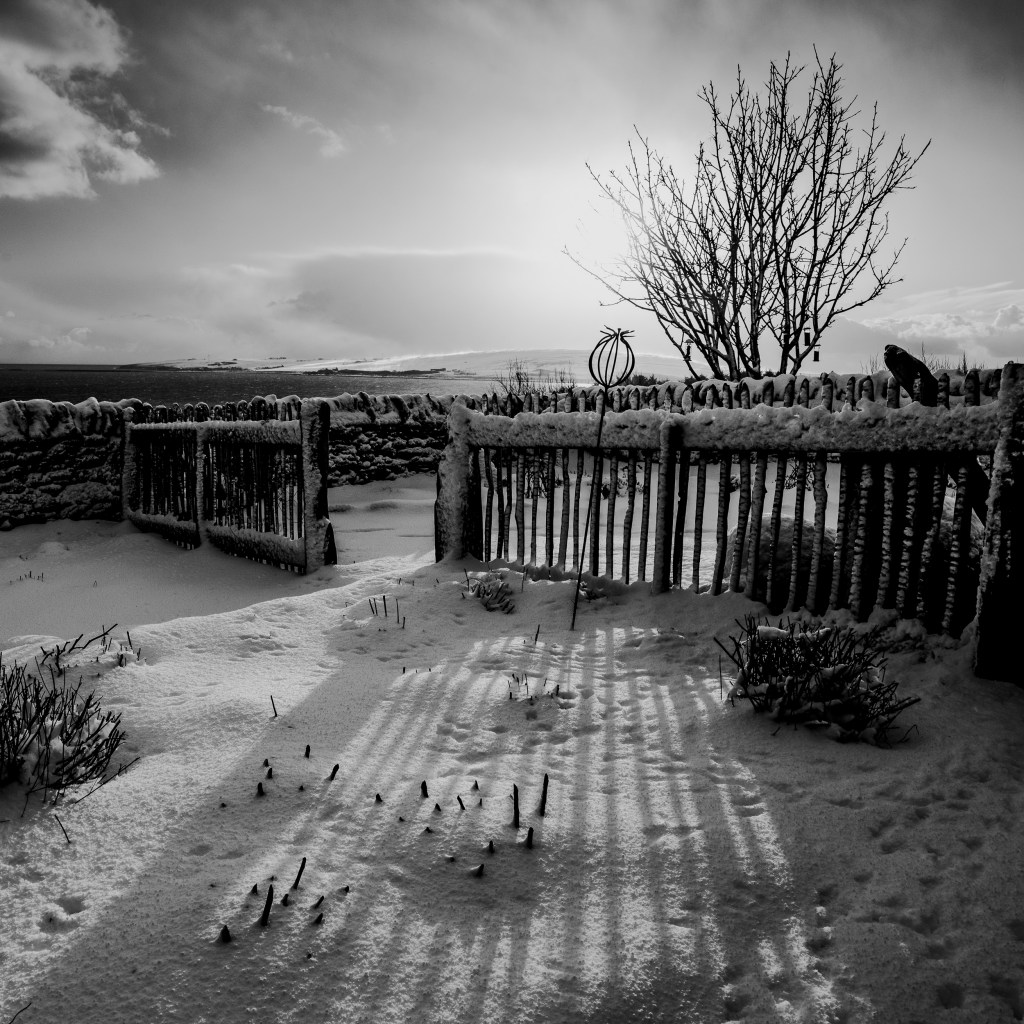
First light, Winter Solstice, 2025.

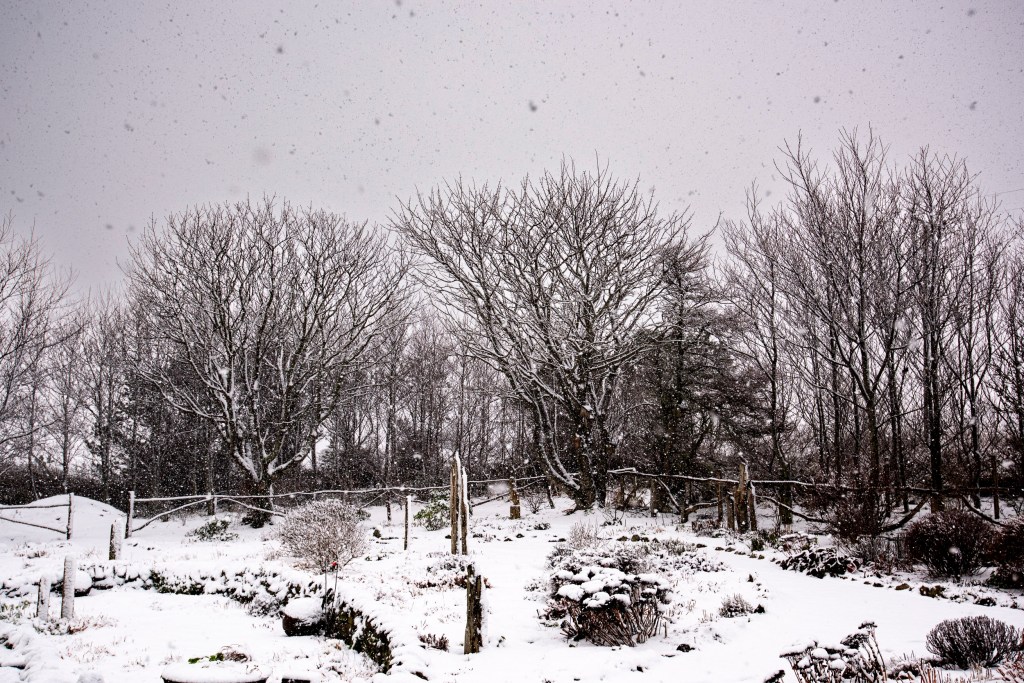
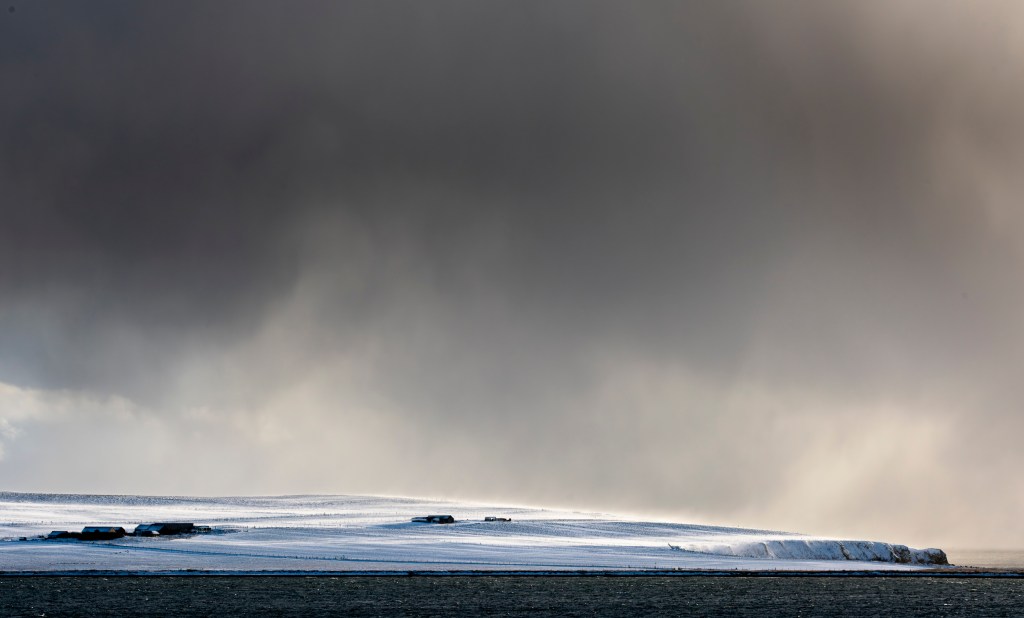
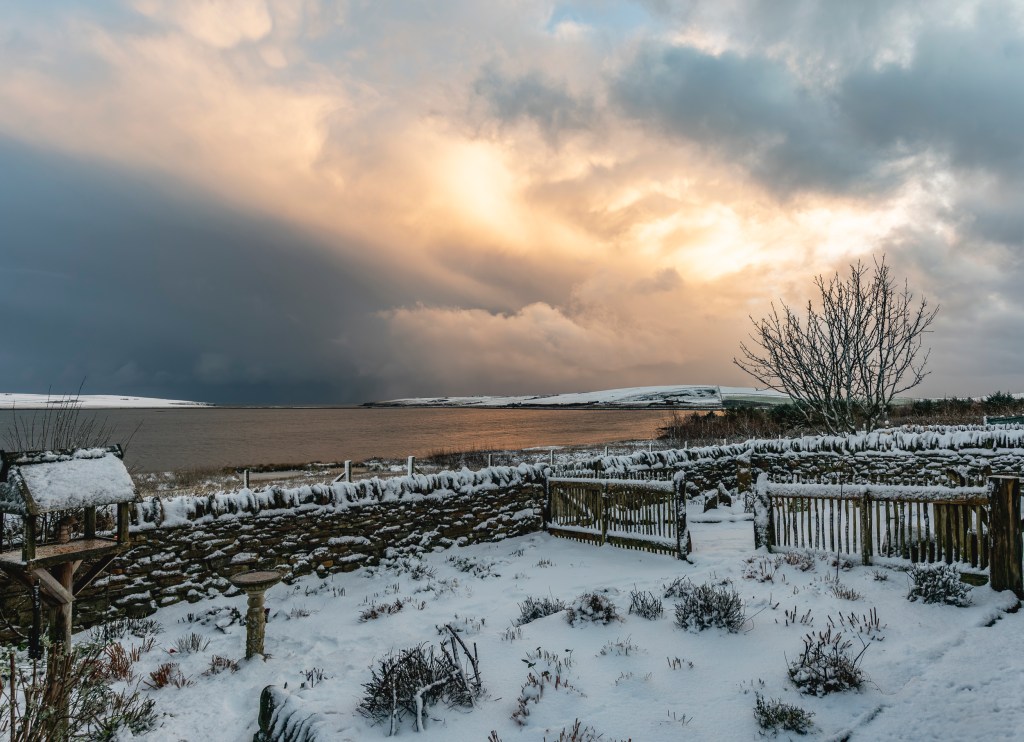
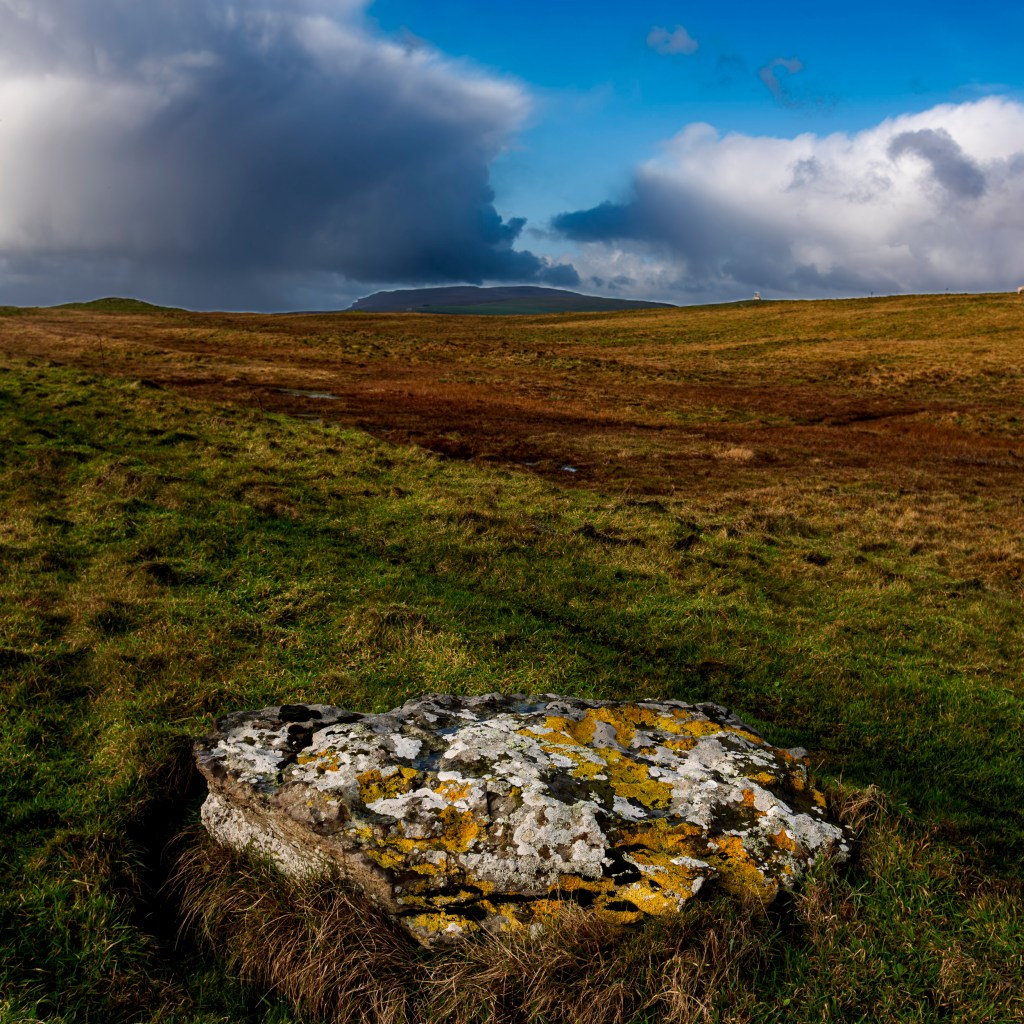
It’s hard to believe that the Solstice is here. We have barely noticed that winter is already halfway through. Spring is spinning towards us. Although the short days have never bothered us, for the first time since we made Orkney our home, the winter gloom has passed by unremarked. For the next few days the sun will rise at just after 9, setting again at a quarter past three, after that the days will slowly but surely lengthen. Decembers weather has been as expected, mild, wet and often wild but we’ve had bright crisp days as well and, just the once so far, a sprinkle of snow that gave the islands hills a dusting of icing sugar.

Ward Hill, the highest point in Orkney, from the road to Moaness.

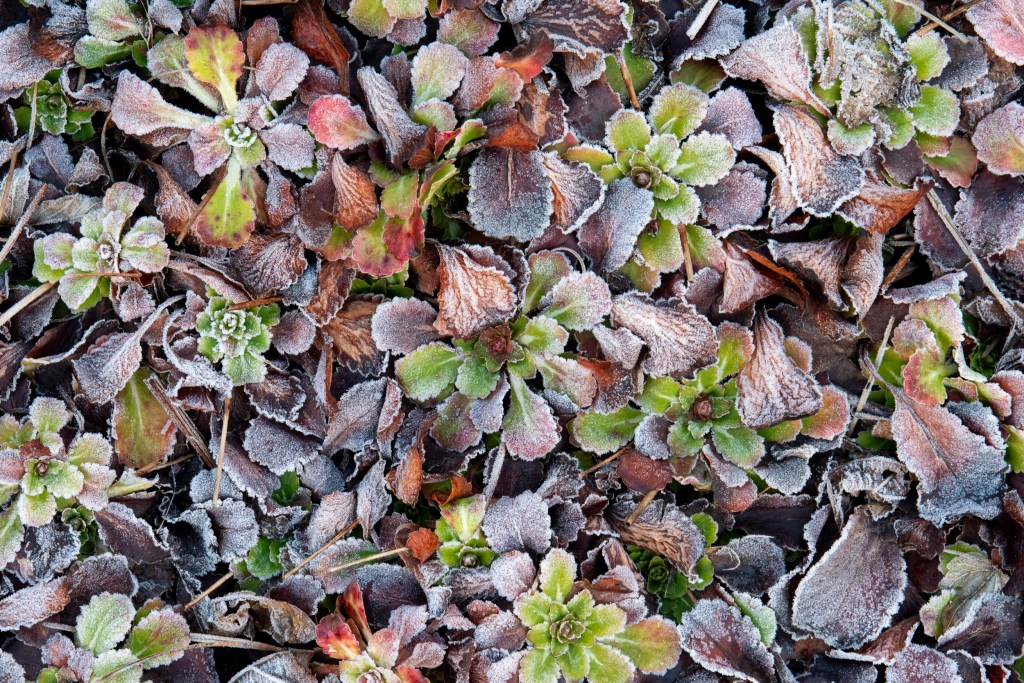
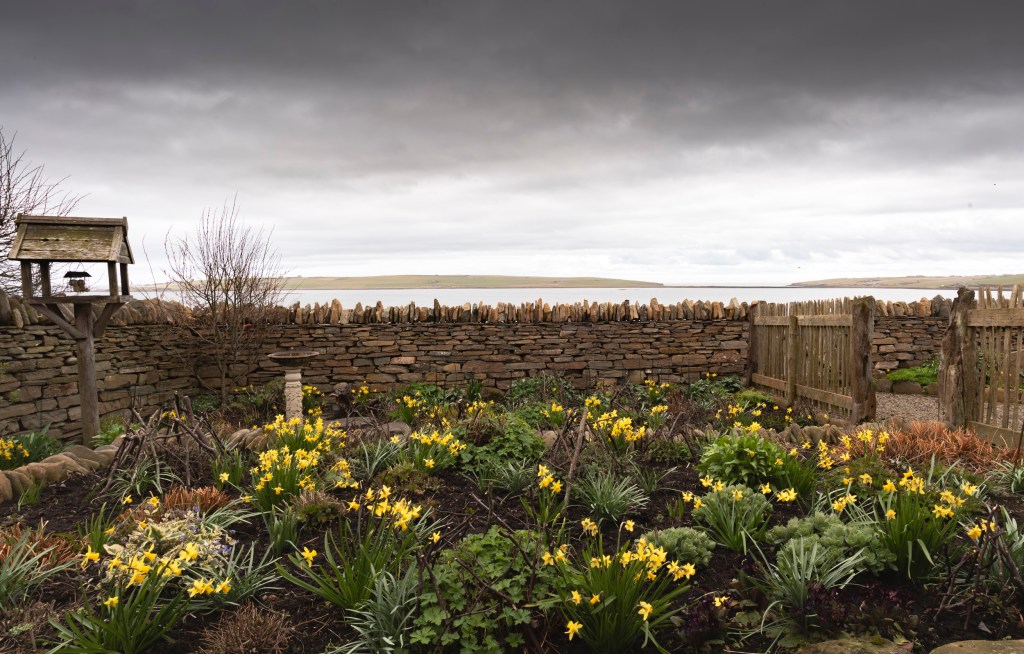
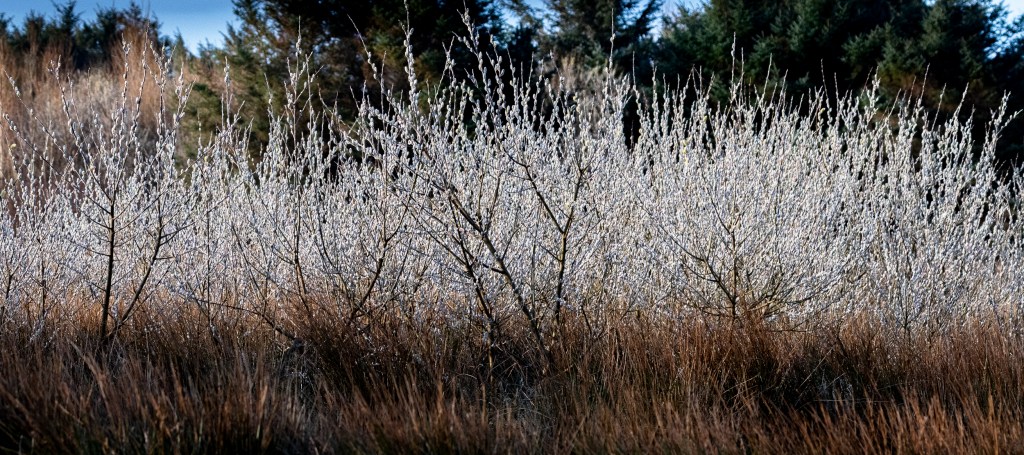
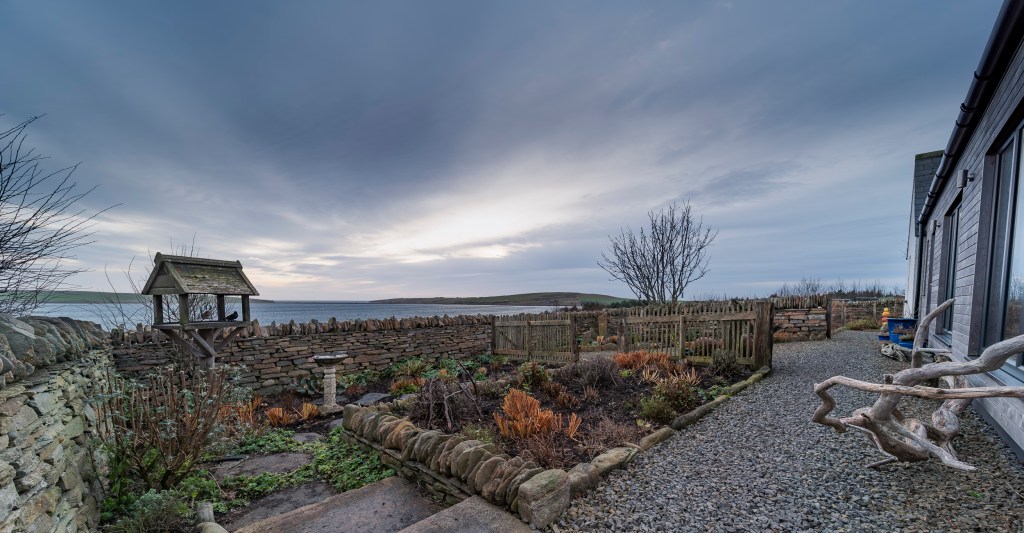
Weather permitting, Jacqui has been busy putting the garden to bed. In our old garden, some 400 miles or so further South, many of the plants were left to over winter. Up here most, if not cut back, will turn to mush. A combination of rain and and salt laden winds soon puts to bed any thought of picture-perfect frost whitened seed heads. It doesn’t mean though that the garden is bare, just pared back, waiting for warmth and longer days. 

Waiting for Spring.

Not all plants though get the winter memo. A Himalayan poppy has decided that now is a good time to flower. Meconopsis do well here, they prefer cool, moist and slightly acidic soil, a perfect fit for a garden at the edge of a peat moor. They normally flower in late May, throwing up tall green stems topped with short lived electric blue flowers, this one though is a few inches tall and despite flowering blue in Summer, is a shade of soft mauve-pink.

Five months early, or seven months late…

In addition to cutting and clearing, Jacqui has also been splitting and potting on anything that has outgrown its space. Some of the new plants go into cold frames, others will over winter in old fish boxes collected from the shore. In summer, once well rooted, they’ll be sold online or at the garden gate.

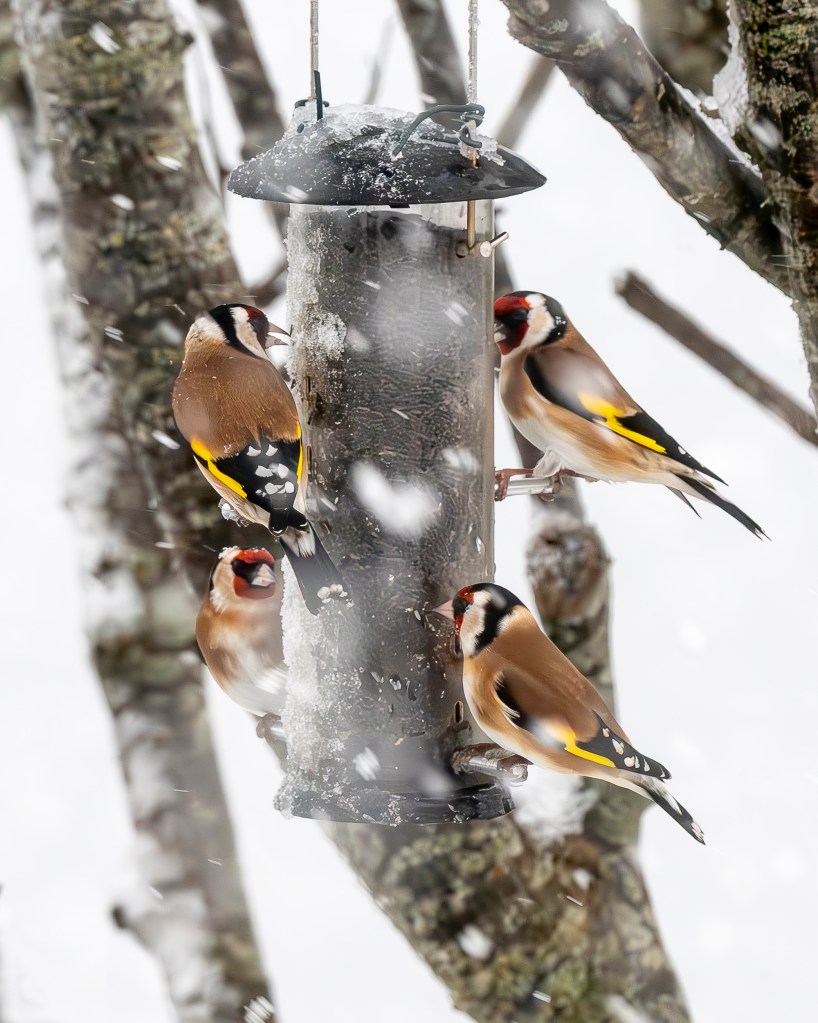
Garden birds are coming and going. We’ve seen an influx of Greenfinches this week, a flock of perhaps forty birds. They vie for feeder space with winter resident Goldfinches and, after a few fisticuffs, both sides have come to an unwritten truce, sometimes the greenfinches dominate the feeders and the goldfinches get to pick up the dregs dropped on the path, sometimes the roles are reversed, the goldfinches get the feeders while their olive green cousins slum it on the gravel.

Greenfinches hog the feeders, a goldfinch tries his luck

Two other closely related species that are here in numbers are Rock doves and Collared doves. The former are avian hoovers, arriving daily at dawn to clean up anything and everything. They remind me of Black Friday shoppers, all rush and sharp elbows. Once sated they lurk for a while along fences and dyke tops, just in case more food is put out. 

Rock dove

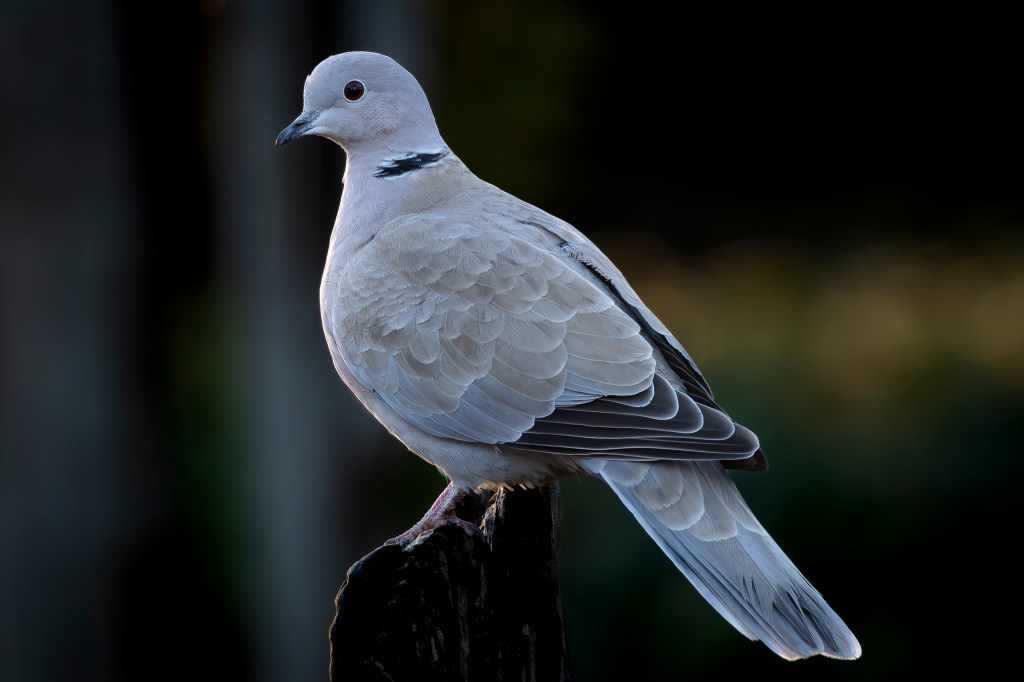
The collared doves in contrast to the rush-rush Rocks are gentle souls, they’ve multiplied here year on year, we started a few years ago with four, last week gave  a count of  thirty-odd. Now that the trees are bare, once hidden nests can be seen, a thin and often precariously sited platform of twigs that somehow stands up to our inevitable curve ball Summer gales.

Collared dove

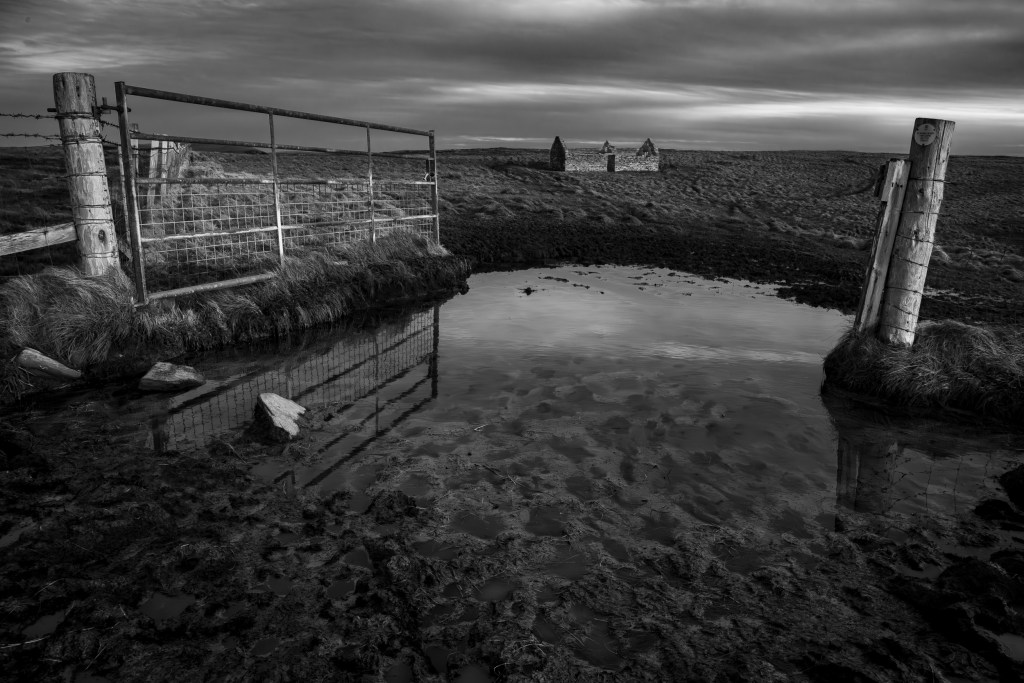
We’ve had our fair share of rain and in the wider landscape the ground is sodden. At this time of year hardy Shetland and Shetland cross sheep are put out on a South Walls headland. Part of an environmental scheme that helps keep the sward short and allows low growing wildflowers, including the elusive Primula scotica, to thrive. At a bottleneck gate, where they funnel from one area of heath to the other,  the ground is poached to mud and a temporary pond has formed, a true test for just how waterproof your boots really are 🙂

Near Isbister, South Walls

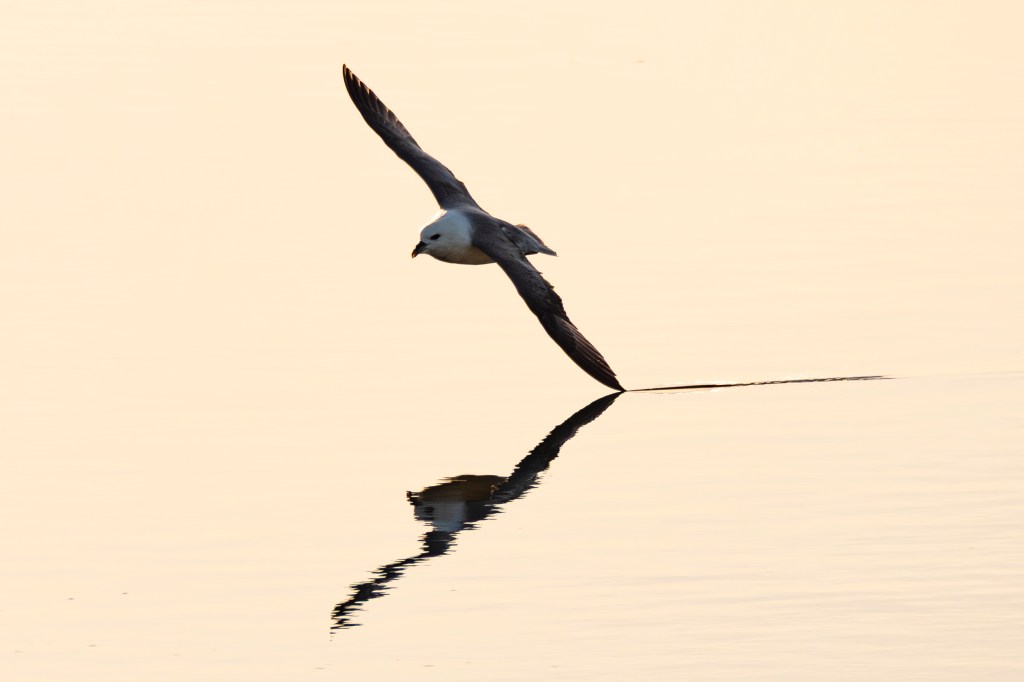
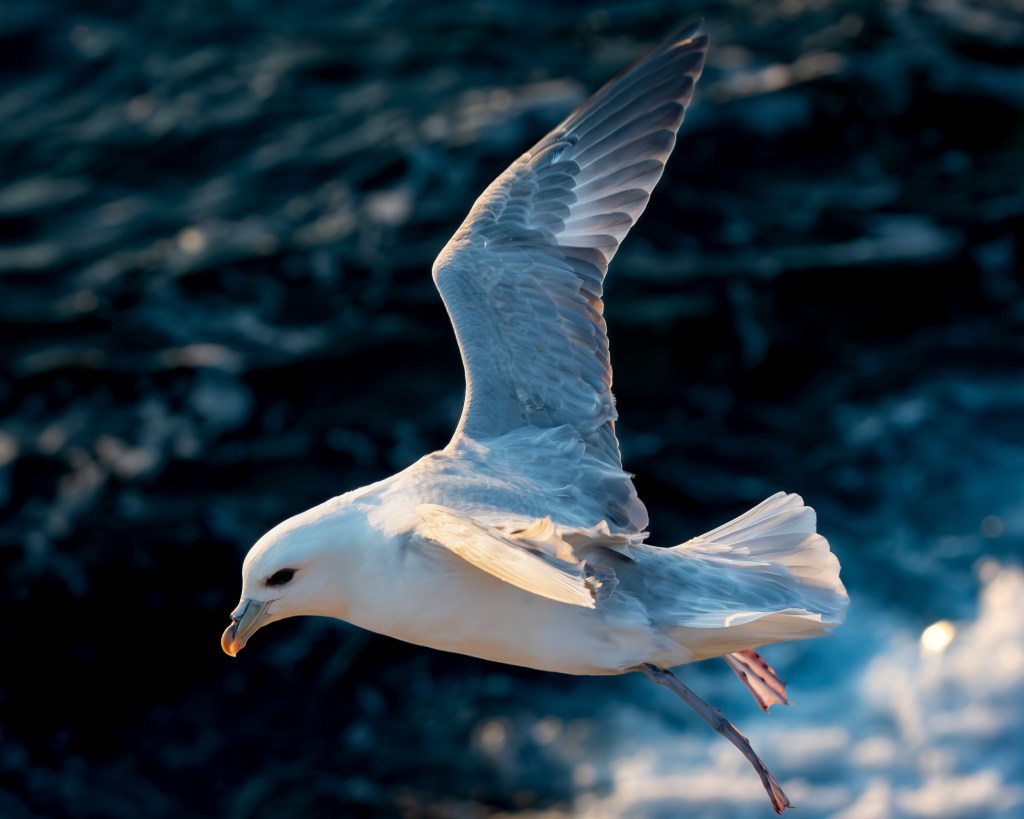
A sure sign that Spring isn’t too far away, is the return of Fulmars to the cliffs. One day last week, not far from the temporary pond, I watched them rise and fall on the up-draughts. They’re pelagic birds, nomads of the sea, returning to land only to breed, laying a single egg in May in a scrape of a nest that the same monogamous pair could have used for decades. With a stiff easterly coming in off the sea, the birds were riding the wind, perhaps just for the joy of it. They’re of their own world, seemingly oblivious to ours and come so close that you can almost reach out and touch them. To do so though would be like breaking a spell.

Riding the breeze.

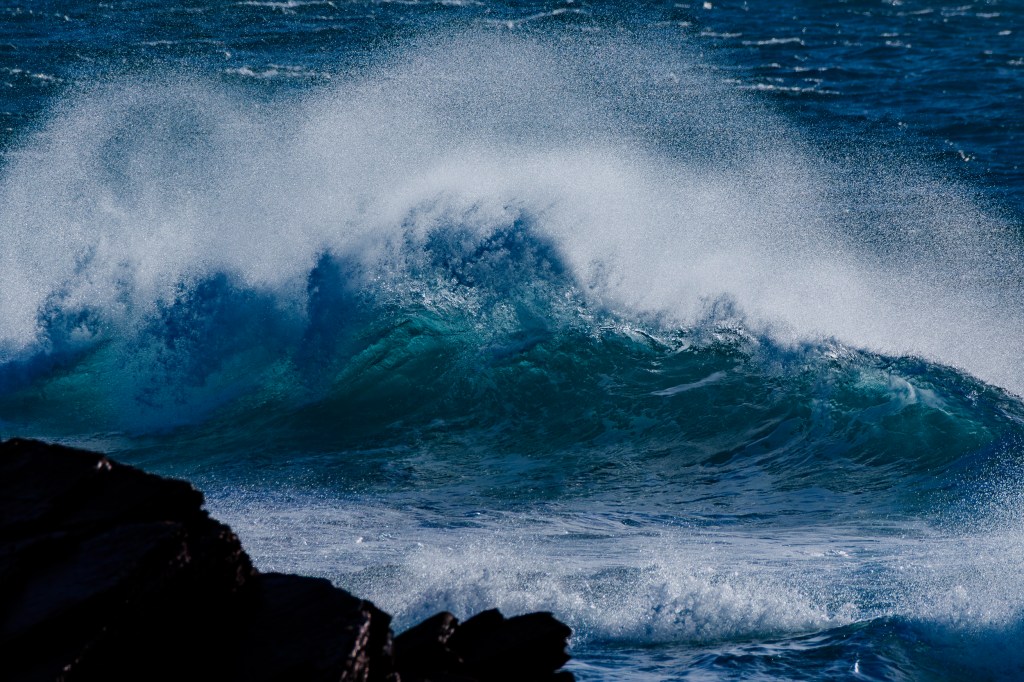
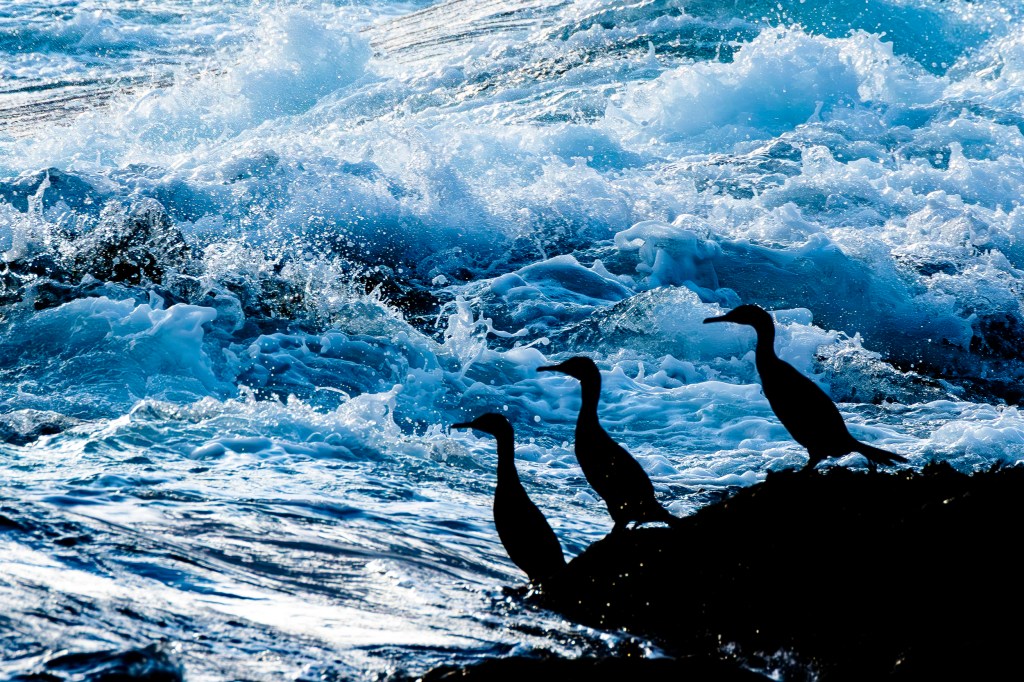
Below the fulmars wings, there are steep sided geo’s and rocky shores. On a day where a cauldron of surf seethed and boiled, courtesy of a recent gale,  I watched three Shags, each seemingly plucking up the courage to enter the water. In the end they went in together, bobbing like corks in a washing machine, dashed to and fro by the surf and like the fulmars above them, perfectly at home in their world.
“No, you go first”

A visitor from the North

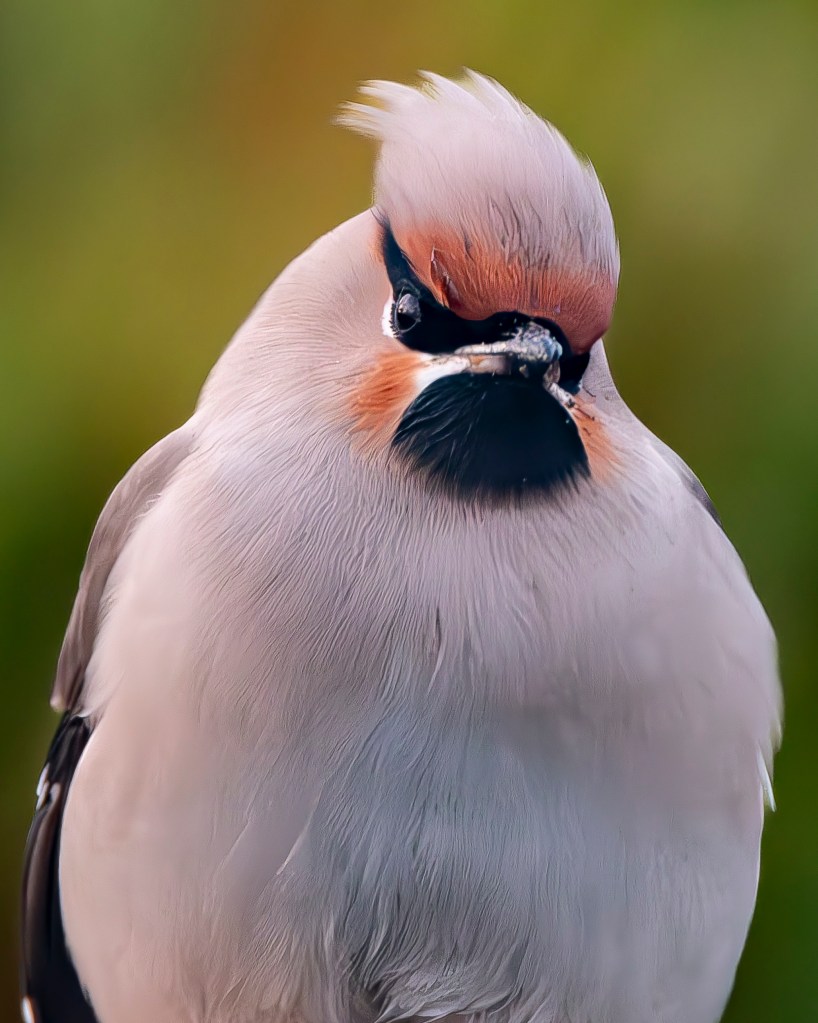
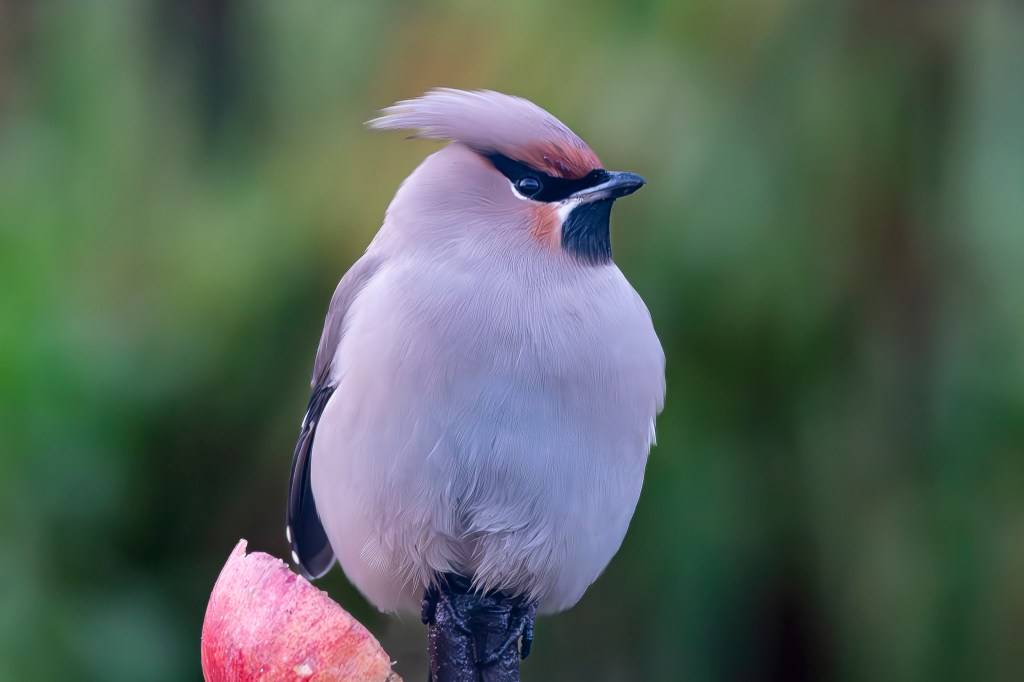
The third week of November brought the first snow of the Winter. It didn’t last, snow rarely does here, a day of snow followed by a day of sleet and after that normal service resumed, back to our usual breezy mix of bright days and wet days. The gales that brought the snow also brought a surprise visitor to the garden, a Bohemian waxwing, a bird that, like the winds it arrived on, was born in the North.

At home they’re arboreal, a bird of Scandinavian forests, both coniferous and deciduous, and are occasionally seen here when an “irruption”, usually caused by a lack of Autumn berries in their homelands, will see them push further South. In the 12 years we have lived in Orkney we’ve witnessed just two such irruptions, the best was a few years ago and brought 35 birds to the garden. They stayed for almost a month, stripping Rowans of berries and eating us out of supermarket apples.

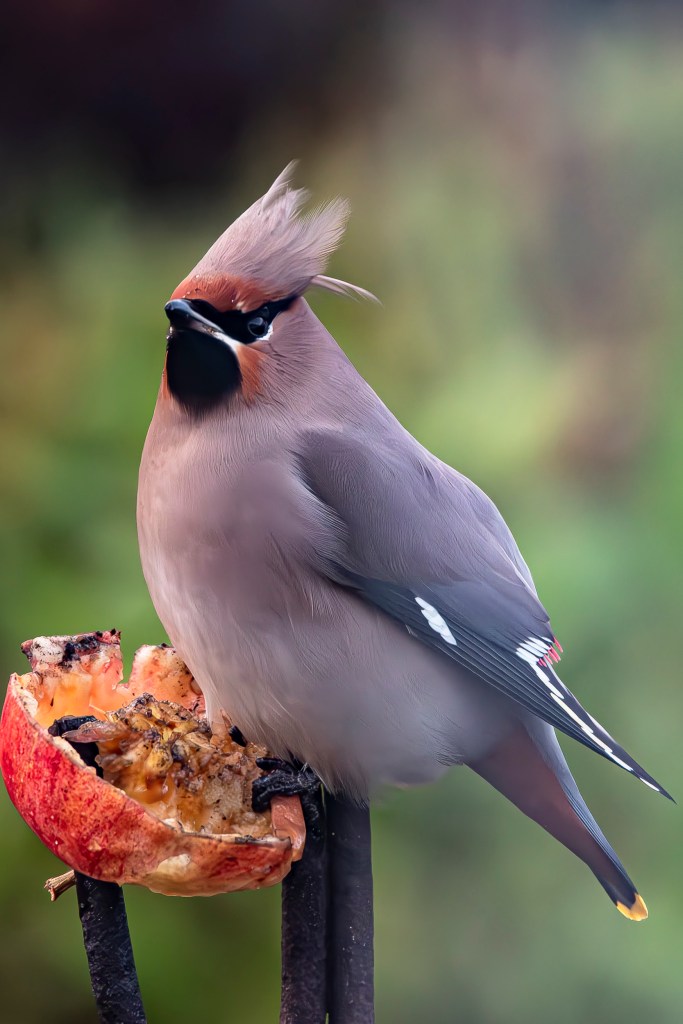
This bird though, an adult male given away by the sharply defined edges of the species unisex black bib, was alone and late. The rowans, stripped in October by Fieldfares and Redwings, are long since bare. Apples though are still put out every day, a treat for winter-resident Blackbirds and the occasional visiting Blackcap, and it’s to these, like bees to honey, that Waxwings are drawn. We hoped his arrival would bring an Earful, the slightly odd collective name for a flock of Waxwings. A term that’s believed to come from the second word of the birds latin name, Bombycilla garrulus, garrulus – to chatter.  Bombicilla is silk-hair, a reference to the birds feathers and crest. Their common name comes from a wandering lifestyle and red tipped wing feathers, the colour of medieval sealing wax.

No more arrived and we think he was likely an accidental visitor, pushed south by the winds that brought the snow. Waxwings have been rare in Orkney this year, one here, two there, only a handful of reportings. The bird stayed for ten days, feasting on half apples set on old rebar, placed a few feet from the kitchen window. Arriving in the pre-dawn gloom and not leaving until dusk. They’re very tolerant of humans, Jacqui is busy putting the garden to bed and as she forked and pottered, often within a few feet of him, the biggest reaction she got was a turn of the head and a raising of a pink punk-rocker crest. They’re beautiful birds with fine plumage that lives up to their silk-hair latin name but it’s also fair to say that they have a slightly grumpy and quizzical look to them, on the photo below a “what you looking at” thought bubble would be appropriate.

The bird left us on Friday, on the coat-tails of a gale from the South, perhaps a coincidence but more likely instinct, riding the winds back home to the North. I hope he finds his Earful.

Sun,showers & Solan Geese.

At this time of year gales are pretty much a given. Southerlies tend to be warm, Northerlies bitterly cold. Usually, from whatever direction they arrive, sheets of grey rain will ride in on their coat-tails, overtopping ditches and turning the ground to boot sucking clart. Occasionally though they coincide with the magic words – sun & showers. On those days it’s good to be out. One such day came at the end of October, with a Northerly blowing at 60mph the logical place to be was the sheltered and Southwest facing coast of Brims, as the crow flies a couple of miles or so from home.

Sun and showers – Brims coast.

To get to the shore you go over an exposed headland. The wind hits side on, with streaming eyes you adopt a gait of head down – lean sideways, walking like a half shut penknife. More than once a gust pushed me in the direction it wanted me to go rather than the direction I was aiming for. Beyond the headland  there’s an undulating landscape of low coastal grassland, cropped tight by Sheep and shaggy coated Cattle. In Summer it’s lit with wildflowers and snow white tufts of cotton grass. Today, after October’s rains, it’s miry, on OS maps it carries the name Rotten loch, earned perhaps from the brackish black water that rises up from each boot step. Despite the name it’s a home from home for hidden wisps of Snipe who prod and probe the saturated ground.
Rotten loch

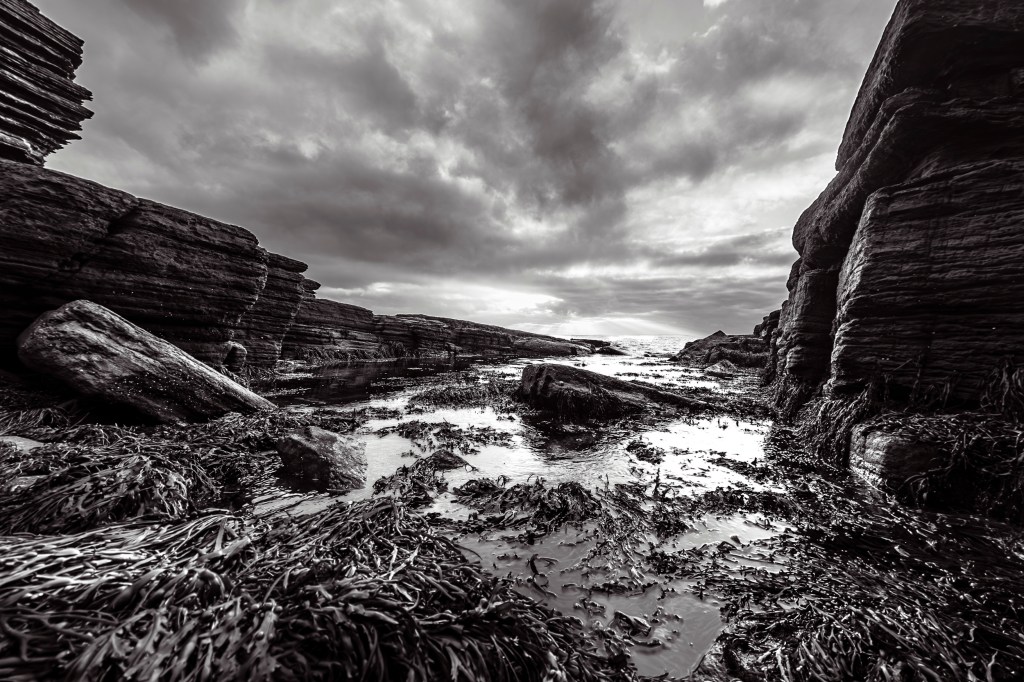
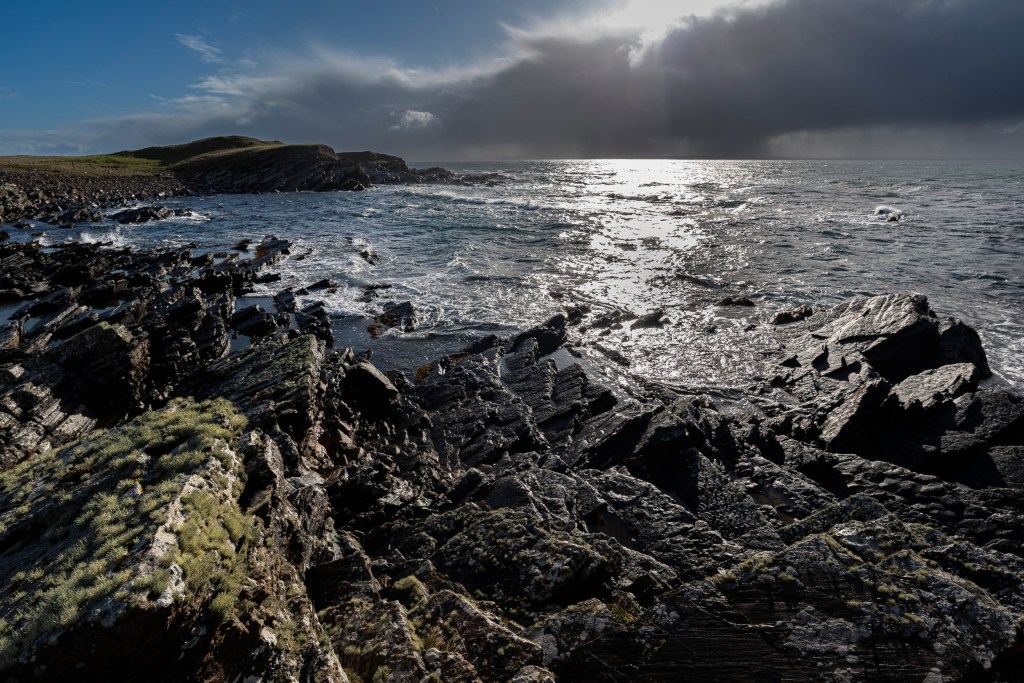
Beyond the grassland there’s a shoreline of shallow Geos, a mix of sandstone and black basalt, formed when Orkney sat far closer to the Equator than it does today. The basalt rises from the shore as if lifted by a wave, above the high water mark it’s dressed with Lichens, below it, washed twice daily by the tides, it’s dark and slick. The rain comes and goes. I’ve got a camera around my neck with a telephoto zoom, a wide lens is in a pocket. When the rain arrives I tuck the camera inside my coat and turn my back to the weather. Way over in the distance a group of cattle follow suit, heads to the South, arses to the North.

Black basalt- the geo of rotten loch

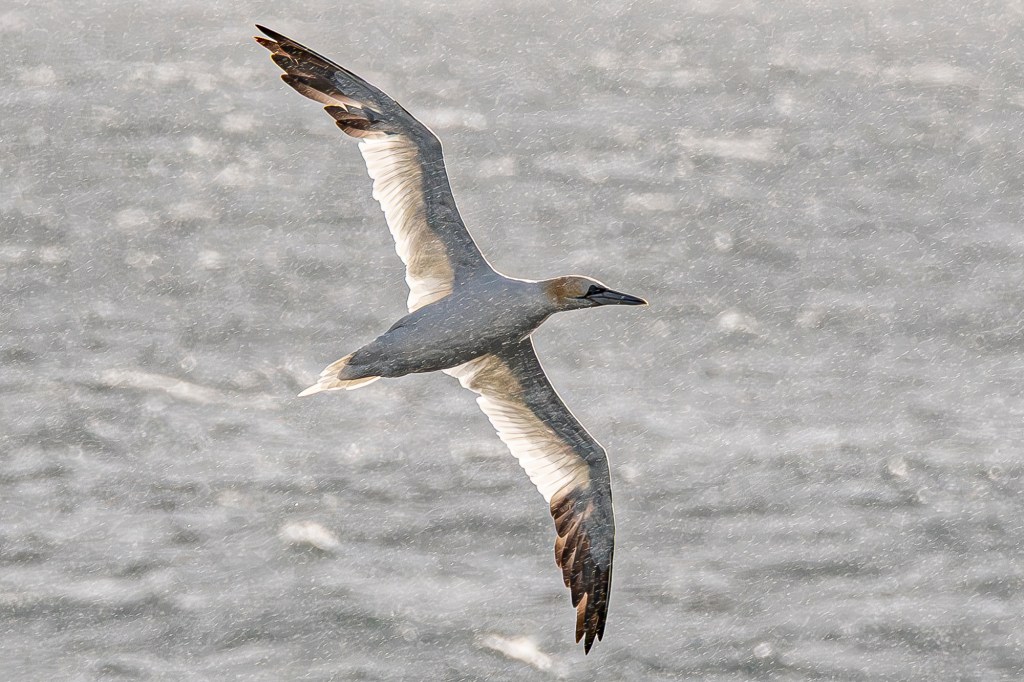
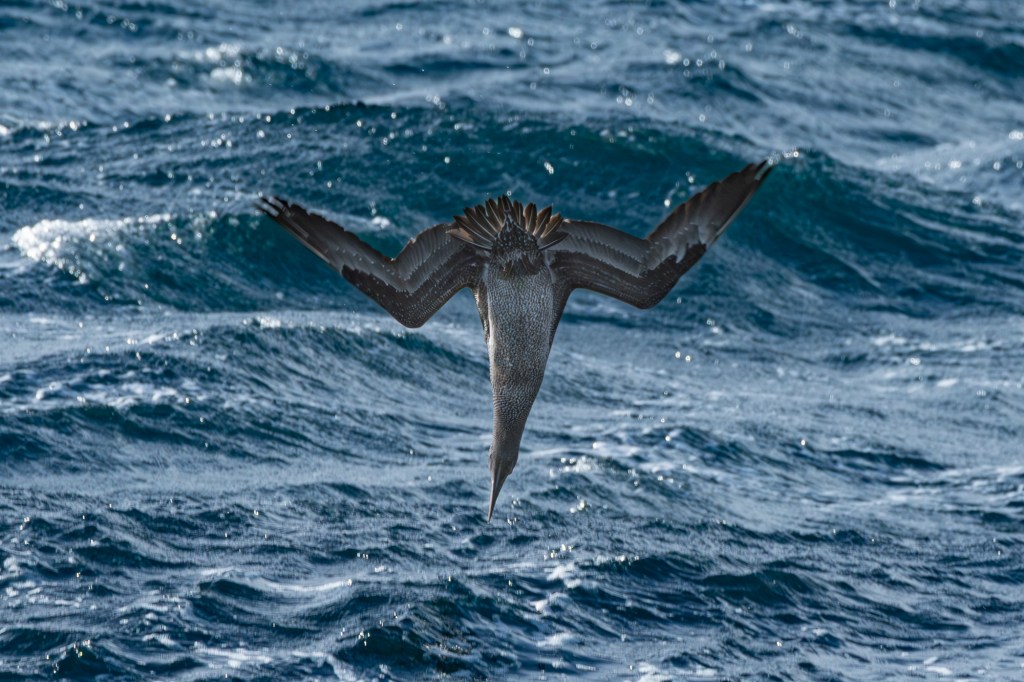
After a while I find a place to sit, sheltered by a bank, facing South towards Caithness. Gannets are fishing offshore, in Orkney they’re Solan Geese, from the old norse, sula. In old english they were the Ganot, a gander or a goose. As the weather turns and another shower blows in, a half dozen birds come within camera range and are photographed through a gauze of backlit rain. They’re large birds, a metre long body sporting an almost two metre wingspan. At a distance they’re white, up close they have eyes of pale blue-grey, black tipped wings and a head and neck dusted with ochre yellow.

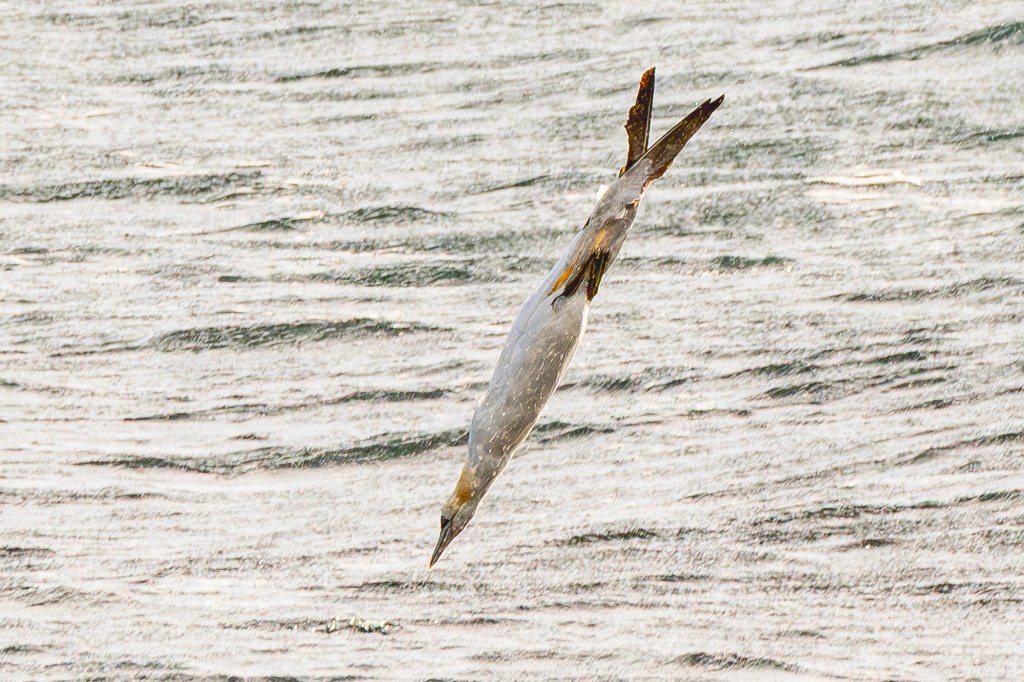
As the rain continues, I watch them dive, when a fish is spotted there’s the briefest inflight pause, they dip their heads and stiffen their wings, almost a hover, a split second later, down they go. At first they form the classic W, slanting in, wings half closed, eyes on the prize.

At the last moment they become a missile, a tube of feathers, feet at one end, dagger like beak at the other. Hitting the water at 60mph and barely causing a splash. My reflexes couldn’t keep up, from dive to impact is a couple of seconds – when I chimp the screen on the back of the camera I see far more out of focus misses than in focus hits. Other birds are seen, wandering Black-backs and pleeping Oystercatchers. Greylag geese rise honking and complaining from the mire, upset by my presence. Two fence lines away a Hen harrier flies at sheep’s back height, ducking the wind, but for today at least the Gannets are the star attraction.

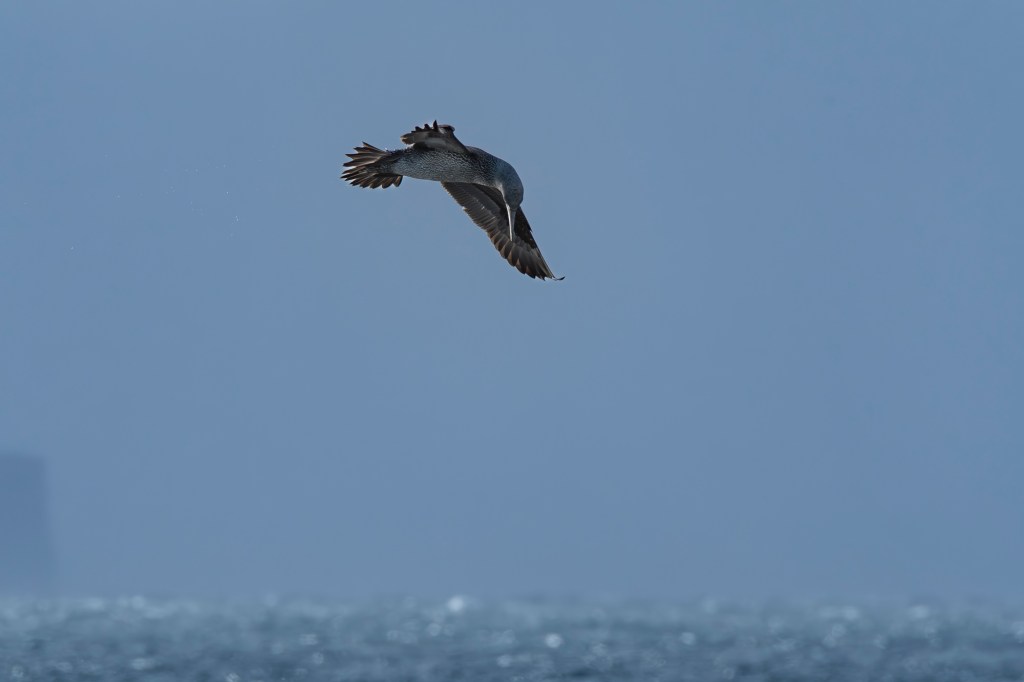
As the day wore on the showers thinned and the skies turned blue. On the walk home I watched a young Gannet hunt close to the shore. If an adult at a distance is white, a youngster is sooty black. Up close they’re mottled grey-brown, the colour of a Basking shark. As with the adults, just before diving, the bird had a tell, an almost imperceptible pause of the wings and a tilt of the head.

A pause, then a dive – juvenile Gannet.

The dancers pay a visit.

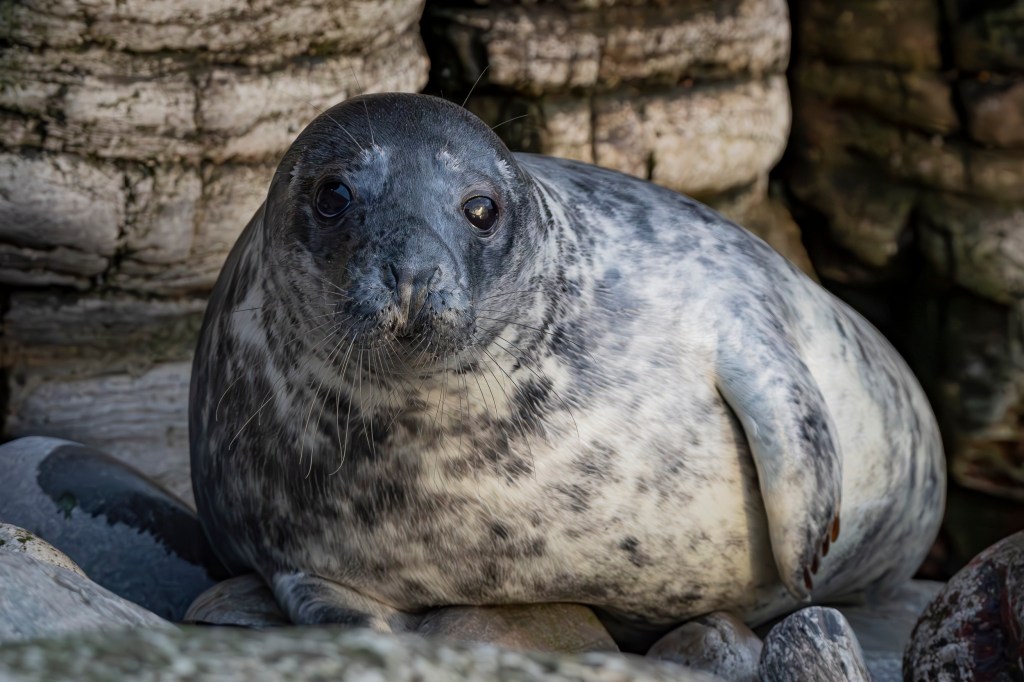
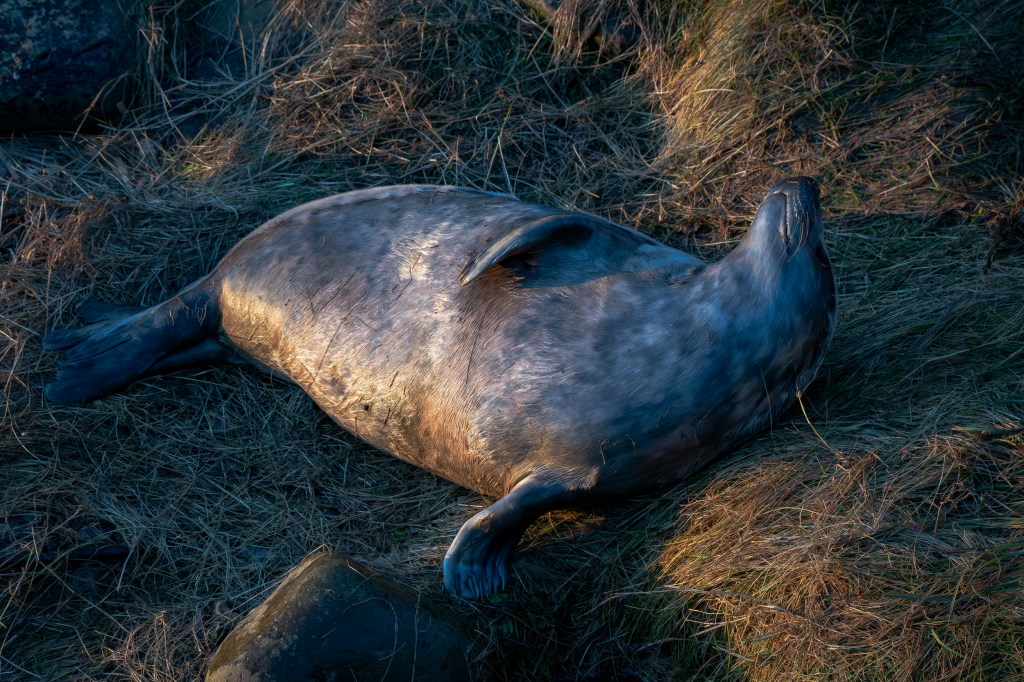
In Orkney, October marks a change. Summer is a memory. The days shorten rapidly, regular gales are a given, ditto our sometimes biblical rain. An unwritten rule says that bright dry days are to be grabbed with both hands. There are many upsides though, misty days bring a soft light, storms bring a white-capped life to the sea. Grey seals give birth to doe eyed pups and there’s the musical and beautiful yap of wintering Barnacle geese. One of the best gifts that October brings is the chance to spend a quiet couple of hours watching and photographing the Mirrie Dancers, the Northern Lights.

We’ve had a few teasers, an app tells of imminent displays – you go outdoors and see a blanket of unbroken grey cloud. Occasionally though it all comes together. Saturday past was such an evening, the sky velvet black, shot through with scattergun pin-pricks of light. Clear and still, a true silent night.

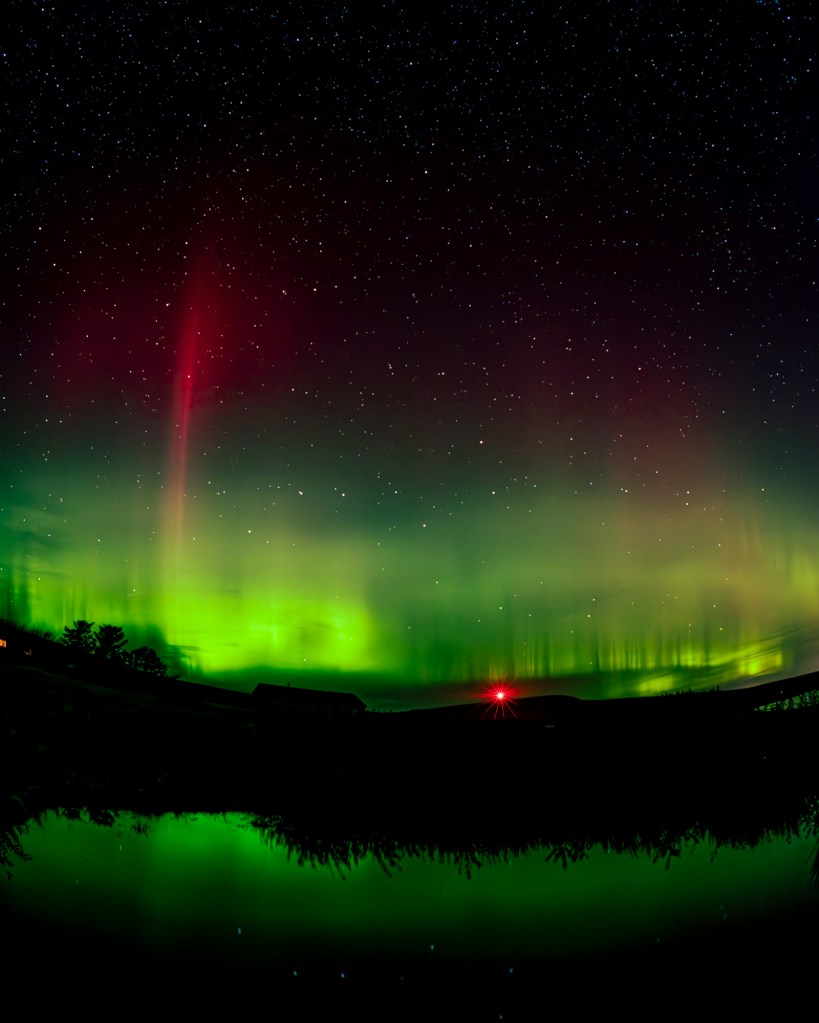
I stayed close to home, the frames above and below were taken in the garden and the meadow. In the frame above I used a fisheye, a lens that gives a 180 degree angle of view, wide enough to take in both the Milky Way to the West and the beginnings of the Auroras glow to the North. The downside of a fisheye is uncorrected distortion, those trees on the frame edges aren’t really growing on a slope. For the frame below I’d walked down to a pond in the meadow, disturbing a pair of what I think were Mallards. A splash of wings, a silver ripple on torch-lit water and they were gone, lost to the dark.

The aurora ebbed and flowed, the nights finale came as I walked back up to the house, dozens of light pillars erupted, green topped with red, filling the Northern horizon and stretching hundreds of miles high. For twenty minutes or more they shimmered and danced, a silent orchestra of light.

Summers end.

As summer drew to a close and astrological Autumn officially began, our weather for the most part stayed settled and dry, warm bright days that brought a swan-song flush of butterflies to the garden. Most numerous were Red Admirals and Painted Ladies, both of whose grandparents, or perhaps great-grandparents, had started their migration to Britain in the early months of the year, carried on the winds from North Africa. For both species the garden is a pit stop, somewhere to fill up with fuel before reversing the journey of their forebears. The Painted Ladies will return to North Africa, the Red Admirals to either Africa or continental Europe. Epic journeys for such seemingly delicate creatures who tip the scales at around 1 gram.

Red Admiral.

In the garden, Sedums are at the top of the list of the butterflies favourite plants, closely followed by geraniums and catmints. Sedums allegedly hate wet feet but in this winter-wet garden they grow so well that they need to be divided at regular intervals. Recently they’ve been given a new moniker, Hylotelephium, for us though they’ll always be sedums, old dogs and new tricks…

Painted Lady & Sedum flowers

It’s the time of year for Hesperantha coccinea to come into its own. Like the butterflies it hails from Africa and looks far too exotic for this Northern garden. It wears the same bright colours of the sedums, crimson-red flowers that are held aloft on lush sword-like stems. A plant that despite its exotic looks shrugs off the worst of our salt laden October gales. In the garden it’s usually our last man standing, often flowering through to late November. Jacqui has been planting spares along the length of the guerrilla garden, a strip of council verge dug and planted with waifs and strays from the garden itself.

Guerrilla garden Hesperantha coccinea

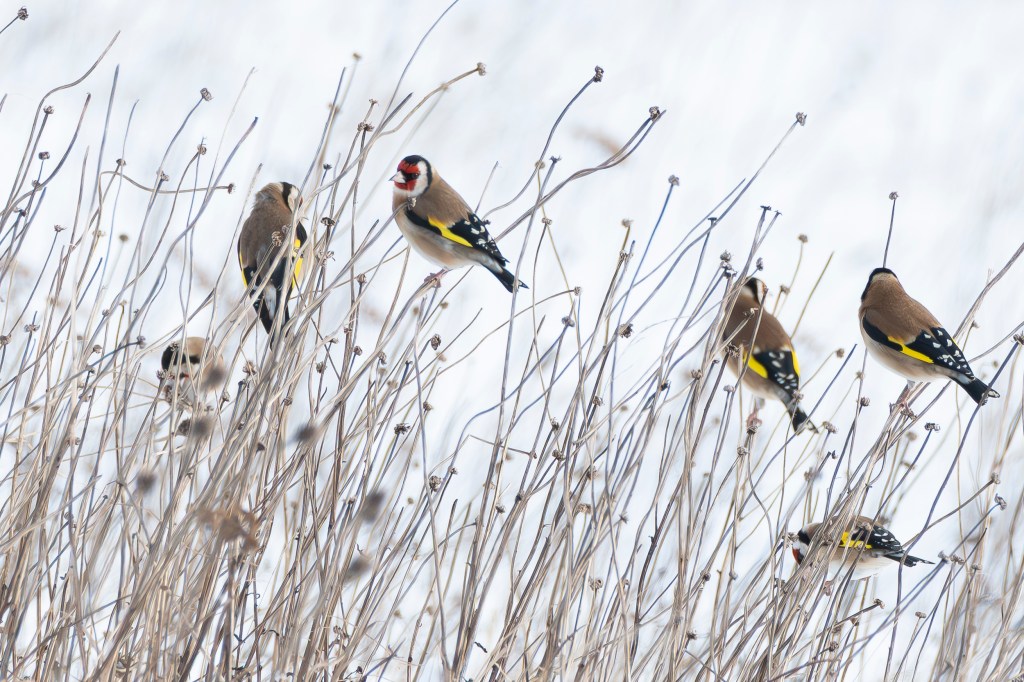
As well as the butterflies we’ve had an influx of birds, most notably Goldfinches, a charm of thirty or so dancing in on the breeze. A mix of adults and youngsters, the former looking all bright and shiny, living up to their alternative name of the seven coloured linnet, the latter are a bit more faded, like old denim, not quite fully moulted into their bright coats of many colours.

Juvenile Goldfinches.

Dining alongside them are Siskins and Lesser Redpolls, birds that arrive here in late Spring, staying for the Summer to rear youngsters in secret nests before moving on again in the Autumn. Their numbers are thinning already, soon they’ll be gone. For the photograph below I set a camera and tripod within a couple of feet of a feeder, tripping the shutter with a remote release. At first the birds were wary of the one-eyed, three legged interloper, (the camera & tripod, not me), within fifteen minutes it became a handy perch, somewhere to await a turn on the feeder.

Siskins & Lesser Redpolls
A handy perch…

Though the garden will last a while yet, the meadow has gone over. Once a tapestry of colour, now a field of sun bleached grasses and seed heads. Dotted here and there are single bright flowers, Cats ears that didn’t get the memo. A  few weeks from now we’ll mow it all down and rake it off, a favourite job  that’s best saved for a bright sunny day.

Cats ear.

A sure sign of Summers end was the arrival of Amy, our first named storm of the Autumn. She arrived on Friday afternoon, cancelling ferries and the community bus, spooling up to her maximum strength on Saturday evening. In Orkney you can see, and sometimes feel, the weather coming. Friday dawned still and bright but there was a change from previous days, an oil-slick sky and a damp chill to the air. Lunchtime brought whitecaps and spindrift to the bay, by mid-afternoon the view was stolen by sheets of grey rain. Despite her strength she passed by the garden without much incident, no damage bar a moor-edge lodgepole pine, left at an angle, roots half in and half out of the peaty black ground. This afternoon I’ll walk the shore at Snelsetter, checking Geo’s for driftwood cast up by rolling seas, Amy’s silver lining.

Snelsetter shore.

A welcome upside of Autumn is the arrival of darker nights, with the twilight of the simmer dim a distant memory night skies are once more as black as moleskin. The Milky Way, pictured top, is visible again, it rises to the West, conveniently over the house, an easy picture from the garden gate. It’s also the time of year when the mirrie dancers might put in an appearance. So far we’ve had teasers, an Aurora app pinging an alert of weak green glows rather than spectacular shows. The photograph below is my first sighting of the season, taken on a breezy September night from the moor beyond the garden.

A walk to Hoglinns.

Common sandpiper.

Beyond the low hills at the back of the house, Hoglinns Water lies in a shallow valley. From home, as the crow flies, it’s a couple of pathless miles of tangled heather and soft bog, in reality more a squelch and a stumble than a walk.  A  longer, but much more sensible route is via Heldale, following for the most part a favourite walk into the hills that has been mentioned on here before.

Heldale.

I went there a while ago, on a day that started dry and bright and ended with rain pattering the hood of my coat. I took the sensible route, first a stone track that leads into the hills, then along the shore of Heldale Water, the islands natural reservoir. As can be seen from the photograph above, it’s an open and ancient landscape, cleared by the stone axes of Neolithic man. What once was scrub and low growing trees had by 3500BC become pretty much the landscape we see now. It’s not devoid of life, nature doesn’t do vacuums but it pays to look down, rather than up as you might do in a woodland. As I walked a flitter of sulphur caught my eye, a pale leaf carried low on the breeze, I walked to where it had settled – a female Northern Eggar moth. She looked the worse for wear, tattered and faded, coming to the end of her brief few weeks of adult life.

Northern eggar.

Brighter coloured Magpie moths were also seen, a relatively new species to Orkney, arriving around four decades ago. The bright colours are a warning to predators, it’s said that they are so distasteful that spiders will cut them from their webs rather than eat them. Their caterpillars are one of the easiest to identify, they wear the same colours as the adults, in bright body length stripes, and look as if someone has squeezed them toothpaste-style from a tube.

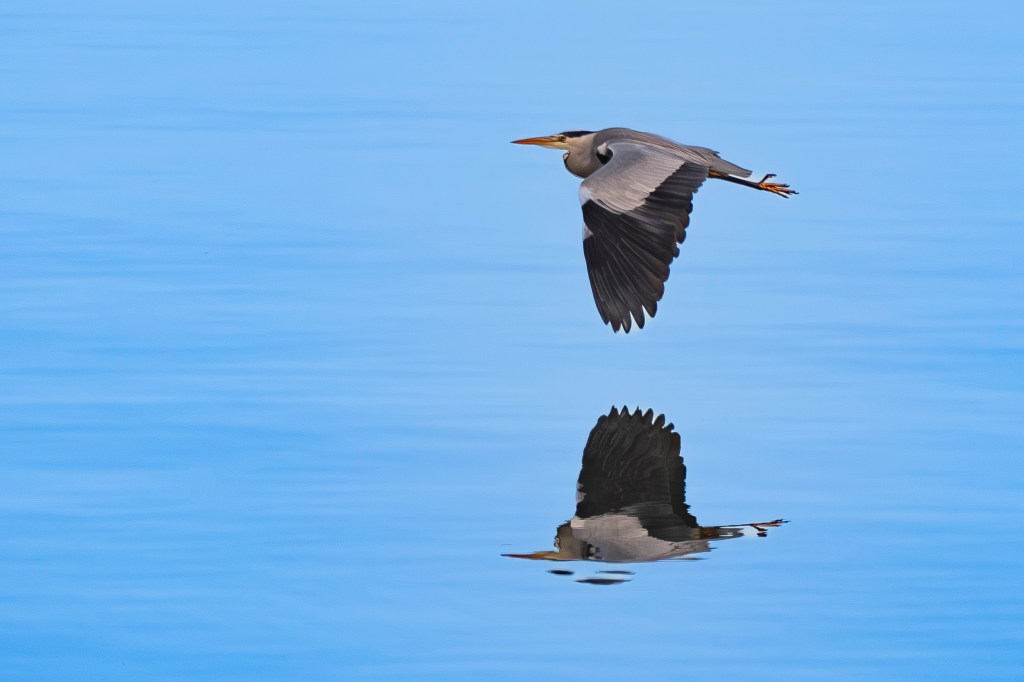
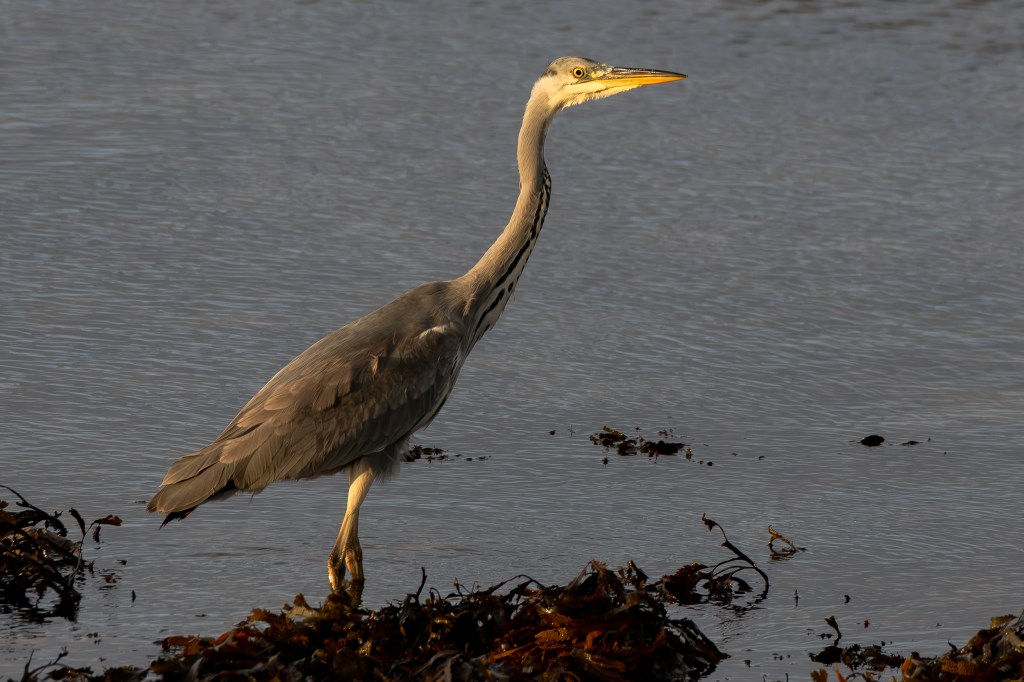
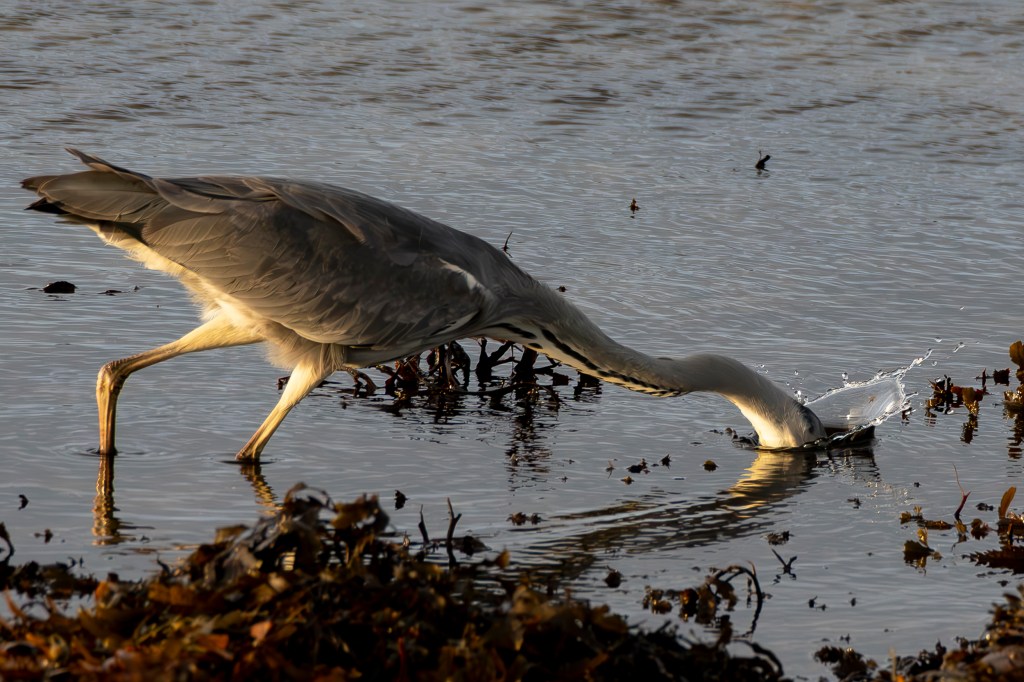
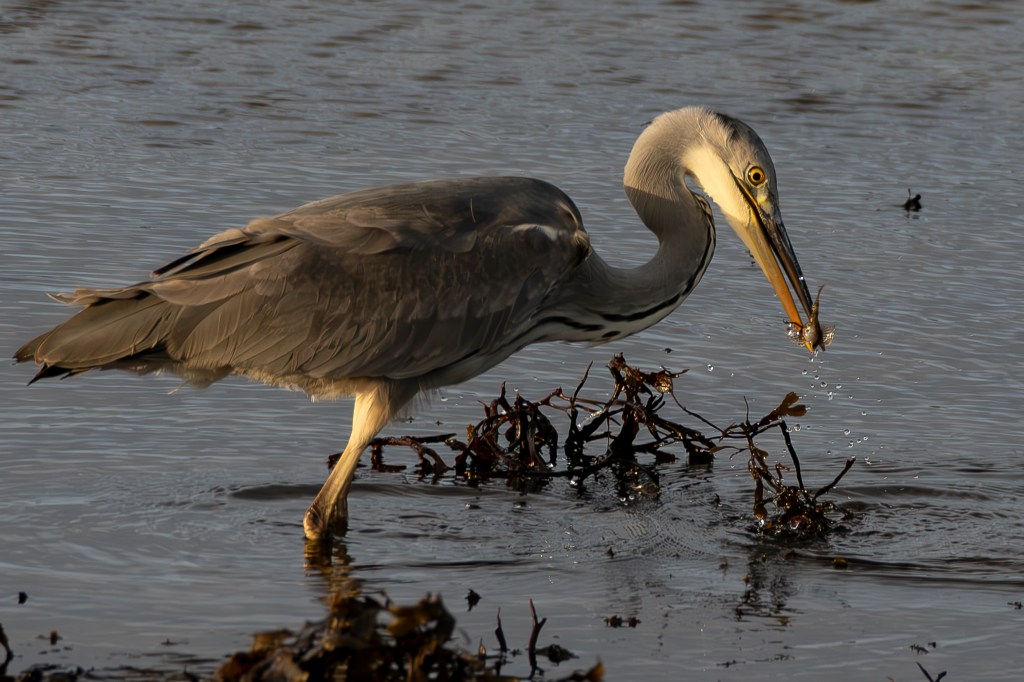
At the margins of Heldale water, Sticklebacks can be seen, small pot-bellied submarine flotillas that bask in the warmth of the shallows. They’d be an easy meal for a patient Heron but for whatever reason, on Hoy at least, the Heron is a bird of the coast. Heldale was also once the home of a much rarer fish, the Orkney Char, a relative of the Salmon and known only from specimens caught in Heldale itself, not seen since 1908 it was officially recorded as extinct in 2024.

Sticklebacks.

As you reach the end of the Water, where shore turns to marsh, there’s a manmade abutment, cast concrete and driven piles. Built to stop water being lost to the surrounding low lying bog. A handy spot to pause for a bite and a drink and also a great way to avoid wet boots,  a lichen spattered walkway that takes you over the rushes rather than through them.

A bird I’d hoped to see was the Arctic Skua, a slender cousin of the commoner and much more thickset “Bonxie”, the Great Skua. As with the Bonxie they’re a bird of  Northern summers and Orkney is about at the edge of their breeding range. An alternative name is the Parasitic Skua, a moniker that they live up to. They’re often seen in pursuit of Terns – a brief  twisting dogfight ensues, an aerial ballet that usually ends with the pursuer getting a free meal, a prize of fish or sand eels, either dropped or literally coughed up by the pursued. In the end I saw a half dozen. They come in two forms, dark phase and pale phase, the former is dusky brown, the latter is two tone, cream below and mocha above. 

Dark phase Arctic skua.

From the abutment it’s a short walk to Hoglinns, up over a low hill and back down into a valley. The ubiquitous Skua in Orkney is the already mentioned bonxie. The size of a Herring Gull on steroids they’re known as the Pirate of the seas. It’s almost a given here that if you’re walking in the hills a bonxie will take umbrage at your presence and buzz you for the sake of it. Sure enough as I crested the hill to walk down to Hoglinns there was a whoosh of wings as a bonxie, sneaking up from behind, applied the air brakes and passed within a couple of feet of my shoulder, returning for a second head-on pass a few seconds later. It’s not an attack of course, just a bluff where no contact is made. Stand still and the bird will veer off at the last second but that whoosh of wings and passing shadow is enough, when it suddenly interrupts the silence of your thoughts, to give a quick heart skip.

Bonxie eye contact.

Hoglinns itself is a pool of peat-dark water, cupped in the hands of the surrounding hills, ringed by ferns and grasses that shiver on the breeze. I stayed for a while but as is often the case the journey is better than the destination. The origin of its name seems to be lost to the mists of time, in Orkney many place names derive from the Norse and the Norsemen who settled these islands and the best I could find was “Hoaglin”, a woodcutter or farmer. Definitely not the former, Neolithic man had beaten him to it, but perhaps the latter.

Hoglinns.

From Hoglinns the sea isn’t too many stone throws away, around a half mile or so to the West. Before turning for home I walked to a headland. Gannets were fishing offshore, cruising over a silver swell. Occasionally they would dive for a meal, half-folding their wings and falling vertically, like head shot geese.

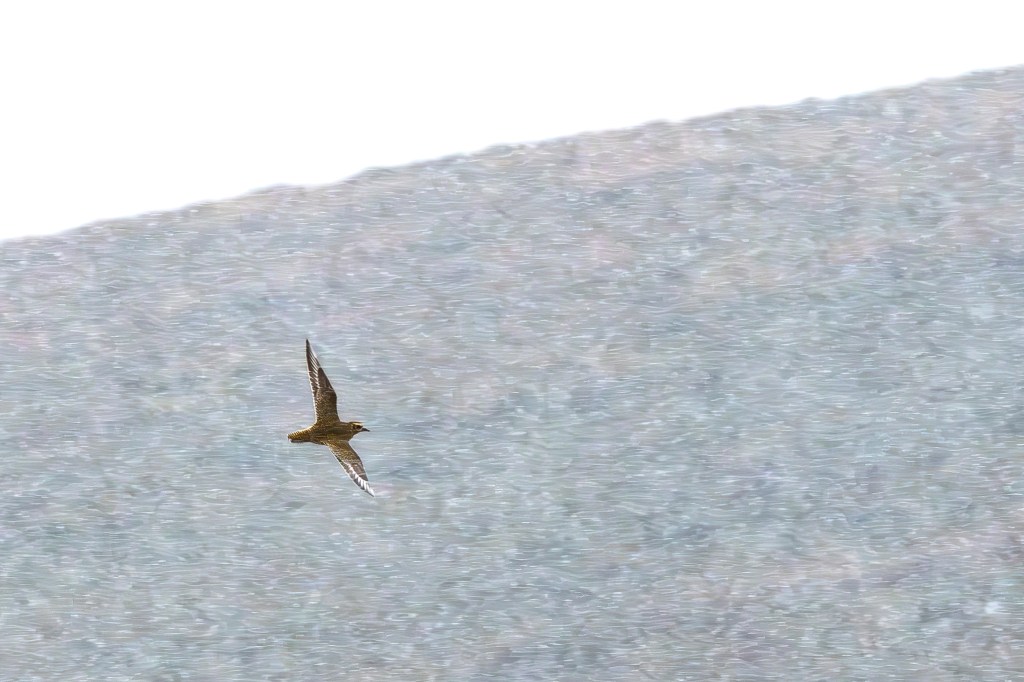
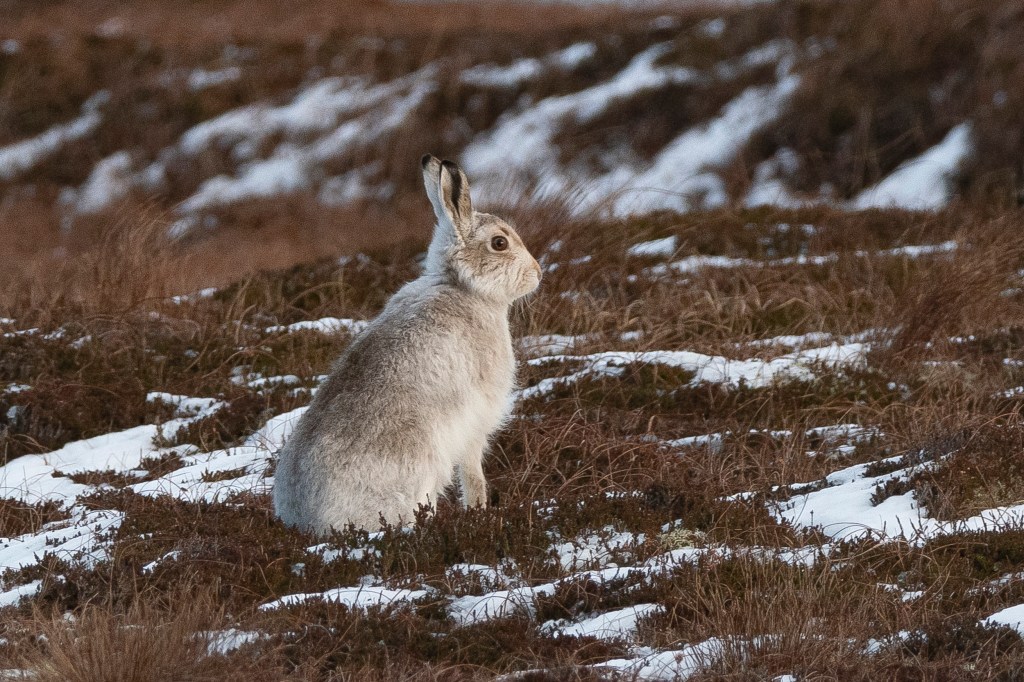
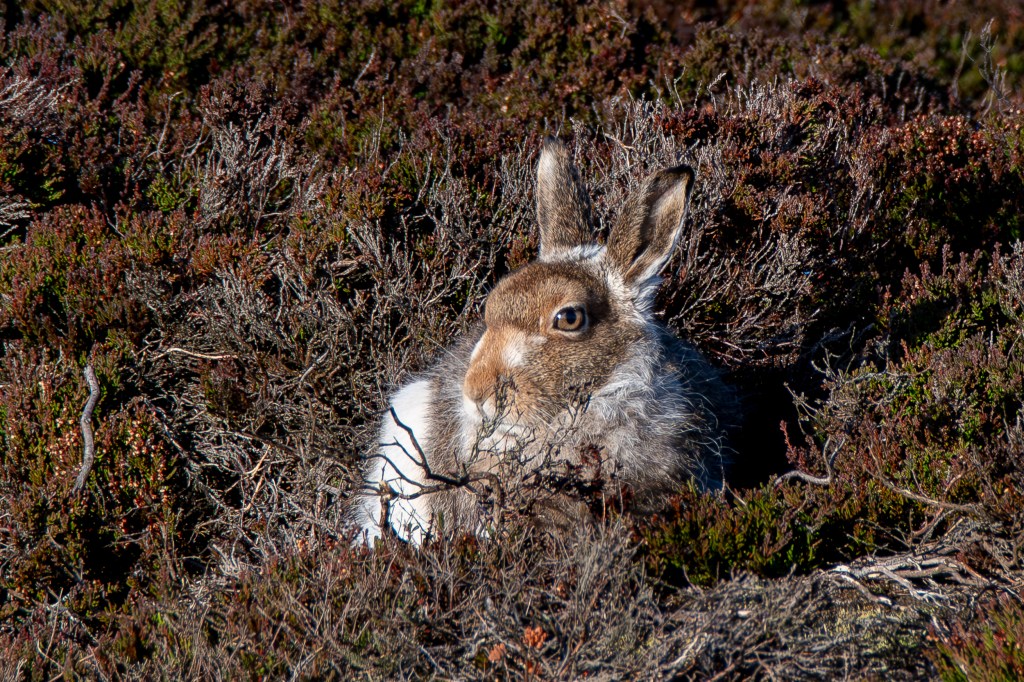
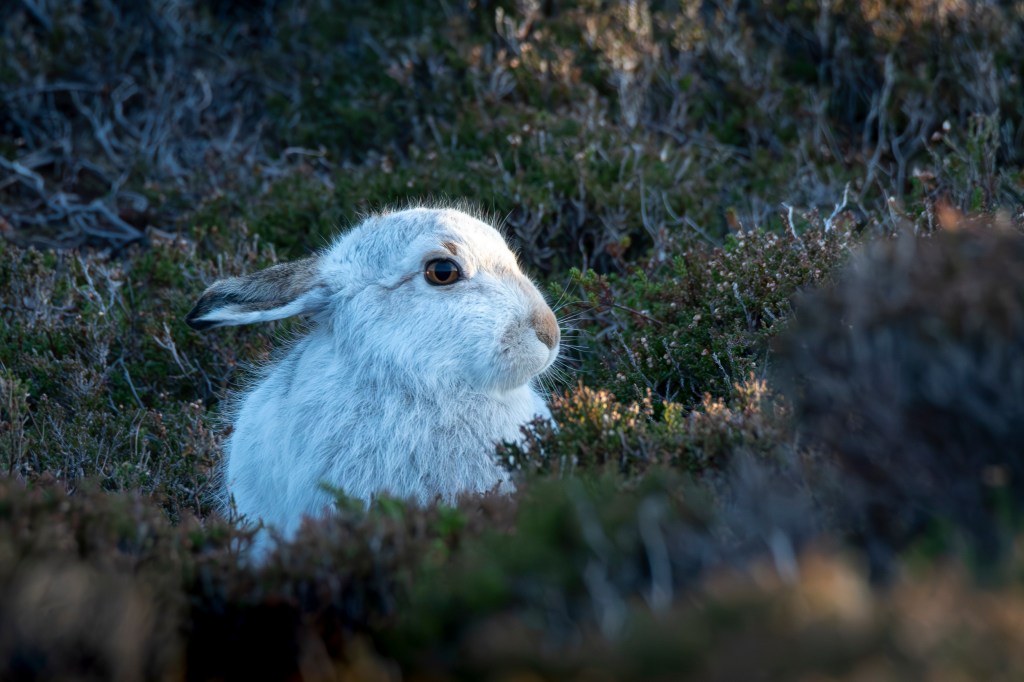
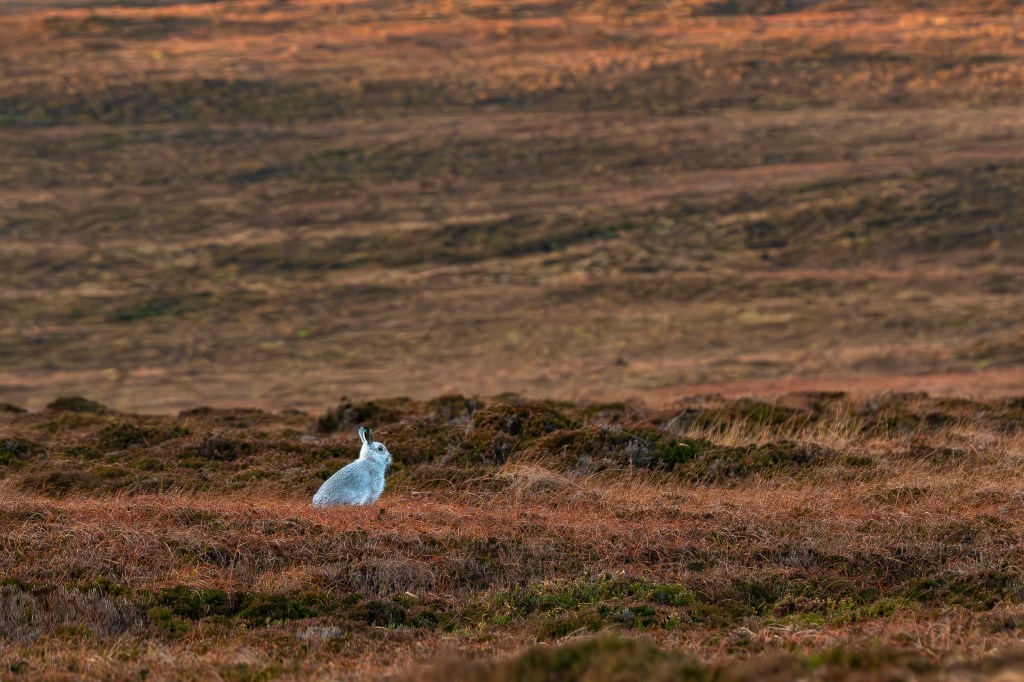
The walk home brought sight of a Common sandpiper (pictured top) and a good number of Mountain Hares. The Sandpiper scolded me with a warning as it bobbed up and down, as Sandpipers do, on its fence stab vantage point. Like the Skuas it will leave soon for a Winter in Africa. The Hares were clad in their summer coats, blue-tinged brown, soon they’ll moult to white, camouflage for snow that in Orkney rarely arrives.

September the 1st.

Lysimachia firecracker

For the past couple of weeks I’ve been working with a friend, fitting a weatherproofing skin of timber cladding to his new build house that sits just along the way. The weather was kind and for Orkney, as for most of this year, unusually dry. Of the fifteen days that we spent on it, we saw perhaps a half hour of rain. Tiring work but with moor and low hills to the back, and with the bay to the front, it wasn’t a bad office. As the days passed subtle changes were noticed, the moor slowly turning from brown to purple as Heathers came into flower. The island of South Walls, a mile or so distant, an evolving patchwork of greens and gold as grasses were cut and cleared and Oats slowly ripened in the sun. 

South Walls, once part of the Norsemen’s ‘Vagaland’ – land of bays

In the garden changes are also afoot. In Orkney we don’t get an Autumn where trees are clothed for weeks in lingering yellows and reds. As Summer draws to an end, leaves fade quickly, at first from bright to dull green and then, when a salt laden gale swings in, crisping brown overnight. As if scorched by a man with a blow lamp. What the trees can’t give though, perennials can, it’s the time of year for yellows and reds to show their hand. Crocosmias are a favourite, they grow well here and need little in the way of care. We’ve got the usual eye catching suspect of traffic light red Lucifer, a tall plant that looks good at the back of a border, but prefer the smaller species that sit and mingle with others. A favourite is C.Pauls best yellow, a compact variety that is said to be a spreader but for here at least, is pretty much well behaved. 

Paul’s best yellow

A late summer species that we tried, and failed, to grow in our old garden in Yorkshire is Eupatorium, the Joe-pye weed, On light sandy soil they first sulked, then succumbed to mildew, and then promptly died. Up here they thrive, no sulking or mildew in sight. A  favourite is little Joe who despite the name, can reach a leggy five feet.

Little Joe

Persicaria’s are another late Summer favourite that are doing better here than they did down in Yorkshire. They’re a member of the knotweed family and in times past some varieties were used as a flea repellent in bedding, earning the name “arsesmart”, which I assume means that the skins reaction to the plant was actually worse than the flea bite. The largest we grow is P.Polymorpha,  a tall (and wide) mid-summer flowerer that as with Crocosmia lucifer is better at the back of a border, ours is fading now, plumes of white dimming to soft pink seed heads. As polymorpha fades, others are just getting into gear, P.taurus, a much more compact and pretty much bomb proof variety, has flowered this week, its dark crimson bottlebrush flowers look best either early or late in the day, lit by angled light.

Taurus

If we had to choose a favourite red for this time of year Taurus would get a double thumbs up. A favourite yellow is a split decision, for Jacqui it’s a toss up between C. Paul’s best yellow and Lysimachia ciliata firecracker (pictured top). Lysimachias belong to the primula family and have a long history. The genus gets its name from King Lysimachus, successor to Alexander the Great, who is said to have calmed a mad Ox by feeding it Lysimachia – livestock escapees are a fact of life here, the next time I meet a Bull wandering down the road I’ll know exactly which plant to reach for 🙂 My thumbs up for a favourite yellow would be Rudbeckia goldsturm, aka Black eyed Susan, one of those dead easy from seed plants that looks good wherever you put it.

Rudbeckia goldsturm

Others help with the Autumn feel by fading gracefully, their job done for the year. One is Hosta Sum & substance, whose once bright leaves were recently crisped and mellowed by storm Floris. It will fade now, from pale green to yellow and by October, to a soft marmalade orange, there’s a real beauty in its slow decay.

Sum & substance

Birds are coming and going, the Blackbirds that have graced the garden for the Summer, rearing cocoa brown youngsters that are drawn to half apples like moths to a candle, have gone off to pastures new. In Autumn new birds will arrive from the North, bringing with them their Redwing and Fieldfare cousins, eager to strip Rowans of their berries. As the blackbirds have left, Starlings have returned, pretty much absent for the past few months they’re back from pasture and shore, ready to cluster on feeders, doing what Starlings do, eat, squabble, rinse and repeat. The bird below is a this years youngster, newly moulted into adult plumage but given away by the jet black beak.

I probably really need to get out more but a recent sight that made me smile was a mouse turning over gravel, or boulders if you’re mouse sized, to get at seed dropped on a path from a Niger feeder. I’d first spotted him weeks ago, a tiny just out of the nest youngster with a slice missing from one ear. With no sense of danger, straying, in mouse terms, far from the safety of a dry-stone dyke home, I’d wrongly assumed that his days were numbered. 

We’ve christened him Wing nut.

Damsels & Devils.

Common Knapweed and Carder bee.

Today it’s wild, high winds with a mix of sunshine and horizontal rain. All courtesy of storm Floris, currently tracking his way across Scotland. We’ve had the warmest July ever recorded in Orkney, ditto June, Floris is a reality check, a reminder of what Autumn will likely bring.

Floris pays a visit.

With or without Floris, by this time of year it feels as if Autumn is lurking in the shadows. The nights are drawing in, the seemingly endless daylight of the simmer dim already a memory. In the meadow the Ox-eyes, that in June turned the field white, are fading to seed. It’s now the turn of Cats ear to be dominant. The meadow on a sunny day is lit golden-yellow by their flowers. They’re heliotropes, turning their faces to track the sun, starting the day facing East and ending it facing West. A member of the Hawkbit family, when we first cleared the meadow they needed no reintroduction. Springing to life from the fields slumbering seed bank, growing as thick as grass.

Cats ear.

It’s also the time of year for less dominant late summer wildflowers to put on a show. Common knapweed is a favourite, aka ‘hardheads’ – a great bee and butterfly plant. Reintroduced via home grown plugs, they’ve established well. Unlike the Ox-eyes and Cats ears, who seem set on world domination, they’re happy to mingle with others. Their purple-pink flowers noticed not from afar but up close, as you brush past them.

Hardheads.

Another harbinger of Autumn is the Devils bit scabious, named for its stubby “bitten off by the Devil” root. Up here they’re more a plant of coastal heaths, the clifftops at this time of year are literally bejewelled with their blue pom-pom heads. At home they’re slowly establishing. Year on year the grasses have grown shorter, sucking up what little nutrients the ground had and weakening themselves in the process, in contrast the Devils bits have gained ground, reintroducing themselves as conditions turn in their favour.

Devils bit scabious. A favourite of the Green-veined white butterfly.

The only part of the meadow where Ox-eyes and Cats ear, at least for the moment, aren’t dominant, is a spot close to the house. The ground is new, a bank of subsoil imported from a friends building plot just along the way. Once rotavated and cleared of stone, the bare earth was sown with a mix of native grasses plus whatever wildflower seed we had, almost as an afterthought I added wild carrot to the mix, a biennial, whose root as its name suggests, gave us the cultivated carrot. As with all biennials, sowing in year one gives flowers in year two. They didn’t quite get the memo, nothing in year one, as expected, but also barely a flower in year two. This year though brought an explosion, a sea of large white umbels, occasionally tinted pink. In the garden we treat them as annuals, sowing in cold frames in late Summer, planting out to flower the following year. In the wild they’re a plant of chalk grasslands and drier soils, not suited to Orkney and her winter wet. I’ve a feeling that for the meadow at least, this is their swan-song. Beautiful while they last.

Wild carrot.

A carrot family member that is much more at home here is Wild angelica. Legend says that Angelica came here with the Norsemen, the Vikings who started to settle here in the late 8th century. In a nod to this a local distillery adds Angelica to Kirkjuvagr gin. The distillery is based in Kirkwall, the Orkney Islands capital, the Northmen knew it as Kirkjuvagr – Church bay. 

Angelica.

In the meadow it’s a great insect plant, attracting everything from beetles to butterflies. They’re a particular favourite of both Wasps and Red Admirals. I’m happier getting closer to the latter rather than the former. Both were photographed last week, sipping on the Angelica’s energy giving nectar.

Too close for comfort….
Red admiral, a regular late Summer arrival.

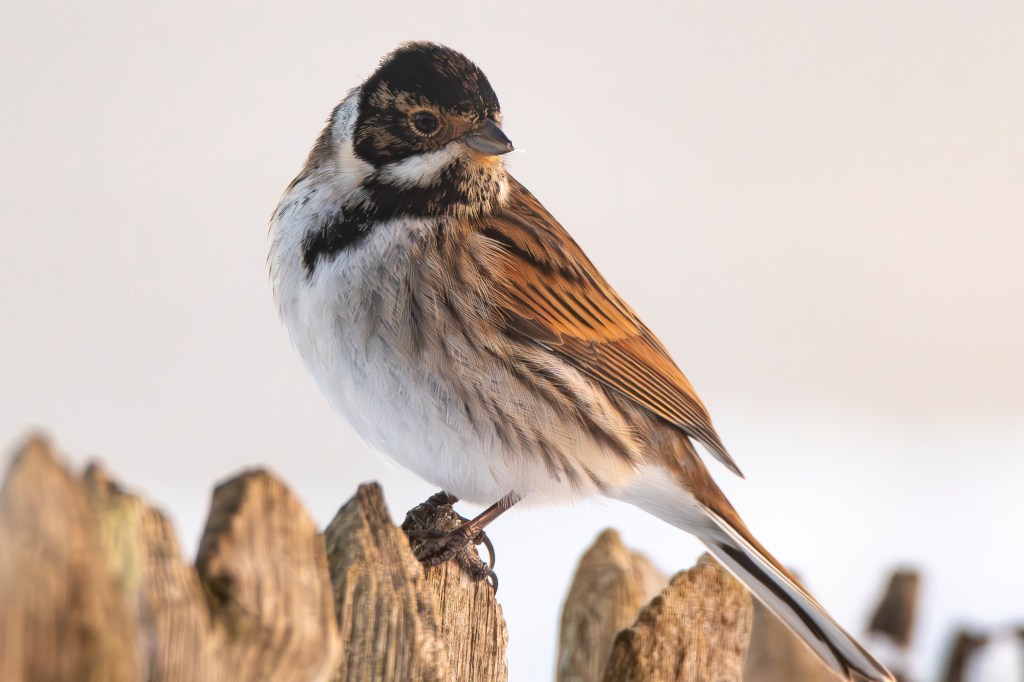
At the bottom of the meadow, close to the shore, three ponds were dug, each filling naturally with run off from the hills. The ground there is peaty, black as coal. A ‘soup’ of life was added, bucket fulls of mud and brown water, collected from a flooded peat cut, after that the ponds were pretty much left to their own devices. The ‘soup’ immediately brought tiny shrimp like invertebrates, whirligigs turned up within days, diving beetles within a few weeks. Wet and Rushy areas close to the ponds were planted with Coastal willow, salix hookeriana. In Summer Reed buntings nest among them, tucking their nests low, amongst the rushes and grasses that grow in the Willows shade.

A (female) Reed bunting.

This summer, for the first time, Damselflies are being seen over the ponds. Like the Scabious mentioned above, they’re tarred with the same brush, this time the Devils darning needle. It is said that if you fall asleep near a pond, damselflies will alight on your face and sew your eyelids together. The one below is the appropriately named Blue-tailed damselfly. Their eggs will hatch as nymphs, who will live an underwater life. Two years from now, providing my eyes haven’t been stitched together because I fell asleep near the ponds, I might just get lucky and see a nymph crawl from the water, bursting from its skin and becoming a Damselfly.


Doves & Daylilies.

For Orkney, today excepted, which is grey and dreich, the past two weeks have been unseasonably dry and hot. Days that have brought mostly blue skies and light winds. I wrote a while ago that the front gardens were standing room only, now it’s the turn of the rear garden. A small oasis, beyond which are thousands of acres of open moor, that owes its existence to a thin shelter-belt of wind filtering Alders and Sycamores. At the moment plants are tucked shoulder to shoulder, barely a gap to be seen.

Standing room only…

Thanks solely to J’s efforts, it is a garden that in Summer is ever changing. This week has seen Japanese Anemones at their best. Given their preference for damp soil and (mini heatwave excepted) cool conditions, they’re an ideal plant for this Northern garden. A favourite is September Charm, that despite its name flowers like clockwork in early July. It’s a member of the buttercup family and like its wilder cousins, can be a bit of a spreader. 

September charm.

Three years ago we planted Anemone Bressingham Glow, a smaller, more compact variety. As is often the case here with new additions, it sulked for a year before deciding that Orkney wasn’t that bad after all. 

Bressingham glow.

Trollius are another buttercup family member that do well here, we grow a couple of varieties, one is bomb proof Europaeus, mentioned in an earlier blog it flowers for us in May and June. The other is July flowering Golden Queen, an unusual dark orange variety whose colour gives no hint of its buttercup DNA. 

Trollius golden queen.

A plant that looks far too exotic for Orkney is the Daylily, Hemerocallis – from the Greek, day and beautiful. They are just starting to flower here and literally do what it says on the tin, flowering for a day or so before yielding their petals to the rain or the wind. For us a variety called Stafford is always the first from the blocks, throwing up multiple buds that collectively will last for a month or so. When backlit by the sun it glows with the heat of the day, a furnace-yellow centre, cooling outwards to dark red petals.

Stafford.

In a back garden shady spot, a plant that would wither in the sun but grows well in the shade, has also come into its own this week, a white Astilbe. We’ve had it for years, both here and in previous gardens, and its specific name is long forgotten. In the photograph below only the multi-trunked Sycamore was here before us, all the other trees are Red Alders, planted between four and seven years ago. It seems that in little more than the blink of an eye a small woodland has been formed. Beyond the simple driftwood fence there’s a work in progress, the new woodland floor is slowly maturing, the thickening leaf litter dotted with plugs of foxglove and red campion. Despite its small size, each Autumn and Spring, migrating Woodcock are drawn to it like moths to a flame.

Shady spot Astilbe.

We’ve tried a few red hot pokers here and most successful by far has been Kniphofia Fiery Fred, whose rockets of orange at this time of year sit well in back garden semi shade. An alternative name is the torch lily, and at dusk or on a grey day, they literally do light up the gloom. They’re a good foil for the cooler blues of geraniums and catmints, but on a clear day look best not in the shadier back garden but at the front, against the blues of sea and sky. 

Fiery fred.

It has been a good year for breeding birds, a pair of Wrens reared a family in an old hollow gate post. Robins have reared broods in open fronted boxes knocked together from offcuts of old ply.  House Sparrows, again in homes made of ply, are on brood number two, with time yet perhaps to squeeze in brood number three. A bird that when we first moved here was a rarity in the garden, fast forward a few years and with the addition of the basics, food, shelter and somewhere to nest, it seems every bush or tree has its own cluster of newly fledged youngsters.  

A juvenile house sparrow.

Whichever the species, parent birds are run ragged from dawn to dusk, finding food for never full bellies. Collared Doves are a garden favourite, gentle birds that first bred in the UK, in Norfolk, in 1955. So successful was their colonisation that in 1962, a mere seven years later, the first Collared Dove was recorded in Orkney. A few days ago I watched a pair of adults atop a stone dyke, each gently preening the other, having some us time after the kids had finally flown the nest.

July the first.

June ended as it began, days of bright and breezy weather with occasional bouts of heavy rain. The Solstice weekend, when you secretly hope for a stunning sunrise or sunset, brought a thick haar on the Saturday and on the Sunday, after a monochrome start to the day, thunder and lightning with cloudburst rain. I wonder what the first settlers to Orkney would have made of it, the people who built Maeshowe and the Ring of Brodgar, to mention just two of many Neolithic sites that dot these islands, waiting patiently for a sunrise and getting thunder and lightning instead. Probably that in the eyes of whichever gods they worshipped, they were definitely in the bad books…

Solstice Sunday – towards Longhope.

In the garden the high winds and rain have been shrugged off. You learn quickly in Orkney to be preemptive with staking, a task that Jacqui starts in early Spring and continues as plants grow, tweaking and re-tying anything that is wide or leggy. 

The guerrilla garden.

Some plants though don’t need support, Cephalaria gigantea, the Giant scabious, is one of them. It lives up to its moniker, comfortably reaching eight feet in height, at least half of which is a lattice of thin green stems topped with creamy-yellow pincushion flowers. We dot them everywhere, a few are in the guerrilla garden, pictured above, a roadside verge beyond the front garden dry-stone dykes. Part ours but mostly the county councils, a home for spare plants, waifs and strays from the garden proper. Last week the cephalarias shrugged off a 50mph southerly, flower stalks bending almost flat before springing back up.

Cephalaria gigantea.

A couple of other favourites that look far more wind delicate than they are, grow at the other side of the dyke, in the still very exposed front gardens. One of them is ligularia Rocket. As with the cephalaria it’s another plant that lives up to its name, shooting spires of yellow flowers, held on inky-black stems, to a height of six feet or more. A bit of a damp lover that needs space to look its best.

Ligularia rocket

The other is linaria purpurea Canon went, a member of the toadflax family. Not quite as lofty as the ligularia it seeds freely, is as tough as old boots, and is pretty much left to do its own thing. It’s also a perfect bee magnet.

Canon went.

While some plants reach for the sky others are happier at a lower level, a white aquilegia that came as a gift uses others as a support, relying on catmints and geraniums to hold its flowers aloft. It never had a label but it might be Munstead white. The lady who gave it is no longer with us so much more important than a name is to keep it going, young plants grown from seed collected last year are doing well. One of those plants, like the cephalaria that originally came from my fathers East Yorkshire trackside allotment some 45 years ago, and has been split and re-split ever since, that you really don’t want to lose.

A keeper

Bees are busy in the garden, I watched a small Bumblebee, a Common Carder, feeding on Lupins. A deep flower and a small bee don’t go well together. The bees technique for reaching into the depths of the flower was impressive, land on the lower petal and push down hard with your legs, opening the flower and gaining your reward. A reverse bench press for bumblebees.

And push..

On the moor beyond the garden, Oystercatchers tuck their nests amongst  the heathers and grasses. This year, on the small patch of moor that came with the house, at least three pairs have reared young, a fourth nest was lost early on to a Raven, spotted leaving the scene of the crime with an egg held firmly in beak, food for his or her family. The youngsters are out of the nests now and are carefully watched over by ever anxious parents. One day last week I walked up to check on young Rowans planted last year. I kept my distance but one parent still buzzed me, pleeping loudly and coming in at head height until the intruder, after checking the rowans, jumped the boundary fence and carried on into the hills.

Get off my land

Climbing higher, up through the old peat cuts, the settlement of Longhope on the island of South walls came in to view. A picture was taken of a Mountain Hare with the village as a convenient backdrop. A 600mm lens compressing perspective and pulling the three mile distant houses closer, just over the brow.

In the UK, moorland is sometimes much maligned, often seen as a desolate treeless waste. The reality is very different and internationally Scotland holds around 75% of the worlds heather moorland. Some species are unique to the moor, one is the Large Heath butterfly. Once so common that before the moors of Englands North-west were drained for agriculture, it got its own local name, the Manchester Argus. Now extinct in many parts of the UK they’re still a common sight on the moors here on Hoy. Easy to spot, as I walked further on into the moor I must have seen a couple of dozen, and hard to photograph. They fly fast and low in a direction that seems to be governed purely by the wind, briefly settling every twenty yards or so before lifting off again. Eventually patience paid off and the photograph below was taken. There are three subspecies, at least two of which I’ve seen in Orkney. This one, with its blue-grey colouring, is ssp scotica.