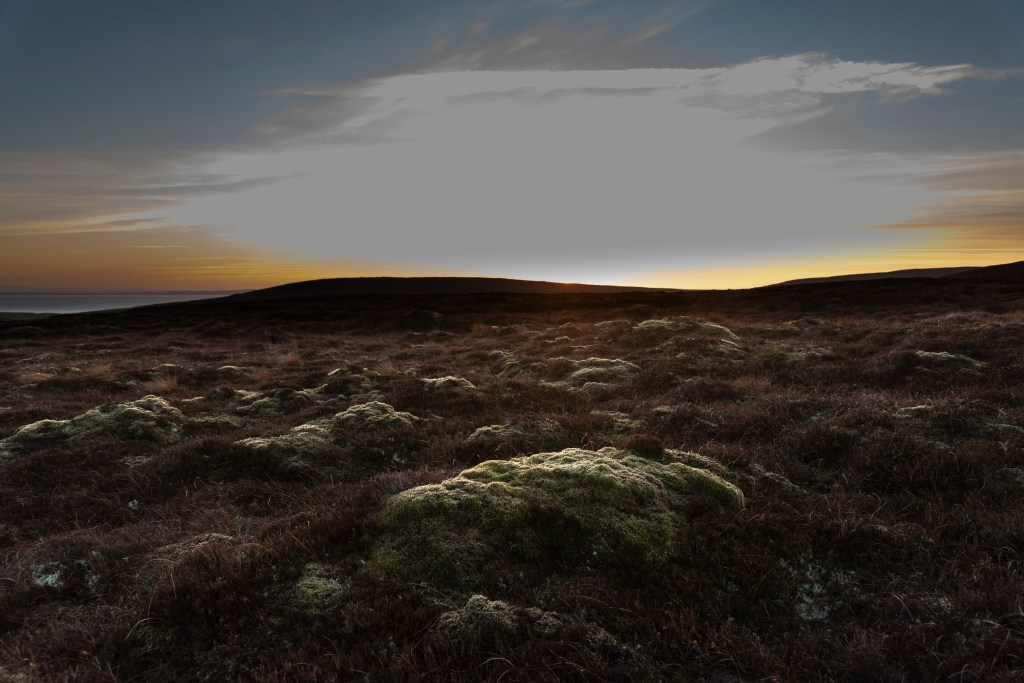
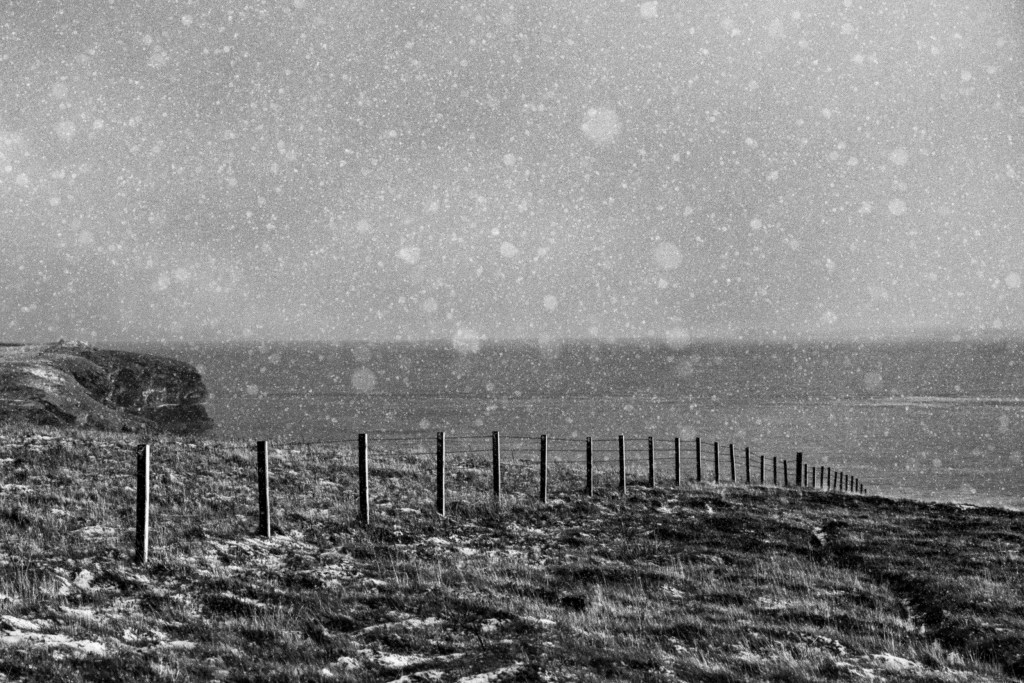
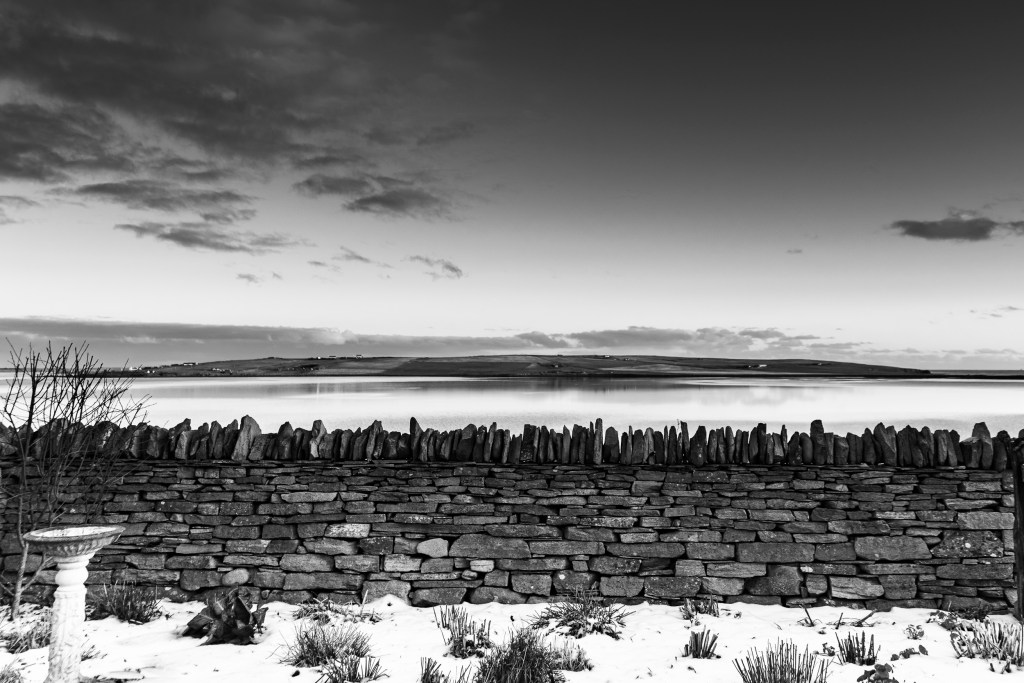
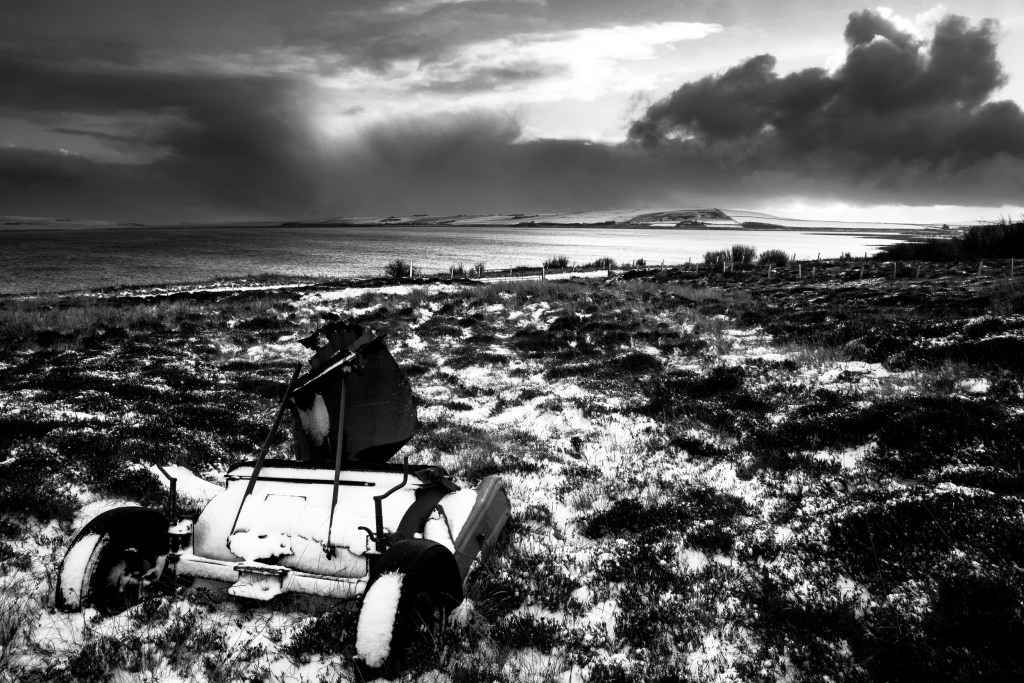
January the 12th.

January has brought a mixed bag of weather. Days of wild winds and relentless rain with occasional days of flat calm and sunshine, but mostly days of snow and frost. New year’s day itself dawned grey and wet, the view from the garden akin to a half finished watercolour, the bones were there but the colours were missing, shades of grey instead of greens and blues. A Sparrowhawk arrived mid morning, resting for half an hour on a nearby fence post, wet and slightly bedraggled but ever alert.

The days following New Year brought better weather, a couple of  fleece and Tee shirt days. A temporary wind break, put up to shield solar panels and their yet to grow screen of young Willow from the worst of the Westerlies, had come a poor second to a pre New Year 90mph gale. While the sun shone, windbreak Mk2 went up, longer stabs, driven deeper into the ground. Despite the loud rhythmic clanging of the post driver, a Robin spent the day with us. Checking the ground around our feet for goodies, and perhaps giving marks out of 10 for fence straightness and height.

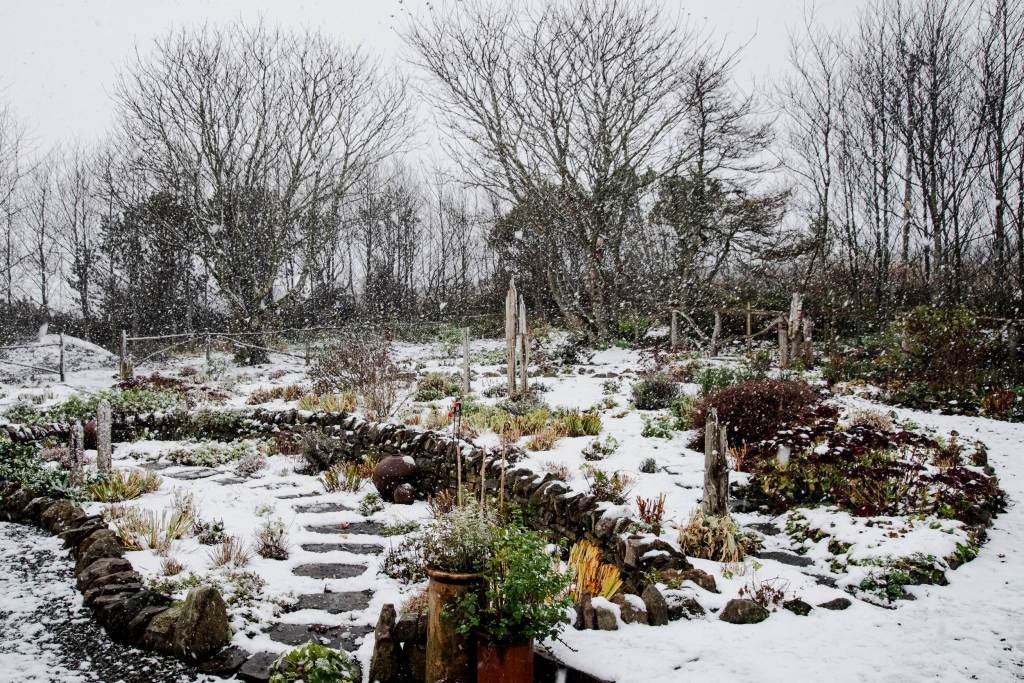
We finished the fence just in time. The following day brought Northerlies, horizontal hail and bitter cold, when the winds eased, the hail turned to snow. Each shower brought no more than a dusting, never settling to any great depth, just enough to give a cold beauty to the land.

Each night brought a frost, not the -16’s and below that central Scotland has suffered but enough to make gravel crunchy and stone steps lethal. The wildlife ponds, dug a couple of years ago at the bottom of the meadow, freezing each night and thawing each day.

The cold snap has brought more birds to the garden. Finches cluster on feeders like Ants on an unlucky Caterpillar. Shyer birds have also been seen, a pair of Reed buntings, who in Spring will nest in a briar filled boundary ditch, have arrived most days. Below the feeders, Wood mice are enjoying a cold weather bounty, feeding on husks and dropped seed.

Although the garden won’t really wake from its slumber for some months,  there’s still old and new life to be seen. At this time of year, Lichens are noticed, brittle clusters of soft grey-green that have a growth rate of a millimetre or so per year. We’ve noticed that they are already starting to form on trees planted only a few years ago, those on the trees we inherited must be many decades old. A forest in miniature.

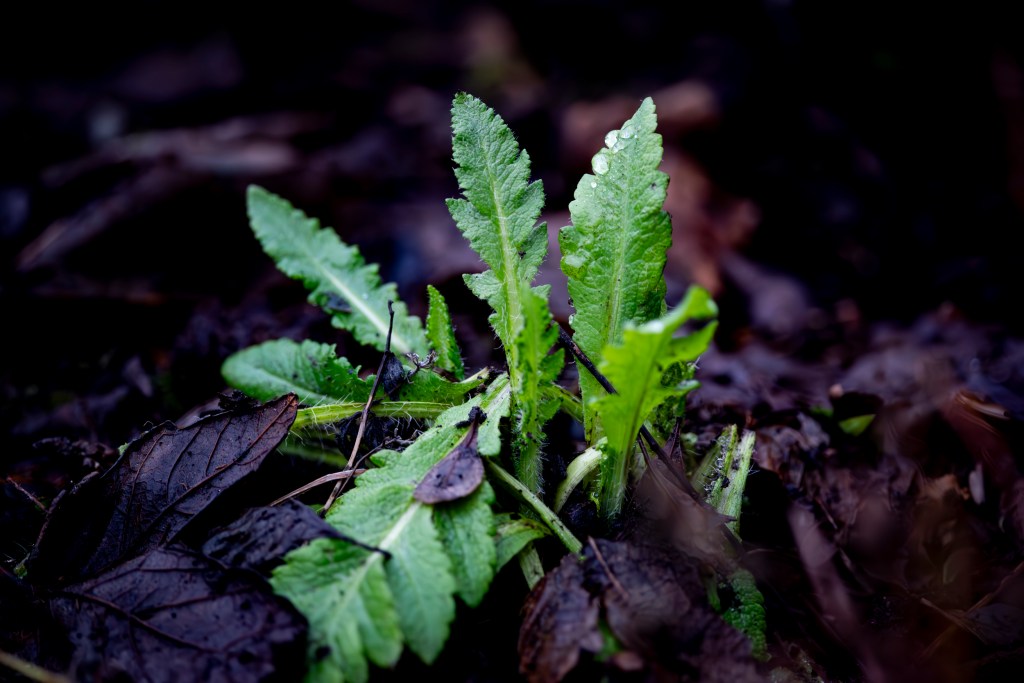
There’s younger life as well. In a sheltered spot, a perennial Poppy, planted in late Summer, is already pushing up through the earth. Bright green against last years fallen Alder leaves.

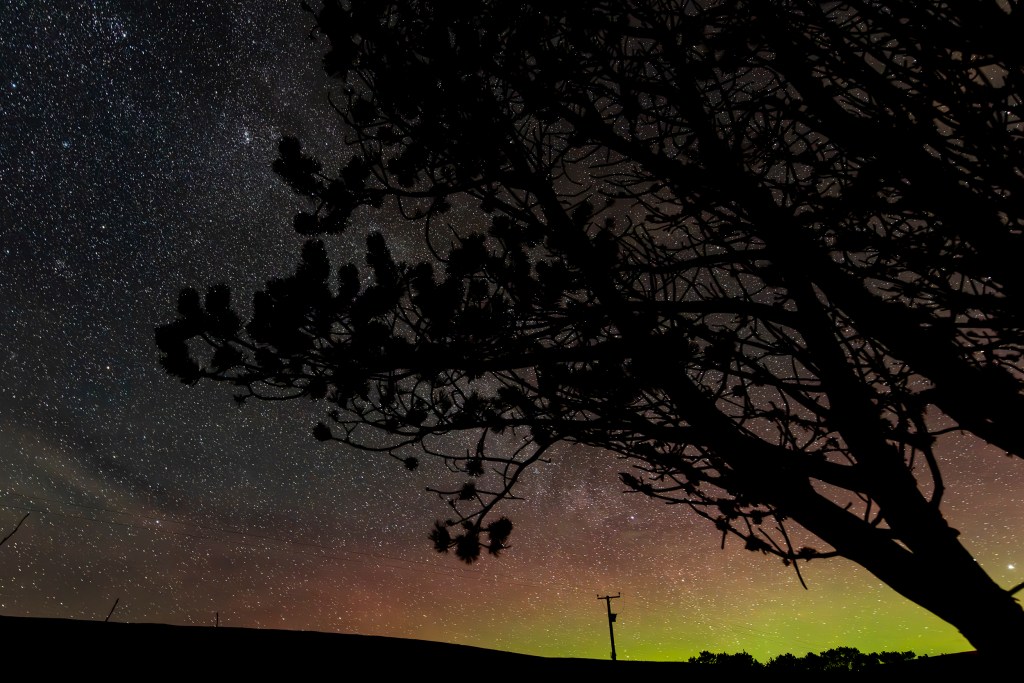
Clear frosty nights brought faint views of the Mirrie Dancers together with crystal clear views of the night sky and the Milky way. One evening, at close to midnight, I took a couple of frames, one from the edge of the garden, another from a spot where garden ends and moor begins. The silence was deafening, only broken by the click of the shutter or the occasional murmuring of Greylag geese roosting out on the water of the bay.

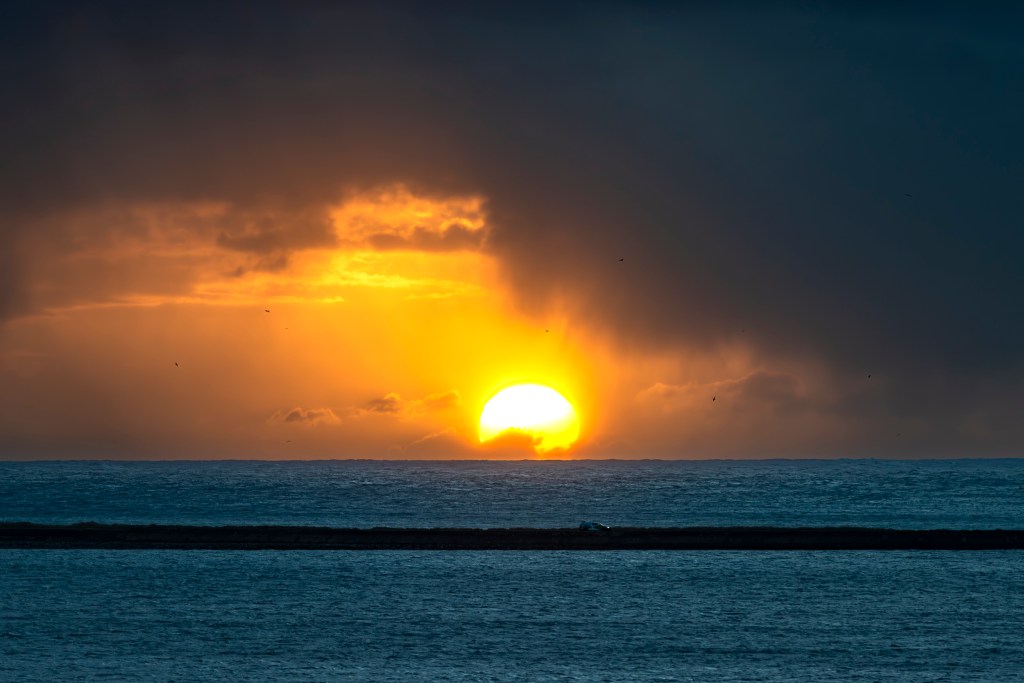
The weather has changed today, northerlies replaced by south-westerlies. At sunrise I walked down to the shore and took the photograph below. The grass was crunchy underfoot, white from an overnight frost, but the bite had gone from the air. Next week will bring warmth and a thaw. As I crunched down to the shore a small bob of ever inquisitive Harbour Seals appeared, homing in on the human, to see what he was up to.

Sunrise and a posse of Harbour Seals


A Winter Solstice

The solstice, for us, dawned grey but bright, an almost monochrome start to the day. As the day moved on winds increased to gale force, the lifeline inter-island ferry managing a single early morning trip. With more wind to come tomorrow, with the exception of a medical emergency, it will be Monday now before anyone can leave or return to the island. Previous days have brought much of the same, spells of relentless rain and seemingly daily gales. Yesterday though brought a brief lull and the chance of quick trip to mainland to stock up on supplies.

Despite the wild weather, today marks a turning point, a harbinger of better things to come. The word Solstice comes from the latin, sol – sun and sistere, to stand still. For the rest of the month, at sunrise, the sun literally will stand still, rising at 09.05 on the same compass point, but at sunset, the days will slowly lengthen, by a few seconds at first but then by a minute here and a minute and a half there. By the first days of January the sunrise will also be earlier, the sun slowly tracking back eastwards. By the end of January the gloom will be behind us, in a few short weeks we’ll have gained two hours of light, spinning towards June and the seemingly endless daylight of the Simmer dim. 

At this time of year, for a few weeks through December and January, on those rare clear days, we get to see the sun rising in the Offing. The distant point on the sea where the view is lost to the horizon. The word coined the phrase “in the offing”, describing a returning ship coming into view. 

A sunrise in the Offing.

For the rest of the year the island of South Walls hides the sunrise. The island lies low in the sea and in the right light and with a little, or perhaps a lot, of imagination, it becomes one of the Orcadian poet and author, George Mackay Browns, whales – “sleeping in a silent ocean of time”.

South Walls.

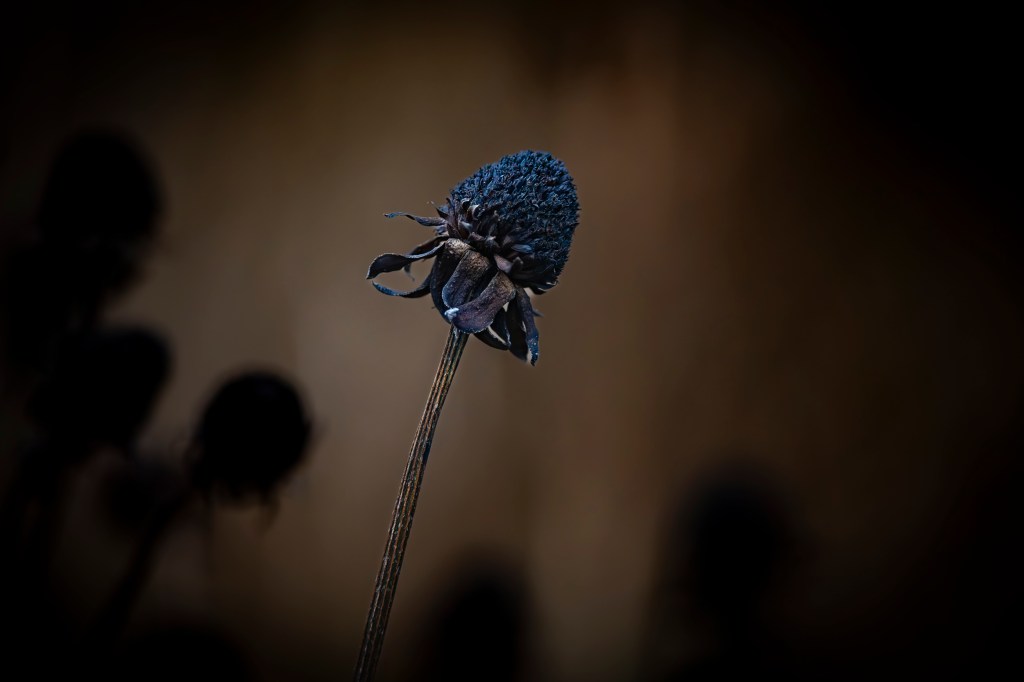
In the garden, Jacqui cuts back most of the plants before the gales do it for us but here and there, in sheltered spots and on stronger stems, seed heads are left be. In the lee of a dry-stone dyke Hydrangea flowers have turned crisp as brown paper, nearby Rudbeckias are a deep blue-black, as if dipped in ink. Others that were also deliberately left haven’t fared so well, Moor Grasses that lit a front garden with sprays of straw-gold seed heads have finally succumbed to the winds, their broken stems scattering the ground like randomly thrown pick-up sticks.

Brown paper Hydrangea.
Ink dipped Rudbeckia.

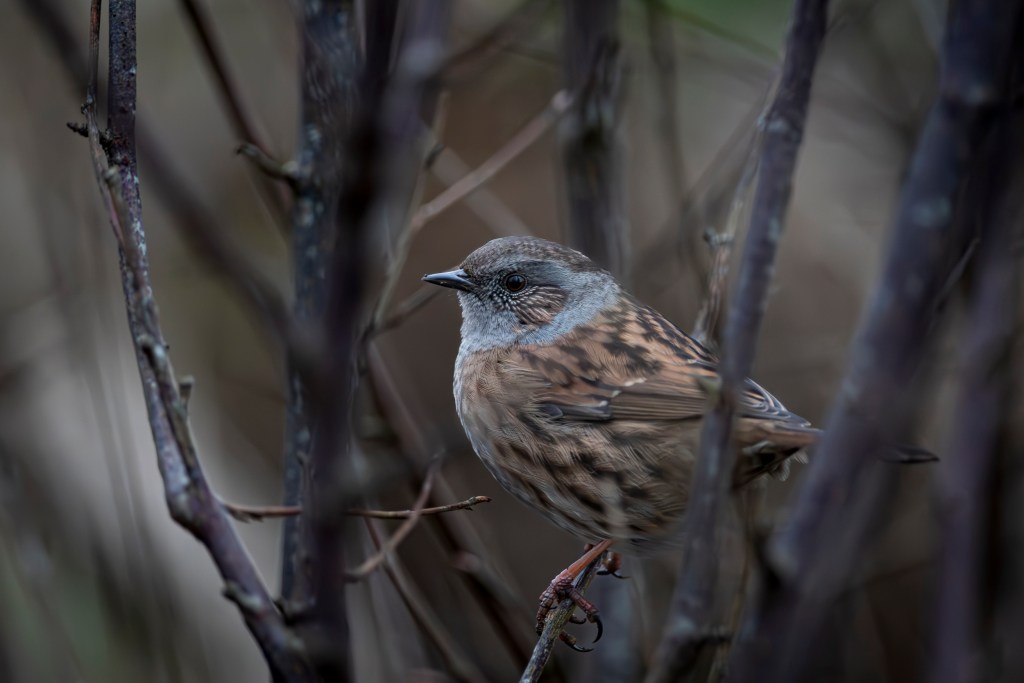
The weather has brought an influx of finches to the garden, a mixed flock of perhaps sixty birds, goldfinch, greenfinch and chaffinch, are here most days. At the moment they’re getting the full fairground waltzer experience, clinging to feeders that spin and swing in the wind. Other birds are less easily seen, in a new willow coppice planted close to the shore, Wrens are occasionally glimpsed, a brief view of a bright eye and a cocked tail as they go about their business, searching grasses and bracken for hidden goodies. Closer to home, Dunnocks, who in Spring will lay pale blue eggs in a cup of moss, flit among shrubs and undergrowth at the edge of the garden. As a child they were hedge sparrows but in reality are no relation of our house and tree sparrows. They belong to the accentor family. They get their common name from dun, brown, but their posh or Sunday name is Hedge Accentor. Of that family they’re the odd one out, all the other species preferring mountainous regions and altitudes of 1000m or more. 

Wren, above, & Dunnock below.

Another favourite wren haunt, is a boundary ditch that runs from the top of the meadow to the shore, six feet deep and never designed to carry water. A crofters Ha-ha, designed to keep livestock either out or in. Stock fence and barbed wire have made its original purpose redundant but now, overgrown with bracken and briar, along with the wrens, it’s also a perfect home for stonechats and reed buntings and others. The bracken at this time of year is the colour of burnished brass, it’s our marmite plant, tolerated in ditches and under trees but due to its invasiveness and smothering habit, unwelcome anywhere else.

Bracken, our marmite plant.

At this time of year calm spells are grabbed with both hands. Last week, after a day or two of rain, I took a walk close to home, along a nearby headland that has views across the Pentland Firth towards the Caithness coast. It’s the year round home of a group of shaggy coated cattle who seemingly shrug off the worst that the weather can throw at them. Normally they ignore you, too busy feeding to pay much attention, but occasionally a beast will walk over for a nosey. They appear harmless but are semi-feral, so caution and common sense says put a fence between you and them. Environmentally they have a strong and positive impact. A few animals are spread over many acres, their grazing keeps the sward short and allows wildflowers and orchids to flourish, their feet will also push seeds into contact with the soil and create small areas of poached earth, bare ground where seedlings can germinate.

With the sun setting at not much after three, an afternoon walk usually involves walking home in near darkness. Last week, after checking geos for newly cast up driftwood, time was spent photographing the sea, lit by the last few minutes of afternoon light. The photographs were taken out of curiosity, to see how a new camera,  if a 10 year old camera can be new, would cope in low light. The results were better than expected. Despite the gloom each image was tack sharp, the out-takes let down not by the camera but my rusty timing, more often than not the breaking spray was captured either too soon or too late.
By the time I set off home it was just about dark. In the orange afterglow of sunset, the cliffs of Dunnet Head on the Caithness coast, some ten miles distant, were pulled close by a telephoto lens. Its lighthouse, built in 1831 by Robert Stevenson and dwarfed by the cliffs it stands on, has a beam that, on a clear night, is said to be visible from 23 miles away.

Dunnet Head.

Grey Seals and Selkies.

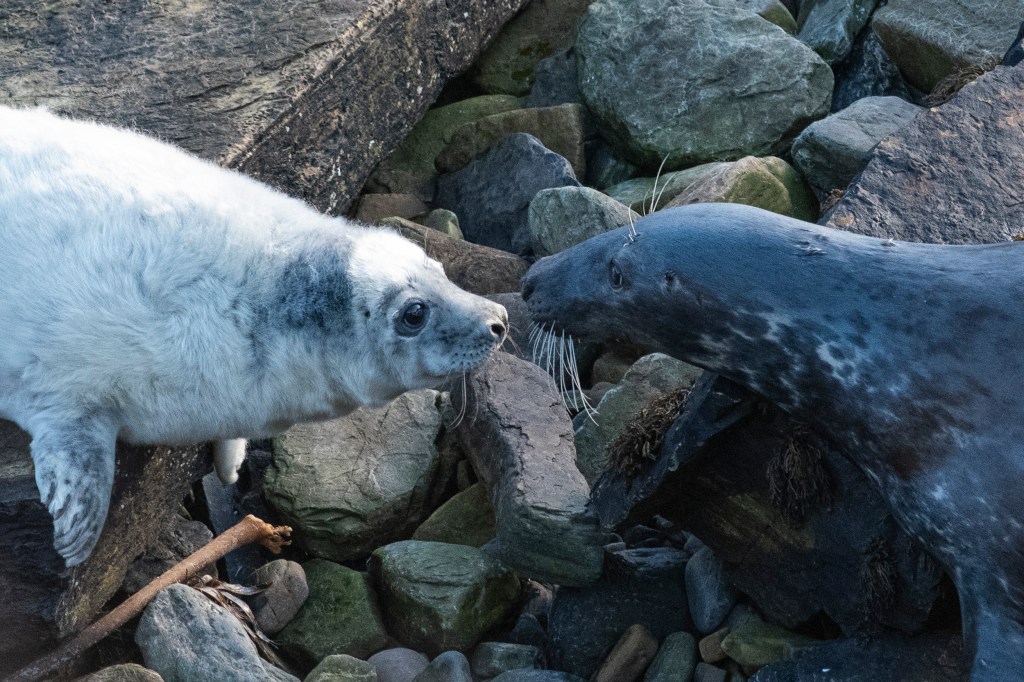
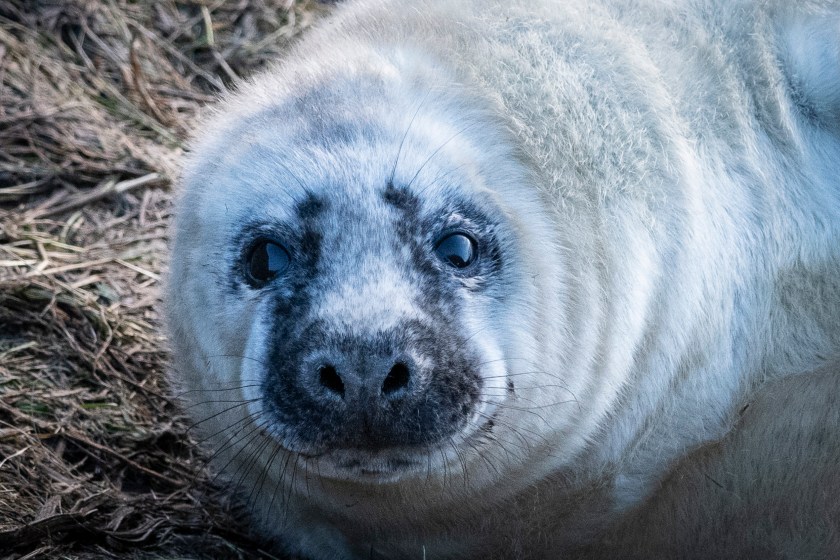
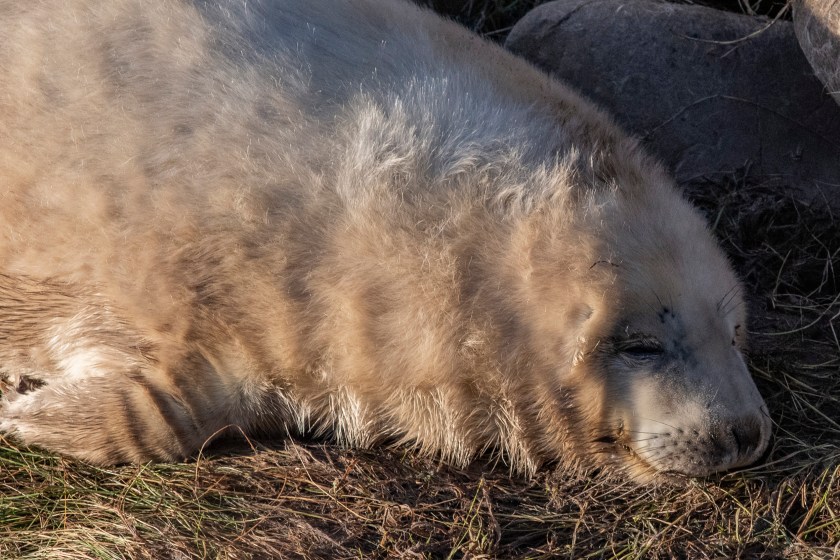
For the last few weeks, Grey Seals have been giving birth to doe eyed pups in nearby geo’s – an inlet or gully in the face of a cliff. There are two species of seal in Orkney, the Grey and the Common. Greys are larger and favour more exposed coasts. The shore of the sheltered bay below the meadow here is home to a small bob of Common Seals, but out on the headlands, and in the wilder spots, the larger Grey is much more likely to be seen. The two are easy to tell apart, the Common seal has a rounded cat like face, the face of the Grey is longer, with an elongated muzzle, a “roman nose”.

Grey seal and pup. Mum shows off her roman nose.

Unlike Common Seals that in Orkney pup quite sensibly in June, Greys choose the wilder winter months. On Hoy they start to give birth in late October. By mid November, local geo’s will be host to dozens of dozing pups and watchful mothers. 

Care has to be taken when approaching the seals, the mothers, if spooked, can quickly panic and toboggan back into the sea, squashing all before them. The rule is to walk slowly and quietly to the edge of the geo, and if an adult makes eye contact, back away just as quietly. For photography, a telephoto lens is essential. All the photographs here were taken from the cliff tops.

Sweet dreams, between a rock and a hard place.
Time to back away…

Once born the pups growth seems almost exponential. On a diet of milk that is 50% fat, the pups will, in a few short weeks, grow from around 12kg in weight at birth, to 50kg at 3-4 weeks old, a gain of up to 2kg per day.

With growth comes the moult, the pups start to shed their white coats at around two to three weeks old, a process that will take around three weeks to complete. Unlike Common Seals, who moult whilst still in the womb and can swim at a day old, grey seal pups need to moult before they are sea worthy. Moulting pups are easy to spot, the ground around them dusted white with cast off fur. As adults they’ll moult once a year, in Spring.

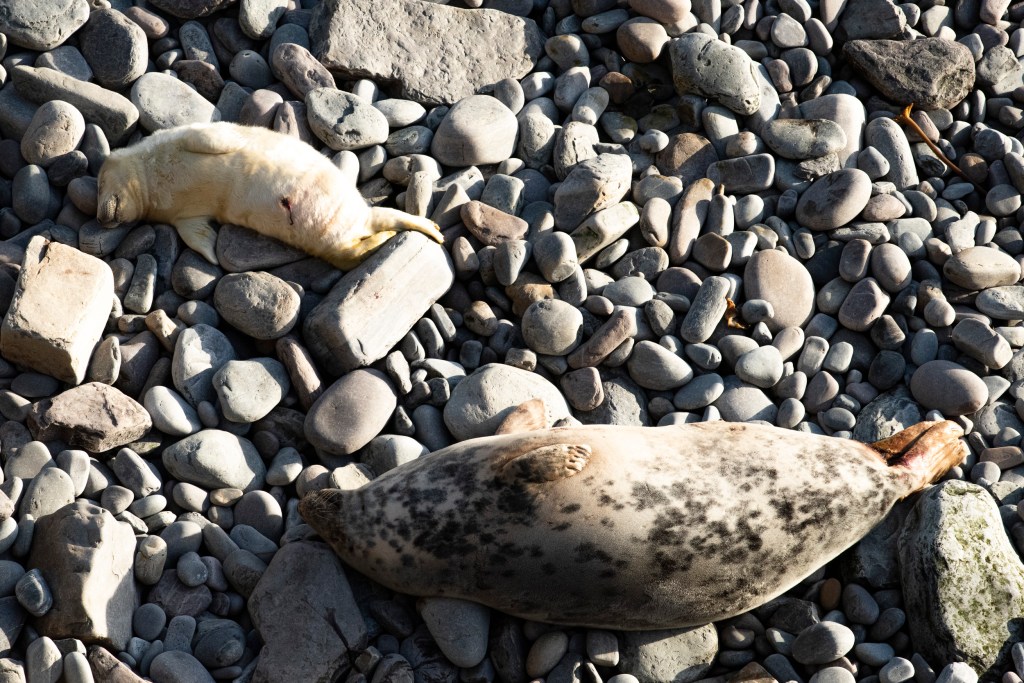
Generally the geo’s are a scene of calm, mothers and pups snoozing the day away on a bed of rock or sea rounded cobbles, protected from any discomfort by a thick layer of blubber.

Mum and pup snooze the day away.

But there’s death as well as life of course. In one geo a small white body bobbed in the surf, watched from a nearby outcrop by a pair of Black-backed Gulls, waiting for the tide to recede and give them their meal. In the early days of life a few will always be lost but the most imminent threat is the weather. In 2021, on a Scottish reserve, storm Arwen took over 800 pups. This year though, despite a few days of wild seas courtesy of storm Bert,  losses, at least locally, seem to be few and far between. By mid December most of the pups will have moulted, greatly reducing the risk of loss.

If they make it to adulthood, grey seals can live for forty years.

I’ve visited the same geo’s a half dozen times through November, seeing not just the pups but other wildlife as well. At this time year there’ll be Greylag and Barnacle Geese grazing the headland, on the shore Rock Pipits will be seen in numbers along with the occasional Snow Bunting. Rarer visitors may also blow in, last week, feeding in the shallows of a small pool, a Great White Egret was seen. Sods law dictating that on that particular day, I’d chosen not to take a camera because the light was so flat and overcast.

Orkney folklore tells of another breed of seal, the Selkie, the largest of all. Said to be able to shed their skins and shape shift into the human form. A local story tells of a man who stole the skin of a beautiful selkie woman and took her for his wife, she came to love him but loved the sea more. She bore him seven children but one day while her man was at sea, she found her hidden coat. Kissing her children goodbye she returned to the sea, seeking out her husbands boat to bid him a final farewell before slipping under the waves….

November the 24th.

Grey skies and sunlit turbines, Caithness.

The past couple of weeks have done their best to live up to Thomas Hoods poem of November,  no sun -no moon – no morn – no noon – no dawn, etc, etc. Not quite true because we have had the Beaver moon and occasional days of sunshine but generally grey days and rain, with, over recent days,  snow and hail thrown in for good measure. Yesterday brought storm Bert, wild seas and sheets of rain. Today though, looking out towards South Walls, the sun is starting to light the landscape, the sky a clear deep blue. No matter how grey or wild, there’s always a silver lining.

Tuesday brought a dusting of snow.

As mentioned in the previous blog, early month dry days allowed the meadow to be cut. Once dropped, before being raked into winrows, it was left for a few days for the winds to dry the grasses and flower stems. When we first cleared the field, with a view to reinstating a wildflower patch, so thick was the growth that the raked up winrows were more like berms, snaking chest high across the field, ready to repel seaborne invaders. Now, after a few Summers of nutrients being sucked up and not replaced, the seed-heads of once chest high grasses, even in the lushest spots, can barely tickle your knees. The winrows still snake across the field but are now shin high, not chest high.

Blue skies and winrows.

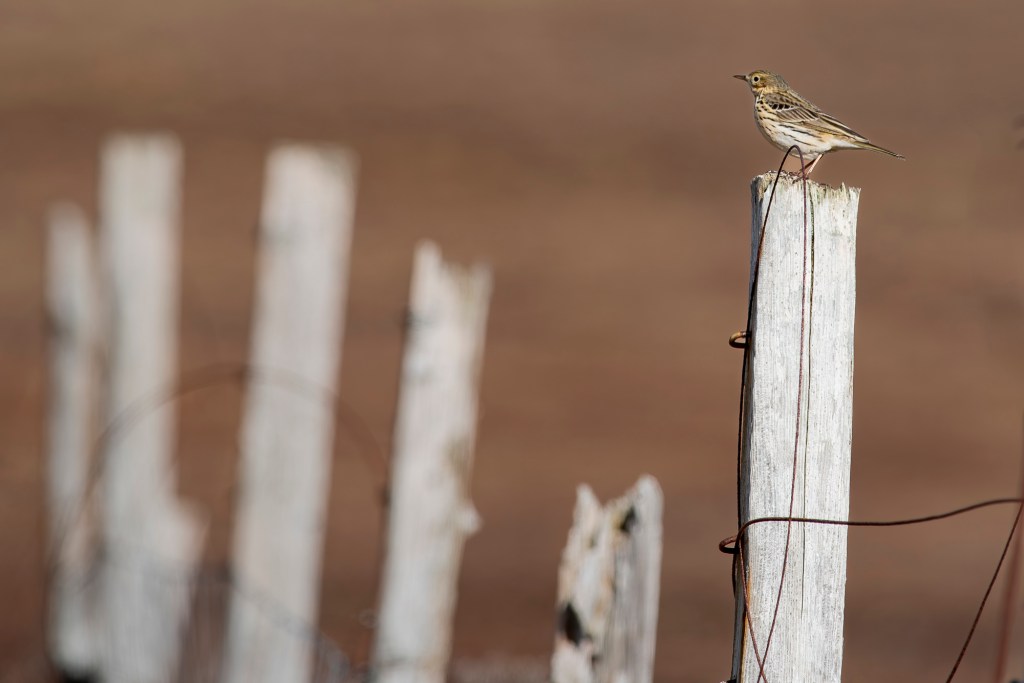
The grasses, once raked up, are collected by the pitchfork full and dumped either at the edge of the low cliff or amongst young Willow coppice. Mini haycocks, left to slowly rot down, a home for mice and bugs. As I worked a Rock Pipit arrived, leaving his or her natural habitat of the shore below the meadow. Flitting from post to ground, picking up uncovered goodies too small for the human eye to see.

Rock Pipit.

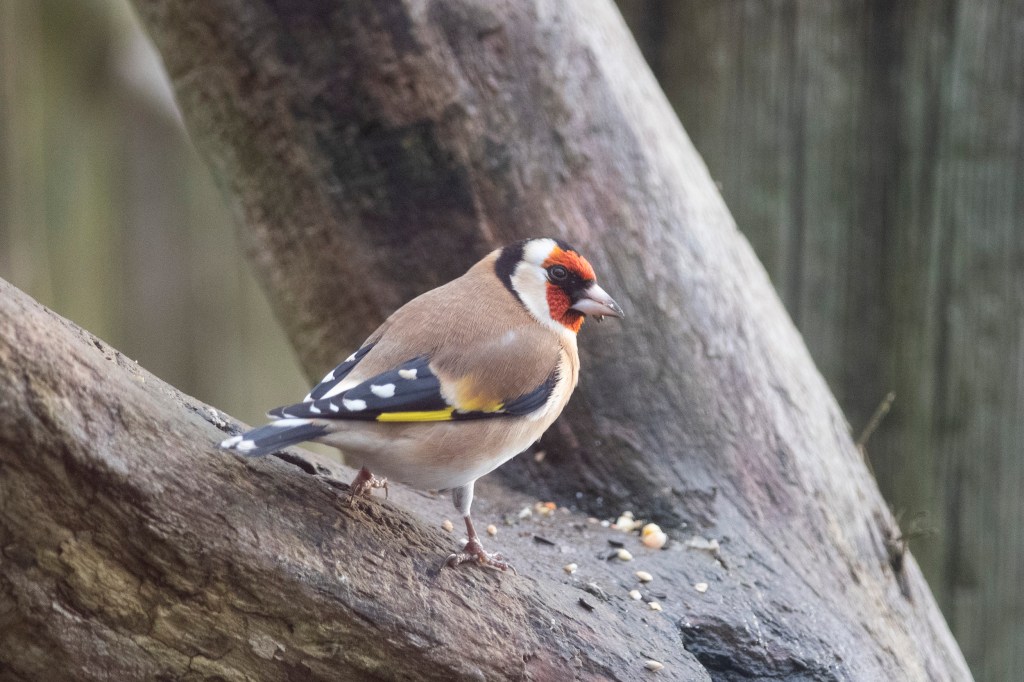
In the garden the last of the flowers have succumbed to the cold. The only plants still trying to put on a show are red Hesperantha’s, for us, they’re the last man standing. The cold, or perhaps just the time of year, has brought an influx of Goldfinches, one or two pairs breed here but in Winter, although numbers ebb and flow from one week to the next, we expect to count them in tens rather than in one’s and two’s. If I wore a watch, the birds that I could set the time by would be Starlings, they arrive mid morning, bathe, squabble, eat – rinse and repeat, and stay for the rest of the day, leaving, like clockwork, a half hour before sunset to roost in a thick stand of conifers at the edge of a nearby garden.

Goldfinch.
Grumpy Starlings.

The snow didn’t last. By Thursday, although we still got the occasional flurry, only the hills at the North end of the island still had a cloak of white, the winds, swinging back from North to South, warming and losing their edge. 

Hoy hills.

A favourite walk takes you from the farm of Snelsetter on South Walls, through a spot known as The Hill of the White Hammars, and from there along the coast of Cantick Head. It’s an area of coastal heath kept short by scouring Winter winds and the teeth of a flock of Shetland and Shetland cross sheep.

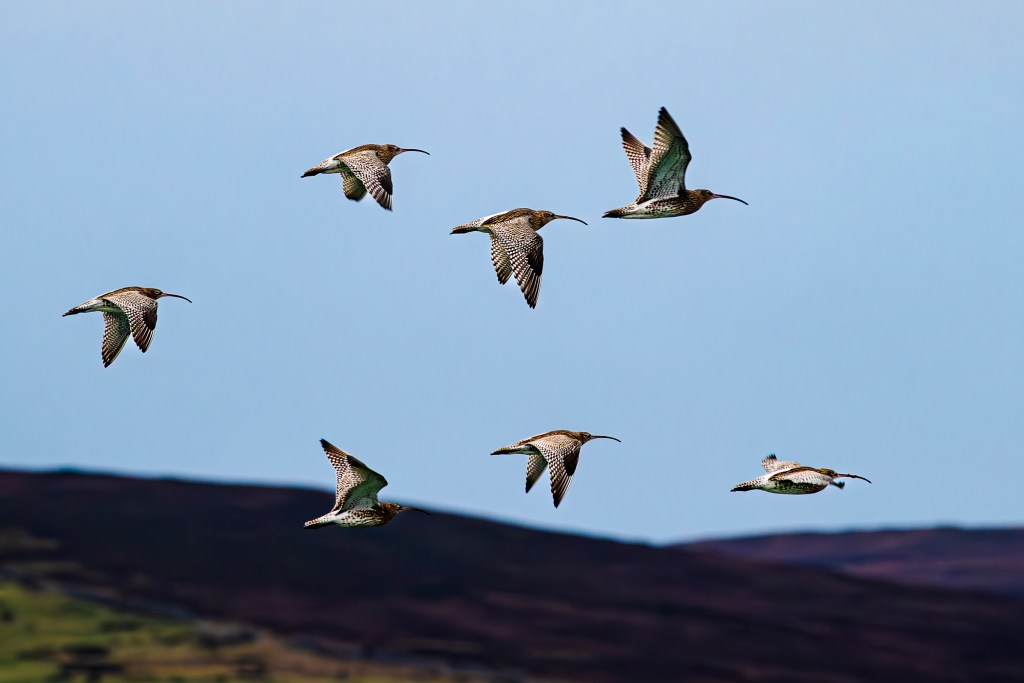
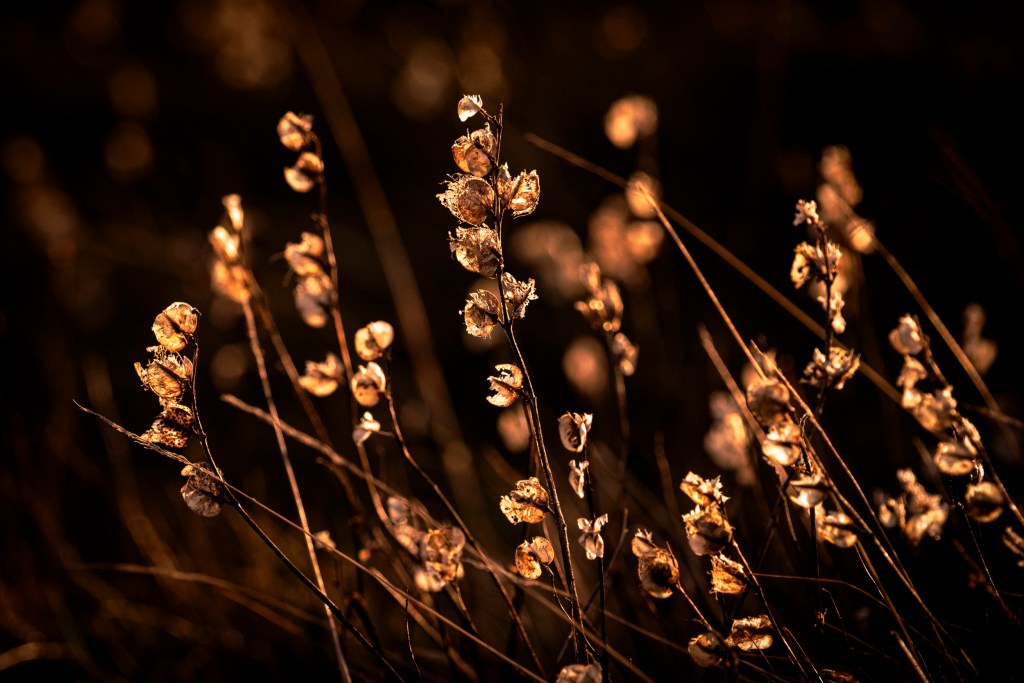
In Spring, the ground is bright with Yellow Rattle, a semi parasitic plant that feeds on the grasses, and along with the Winter nibblings of Sheep, together with the winds, helps keeps the sward short and allows wildflowers to flourish. In Summer it’s a tapestry of colour, alive with the call of Curlews and Lapwings, at this time of year the Lapwings are absent but the Curlews still call. The flowers are gone until Spring. The seed-heads of Rattle though are still visible, backlit by a low sun, shook empty by the wind.

Yellow Rattle.

Just off from the walk, in a field that in Summer is grazed by cattle, there’s what remains of a But and Ben house, a simple two room cottage. Only one gable remains, its hearth still intact, the coursed stone that would once have worn a coat of lime plaster, laid bare by the elements. Just beyond the house, on the heath itself, there’s the remains of a byre. If the light is low and angled just right, to the side of the byre the bumps and shadows of an old ridge and furrow system can be seen. The rest of the house is long gone, probably incorporated into a newer house, also now roofless and empty, that stands, as the crow flies, a mile or so away.

But & Ben, Misbister.

On Friday afternoon, before Bert  blew in, I walked the route again, Snelsetter to Cantick, intent on photographing Grey Seals and their pups, a subject for next weeks blog. It’s dusk here now by 3pm and by 3.30 the sun has set. The seals, pups especially, are photogenic and I spent too much time and walked too far, getting back to Snelsetter in near total darkness, mental note to self, next time, remember a head torch.

Last light, near Snelsetter.

November the 10th.

November has, so far, gifted much kinder weather than expected. The past week brought mostly blue skies and sunshine. The days of course are still getting shorter, the light fading rapidly now by 3.30 in the afternoon but for a month where gales and rain are expected to dominate, the past days have been a welcome and unexpected bonus.

Late afternoon, North Walls coast.

Jacqui has continued putting the garden to bed. Getting in her ten thousand steps between borders and compost bins, ferrying barrow loads of cut back stems and greenery in one direction and returning in the other with last years well rotted compost. The last sowings of veg are being lifted. All that remains are a  few strides of Carrots and Parsnips and a couple of square yards of Neeps. This is the last year that we’ll grow veg here. Carrots have been swapped for kilowatts, a solar system, panels and batteries, has recently been installed, part of an island carbon neutral scheme, funded by the island trust and the Scottish government. We’ve grown veg all our gardening lives but the plot won’t be missed, a wet and stony edge of moor site that often couldn’t be tilled until May.

With a couple of dry and bright days on the cards, it was decided that as well as the garden, the meadow would also be put to bed. In past times this would have been a job for June or early July, the people who worked this land anxious to catch the grasses before they went to seed and lost their feed value. With no stock to worry about we leave the cutting as late as we can, leaving it be until the last of the wildflowers have faded to seed. We cut the meadow with a power scythe, a twenty odd year old  machine that probably has a list of previous owners as long as your arm. The upsides are that it sips red diesel and it cost a couple of hundred pounds, (a new one is seven and a half thousand pounds). The downside is that it cost a couple of hundred pounds….

Native Yarrow fades to seed.

I started cutting on Thursday, a bright and flat calm day. Three passes in, a loud crack announced the shearing of a stud that holds the cutter bar to the  machine. I took it to the islands mend anything man, the diagnosis was a new stud and reinforcement with weld, “pick it up tonight”. Friday brought attempt number two, dry and bright, a carbon copy of Thursday. I managed a single pass before the drive on the cutter bar failed, back into the van, back round to the man, “pick it up tonight”. A swear box hung on a fence post would have filled in no time. Saturday brought third time lucky, the machine behaving itself, the grasses and flower stems falling like nine pins to the chattering blade. 

As I walked the mower across the meadow, a woodcock was flushed from a wet spot that in summer is lit pink with ragged robin, silently jinking away, a second lifted just as quietly from beneath a small copse of young alders. At the edge of one of the ponds, a Heron, intent on catching unlucky frogs, stayed as long as it dared, eventually leaving, as the mower got closer, with a harsh and complaining “kark-kark’.

Grey Heron.

Despite the garden being cut back hard, care is being taken to leave fuel for late flying bumblebees. A favourite geranium, pretty much bomb proof late summer flowering rozanne, is a late flying bumblebee magnet, an oasis of blue. In places Welsh Poppies, another Bee favourite, are also putting on a very much out of season second show.

Geranium rozanne.
Welsh poppies.

Garden birds are coming and going. Goldfinch numbers are rising, chaffinch numbers falling. Blackbirds are being counted in tens. In cahoots with redwings they’ve stripped garden rowans bare of berries. Blackcaps are being seen again, small Scandinavian visitors that are drawn to apples like a magnet to iron.

Blackcap and magnet.

Clouds permitting, the mirrie dancers are still putting on a show. Thursday brought clear skies and the promise, according to an app, of a good display. I took a camera to Osmundwall, a small sheltered beach on the narrow headland of Cantick, where, according to legend, in 995ad Earl Sigurd the Pagan, who fought under a black raven banner, was converted to christianity at the point of King Olaf Tryggvesson of Norways sword. 

Osmundwall.

There’s a saying that if you put a spade in the ground in Orkney, you’ll dig up history. A short walk from the beach there’s the bump of a neolithic chambered tomb, flat topped and almost certainly first excavated by Sigurd or Olaf or some other Viking hoping for grave goods. It’s another good spot for a photograph. The picture needed a figure for a sense of scale, so I set up the camera, tripped the self timer and by the light of a head torch ran up the bump to get into the frame. When the dancers had finished their show, I cut across a field and walked back to the van via the opposite coast, listening to the crash of waves on a hidden by darkness shore. My route took me over one piece of history, a Bronze age settlement, hidden beneath wind cropped turf, and past another, the remains of a Broch at Hesti Geo. Despite being long collapsed, in daylight, at its base, beautifully coursed stonework is still visible, as tight as the day it was laid.

Dancers, chambered tomb, and a man trying to stand still for a 30 second exposure…

October the 27th.

A female Brambling pays a visit.

The garden is being put to bed. Sunday and Monday past brought gales and heavy rain, the winds gusting locally to 85mph. Our first real storm of the Autumn. A timely reminder that, in our exposed spot, if we don’t start to cut back hard, the gales will do it for us. Shredding all before them.

Molinia’s catch the breeze.

Garden wise, if not quite weather wise, it has been a good summer. Under Jacqui’s care most plants have thrived, losses have been rare, few and far between. Despite the gales some plants are stubbornly hanging on. Sedums are still attracting the odd bumblebee and despite taking a battering, will be left alone until the bees have gone. Ditto anemones and hesperantha’s, both of which, along with a few other hardy souls, are still putting on a show.

Anemone hupehensis.
Anemone dreaming swan.

The sun is literally setting on the garden. Even before the clocks went back the garden was losing its light by 4pm, the sun lost below the hills to the west. In a few short weeks, courtesy of our tucked down spot, it will dusk here by 3pm.

Late afternoon.

As plants are cut back and bare soil is exposed, the garden is being given a dressing of muck. It’s the time of year for wriggly tin compost bins to be emptied and refilled. As jacqui tackled wind blown foliage, I turned last years compost, two well rotted bays made into one. A wood mouse got a brief eviction, sleek and brown, running past my foot into a newly filled bay. Safe until this time next year. The soil doesn’t get much of a dressing, come spring, the last thing you need in a spot like this, is over-fed leggy young growth that will be flattened by the lambing winds, mid-May gales. The bins themselves are made from old fence stabs along with scrounged roofing from a tumbledown byre. Free apart from a few hours of time. Tucked away in a hidden corner they do the job, but it’s fair to say that they are best viewed on a dark moonless night…

Compost corner…..

With the exception of rear garden Sycamores, who are still partly clothed on their sheltered sides, the trees have lost their leaves. Most are left where they fall but we rake them from stone chip paths and scoop them from a ditch that encircles the garden and rushes rainwater from moor to sea. Forget the ditch and sooner or later you’ll wake to a pond. Time is then spent, usually in the driving rain, rodding a pipe that runs beneath the road. Clearing the leafy blockage and allowing the new pond to gurgle away, back on its journey down to the shore.

Wild carrot seeds are being collected. Their parents were sown as part of a home made wildflower mix, covering bare earth at the top of the meadow. Yarrow, ox-eye, white clover, knapweed and others, whatever we had, all mixed in a bucket with seed from a half dozen native grasses. The rest are being left to self sow but we have plans to spread the wild carrot along the edges of the shelter belt, the seed will be stored through the winter and sown in cold frames in spring.

Wild carrot.

Blackbirds are back in the garden, absent since our breeding pairs left in mid august. Their arrival coincided with the first sightings of Redwings and Bramblings, the former, in the wider landscape, are being seen in flocks of many hundreds, the latter, seen closer to home, are arriving in small groups, ten or twenty at a time, picking at bird seed cast beneath shelter belt trees. All are visitors from Scandinavia, moving south for the winter.

Blackbirds have returned to the garden.

October pretty much draws a veil over the garden, a few plants will cling on, patches of bright colour lasting well into November. We were told when we moved here if we lasted a winter we would stay. I never quite got that, Orkney is beautiful in sun or storm. The landscape though will replace the garden now. More time will be spent walking the cliffs and the moors, beach-combing is a given. Workshop projects, on hold for the summer, will be started. A website for a work from home idea will finally get built. Dark evenings will allow the  dancers to be seen at normal-o-clock, last night I photographed them at 9pm. Summer is missed but winter is embraced, a time to catch up and make plans.

Last nights dancers.

The blog will continue, but for a while, perhaps less about the garden and more about the wildlife, the landscape and the shore.

Gannet and rain, towards Caithness.

Comet 4 – Human nil.

I’ve been trying, and failing, to see and photograph Comet A3. A once every 80,000 years visitor. The last time it passed by Neanderthals walked the earth. From the UK the comet is low in the west and close to the horizon. Google tells me, that for our location, the best views are just after sunset. Four times in recent days I’ve taken a stone track to the top of a low hill called Binga Fea, topped by a telecoms tower and the highest spot close to home that offers a view to the west. Each time clear skies have been promised and each time low cloud has spoilt best laid plans. Yesterday evening brought more of the same, a stubborn bank of cloud sitting out to the west.

On Binga Fea, looking West

Disappointment aside though, it’s a great spot to watch day fade to night. With camera set up I went for a wander,  a male Hen Harrier passed by, appearing almost white in the half light. I caught the briefest glimpse of a Woodcock, newly arrived from Finland, a dark silhouette against a still bright, post sunset sky. To the south, across the Pentland Firth, some ten miles in the distance, there’s the coast of Caithness, where Dunnet head and its just visible lighthouse mark the most northerly point of mainland UK. Beyond that, almost lost in the haze and some 45 miles from the camera, is Morven, the tallest hill in Caithness. To the west, the next landfall is the coast of Labrador and Newfoundland, some two thousand miles away.
Morven, some 45 miles from the camera. The lighthouse at Dunnet Head, is just visible, lower right.

Looking east, Scapa Flow and Orkney spread out below you. There’s the island of Flotta, its 24/7 oil terminal lit like a small town, further out into the Flow, are the lights of a moored oil rig, pausing on its journey to the Cromarty Firth in Scotland, to be refurbed or broken for scrap. Beyond Scapa, lost to the dark, there’s the Orkney Mainland and the linked isles, the latter read like names on a shipping forecast – South Ronaldsay, Burray, Hunda, Glimps Holm, Lambs Holm.

Flotta, lower right, and Scapa Flow.

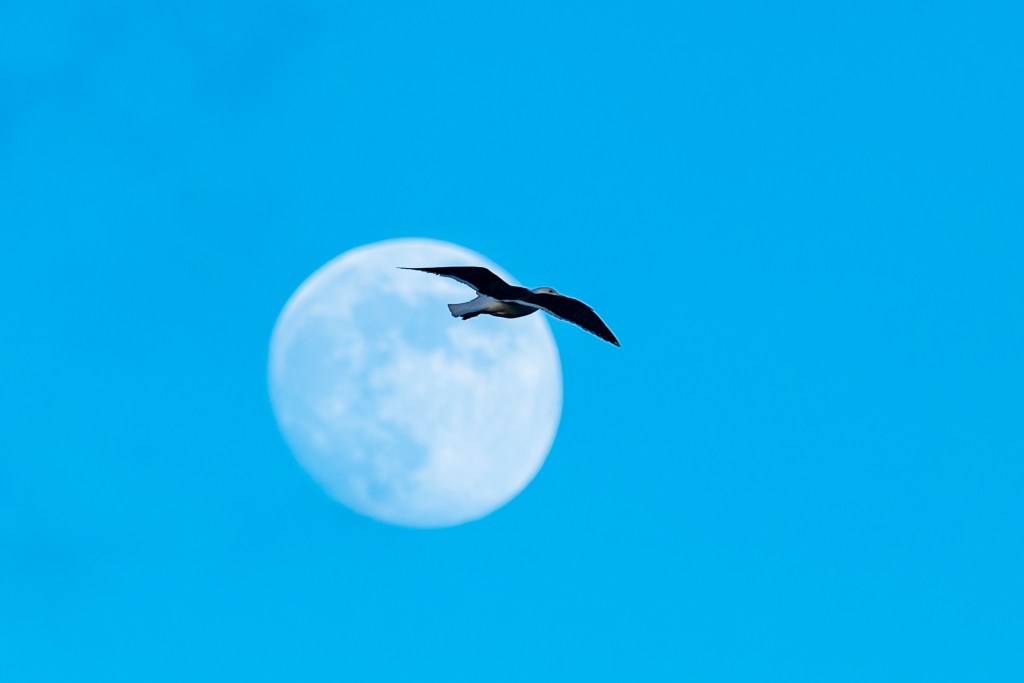
As well as the hoped for Comet to the west, there would also be a moonrise to the north-east. The moon would rise at five to six, five minutes before sunset, a photograph was planned with the moon low in the sky, just above the islands and the sea. At half past five, not wanting to be left out, the north-eastern horizon also wrapped itself in a shroud of thickening cloud. The moon eventually rising above it, too high for the planned picture, but a bonus picture was taken anyway, the moon, cratered and bright, pulled close by a long lens.

The Comet is fading, gone by the month end. The next clear day for us is Wednesday, if the forecast is correct, I’ll take the track and try again, crossing fingers that the final score will be Comet 4 – Human 1.

October the 14th.

In Orkney, this year especially, it seems like every night is an Aurora night. An app pinging regularly with the message – “visible in the far North of Scotland”.

What the app should also add of course, is “subject to the moon and the weather”. A blanket of cloud is an obvious no-no, but so is the moon, at the moment 86% full, more than bright enough to wash out all but the strongest displays.

As mentioned in previous posts, in Orkney the aurora is given the title the ‘mirrie dancers’. When we first moved here, a late night phone call asked if we would like to see the “dancers”, confusion briefly reigned and 2+2 was made into 5, was it an upcoming show at the community hall? Eventually the penny dropped and we went down onto the shore, with the lady who had been kind enough to ring, and watched our first ever light show. 

The name is appropriate, on those rare nights like that first night eleven years ago, the greens and reds literally do fill the sky and dance before your eyes. More often than not though, at first glance, there’s just a faint glow to the North. The rest of the aurora remaining invisible until you get your eye in. With a weak aurora, even when you do get your eye in, the streaks of colour, higher up in the skies, appear as shades of grey and white. Only when you check the screen on the back of the camera, do you see the colours, invisible to the eye but picked up by a much more sensitive to darkness, digital sensor.

Last Thursday promised a spectacular show. To be seen across the UK. A rival for the one eleven years ago. In Orkney we drew a short straw, thick cloud and 40mph winds. The met office though predicted a slight silver lining, the clouds would thin at around 4am on Friday morning, the alarm was set for 3. They timed the forecast to perfection, the clouds thinning on cue, pinprick stars becoming visible.

There are rare moments when the dancers can be seen to every horizon. Friday morning brought one of them. Although the clouds never quite cleared, blurring in camera as they rushed across the sky, they thinned enough to make a 3am start worthwhile. I stayed close to home, dodging the winds behind shelter belt and garden dykes, dashing back indoors when a heavy shower came scudding in.

The photographs below show views to all four compass points. The highlight of the night was an auroral corona, high above the house to the West.

Looking North from the rear garden.
To the West.
An ultra-wide lens captures both the Eastern and Southern horizons. The glow lighting the clouds, extreme bottom left, comes from the streetlights of Kirkwall on the Orkney mainland, some 15 miles distant. The pinprick of light, lower right centre, is a lighthouse on the Scottish coast, beyond the lighthouse, lost in the gloom, is the county of Caithness.

Looking West again. The firework burst of an Auroral corona.

October the 5th.

September ended as it began. A settled month of mostly dry and bright days. Throughout the month late summer storms were noticed by their absence. The first days of October have followed suit, bright days and clear nights, a bonus for this time of year. Next week though is all change, rain and midweek gales. Farmers are cutting the last of the Barley, racing to beat the weather. The landscape dotted with bales of winter feed and bedding.

In the kaleyard garden, Molinia’s are putting on a show. For most of the year they’re almost invisible, low mounds of green that are easily overlooked. They’re a close relative of the native moor grass and, as with the moor grasses up on the hill behind the house, at this time of year they come into their own, throwing out starburst seed heads that, in early morning or late afternoon light, look stunning, especially when given life by a passing breeze.

Molinia’s and early morning light.

As plants go over, Jacqui has continued cutting them back, splitting and replanting and potting on the spares. At this time of year compost bins are usually being filled,  seaweed from the shore along with cut back foliage and muck from a neighbours Shetland pony lawnmowers. At the moment though seaweed pickings are thin, a settled month means most is still anchored to the shore, yet to be torn free by wild seas. Next weeks gales will bring a bounty, bladderwrack and kelp rolled up on the strand line.

Bladderwrack (and Rock Dove)

Wrens are busy in the garden, checking out nooks and crannies in dry-stone dykes, a hunt for unlucky Spiders. Earlier in the year a pair of Stonechats raised a brood in a briar filled boundary ditch. At least three youngsters have survived, yet to get their adult plumage they spend their days among Willow coppice close to the shore, occasionally rising skywards, giving chase to an unseen insect.

A Wren checks out the dykes, a juvenile Stonechat awaits passing insects.

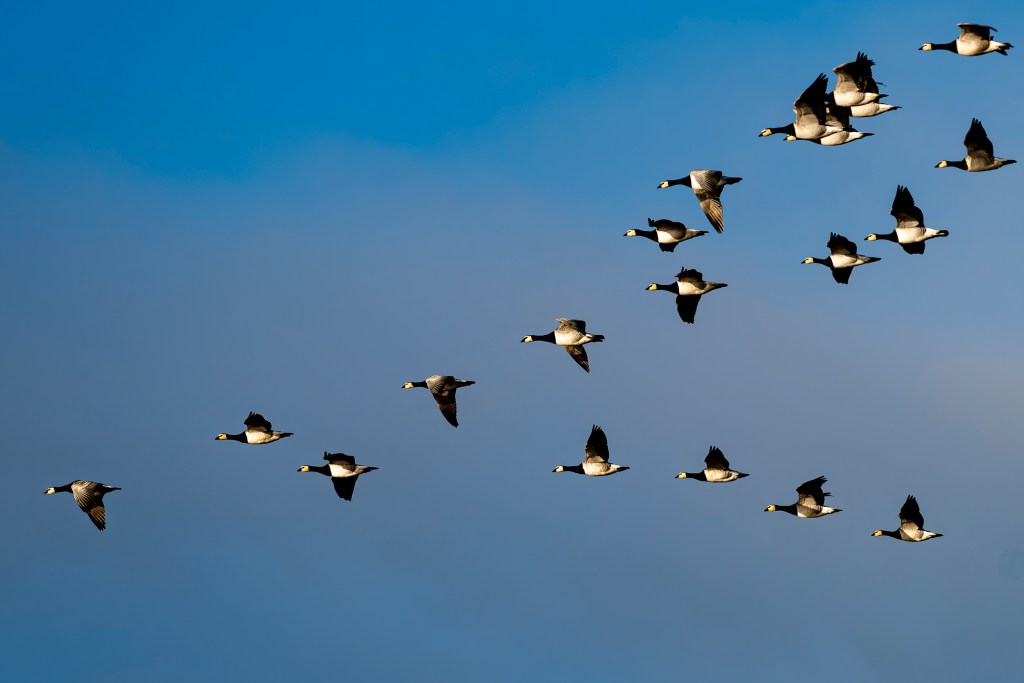
In the wider landscape, some birds are leaving as others arrive. Swallows have been absent now for over a week, ditto Wheatears, both on a journey back to Africa. Terns have left for the winter, as have most of the smaller Gulls, Black-headed gulls have been absent locally for a while. Common gulls, who in summer breed here in numbers, are now few and far between. Their bigger cousins will stay, Herring gulls and Black-backs, finding easy pickings along the shore, the bodies of Seals and Sea birds that fall victim to winters storms. Geese numbers are rising, skeins of Greylags are back from a summer in Iceland. Boosting the numbers of the resident population. Ears are cocked now for the yapping calls of Barnacle Geese, beautiful black and white birds, returning from Greenland. Harbingers of Winter.

Herring Gull and Greylags.

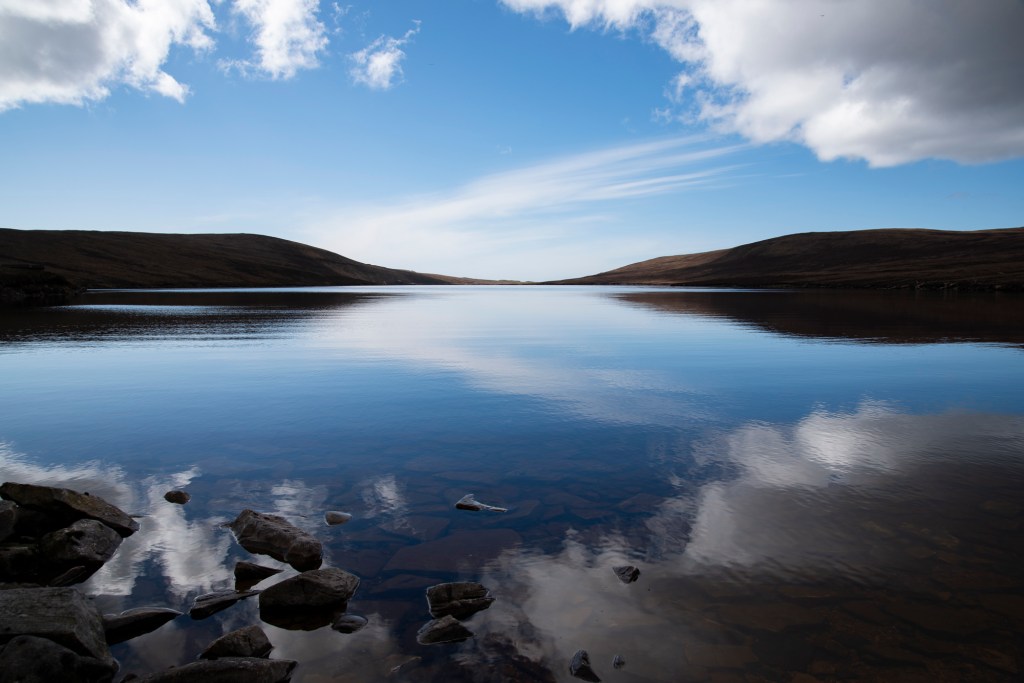
The past week brought clear moonless nights. On Thursday, just after midnight, I took the track up to Heldale, home to a natural reservoir that gives the island its drinking water. Drive along the road for half a mile, hook a left and clatter over a cattle grid, follow a stone track up into the moors until the reservoir appears. At night a long silver shape in a dark fold in the hills. A half dozen Mountain Hares were seen, each lolloping along in the headlight beam, stopping when I stopped, moving when I moved, confused by the light, only when I stopped and flicked off the lights did they leave the track. Snipe were seen in trackside ditches, a gleam of an eye and a glimpse of a long bill. A hedgehog was slowly driven around, a rolled up urchin of spines. The plan had been to photograph the milky way reflecting in the water. Flat calm when I set off, but a breeze picking up from the sea was enough to spoil plans and blur reflections. The aurora gave a plan B, appearing on the Northern horizon, bright enough for a picture to be taken.

Heldale.

I stayed for a couple of hours. The utter silence broken only by the splash of an unseen Otter and the calls of passing skeins of Pink-footed geese. The birds were high overhead, missing out Orkney, heading South to Scotland and beyond. The aurora ebbed and flowed, bright one minute, fading the next. I’d taken two cameras, one with an ultra wide lens that has a 180 degree angle of view. I used it for the image below, capturing the Northern and Western horizons in the same frame. To the North is the aurora, the mirrie dancers, and rising high to the West, is the Milky Way.

Mirrie dancers and the Milky way.

Sunshine and showers.

The last days of September are sticking to the script. Following the pattern of previous weeks. The odd haar, the occasional spell of rain, but generally dry and bright. Sunshine and showers. What the past week has brought though is a sharp edge to the wind and, on still days, a real nip to the morning air. We’re into fleece and body warmer days.

A week of Sunshine and showers.

From the rear garden, the moor can be seen again. Shelter belt trees are losing their leaves. At the moment the view through the trees is patchy, like looking out through the window of a long abandoned croft house, tattered and torn lace curtains and dirty glass. The Alders will shed their leaves first, already falling, crisped and browned.  Sycamores and Rowans will cling to their green modesty for a few more weeks. Sycamore keys are hung in bunches, waiting for a gale to set them free. In Spring they’ll germinate in borders by the hundred, growing as thick as grass.

Sycamore keys.

Hesperantha coccinea has come into its own this week. The books tell us that they need shelter and don’t like the wind, regardless of that, they thrive here. By November they’ll be the last plant standing. Another good doer, that we never tire of looking at, is Rudbeckia goldsturm, we plant them close to the house, a splash of sunlight on a rainy day.

Hesperantha catches the light, Rudbeckia catches the rain

Late Summer flowering Aster, little carlow, is proving to be a bee and hoverfly magnet. It’s quite tall and leggy and in its exposed front garden location has to be discretely wired to a fence. Bought from an online nursery in a 9cm pot it has grown at a rate of knots, clearly a keeper.

Aster and hoverflies.

Other plants of course are fading, done for the year. Two favourites, whose full names are lost to the mists of time, are a compact purple flowering geranium, whose leaves at this time of year give a show of reds and yellows, and a leucanthemum, a gift from a garden a few miles away. The leucanthemum has flowered through August and is only now starting to fade, shedding its petals to the wind. As with all plants that are gifts, even if we found out the name tomorrow, it would always be “the one from Leslye’s garden”.

Geranium leaves and Leslye’s leucanthemum.

After a few weeks of quiet, Starlings have returned. Most are juveniles, moulting into adulthood. An odd mix of spangled bodies and dull brown heads, the moult into adulthood must start from the bottom up. They arrive en masse and spend as much time squabbling as they do eating, a brief peace for a communal bath before returning to the feeders for fisticuffs. As a child they were Sheppies, a corruption of their old name of Sheepstare. The stare is believed by many to have given the Starling its name, from the white speckled starry plumage of its breast.

Juvenile Starlings.

An on-off summer project has been the building of dry-stone dykes to create a small courtyard garden. The best stone here came from a long ago closed island quarry, varying in thickness but flat and easy to lay. The worst comes off the hill, rubble with no ‘face’ or flats, fit only for farm tracks. After rebuilding front garden dykes we were down to the dregs of our of quarried stone, and so have had to use both. The inner face, seen from the garden, is a match for the rest of the dykes, quarried stone, a continuity of colour and shape. The outer face is whatever we had, rubble from the hill and stone dug from the ground while making the garden. It’s awkward and slow to build with. I once built a rubble-stone dyke around a half acre plot at the North end of the island, it took weeks and I said never again, but beggars can’t be choosers and so the walls, after a Summer of an hour here, and two hours there, are up, awaiting their pennies.

Quarried above, rubble below.

The pennies are the upright top stones. There’s a spot a few miles away, where the stone is just right, accessible by a barely passable track. In days past the place where fishermen would collect flat stones to act as weights for wooden creels. I went a few days ago, planning to visit a nearby geo with a camera before filling the van with suitable stone. It’s dark here now by 7.30 and I’d left it too late, managing the single photograph below before realising that if I didn’t get a scoot on I’d be searching for stone in the dark. All went well until I attempted to turn round at the end of the track. A crack like a pistol shot and a loss of power steering. I googled the part when I got home, one third of the value of the van. The next day I took it to the islands mend anything man, a couple of hours later as good as new, in the sense that a sixteen year old, moon and back mileage van, can be ‘new’. The necessary part fashioned with heat and a hammer from a pipe taken from a long dead tractor.

Late evening, Hesti geo.

It has been a good month for the mirrie dancers. At the moment on a clear night it’s rare to look to the North and not see at least a hint of green. The aurora giving the impression that just beyond the hill there’s a town or city whose streetlights are glowing green, lighting up the atmosphere. Just after midnight on Wednesday, the dancers put on a show of pinks, reds and greens that lasted an hour, only brought to a close by the arrival of low cloud and rain.

The dancers pay a visit.