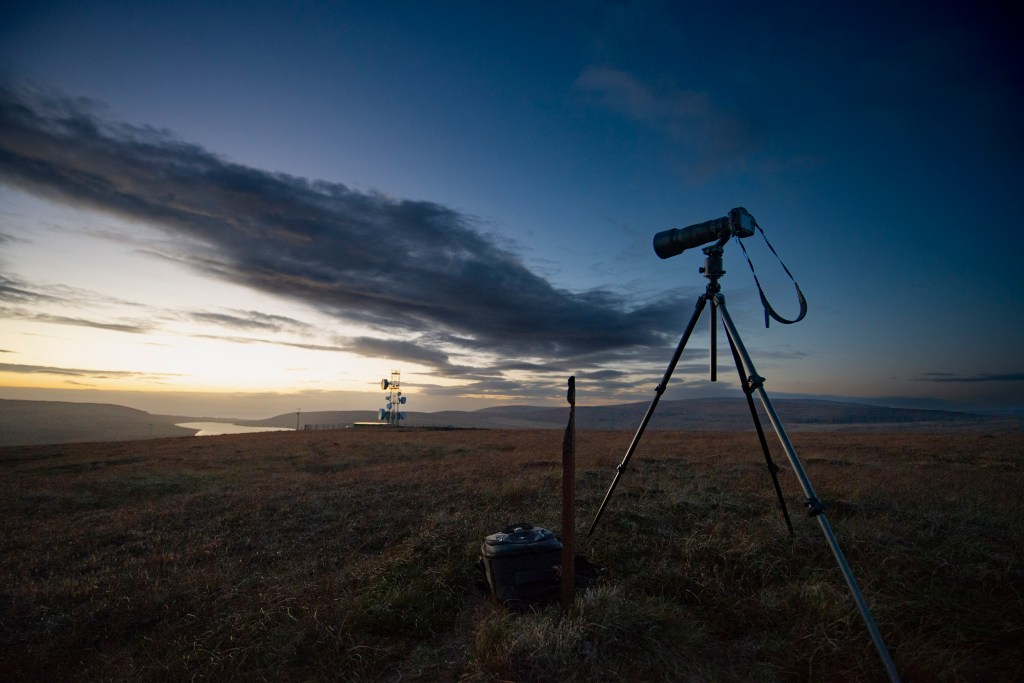
I’ve been trying, and failing, to see and photograph Comet A3. A once every 80,000 years visitor. The last time it passed by Neanderthals walked the earth. From the UK the comet is low in the west and close to the horizon. Google tells me, that for our location, the best views are just after sunset. Four times in recent days I’ve taken a stone track to the top of a low hill called Binga Fea, topped by a telecoms tower and the highest spot close to home that offers a view to the west. Each time clear skies have been promised and each time low cloud has spoilt best laid plans. Yesterday evening brought more of the same, a stubborn bank of cloud sitting out to the west.
On Binga Fea, looking West
Disappointment aside though, it’s a great spot to watch day fade to night. With camera set up I went for a wander, a male Hen Harrier passed by, appearing almost white in the half light. I caught the briefest glimpse of a Woodcock, newly arrived from Finland, a dark silhouette against a still bright, post sunset sky. To the south, across the Pentland Firth, some ten miles in the distance, there’s the coast of Caithness, where Dunnet head and its just visible lighthouse mark the most northerly point of mainland UK. Beyond that, almost lost in the haze and some 45 miles from the camera, is Morven, the tallest hill in Caithness. To the west, the next landfall is the coast of Labrador and Newfoundland, some two thousand miles away.
Morven, some 45 miles from the camera. The lighthouse at Dunnet Head, is just visible, lower right.
Looking east, Scapa Flow and Orkney spread out below you. There’s the island of Flotta, its 24/7 oil terminal lit like a small town, further out into the Flow, are the lights of a moored oil rig, pausing on its journey to the Cromarty Firth in Scotland, to be refurbed or broken for scrap. Beyond Scapa, lost to the dark, there’s the Orkney Mainland and the linked isles, the latter read like names on a shipping forecast – South Ronaldsay, Burray, Hunda, Glimps Holm, Lambs Holm.
Flotta, lower right, and Scapa Flow.
As well as the hoped for Comet to the west, there would also be a moonrise to the north-east. The moon would rise at five to six, five minutes before sunset, a photograph was planned with the moon low in the sky, just above the islands and the sea. At half past five, not wanting to be left out, the north-eastern horizon also wrapped itself in a shroud of thickening cloud. The moon eventually rising above it, too high for the planned picture, but a bonus picture was taken anyway, the moon, cratered and bright, pulled close by a long lens.
The Comet is fading, gone by the month end. The next clear day for us is Wednesday, if the forecast is correct, I’ll take the track and try again, crossing fingers that the final score will be Comet 4 – Human 1.
In Orkney, this year especially, it seems like every night is an Aurora night. An app pinging regularly with the message – “visible in the far North of Scotland”.
What the app should also add of course, is “subject to the moon and the weather”. A blanket of cloud is an obvious no-no, but so is the moon, at the moment 86% full, more than bright enough to wash out all but the strongest displays.
As mentioned in previous posts, in Orkney the aurora is given the title the ‘mirrie dancers’. When we first moved here, a late night phone call asked if we would like to see the “dancers”, confusion briefly reigned and 2+2 was made into 5, was it an upcoming show at the community hall? Eventually the penny dropped and we went down onto the shore, with the lady who had been kind enough to ring, and watched our first ever light show.
The name is appropriate, on those rare nights like that first night eleven years ago, the greens and reds literally do fill the sky and dance before your eyes. More often than not though, at first glance, there’s just a faint glow to the North. The rest of the aurora remaining invisible until you get your eye in. With a weak aurora, even when you do get your eye in, the streaks of colour, higher up in the skies, appear as shades of grey and white. Only when you check the screen on the back of the camera, do you see the colours, invisible to the eye but picked up by a much more sensitive to darkness, digital sensor.
Last Thursday promised a spectacular show. To be seen across the UK. A rival for the one eleven years ago. In Orkney we drew a short straw, thick cloud and 40mph winds. The met office though predicted a slight silver lining, the clouds would thin at around 4am on Friday morning, the alarm was set for 3. They timed the forecast to perfection, the clouds thinning on cue, pinprick stars becoming visible.
There are rare moments when the dancers can be seen to every horizon. Friday morning brought one of them. Although the clouds never quite cleared, blurring in camera as they rushed across the sky, they thinned enough to make a 3am start worthwhile. I stayed close to home, dodging the winds behind shelter belt and garden dykes, dashing back indoors when a heavy shower came scudding in.
The photographs below show views to all four compass points. The highlight of the night was an auroral corona, high above the house to the West.
Looking North from the rear garden.To the West.An ultra-wide lens captures both the Eastern and Southern horizons. The glow lighting the clouds, extreme bottom left, comes from the streetlights of Kirkwall on the Orkney mainland, some 15 miles distant. The pinprick of light, lower right centre, is a lighthouse on the Scottish coast, beyond the lighthouse, lost in the gloom, is the county of Caithness.Looking West again. The firework burst of an Auroral corona.
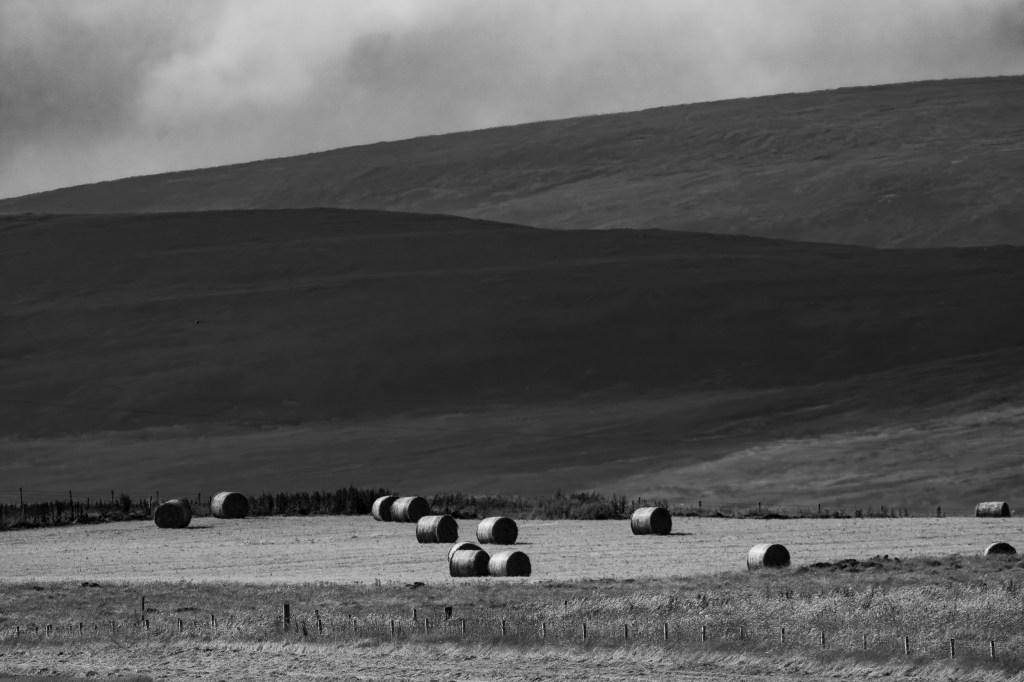
September ended as it began. A settled month of mostly dry and bright days. Throughout the month late summer storms were noticed by their absence. The first days of October have followed suit, bright days and clear nights, a bonus for this time of year. Next week though is all change, rain and midweek gales. Farmers are cutting the last of the Barley, racing to beat the weather. The landscape dotted with bales of winter feed and bedding.
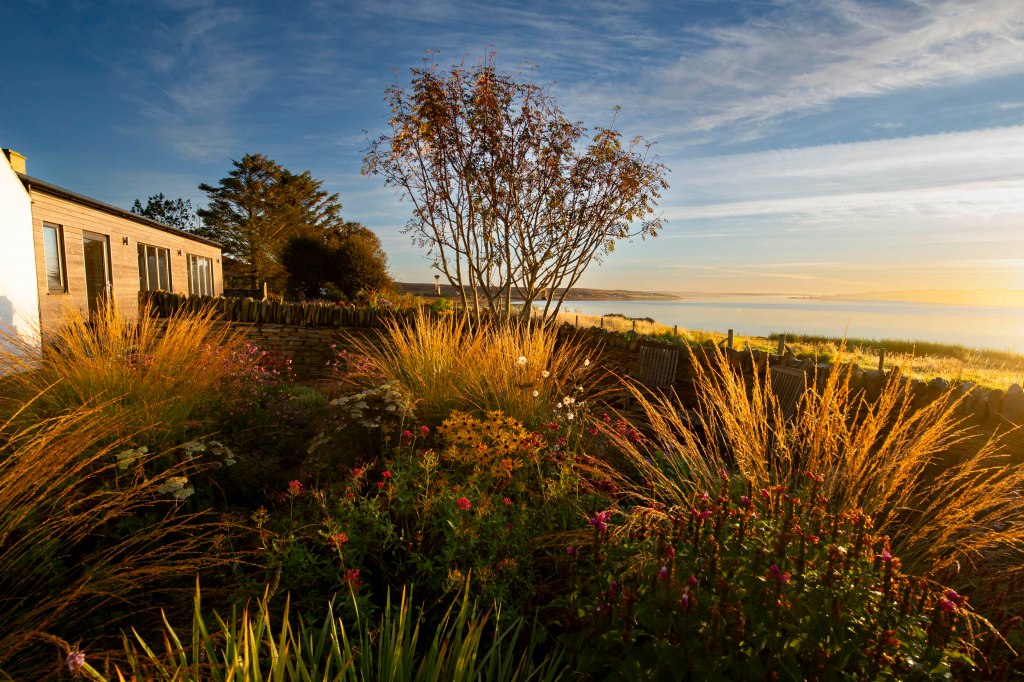
In the kaleyard garden, Molinia’s are putting on a show. For most of the year they’re almost invisible, low mounds of green that are easily overlooked. They’re a close relative of the native moor grass and, as with the moor grasses up on the hill behind the house, at this time of year they come into their own, throwing out starburst seed heads that, in early morning or late afternoon light, look stunning, especially when given life by a passing breeze.
Molinia’s and early morning light.
As plants go over, Jacqui has continued cutting them back, splitting and replanting and potting on the spares. At this time of year compost bins are usually being filled, seaweed from the shore along with cut back foliage and muck from a neighbours Shetland pony lawnmowers. At the moment though seaweed pickings are thin, a settled month means most is still anchored to the shore, yet to be torn free by wild seas. Next weeks gales will bring a bounty, bladderwrack and kelp rolled up on the strand line.
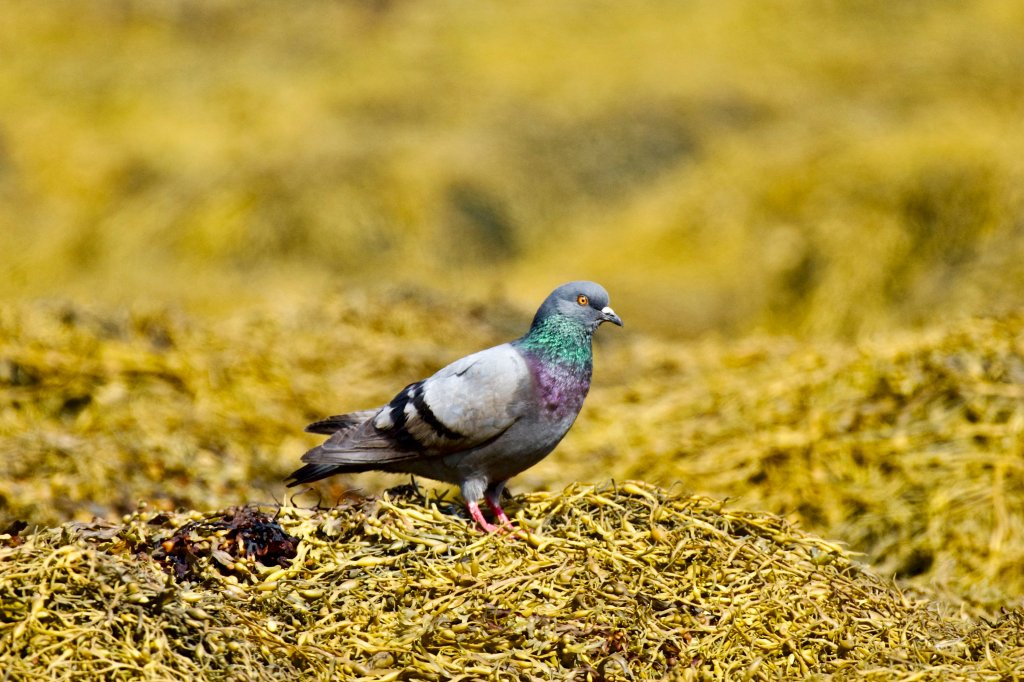
Bladderwrack (and Rock Dove)
Wrens are busy in the garden, checking out nooks and crannies in dry-stone dykes, a hunt for unlucky Spiders. Earlier in the year a pair of Stonechats raised a brood in a briar filled boundary ditch. At least three youngsters have survived, yet to get their adult plumage they spend their days among Willow coppice close to the shore, occasionally rising skywards, giving chase to an unseen insect.
A Wren checks out the dykes, a juvenile Stonechat awaits passing insects.
In the wider landscape, some birds are leaving as others arrive. Swallows have been absent now for over a week, ditto Wheatears, both on a journey back to Africa. Terns have left for the winter, as have most of the smaller Gulls, Black-headed gulls have been absent locally for a while. Common gulls, who in summer breed here in numbers, are now few and far between. Their bigger cousins will stay, Herring gulls and Black-backs, finding easy pickings along the shore, the bodies of Seals and Sea birds that fall victim to winters storms. Geese numbers are rising, skeins of Greylags are back from a summer in Iceland. Boosting the numbers of the resident population. Ears are cocked now for the yapping calls of Barnacle Geese, beautiful black and white birds, returning from Greenland. Harbingers of Winter.
Herring Gull and Greylags.
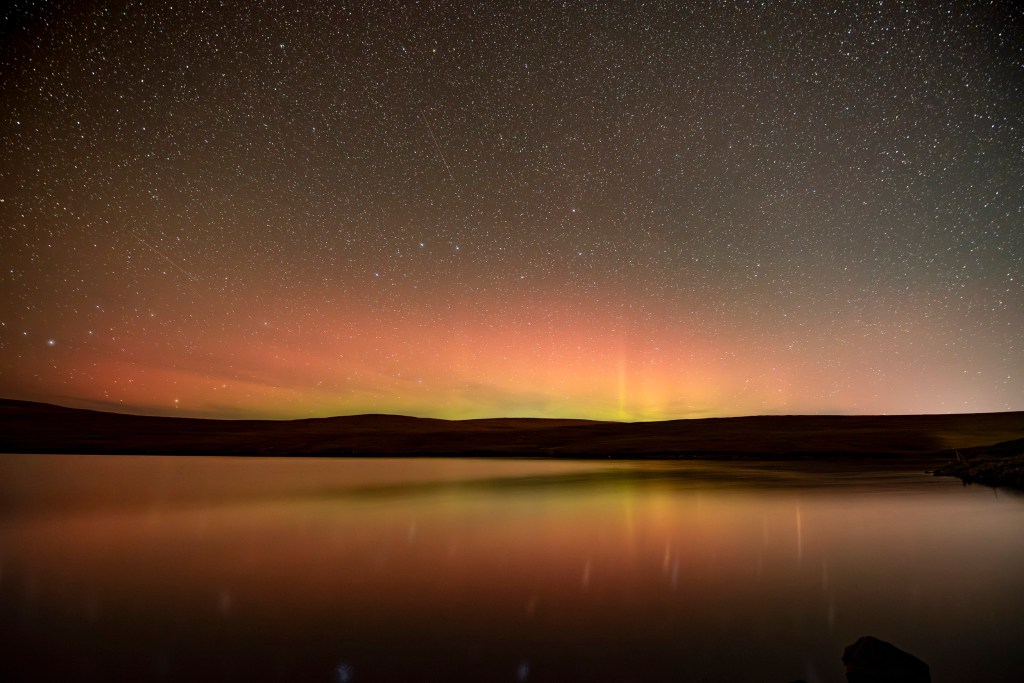
The past week brought clear moonless nights. On Thursday, just after midnight, I took the track up to Heldale, home to a natural reservoir that gives the island its drinking water. Drive along the road for half a mile, hook a left and clatter over a cattle grid, follow a stone track up into the moors until the reservoir appears. At night a long silver shape in a dark fold in the hills. A half dozen Mountain Hares were seen, each lolloping along in the headlight beam, stopping when I stopped, moving when I moved, confused by the light, only when I stopped and flicked off the lights did they leave the track. Snipe were seen in trackside ditches, a gleam of an eye and a glimpse of a long bill. A hedgehog was slowly driven around, a rolled up urchin of spines. The plan had been to photograph the milky way reflecting in the water. Flat calm when I set off, but a breeze picking up from the sea was enough to spoil plans and blur reflections. The aurora gave a plan B, appearing on the Northern horizon, bright enough for a picture to be taken.
Heldale.
I stayed for a couple of hours. The utter silence broken only by the splash of an unseen Otter and the calls of passing skeins of Pink-footed geese. The birds were high overhead, missing out Orkney, heading South to Scotland and beyond. The aurora ebbed and flowed, bright one minute, fading the next. I’d taken two cameras, one with an ultra wide lens that has a 180 degree angle of view. I used it for the image below, capturing the Northern and Western horizons in the same frame. To the North is the aurora, the mirrie dancers, and rising high to the West, is the Milky Way.
The last days of September are sticking to the script. Following the pattern of previous weeks. The odd haar, the occasional spell of rain, but generally dry and bright. Sunshine and showers. What the past week has brought though is a sharp edge to the wind and, on still days, a real nip to the morning air. We’re into fleece and body warmer days.
A week of Sunshine and showers.
From the rear garden, the moor can be seen again. Shelter belt trees are losing their leaves. At the moment the view through the trees is patchy, like looking out through the window of a long abandoned croft house, tattered and torn lace curtains and dirty glass. The Alders will shed their leaves first, already falling, crisped and browned. Sycamores and Rowans will cling to their green modesty for a few more weeks. Sycamore keys are hung in bunches, waiting for a gale to set them free. In Spring they’ll germinate in borders by the hundred, growing as thick as grass.
Sycamore keys.
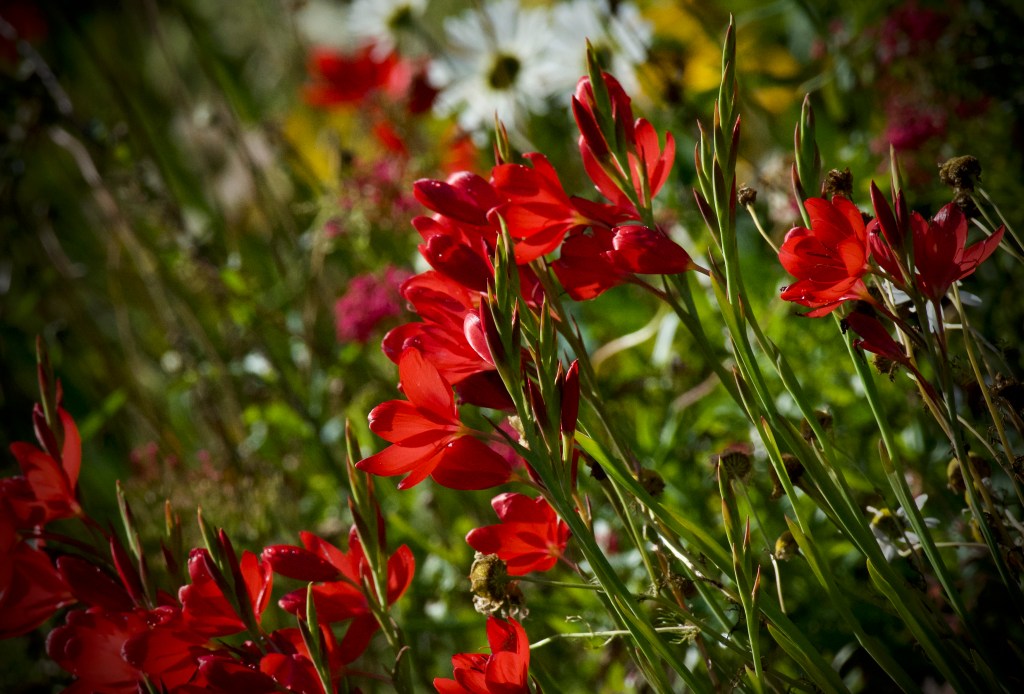
Hesperantha coccinea has come into its own this week. The books tell us that they need shelter and don’t like the wind, regardless of that, they thrive here. By November they’ll be the last plant standing. Another good doer, that we never tire of looking at, is Rudbeckia goldsturm, we plant them close to the house, a splash of sunlight on a rainy day.
Hesperantha catches the light, Rudbeckia catches the rain
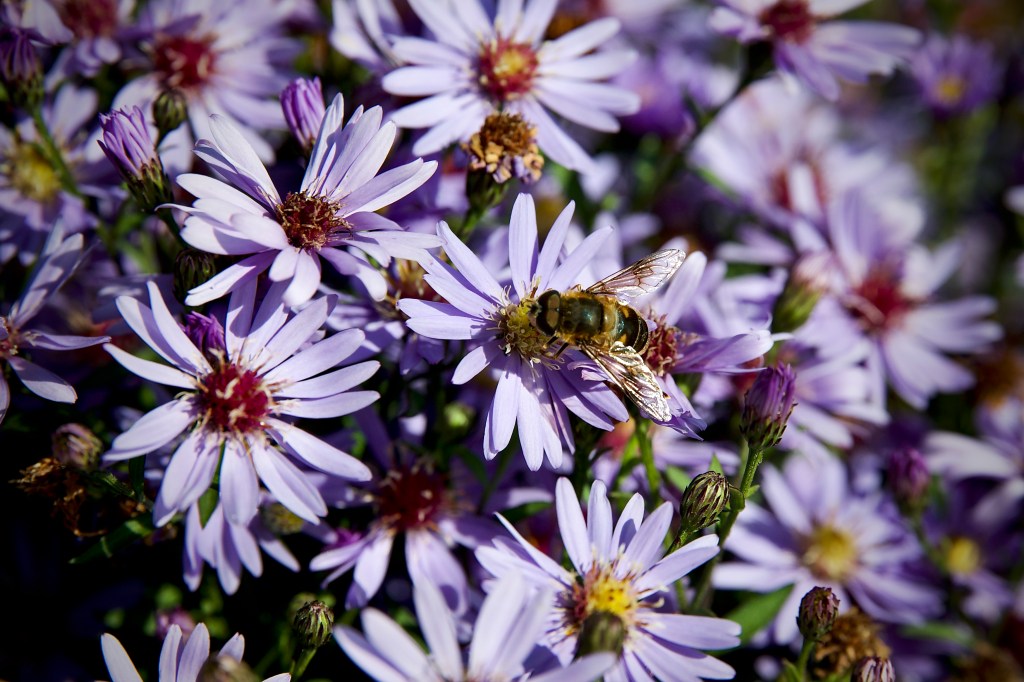
Late Summer flowering Aster, little carlow, is proving to be a bee and hoverfly magnet. It’s quite tall and leggy and in its exposed front garden location has to be discretely wired to a fence. Bought from an online nursery in a 9cm pot it has grown at a rate of knots, clearly a keeper.
Aster and hoverflies.
Other plants of course are fading, done for the year. Two favourites, whose full names are lost to the mists of time, are a compact purple flowering geranium, whose leaves at this time of year give a show of reds and yellows, and a leucanthemum, a gift from a garden a few miles away. The leucanthemum has flowered through August and is only now starting to fade, shedding its petals to the wind. As with all plants that are gifts, even if we found out the name tomorrow, it would always be “the one from Leslye’s garden”.
Geranium leaves and Leslye’s leucanthemum.
After a few weeks of quiet, Starlings have returned. Most are juveniles, moulting into adulthood. An odd mix of spangled bodies and dull brown heads, the moult into adulthood must start from the bottom up. They arrive en masse and spend as much time squabbling as they do eating, a brief peace for a communal bath before returning to the feeders for fisticuffs. As a child they were Sheppies, a corruption of their old name of Sheepstare. The stare is believed by many to have given the Starling its name, from the white speckled starry plumage of its breast.
Juvenile Starlings.
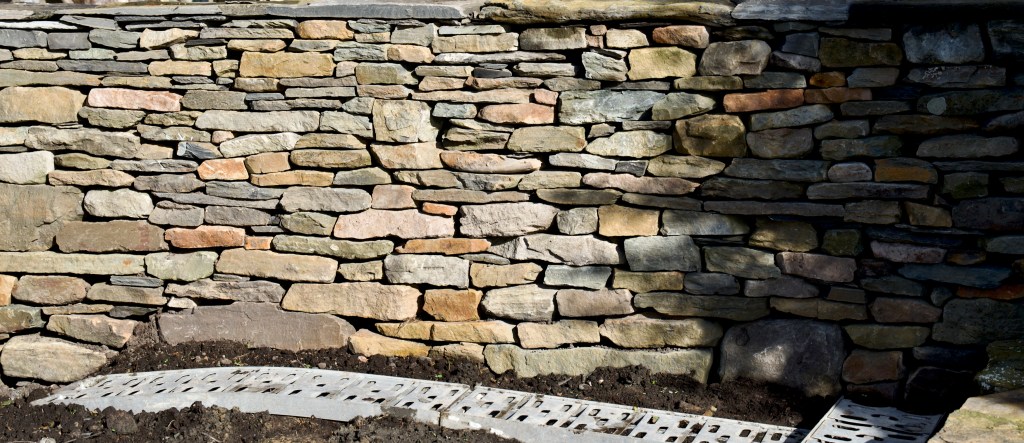
An on-off summer project has been the building of dry-stone dykes to create a small courtyard garden. The best stone here came from a long ago closed island quarry, varying in thickness but flat and easy to lay. The worst comes off the hill, rubble with no ‘face’ or flats, fit only for farm tracks. After rebuilding front garden dykes we were down to the dregs of our of quarried stone, and so have had to use both. The inner face, seen from the garden, is a match for the rest of the dykes, quarried stone, a continuity of colour and shape. The outer face is whatever we had, rubble from the hill and stone dug from the ground while making the garden. It’s awkward and slow to build with. I once built a rubble-stone dyke around a half acre plot at the North end of the island, it took weeks and I said never again, but beggars can’t be choosers and so the walls, after a Summer of an hour here, and two hours there, are up, awaiting their pennies.
Quarried above, rubble below.
The pennies are the upright top stones. There’s a spot a few miles away, where the stone is just right, accessible by a barely passable track. In days past the place where fishermen would collect flat stones to act as weights for wooden creels. I went a few days ago, planning to visit a nearby geo with a camera before filling the van with suitable stone. It’s dark here now by 7.30 and I’d left it too late, managing the single photograph below before realising that if I didn’t get a scoot on I’d be searching for stone in the dark. All went well until I attempted to turn round at the end of the track. A crack like a pistol shot and a loss of power steering. I googled the part when I got home, one third of the value of the van. The next day I took it to the islands mend anything man, a couple of hours later as good as new, in the sense that a sixteen year old, moon and back mileage van, can be ‘new’. The necessary part fashioned with heat and a hammer from a pipe taken from a long dead tractor.
Late evening, Hesti geo.
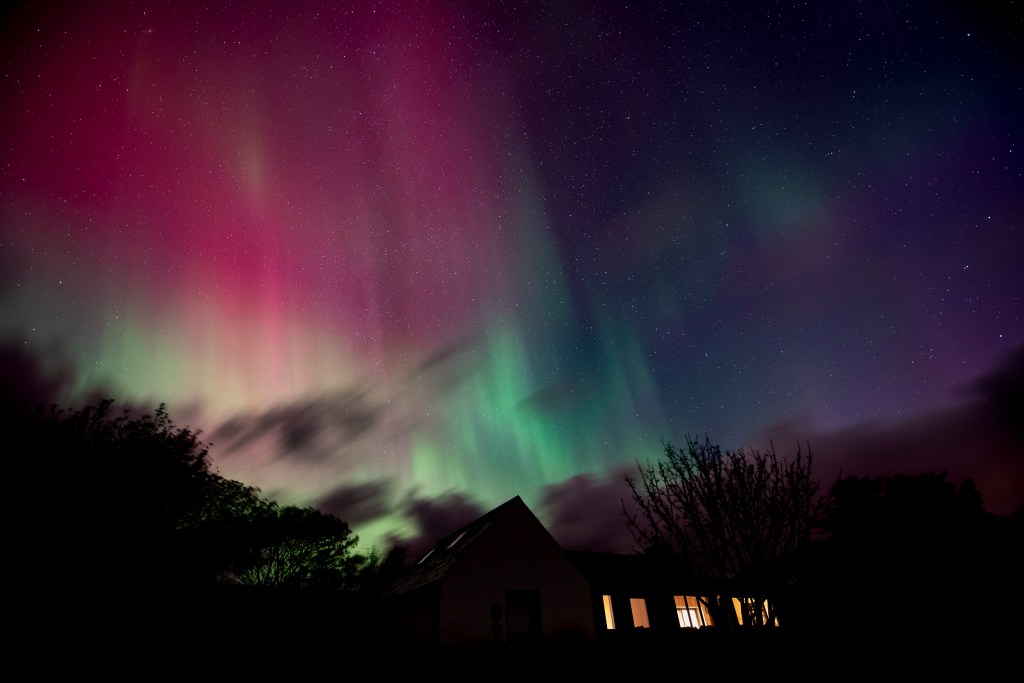
It has been a good month for the mirrie dancers. At the moment on a clear night it’s rare to look to the North and not see at least a hint of green. The aurora giving the impression that just beyond the hill there’s a town or city whose streetlights are glowing green, lighting up the atmosphere. Just after midnight on Wednesday, the dancers put on a show of pinks, reds and greens that lasted an hour, only brought to a close by the arrival of low cloud and rain.
September has, so far, brought dry days and settled weather. The past midweek days especially, were a late Summer bonus, sunshine and wall to wall blue skies. Out on the islands of course you shouldn’t tempt fate, I’m writing this sitting in the car on the deck of the inter-island ferry that runs between Hoy and the Orkney mainland. We’ve just left the island of Flotta and are now passing the uninhabited island of Cava, a low grey shape, just visible through a thickening sea fog….
Blue skies and sunshine.
The clear skies coincided with a full moon. There’s no street lighting in this neck of the woods, from the garden there are a few pinpricks of light from the windows of houses across the bay and there’s the spinning on-off beam of a lighthouse at Duncansby Head, some four miles distant, just visible at the tip of the Scottish mainland, but that’s about it. To wander around outside after dark without a head head torch is to risk either walking into something or twisting an ankle, but on a clear night with a full moon all is transformed. The garden and landscape are lit with a silver light, the parish lantern, bright enough at midnight to cast dark shadows. Whitewashed houses, a mile or more distant, are clearly visible.
The garden at midnight, lit by a full moon – the Parish lantern.
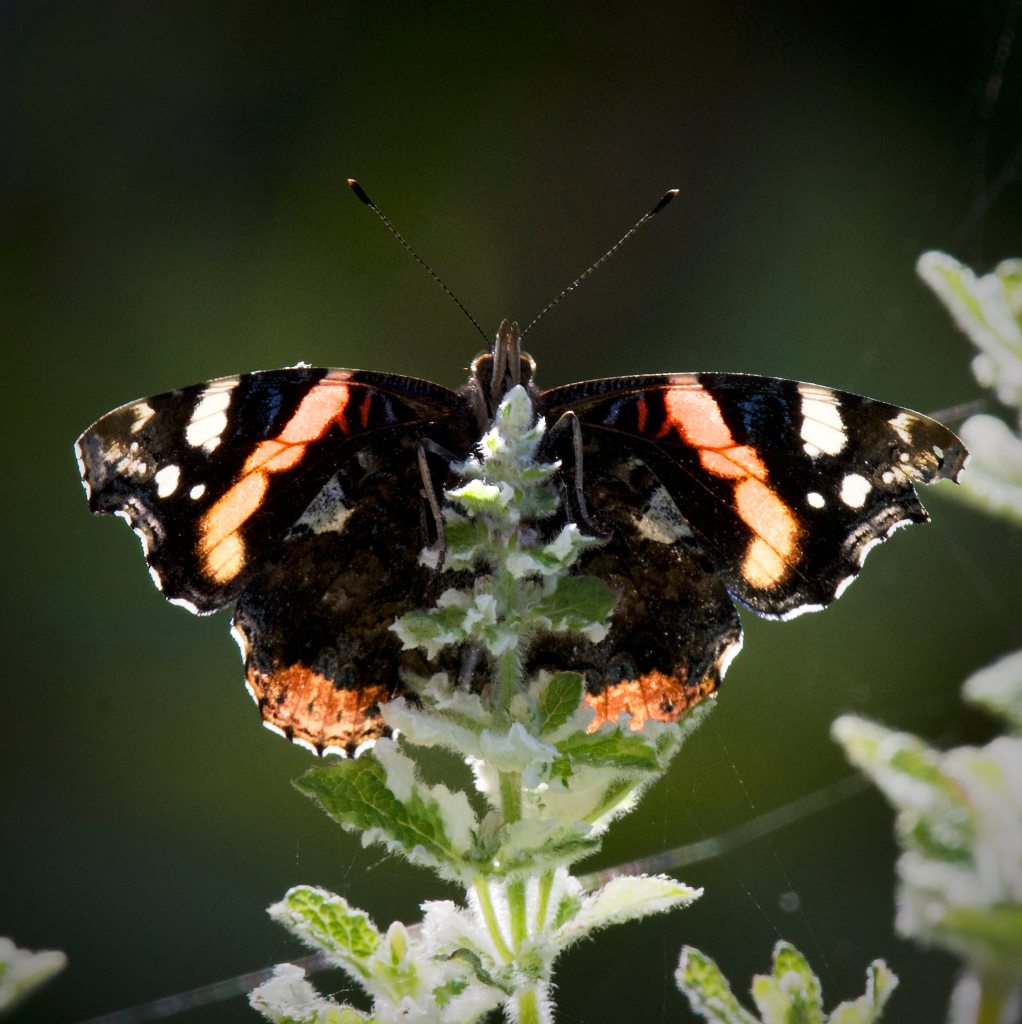
The recent warmth brought an influx of butterflies to the garden. Newly hatched Red Admirals, fresh and vivid in reds, whites and blacks, feasting in groups on the nectar of reddening sedums, a pair occasionally rising up to engage in a brief twisting ballet. Perhaps a courtship dance or perhaps a territorial dogfight. Slightly frayed at the edges Small Tortoiseshells are also being seen, together with Peacocks, who flash eyed wing warnings at passing bumblebees.
Small tortoiseshell, Peacock and Red admirals.
September brings Giant horntails to the the garden. Members of the sawfly family that are often given the name Giant wood wasp. They grow up to one and a half inches, 4cm, in length, and have a slow meandering up and down flight that gives the impression of having no real aim or destination. They’re completely harmless, the fearsome looking ‘sting’ is an ovipositor, used for laying eggs into rotting pine trees. Once hatched, the larvae will spend five years munching away before finally emerging as adults. Rinse and repeat. Despite knowing that they are harmless, when they land on you there’s a moment of apprehension, the huge size and yellow and black markings triggering an urge to do the ‘wasp dance’, before common sense kicks in.
Giant horntails pay a visit.
In the meadow most of the wildflowers have turned to seed. One or two scabious are still in flower and there’s a single pink splash of ragged robin but at this time of year it is down to ox-eyes to keep the show going. A friends house along the way takes its name from the ox-eye daisies that once grew along the verges here, sadly lost over past decades. We reintroduced them as plugs grown from seed, crossing fingers that they wouldn’t die out after a season or two. So far so good, three years on from first reintroducing them, they have gone from strength to strength.
Ox-eye and Hoverfly.
On a nearby favourite walk, in an area known as the Hill of the white Hammars, areas of coastal heath that a few weeks ago were lit lilac-blue with the pom-pom flowers of devils bit scabious, are now also cast with a confetti of pale dry seed heads. Grasses are turning dun brown. Dockens have thrown up dark spires of black seeds, a winter food source for Twite and Goldfinch. I walked there on Wednesday, a day of bright sunshine and big skies. I’d slung a camera with an ultra wide lens, a fisheye, over my shoulder. The lens has an angle of view so wide that it is easy to accidentally get the toes of your boots in the frame. Tilt the camera and you’ll get wild distortions, see the horizon in the ox-eye picture above, but keep it level and the lens just about behaves itself. In the photographs below only the curved boundary post in the seascape gives a clue to the lens used. In reality the post is straight as a die.
In Orkney, my favourite month is June, the time of the “simmer dim”, a time where the sun dips briefly below the horizon before quickly rising again. Long summer days separated by an hour or two of pale twilight. A time when it seems summer will never end. Behind June, September runs a close second favourite. It shouldn’t be so, September is the month that marks the end of our short Orkney summer. A harbinger, first of a brief autumn, then of gales and winter wet. But it also brings back the things that summer here takes away, dark skies dusted with pinpricks of light, jewelled cobwebs and foggy mornings. The Milky Way, pictured above rising over the house, is visible once more.
The past week has lived up to expectations, bringing early morning sea fogs and clear night skies. The fogs are always localised, more common out on the islands. Yesterday we took the ferry to Mainland, (the largest island in Orkney), no real plans bar a walk around Stromness followed by fish & chips in Kirkwall. We left Hoy with the landscape wrapped in grey, thirty minutes later we drove off the ferry ramp and headed on to Stromness under clear blue skies. We caught the last boat home, the ferry gliding back into a sea fog half way across Scapa Flow. By evening though, the days grey shroud had faded away, dispersed on the breeze. Leaving behind clear skies that bring the chance, if you look to the North, of a glimpse of the mirrie dancers.
Looking North, pinprick stars and the glow of the dancers.
In the garden it’s also all change, while the soil is still warm Jacqui is on a mission to move plants that have outgrown their space. Gravel paths are dotted with clumps of split roots as space is remade for plants that are thriving and, for the few that aren’t, a new home is tried. A second chance to find their feet. Out of the two of us Jacqui is the real gardener, somehow in a few short summers, she has managed to create a garden where a garden really shouldn’t grow, an exposed spot of thin stony soil, lashed by salt laden gales. A spot where if you read and believe the books you wouldn’t bother, but J gardens with her heart and soul and so the garden thrives. I build dykes and make meadows but without her love and dedication, there wouldn’t be a garden here.
Jacqui sows her magic, a front garden plot, from bare space to garden in a few short summers.
A recent trip “sooth”, in Orkney “sooth” is anywhere South of John o’ Groats, saw a couple of Crocosmia’s that had been on Jacqui’s wants list brought home. Crocosmia Emily McKenzie and Crocosmia Carmine. As a species they’re a late summer mainstay for this garden, traffic light red Lucifer is the first to flower but as Lucifer fades cooler colours take over, yellows and pale oranges that sit well in soft light. A favourite for this time of year, one that travelled with us from our old garden in Yorkshire, is C.Pauls best yellow.
Crocosmia Emily McKenzie bows to the rain. Below is Crocosmia Carmine
Rudbeckia’s have also come into their own. They’re a good doer for here, one of the best, which we grew from seed, is Goldsturm, used here and there in both the garden proper and in the “guerrilla garden”. A roadside strip of no mans land beyond the front garden dykes, a grey area of undefined ownership, part ours, part councils.
Rudbeckia goldsturm and Crocosmia paul’s best yellow above, Guerrilla garden below.
I’ve written before that trees don’t gently fade to yellows and reds here. Courtesy of salt laden easterly gales, leaves will turn quickly from vibrant green to crisped brown, stripped away in days and cast to the floor. What the trees can’t give though the garden does. At this time of year, the pale reds of sedums, together with the oranges and yellows of crocosmia and rudbeckia and others, when added to the fading foliage of early summer perennials, give us our autumn finale . A swan song that, if we are lucky, and the gales from the East stay away, will last well into October.
August, so far, has brought unseasonably cool weather. A few days gave spells of sunshine and others, despite a grey blanket of low cloud, were warm enough for a T-shirt and jeans. But many days, especially during the past week, brought cold south easterly winds, occasionally peaking to gale force. Horizontal rain and cancelled ferries.
August has brought a mixed bag of weather. Calm seas and stormy skies, Osmundwall.
The garden of course shrugs it all off, a few plants get battered and leaves that shouldn’t fall until Autumn are torn from branches and cast to the ground, but the garden, like its owners, goes with the flow. Many perennials are discreetly staked and when the gales have moved on, a re-tie here and there, along with a tweak with secateurs, soon sees order restored.
Despite borders being full of colour and alive with the buzz of bees, the gales bring a timely reminder that, for this northern garden, the days of our short summer are numbered. Wriggly tin compost bins are already filling with the cut back growth of faded early summer perennials. Some plants though are only just getting started. Ligularia othello has come into flower this week, timed to perfection, the new flowers taking an instant battering from an easterly gale. It’s a plant that we grow mostly for its large showy leaves, the golden-yellow flowers a welcome bonus.
Ligularia othello
In the kaleyard garden, a late summer favourite, Sidalcia party girl, has tall showy spires of white eyed pink flowers. Another kaleyard favourite, a Molinia whose name is long forgotten, has cast up hundreds of seed heads on thin green stems. A close relative of the native moor grass that grows wild on the hill behind the house. On a still day it is easily overlooked, only coming to life when a breeze passes over the garden, seed heads swaying and dancing to the rhythm of wind.
Sidalcia party girl, above centre, and Molinia below.
As the year moves on birds that arrived for the summer to weave nests and rear ever hungry chicks are now being noticed by their absence. A half dozen pairs of Blackbirds, who a few weeks ago were run ragged feeding cocoa brown fledglings, have, along with their youngsters, moved on to pastures new. Ditto the Lesser Redpolls who arrive every Spring to raise broods of youngsters in nests tucked low amongst moorland heathers and grasses. A week or two ago we counted adults and juveniles in tens, now just a single pair remains, perhaps hanging back to rear a late hatched brood.
Blackbirds and Redpolls have left for pastures new.
In the wider landscape summer visiting Common Gulls have left their breeding grounds on moor and heath. Like most gulls they’re opportunists and won’t pass up the chance to grab an unguarded egg but when watched from afar there’s a gentleness to their colonies, the birds generally rubbing along together and quickly settling neighbourly disputes with barely a raised wing or ruffled feather. Great black-backed gulls also breed on the moors here, unlike their smaller Common Gull cousins the birds are year round residents. They’re the largest of all the gulls, powerful thickset birds who are merciless stealers of eggs and chicks. In summer the adult birds are always on patrol, gliding along the cliffs or shore on broad wings. Always on the lookout for an unguarded egg or unlucky chick. In winter they feed on the victims of storms and crashing seas, the bodies of seals and seabirds cast upon the shore, are fought over by Black-backs and Ravens.
Common and Great black-backed Gulls.
With the long daylight hours of June’s ‘Simmer Dim’ behind us, a bonus brought by the shorter days, is that the mirrie dancers, the northern lights, are being seen again. Sunday, a week past, brought the promise of a good show. The hardest thing about photographing the dancers is getting something in the foreground, a sense of scale. A roofless clifftop byre a few miles from home seemed a likely spot. It’s an area of coastal heath, grazed in summer by rare breed sheep. As I walked to the byre I passed a small flock of them, in the near total darkness their eyes were lit yellow by the beam of my head torch, they stood their ground, more curious than afraid. With the camera set up all you had to do was cross your fingers and wait, passing the time by counting the spinning on-off beams of lighthouses. Some were closer than others, five of the eight that I could see are in Orkney, three are more distant, warning of hidden dangers along the coast of Scotlands Caithness.
Byre, mirrie dancers and yours truly. Standing still for a thirty second exposure is harder than it looks.
The last days of July brought mostly settled weather. The odd spell of rain but generally dry and bright with light winds and clear skies.
The past week brought mostly dry and bright days.
In the garden, the warmth brought Crocosmia lucifer into flower. A traffic light red back of a border plant that travelled with us on the journey from Yorkshire. We grow around eight or nine varieties of crocosmia, in various shades of yellows, oranges and reds. Lucifer is a favourite and is always the first to flower. A good late summer perennial for this island garden, happy in dry or damp, in both sun or part shade.
Crocosmia Lucifer.
Another plant that also marks the coming of August is the Day Lily, hemerocallis. They live up to their name, each bloom literally lasting a day. As fast as one flower fades though another takes its place, each stem carries multiple buds, a mini production line of oranges and reds.
Day lily, flower and bud production line.
In the meadow, tucked low amongst the grasses, soft blue pincushion heads of Devils Bit Scabious are starting to appear. The plant gets its name from its truncated root, which was, according to folklore, bitten off by the Devil. After the meadow was cleared a single plant appeared, to boost numbers we tried, and failed, to grow more of it from seed. We shouldn’t have bothered, three years on, from that single plant there are now dozens of them, happily self seeding their way across the ground. A plant that we did introduce from seed was Lesser Knapweed, found locally but absent from the meadow. Unlike the devils bit they’re one of the easiest wildflowers to grow, show them compost and they’ll germinate. We’ve planted hundreds of plugs of them over the last couple of years and notice that now, around the oldest of them, the turf is dotted with self sown seedlings.
Devils bit Scabious and Lesser knapweed.
As some plants come into flower others are already fading to seed. In the meadow the dandelion like seed heads of cats ear are starting to form. For us they’re the most successful of the grassland plants. They first appeared along the fields southern edge, a line of bright yellow springing up where decades old grass and thatch had been cleared to allow the repair of a boundary fence. Their appearance gave weight to our hope that, beneath the fields thick coat of thatch, a meadow was lurking, waiting for warmth and light. Now they carpet almost the whole of the meadow. Only absent in the wettest of spots, the places where buttercups take over the task of turning the land from green to gold.
Cats ear.
Meadow Brown butterflies are on the wing. As each year passes we see them more and more, both in the meadow and within the garden. Of the ten species of butterfly that are usually seen in Orkney, so far we’ve managed to record eight of them. Only the extremely rare for this this far North, Large Heath and Dark Green Fritillary, have so far eluded us.
Meadow Brown.
On the low cliff, where the meadow falls steeply to the shore, a few pairs of Fulmars nest. It’s not really ideal for them, the face of the cliff is mostly covered with a vertical green wall of blackberry and wild rose but here and there, wherever space allows a clear landing and take off, a scrape will be made and a single egg will be laid. Some of the nests are barely head high but at low tide, looking back at the cliff with a long lens on the camera, the chicks can be safely photographed without disturbance. Despite being many weeks old they have yet to feather up. They sit motionless, like downy Buddha’s, patiently waiting for their parents to return from a fishing expedition. After hatching it’s around seventy days before the chick leaves the nest, from an egg laid in May, it’s late summer before they spread their wings. If lucky, they’ll live for thirty or forty years. It’s hard to imagine that those fluffy balls of down will soon be mastering up-draughts and thermals and wandering the winter seas.
A Fulmar chick awaits food (and feathers). An adult rides the up-draughts.
The shore below the cliff is literally a tumble of stone and rock, there’s no beach except at the very lowest of tides. It’s home to a bob of around twenty or so harbour seals. They pup in June and during that time we leave them be for a few weeks, avoiding walking on the shore. By this time of year, with the pups well grown, a count can be made of how successful they’ve been. This afternoon, after photographing the Fulmar chicks, I counted seventeen adults and at least eight pups, all hauled out on the wrack covered rocks. Keeping a wary eye on me and deciding if they could be bothered to slip back into the sea. In the end they couldn’t be bothered, staying put, craning their necks to watch me pass.
A Harbour Seal and her pup.
Before the days of roll-on, roll-off ferries and household refuse collections, the shore, for houses close to it, was seen as a handy place to get rid of household waste. The tide takes no prisoners, bottles and pots dumped over the cliff by barrow or cart would soon be reduced to sea smoothed fragments of stoneware and glass. Occasionally though a stoneware bottle will be found intact, somehow surviving a century or more of being rolled back and forth by the tides. Broken china also went into the sea, there are many hundreds of fragments of spongeware and willow pattern, pieces of dropped plates and broken cups.
Rarer, and naturally occurring, are pieces of Malachite. An Ore of copper that is sometimes cut and polished for the jewellery trade. In colour it has the same verdigris as aged copper pipe and is often found near the mouths of burns, perhaps swept down from the surrounding hills by rainwater rushing from moor to shore. The ore only occurs here in small quantities and in the distant past there have been unsuccessful attempts to mine it, at Wha Taing on the Orkney mainland, and also, in the sixteenth century, on the island of Rousay.
The past week brought a mixed bag of weather. On Monday we woke to a mackerel sky, a display of high altocumulus cloud, backlit by the early morning sun. Such a sky is said to be a harbinger of change and the following few days were indeed much warmer than previous weeks. With barely a breeze and with clear blue skies there was a mugginess to the air, as if the weather was holding its breath. T-shirt and sunscreen days. The bigger change came on Friday, stair rod downpours with growling thunder and grey skies lit with lightning.
Monday brought a mackerel sky – towards South Walls from the garden gate.
There’s also change afoot in the garden. As mentioned last week, as we move into August hotter colours will start to take over. There’s no Autumn of lingering reds and golds here, when Septembers salt laden gales swing in, trees will quickly turn from green to brown. The Sycamores suffer first, in the space of a day they’ll be crisped and scorched, as if a giant has passed by and set about them with a blow lamp. Next come the Alders and finally the Larch. In a good year the Larches will glow yellow for a while but needles are soon shed. A brief dusting of gold beneath shelter belt trunks, marking the end of our gardening year.
What the trees can’t give the garden does, our reds and golds will come from perennials, it’s early days yet but buds are swelling. A favourite hot red, aptly named crocosmia lucifer, is on the cusp of flowering, a matter of days now before the buds unfurl. Lucifer was created by Alan Bloom in the 1960’s, the name, it is said, taken from the brand of a box of matches.
Crocosmia buds are starting to swell.
In the wider landscape, on a walk that takes you close to the shore, Ringed Plovers were seen with youngsters in tow. They’re around the size of a Thrush and nest amongst the shingle at the side of a track that leads to Cantick Head lighthouse. When the chicks are very young the adults will feign injury to draw you away, fluttering along a few feet in front of you, holding a broken wing at an awkward angle. When it is deemed that there’s enough distance between you and the nest, the wing will suddenly heal and the bird will take off, skimming the sea in a low arc and returning to the nest. More often than not, if watched through binoculars, when the bird lands back where the pretence started, two or three pieces of shingle will grow legs and spring to life. Perfectly camouflaged fluff ball chicks on hairpin legs, each not much bigger than a Bumblebee.
Ringed Plovers, adult above and juvenile below.
The lighthouse itself, from the landward side, is well hidden. The best view comes from the ferry that runs between St Margarets Hope on the linked island of South Ronaldsay and the Scottish port of Gills Bay. On rare trips South, the lighthouse and its surrounding cottages, are the thing we seek out by eye on the trip home. Once seen we’re still a few hours away, there’s a drive across the linked isles to Mainland and then another ferry to Hoy, but when the lighthouse comes into view, it feels like home. From inland though the lighthouse is barely visible, only the very top is on show, the cupola and the lantern pane and a short length of tower.
Inland from the track are areas of coastal heath and grassland, rich with wildflowers. Grasses sway in the breeze, red clovers and pink spires of marsh woundwort are abuzz with bees. There are empty houses here and there. As farming practices changed smaller crofts were swallowed by larger concerns, in days past the value was in the land. The houses, remote from power and piped water, were left to their own devices. The roofs were often stripped of their stone slates, sometimes the walls were taken too. In one field there’s just a gable end, its hearth still intact. The rest of the house carted away, for use elsewhere.
Old houses dot the meadows.
Just offshore from the track, at around a mile distant, there’s the island of Switha. At less than a fifth of a square mile in size, from a wildlife point of view, it’s a small island that punches well above its weight. Designated both a sssi, a site of special scientific interest, and a special protection area. In Summer the island is home to many species of breeding seabirds and in Winter it’s the roost for around 1200 Greenland Barnacle Geese, who, each evening, rise yapping from the grasslands of South Walls and cross the narrow strip of water to the island. A spectacular sight on a Winters afternoon. Although the island has been grazed in the past there’s no evidence that it has ever been inhabited. Along with a cairn, there are two Neolithic standing stones, but so far, no indications of a permanent settlement have been discovered.
Switha.
Between the shore and the island there’s the Ruff. Ruff by name and rough by nature, it’s a spot where two tides meet. In Winter a boiling cauldron and in Summer, more often than not, a spot where the breakers from the two opposing tides slap relentlessly against each other. At the point where the tides meet there’s a low reef that stretches out from the shore, at the end of it a light tower, that like the nearby lighthouse, warns of impending danger. Occasionally though all can be calm, on such days, at low tide a narrow concrete service path, that in places is made slippery with bladderwrack and in others is worn away by the sea, can, with care, be taken out to the light.
A rare moment of calm at the Ruff. To the left of the light is the island of Flotta, to the right, the island of Switha.
The past week has brought mild and calm days. As with the earlier days of July we’ve had our fair share of rain, but generally the weather gods have timed it right, dry days with spells of overnight rain. The sun is still shy, mostly hiding his face behind a grey blanket of cloud but now and then we’ve had T-shirt spells of bright blue sky.
A grey start to the day – dawn over Longhope.
As is usual at this time of year it’s all change in the garden. It will soon be a time of late summer hot colours, courtesy of hemerocallis and crocosmia and others. A kniphofia, fiery fred, has got in early, pushing up bright candles of hot orange. Opium poppies are popping up here and there, most come from seed collected from a friends garden but there’s one, the marmite poppy, that we inherited. It’s nicknamed the marmite poppy because we can’t quite work out whether we like it or not, a powder puff of red petals that the jury is still out on.
Opium poppies, regular above and ‘marmite’ below.
Of the other plants that have come into flower in recent days, salvia nemorosa caradonna and ligularia rocket are two favourites. Both throw out spires of colour, blueish purple for the salvia and yellow for rocket. The ligularia flowers are borne on tall dark stems, as height is always dodgy for here, they’re discreetly tied to the top stones of a dyke. The salvia is borderline for this neck of the woods, winter wet is always a danger, but so far so good.
Ligularia rocket and salvia caradonna, centre right.
In the meadow, dryer areas of ground are lit with the flowers of cats ear, a member of the hawkbit family. The flowers are heliotropes, slowly turning their heads from East to West as they track the motion of the sun across the sky. Three years ago, after we cleared the meadow of thatch and dead grass, these were the first to appear, dormant seeds springing to life and carpeting the ground with gold.
Cats ear.
In the meadows damper spots, marsh thistles are proving to be bee magnets, they’re tall and slightly gangly biennials whose low starfish shaped first years growth, when accidentally knelt on, is just prickly enough to pierce your jeans. They’re a favourite food source for the rare and declining Great yellow bumblebee and because of that, despite being quite invasive, they’ll always get a free pass.
Marsh thistle.
Two other damp lovers that are in flower at the moment, are wild angelica and marsh willowherb. They’re chalk and cheese. The angelica flower heads are large and showy, the size of a small cauliflower. In contrast the willowherb flowers are tiny and easily overlooked, soft pink blooms, no bigger than a hat pin head, are held aloft on delicate stems.
Wild Angelica and marsh willowherb.
In the wider landscape, large flocks of juvenile Starlings are being seen. The birds have left the care of their parents and are counted by the hundred, foraging along the shoreline just below the meadow. Every now and then they’ll lift off en masse and settle on the hydro wires that string across the moor, packing themselves tightly together, like mussels on an old anchor rope.
Juvenile Starlings are being seen by the hundred.
The calmer days have brought gentle tides. Beach combing here is a given but at the moment there’s little chance of any new driftwood. Harder timber or softwoods not long in the sea, once dried for a year, are a handy source of fuel. Gnarled and silvered pieces, given a beauty by sea and salt air, sooner or later find a space in the garden. Despite the Summer dearth, on walks that take you alongside the sea or across the cliff tops, geos and shorelines are always checked, just in case.








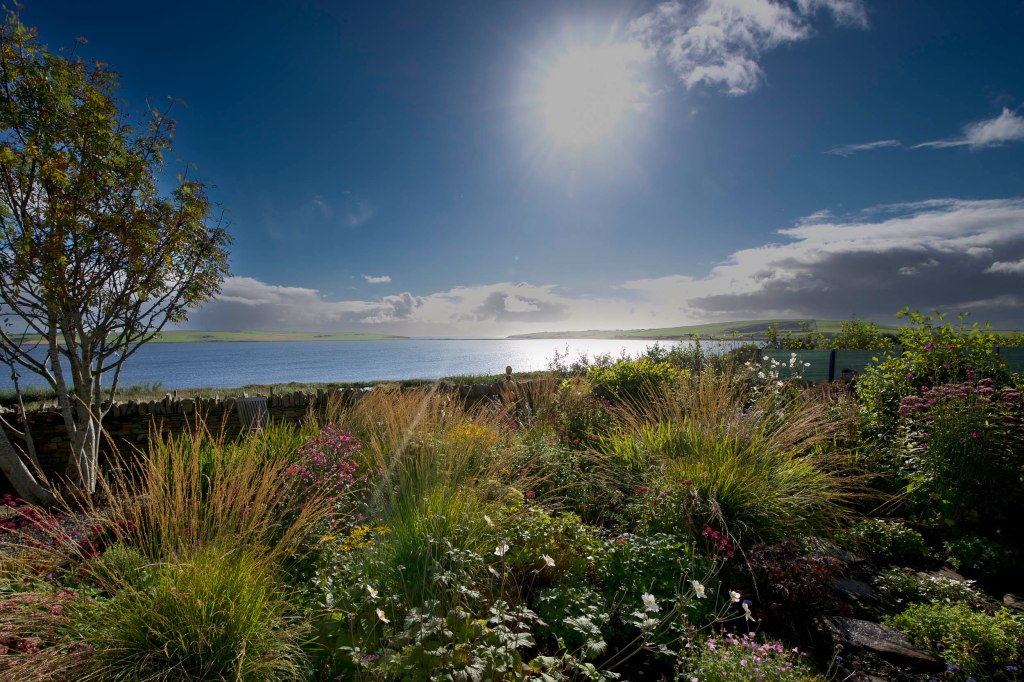







 A garden in Orkney