
This weeks Six on Saturday is a selection of wildflowers, a subject close to my heart. Like most houses on the island, as well as a garden space, the house also came with a parcel of land, and again, as with most houses on the island, that parcel of land was mostly moor. To the front though, between house and sea there was a small field, overgrown to waist height with Soft rush and coarse grass and with a bed of thatch so thick and springy that to walk on it felt like walking across a trampoline. It was pretty barren, from a wildlife point of view, a duo culture that we set about clearing one Winter with rake and pitchfork and an old diesel power scythe. The following year we cut it hard until the end of May and then allowed it to grow. By summers end it had transformed, so many species appeared, fine grasses and multiple varieties of wildflower, all must have lain dormant, perhaps for decades, waiting for light and warmth to bring the fields slumbering seed bank to life.
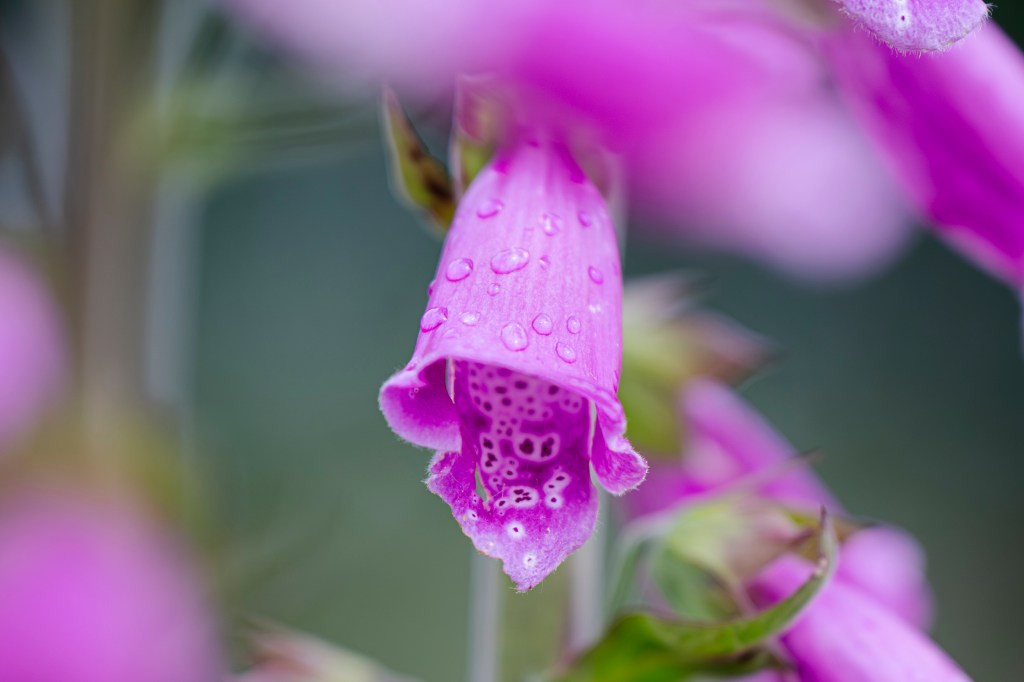
First up is the foxglove, this was a surprising sight, not a plant of meadows but up popped a half dozen of them. They were marked with canes and mown around so that the following year their seed could be saved and scattered in a newly planted shelter belt. They haven’t reappeared, but the rapidly establishing shelter belt floor is now thick with their offspring.
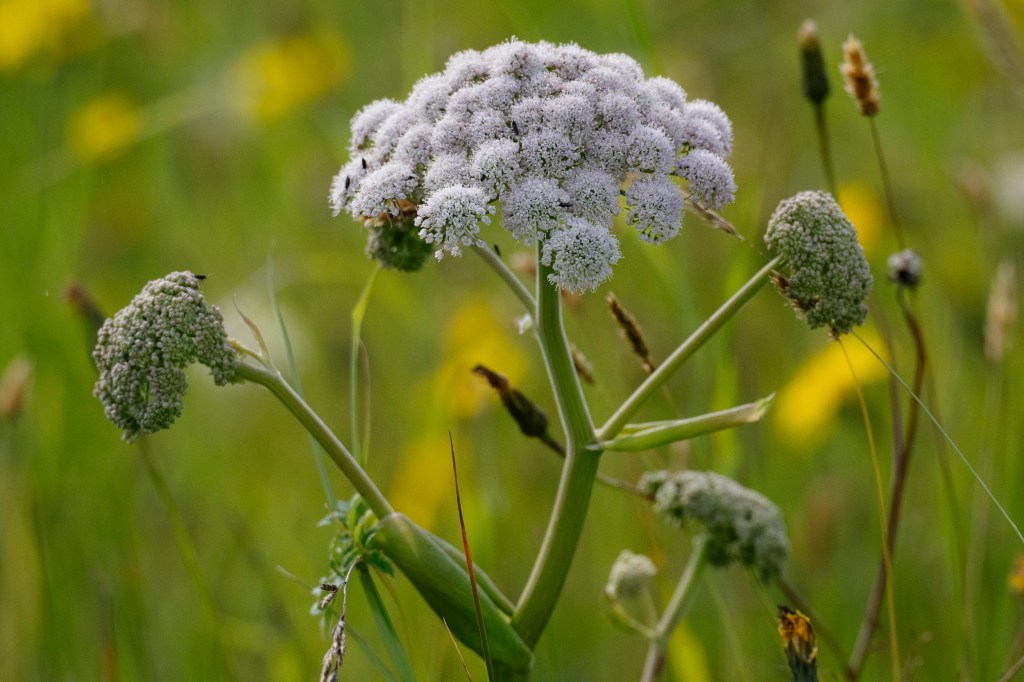
Next is Wild Angelica, a plant that introduced itself within a couple of years of the fields reincarnation as a meadow. Like the foxglove above they’re a biennial but they sit low enough in their first year of life to be unbothered by the meadows Autumn mowing regime. For us they’re quite statuesque, often achieving a height of four feet or more but travel half a mile from here to the wind scoured headland of Brims, where they duck the easterlies ripping in off the sea, and they are barely twelve inches tall.
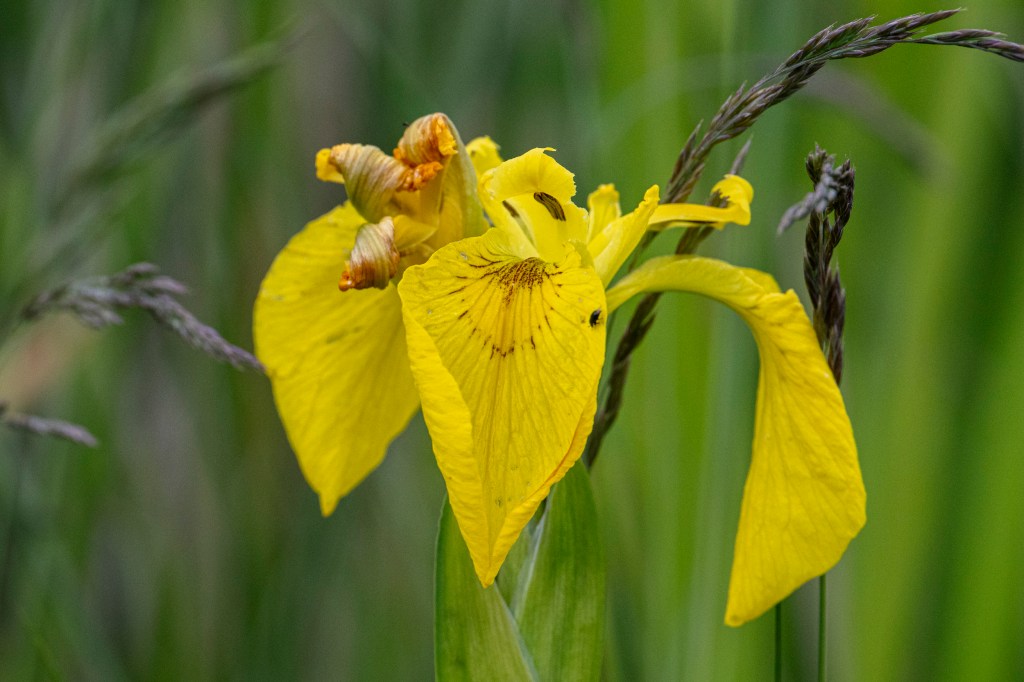
Next up is the Yellow Iris, not truly a plant of the meadow, at home they live in an old boat noust, a natural or man made hollow where boats would be hauled up out of harms way of Winter storms. The noust here is man made and sits half way up the low cliff, where meadow falls to sea, and must at some point have had a winch or pulley system to drag a boat twenty feet up a now long disappeared timber ramp. Yellow iris has a long history of multiple uses, among others the rhizomes of the plant were used to produce a black dye for ink, the leaves were used for basket weaving and thatching and a potion could be made that was said to cure toothache. The seeds were ground up to make a form of snuff. On the Orkney mainland remains of Yellow iris were found in the 5000 year old middens of Skara Brae.
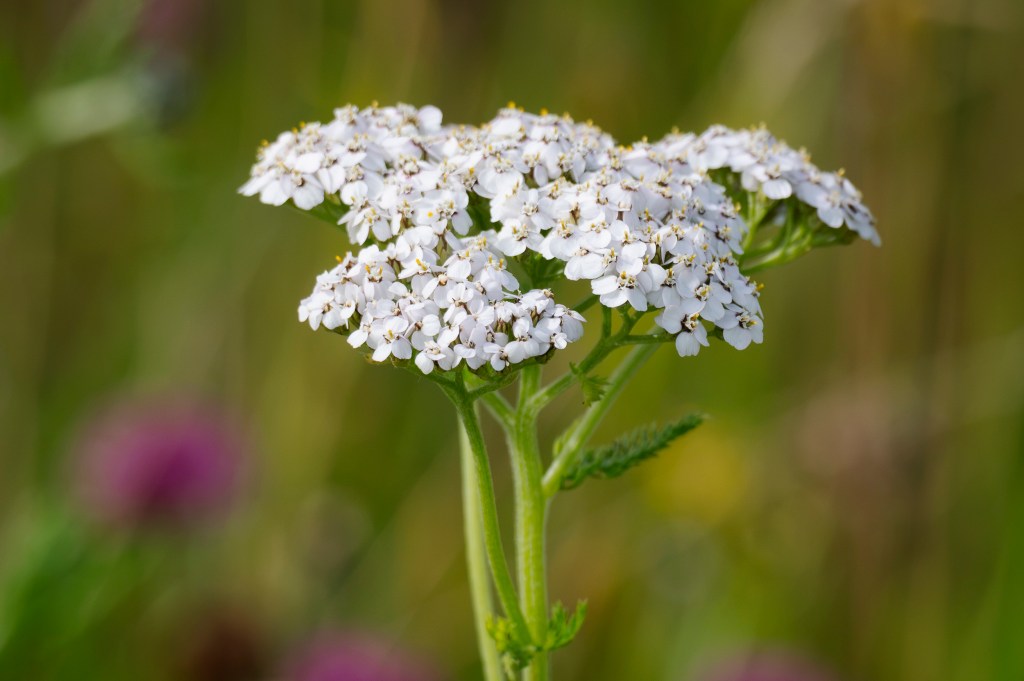
Next comes Yarrow, a plant that on Hoy is seen on the coasts and amongst dry grasslands but is absent from much of the island due to its dislike of wet feet and acid soil. At home they’re a late Summer flower, just getting into their stride when many other species have already faded to seed. As with the Iris there’s a list of old uses as long as your arm. It’s said to be a healer of wounds caused by iron weapons and a hint for this comes from its latin name, achillea millefolium, a reference to Achilles. In Orkney tea was and likely still is made from it and across the pond indigenous tribes used it as a mosquito repellent.
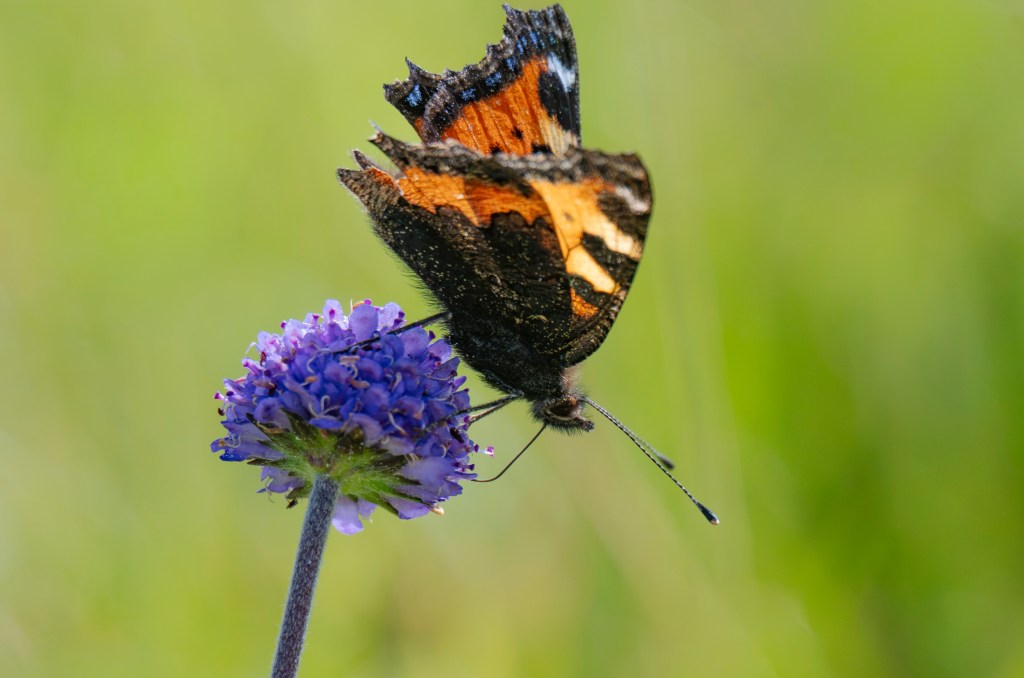
Next comes another late Summer flower, the Devils-bit scabious, whose blue pom-pom flowerheads are a magnet for butterflies. We had a small group of them appear and as they set seed and multiplied young plants were lifted and dotted through the meadow. They’re quite low growing and we were careful to choose areas that had little competition from grasses, slowly but surely they are starting to spread. In medieval times it was a seen as a cure for scabies and its name comes from a story that the Devil, in a fit of jealousy over the plants virtue, bit off a lump of its admittedly stubby root.
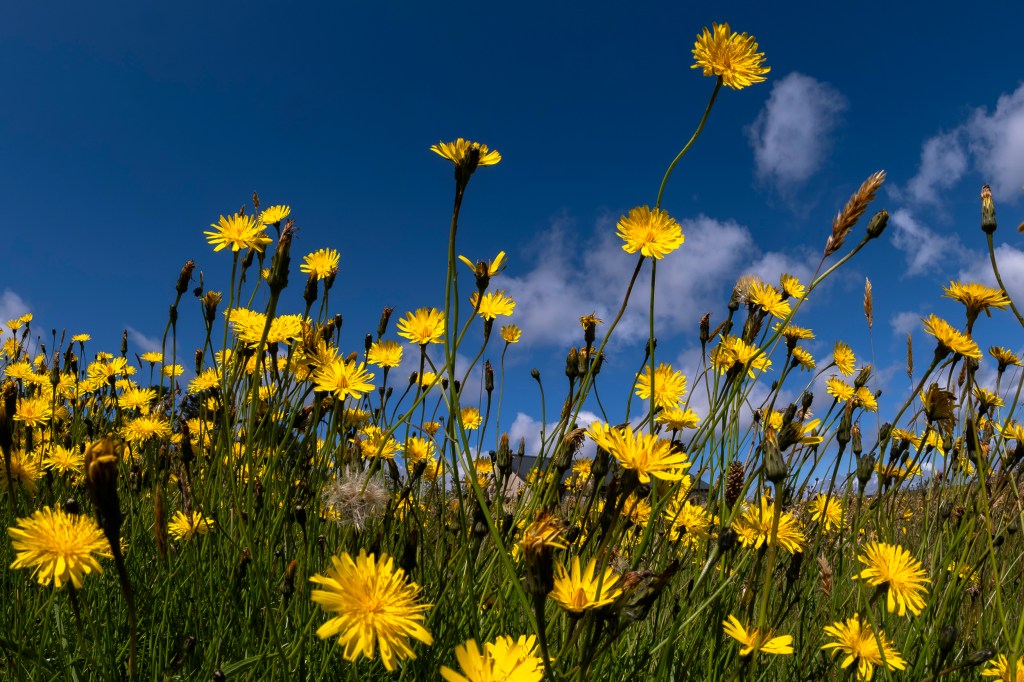
Last but not least comes Cats-ear, the plant, that in the first Summer after clearing the field made all the hard work worth it. Within a few weeks, once we had stopped mowing the now scalped field, cats-ears appeared in abundance, not one or two but a literal carpet of yellow. I would love to know how long the seeds had lain dormant, the seeds are dandelion like but with none growing on adjacent ground I doubt that any blew in. The seed, in a field that had not been mown or grazed in living memory, must simply have been biding its time. Since then they’ve spread to other parts of the plot, the edge of the shelter belt and recently onto an area of ground disturbed by the laying of a cable at the edge of the moor. One of natures pioneers.
For more Six on Saturdays, from gardens worldwide, pop over to Jims blog


🌼💜💖💚🤗😌🍃
LikeLiked by 1 person
❤️🪴
LikeLiked by 1 person
What a beautiful scene! I love that simply removing grasses opened up a surprise seed bank! My garden is in a suburban backyard that had been in lawn for over 60 years – I think it might have been a little marshy before that. People who were here wehn the subdivision was built said that there is a lot oc nasty construction fill down below, concrete, who knows what. It is OK, the native plants I have planted are doing well (sometimes too well) and I get a decent vegetable harvest for a person who does not do any canning. Foxglove has always been a favorite of mine and it is naturalized here in the US, but not native. I am trying to mostly grow flowers native to me, so I am going with Penstemons, though we have some lovely “false foxglove, like Agalinis tenuifolia too,it needs more moisture thn I can willingly provide.
LikeLiked by 2 people
Hi, I love the way nature bides her time, all those seeds just waiting for their chance to grow.
We have the same issues in the Uk, builders bury all the junk and rubble and then hide it with three inches of topsoil, at home here it’s a little bit different, an ex croft so we dig up bits of machinery and old fence wire 🙂
I know how difficult it can be to grow, and sometimes to find, natives. We have a rule that anything goes in the garden as long as it’s bee and insect friendly and not banned in the uk as an invasive species but beyond the garden we stick to natives, native wildflowers are easy to find but not trees that have provenance to Orkney, we’re growing Rowans from seed because because locally grown trees are so hard to source.
I googled agalinis, interesting to read that it’s partly parasitic. No veg garden here, our soil so thin that we sadly gave up on them.
LikeLike
Such a delightful post with stunning photos. All these plants can be found here in West Penwith, in fact all except Angelica and the scabious can be found in my garden. Instead of Angelica I get Hogweed which fortunately is not as toxic as the giant variety.
LikeLiked by 1 person
Hi Jude, the garden form of Angelica also grows wild here, allegedly brought over by the Vikings. I once accidentally strimmed down a regular Hogweed, I had a T-shirt on and for months afterwards every time my arms were exposed to sunlight the skin would blister where the sap had splashed onto me, evil stuff. We tried dbs in the garden but couldn’t get it to establish for some reason, not sure we would dare put cats-ear in the garden, they spread like wild fire here!
LikeLiked by 1 person
The images are beautiful, and they have me wanting to visit your part of the world. The view of Cats-ear framed by the deep, blue sky should be framed. ❤
LikeLiked by 1 person
Thank you Beth, that was a lay on your stomach photograph 🙂, I’ve always thought that blue and yellow make a great colour combination. Orkney gets under your skin, we visited years ago and after that just kept returning until we took the plunge and moved here permanently, a bit wild sometimes but the Summers are beautiful, and mild! I would hate the heat that gardeners further South have suffered this past few years.
LikeLike
Gorgeous picture of the Devil’s Bit Scabious with a Red Admiral, Gary. The species diversity in your meadow over such a short time is incredible.
Do Jacqui’s plant sales include your meadow flowers? If so, I’ll bet they’re popular.
Thanks for the reference to yellow iris being found at Skara Brae – very interesting. Clearly they used it in multiple ways. Here, it’s an invasive that competes with our native (blue) Iris versicolor, which is used by First Nations and others for making cordage for mats and baskets. I have a friend you even wove herself sandals out of it!
LikeLiked by 1 person
Hi penny, the meadow has done far better than we hoped, we have to manage it though, now it’s cleared of thatch you wouldn’t believe the amount of brambles that are bird sown into it every year, clearly a meadow that has aspirations of being a scrub. Traditionally sheep and cattle would have kept them down, we rely on early Spring mowing followed by a late Autumn hay cut with an ancient power scythe, which I’ve been bodging up this week in the hope that it will last another year or two🙏
J sells wildflowers online through Summer, packs of 5 or 10, single species or mixed, they do really well but at the garden sales no one buys them, perennials, especially varieties that are hard to get up here are what everyone seems to go for. What we should do next year, when I buy in some more Red alders, is pot some on for sale, visitors find it hard to believe that the higher than the house shelter belt here is only 6-8 years old, I think they would fly off the shelves.
I sometimes find it odd that a plant that can be quite well behaved in one country can be invasive in another, our yellow iris barely move, the same with patches of them here and there elsewhere on the island, I assume that other native fauna keeps them in check, might be a different story though if you put them in a water course, on Hoy they tend to be a plant of wet grassland. I also wonder if there’s a risk of hybridisation. We grew versicolour down in yorkshire as a pond edge marginal, really beautiful, it must look stunning in the wild.
We live simply and are keen recyclers but I draw the line at Iris leaf wellies😄 The oddest locally grown plant that I’ve seen anyone weave with here are docks, or dockens up here, I can see why, the stems are very tough and pliable.
https://heritagecrafts.org.uk/craft/northern-isles-basket-making/
https://wovencommunities.org/region/northern-isles/
LikeLike
Your weaving links and information sent me down a wonderful new-to-me research rabbit hole. I had no idea you could weave with dock! And remembering how tough marram grass is, I’ll bet it makes wonderfully strong cordage. Docks we have aplenty here, on disturbed ground, but there’s no marram on the west coast.
I’ve passed on all this to both my weaving friend in Norfolk (UK) and the Urban Weaver’s collective here in Vancouver. Thank you Gary!
LikeLiked by 1 person
There’s native Willow here in abundance but it’s the opposite of the willow withies you would see further South that grow single stemmed and arrow straight, here it’s a low growing multi-branched shrub, you can see why other materials had to used instead.The marram here is sharp as a razor, you’d definitely need gloves, or thick skin!
Does your friend have a website?
LikeLike
Hi Gary, I’ve read about wild flowers springing up after coarse grasses have been cut right back, as part of re wilding projects. Wild Woodbury here in Dorset and Holnicote in Somerset. This was featured in the Guardian as it stayed green where all around it the land was brown and drought stricken. Foxgloves love my garden, and I love them, they spring up all over the place, but I’ve no luck with Achillea, either white, yellow or pink. My big success this year was ox-eye daisy, grown from seed and fine with the drought, having a second flowering now. All daisies come from them, I believe. Sea temp has dropped somewhat but I now have gloves and hat added to my two piece wet suit, so, as the weather is getting warmer next week, am planning to keep sea swimming. As long as the air is warm, it’s bearable! Getting noticeably darker here too in the evenings and mornings. The darkness is the worst part of Winter for me. have a good week. Margot xx
LikeLiked by 2 people
Are those neoprene gloves, Margot? I wasn’t sure if my mind’s eye picture of you in woolly hat and gloves was correct. I have seen people here getting into the ocean in December in red woolly hats and mittens, but they keep their wool-covered hands and head out of the water – looks most odd from a distance 🙂
LikeLike
Hi Penny, yes neoprene, I had a friend whose mother knitted her a woolly bathing costume with comical but disastrous results! There’s a group here called “the blue tits” who go in all year without any neoprene additions, but they go in for two seconds, shriek, and rush out for tea and cake! Margot
LikeLiked by 2 people
Hi Margot, yes I saw that article, very interesting. We have to confess to taking all our ox-eyes out of the garden and quarantining them back in the meadow, each plant literally set hundreds of seedlings, often in the middle of another plant!
We’re getting noticeably colder here, we had a week in Aberdeenshire at the end of August and the change in the weather here pre and post Aberdeenshire has been quite stark, although it might just be that the climate down there softened us up, it felt positively tropical 🏝️ The nights are also rapidly drawing in here, I can’t say that I’m looking forward to mid Decembers six hours of daylight but a Winter silver lining will be seeing the night sky and milky way again, and hopefully the aurora.
Enjoy the swimming and have a good week x
LikeLike
👍
LikeLike
In my neighborhood in northern California, catsear or False Dandelion grows in front yards that used to be lawns, very prettily in the springtime. I like it much better than real dandelions, because the long stems allow the flowers to bend with the breezes, and that makes it even more lovely.
LikeLiked by 1 person
Hi Gretchen, we see surprisingly few dandelions here, there’s a few but not many. The same here, I prefer the cats-ear for the same reason, flowers on long stems. I also like the way they track the suns movements, they start the day with flowerheads facing East and end it facing West, before closing up for the night to protect their pollen from the damp air, clever plants!
LikeLiked by 1 person
A wonderful compilation of wildflowers! The thought of all these seeds lying dormant for so long is amazing.
We also have a cat’s ear growing in the grass close to the house. It flowered for ages, and I loved watching all the smaller pollinators feeding on it every morning. The foxgloves in our garden are introduced – I planted them early this year and they look very healthy. Hopefully they will flower next year and then self-seed after that.
LikeLiked by 1 person
A elderly friend says that that the field hadn’t been mown or grazed in his lifetime, even if you say that it took 30 years for the field to become a duo culture, that still leaves another 40+ years of seed dormancy, very impressive!
We love foxgloves, we grow quite a few varieties, alba works well in shady spots, once sown you’ll often get nothing the year after the first sowing has flowered but after that you’ll never be without them. I like the way that cats-ear flower heads turn to follow the sun, from the house we can’t see them in the morning, only in the afternoon when the sun has tracked West.
LikeLiked by 1 person
It’s like redshank – I read somewhere that the seeds are viable for 40 years, so once you have it in the garden, it’s there forever.
I don’t know what kind of foxgloves we got – the seed pack just said mixed, and of course they didn’t flower this year yet. Alba would look nice here, especially under the tree.
LikeLiked by 1 person
I’ve emailed my Norfolk orchardist friend who is a willow weaver to see if he has a website, Gary. Meanwhile here’s some of the bird sculptures he weaves;
Here’s our lovely Bob Lever,… – North Norfolk Arts & Crafts | Facebook
and one of his online tutorials in case you’d like to have a go yourself!
SVTF presents – Bob Lever – Willow weaving tutorial
LikeLiked by 1 person
Thanks Penny.
LikeLike