July the 28th.

A Swallow hawks for insects.

The past week brought a mixed bag of weather. On Monday we woke to a mackerel sky, a display of high altocumulus cloud, backlit by the early morning sun. Such a sky is said to be a harbinger of change and the following few days were indeed much warmer than previous weeks. With barely a breeze and with clear blue skies there was a mugginess to the air, as if the weather was holding its breath. T-shirt and sunscreen days. The bigger change came on Friday, stair rod downpours with growling thunder and grey skies lit with lightning.

Monday brought a mackerel sky – towards South Walls from the garden gate.

There’s also change afoot in the garden. As mentioned last week, as we move into August hotter colours will start to take over. There’s no Autumn of lingering reds and golds here, when Septembers salt laden gales swing in, trees will quickly turn from green to brown. The Sycamores suffer first, in the space of a day they’ll be crisped and scorched, as if a giant has passed by and set about them with a blow lamp. Next come the Alders and finally the Larch. In a good year the Larches will glow yellow for a while but needles are soon shed. A brief dusting of gold beneath shelter belt trunks, marking the end of our gardening year.

What the trees can’t give the garden does, our reds and golds will come from perennials, it’s early days yet but buds are swelling. A favourite hot red, aptly named crocosmia lucifer, is on the cusp of flowering, a matter of days now before the buds unfurl. Lucifer was created by Alan Bloom in the 1960’s, the name, it is said, taken from the brand of a box of matches.

Crocosmia buds are starting to swell.

In the wider landscape, on a walk that takes you close to the shore, Ringed Plovers were seen with youngsters in tow. They’re around the size of a Thrush and nest amongst the shingle at the side of a track that leads to Cantick Head lighthouse. When the chicks are very young the adults will feign injury to draw you away, fluttering along a few feet in front of you, holding a broken wing at an awkward angle. When it is deemed that there’s enough distance between you and the nest, the wing will suddenly heal and the bird will take off, skimming the sea in a low arc and returning to the nest. More often than not, if watched through binoculars, when the bird lands back where the pretence started, two or three pieces of shingle will grow legs and spring to life. Perfectly camouflaged fluff ball chicks on hairpin legs, each not much bigger than a Bumblebee.

Ringed Plovers, adult above and juvenile below.

The lighthouse itself, from the landward side, is well hidden. The best view comes from the ferry that runs between St Margarets Hope on the linked island of South Ronaldsay and the Scottish port of Gills Bay. On rare trips South, the lighthouse and its surrounding cottages, are the thing we seek out by eye on the trip home. Once seen we’re still a few hours away, there’s a drive across the linked isles to Mainland and then another ferry to Hoy, but when the lighthouse comes into view, it feels like home. From inland though the lighthouse is barely visible, only the very top is on show, the cupola and the lantern pane and a short length of tower.

Inland from the track are areas of coastal heath and grassland, rich with wildflowers. Grasses sway in the breeze, red clovers and pink spires of marsh woundwort are abuzz with bees. There are empty houses here and there. As farming practices changed smaller crofts were swallowed by larger concerns, in days past the value was in the land. The houses, remote from power and piped water, were left to their own devices. The roofs were often stripped of their stone slates, sometimes the walls were taken too. In one field there’s just a gable end, its hearth still intact. The rest of the house carted away, for use elsewhere.

Old houses dot the meadows.

Just offshore from the track, at around a mile distant, there’s the island of Switha. At less than a fifth of a square mile in size, from a wildlife point of view, it’s a small island that punches well above its weight. Designated both a sssi, a site of special scientific interest, and a special protection area. In Summer the island is home to many species of breeding seabirds and in Winter it’s the roost for around 1200 Greenland Barnacle Geese, who, each evening, rise yapping from the grasslands of South Walls and cross the narrow strip of water to the island. A spectacular sight on a Winters afternoon. Although the island has been grazed in the past there’s no evidence that it has ever been inhabited. Along with a cairn, there are two Neolithic standing stones, but so far, no indications of a permanent settlement have been discovered.

Switha.

Between the shore and the island there’s the Ruff. Ruff by name and rough by nature, it’s a spot where two tides meet. In Winter a boiling cauldron and in Summer, more often than not, a spot where the breakers from the two opposing tides slap relentlessly against each other. At the point where the tides meet there’s a low reef that stretches out from the shore, at the end of it a light tower, that like the nearby lighthouse, warns of impending danger. Occasionally though all can be calm, on such days, at low tide a narrow concrete service path, that in places is made slippery with bladderwrack and in others is worn away by the sea, can, with care, be taken out to the light.

A rare moment of calm at the Ruff. To the left of the light is the island of Flotta, to the right, the island of Switha.

Cats ears and poppies.

Kniphofia fiery fred.

The past week has brought mild and calm days. As with the earlier days of July we’ve had our fair share of rain, but generally the weather gods have timed it right, dry days with spells of overnight rain. The sun is still shy, mostly hiding his face behind a grey blanket of cloud but now and then we’ve had T-shirt spells of bright blue sky.

A grey start to the day – dawn over Longhope.

As is usual at this time of year it’s all change in the garden. It will soon be a time of late summer hot colours, courtesy of  hemerocallis and crocosmia and others. A kniphofia, fiery fred, has got in early, pushing up bright candles of hot orange. Opium poppies are popping up here and there, most come from seed collected from a friends garden but there’s one, the marmite poppy, that we inherited. It’s nicknamed the marmite poppy because we can’t quite work out whether we like it or not, a powder puff of red petals that the jury is still out on.

Opium poppies, regular above and ‘marmite’ below.

Of the other plants that have come into flower in recent days, salvia nemorosa caradonna and ligularia rocket are two favourites. Both throw out spires of colour, blueish purple for the salvia and yellow for rocket. The ligularia flowers are borne on tall dark stems, as height is always dodgy for here, they’re discreetly tied to the top stones of a dyke. The salvia is borderline for this neck of the woods, winter wet is always a danger, but so far so good.

Ligularia rocket and salvia caradonna, centre right.

In the meadow, dryer areas of ground are lit with the flowers of cats ear, a member of the hawkbit family. The flowers are heliotropes, slowly turning their heads from East to West as they track the motion of the sun across the sky. Three years ago, after we cleared the meadow of thatch and dead grass, these were the first to appear, dormant seeds springing to life and carpeting the ground with gold.

Cats ear.

In the meadows damper spots, marsh thistles are proving to be bee magnets, they’re tall and slightly gangly biennials whose low starfish shaped first years growth, when accidentally knelt on, is just prickly enough to pierce your jeans. They’re a favourite food source for the rare and declining Great yellow bumblebee and because of that, despite being quite invasive, they’ll always get a free pass.

Marsh thistle.

Two other damp lovers that are in flower at the moment, are wild angelica and marsh willowherb. They’re chalk and cheese. The angelica flower heads are large and showy, the size of a small cauliflower. In contrast the willowherb flowers are tiny and easily overlooked, soft pink blooms, no bigger than a hat pin head, are held aloft on delicate stems.

Wild Angelica and marsh willowherb.

In the wider landscape, large flocks of juvenile Starlings are being seen. The birds have left the care of their parents and are counted by the hundred, foraging along the shoreline just below the meadow. Every now and then they’ll lift off en masse and settle on the hydro wires that string across the moor, packing themselves tightly together, like mussels on an old anchor rope.

Juvenile Starlings are being seen by the hundred.

The calmer days have brought gentle tides. Beach combing here is a given but at the moment there’s little chance of any new driftwood. Harder timber or softwoods not long in the sea, once dried for a year, are a handy source of fuel. Gnarled and silvered pieces, given a beauty by sea and salt air, sooner or later find a space in the garden. Despite the Summer dearth, on walks that take you alongside the sea or across the cliff tops, geos and shorelines are always checked, just in case.

Slack tide, Misbister geo.

July the 7th.

A Greenfinch catches a shower of rain.

As June has turned to July, the past week brought mostly grey days. We’ve had occasional bursts of sunshine and the odd shower of rain, but generally a spell of mild days with low cloud.

Late evening, towards South Walls

In the garden as some plants are starting to flower, others are already setting seed. Alliums, an early summer favourite, have gone from starburst flower heads to starburst seed heads.

Allium seed heads.

As the alliums fade, others are just getting going. Wild carrot dara, a biennial that gives broad flower heads in shades of pinks and purples, is dotted here and there throughout the borders, pushing up through gaps between more established plants and stretching for the light on hairy stems.

Wild carrot, dara.

Siberian iris are just about over for the year, a plant that thrives in our cool summers and damp climate. Most have already finished but a white variety whose name, for us at least, is long forgotten, is still holding court. We’re still in the simmer dim, light until past eleven pm, at dusk viewed from a window, they can appear almost luminous.

Iris sibirica.

Lychnis are starting to flower. They’re a member of the campion family and we also grow their wilder cousins, Ragged robin and Red campion, the former in wetter spots in the meadow, the latter scattered amongst newly planted trees. As with their wilder cousins the garden variety is a real bee magnet. They’re not really suited to our soil, but they do ok. For us, the main attraction is the silver-grey foliage that has the texture of felt, the flowers are an added bonus for both human and bee alike.

Lychnis coronaria and a White-tailed bumblebee.

A plant that, once established, does well in our soil, is Persicaria polymorpha. We saw it years ago in a garden down south and not having a pen to copy down the name, told ourselves that if, as is usual, we forgot the name, to think of Monty pythons dead parrot sketch. The logic worked and when we got home one was found online. It went into a corner of the kailyard and promptly sulked for the first year, only in year two did it come into its own and reach the height and spread of the one seen further south. Great for the back of a border it will easily reach six feet, in summer throwing out spires of creamy white flowers, that in autumn, turn a soft red as they fade to seed.

Persicaria polymorpha.

An unusual visitor to the garden this week was a female Hawfinch. They’re the uk’s largest finch, chunky thickset birds with an oversized beak that is perfect for cracking hard stoned fruit. A sparrow on steroids with a pugilists beak. They’re not a bird of Orkney, rare breeders in the South of England they are occasionally seen on passage in the Northern Isles. In the five years that we’ve been making this garden they’ve visited perhaps a half dozen times.

A female Hawfinch pays a visit.

For the past few summers we’ve been making a small field back into a meadow. It’s at the stage now where we can pretty much leave it to its own devices, not yet in full flower, it will be a week or two before the ground is carpeted with colour, but Ox-eyes and others are out of the blocks and already putting on a show. 

Ox-eye daisy.

Narrow paths have been mown through the meadow in rough figures of eight, they’re walked most days, usually with a cup of tea in hand. Below the meadow, where the ground falls steeply to the shore, a bob of harbour seals haul out at low tide, basking on the rocks or stretching out on a thin mattress of bladderwrack. When we first moved here they would panic at the sight of a human, tobogganing back into the water, noisily splashing to warn others of our presence. Now we are tolerated, watched warily from a distance but no longer enough of a threat to break the peace of their out of sea siesta.

Harbour Seals haul out below the meadow.

In the wider landscape in a nearby geo, there’s a rock covered in what I think are the fossilised anchor marks of Limpets. In the whole of the bay it’s the odd stone out and perhaps it has been cast up from deeper waters, jet black in colour, with surface cracking, it has the look of fossilised mud. I photographed it mid week, under a low grey sky with an incoming tide that threatened to overtop my walking boots. A time exposure seemed appropriate and an exposure of one minute was made. For a  rock that might be millions of years old, not even the blink of an eye.

Passing time and a pockmarked rock – Langi geo.

Blue Hares and Bonxies.

Not far from home there’s the valley of Heldale. At its base is Heldale Water, a natural reservoir that supplies drinking water to this end of Hoy and to the linked island of South Walls. It’s a favourite spot for a walk, a low rolling landscape of heather clad hills cut with tinkling burns, whose sole mission in life is to rush rainwater down into the valleys and on towards the sea.

Heldale Water, from Bakingstone hill.

The valley is approached by a long stone track, a left turn on the road from Longhope to Lyness. If time allows I’ll walk from home, if not I’ll take the van, clattering over cattle grids and passing the wide shallow graves of peat cuts. Most of the peat cuts are long abandoned. Of the dozens that line the track, a single cut is still worked, the cut peats are stacked in threes, like sheaves of corn, relying on summer winds to dry them. As I  took the photograph below I got caught in a shower, the rain drops pattering on the hood of my coat and dotting the front of the lens.

Cut peats and approaching rain.

On a calm day, the moors are beguiling, silent apart from the burbling call of a Curlew or the cro-ak, cro-ak, of Red grouse. On days of rain and wind they are bleak but still beautiful, the birdsong lost to the whistle of the wind.

A home to Curlews and others.

In Summer Golden Plovers are seen, they nest amongst the grasses and heathers and at this time of year anxiously call a warning to hidden chicks as you pass. Pipits are common but often overlooked, their streaked plumage a perfect camouflage, only catching your eye when they take to the wing.

Golden Plover and Meadow Pipit.

Above the reservoir is Bakingstone hill, whose west facing slopes are a favourite spot for Blue, or Mountain, Hares. In early March, with the hares still dressed in winter white I counted thirty-one of them, each tucked low amongst the heather, making the best of the late afternoon sun. Back then they were easy to spot, dots of white in a brown landscape. At this time of year spotting them is harder, white winter fur has been swapped for a coat of grey-blue. As I walked up to the ridge of  Bakingstone I saw a few, but probably walked past many more, their summer coats hiding them well against a backdrop of heathers and grasses.

In Summer, Blue Hares blend into the background…

The moor tops are also the haunt of Bonxies, Great Skuas, powerful thickset and aggressive birds that are around the size of a Lesser black-backed gull, who, if they were human, would be prop forwards or nightclub bouncers. They are one of natures killers, taking everything from eggs and chicks to juvenile Greylag geese.

Bonxie – Great Skua.

They nest in colonies and will dive bomb anyone who strays too close. I give them a wide berth to avoid disturbing parents with chicks, but Bonxies being Bonxies, they’ll dive bomb you anyway. More than once I’ve been buzzed by a bird flying from A to B, breaking off from their journey to buzz me for the sake of it, coming in at knee height before rising to head high and turning away at the last minute, almost close enough to touch.

Buzzed by a Bonxie.

I walked up there again yesterday evening, the day had brought gales and driving rain but in the evening the weather brightened, still blowing a gale but the persistent rain had given way to showers. After taking the photograph of the peats,  I took a track to the top of a hill named Binga Fea, that, in better weather, in one direction gives a distant view of the thin grey line of the Caithness coast and in the other, the Pentland Skerries, a group of four uninhabited islands some 14 miles away, the largest of which, muckle skerry, is home to two white painted lighthouses.

Late evening, towards Heldale from Binga Fea.

June the 22nd.

Lesser Redpoll.

The week that brought the summer solstice also brought better weather. A few grey starts with occasional spells of rain but the cool breeze of early June has lost its edge, now there’s a warmth to the air. It’s the month of the Simmer Dim, the midnight twilight. At the witching hour still light enough to see the dark shapes of cattle grazing the fields on the island of South Walls, a mile or so distant across the bay. In the garden its standing room only, the only bare earth to be seen is where Jacqui is juggling plants. Moving some that are struggling, splitting others that are too big for the space.

Front gardens, like the back, are standing room only.

A perennial that shares a long history with us has started to come into flower this week, Cephaleria gigantea. My father grew it as a cut flower on his trackside allotment, one of a row of a dozen that sat at the edge of Snaith, a small market town in the East Riding Of Yorkshire. When we bought our first home in a nearby village, a tiny end of terrace with a pocket handkerchief sized plot, a piece was given to two very green and novice gardeners. That piece of root has been split and re-split, a forty-three year journey, travelling with us through four gardens, two in Yorkshire and, counting this one, two in Orkney. Since arriving in Orkney it has gone off to other island gardens, one piece travelling to a garden on the small island of Graemsay, that sits between Hoy and the mainland town of Stromness and boasts a population of around twenty-eight. The flowers are borne on long stems and it can be a  little bit leggy, here it reaches six feet, down in Yorkshire over eight. For this Orkney garden it’s a perfect bee magnet back of a border plant or an occasional ‘see through’ front of a border plant, that even in the most exposed spots, rarely needs a stake.

Bee magnet Cephalaria.

Another plant that has come into its own this week is Scots Lovage, Ligusticum scoticum, a native of Northern coasts. An edible member of the celery family that would once have graced the kailyards of many a croft. On the other side of the coin, a non native that really shouldn’t be growing here at all is Sedum matrona, a member of the stonecrop family. A lover of full sun and free draining soil that is, so far, surviving the winter wet and spreading happily in semi shade.

Scots lovage and Sedum matrona.

Welsh poppies are also opening, they turn up wherever it suits them, a favourite spot for them to germinate is beneath the cool shade of Hosta leaves. Candelabra primulas are also putting on a show, they’re well suited to both our garden and climate and we grow a few different varieties. A favourite is primula bulleyana, whose hot orange-yellows glow bright on dull days.

Welsh poppies emerge from beneath Hostas. Primula bulleyana, a native of China and lover of damp soil.

It can take a while for some plants to settle here, sometimes a few years before they finally find their feet. A rodgersia is a good example, planted four years ago, for the first two years a mound of foilage, last year a single flower, this year a half dozen spires of soft pink. One thing we have learnt is don’t be too hasty, if a plant looks healthy, leave it be and give it time.

A Rodgersia proves that patience is a gardening virtue.

The plants aren’t the only ones doing well in the garden. Where trees close to dry-stone dykes are hung with feeders, Wood mice  have taken up residence. The dykes offer shelter and the feeders are an easy source of spilt food, husks and seeds dropped by Redpolls and others. Earlier in the week, beneath a front garden Rowan, I counted five individuals, dashing back and forth, between the safety of the wall and the risks of open ground, to pick up spilt grains. Their young, when old enough to venture out, have no such sense of danger. More than once, in broad daylight, we’ve picked them up by the tail from the middle of a path and returned them to stone-dyke safety.

Weather wise the best day of the week came on Thursday, the day of the Solstice, blue skies and sunshine. A bank of low cloud spoilt plans for an early morning sunrise photograph but later in the day, with the sun starting to edge westwards, a couple of frames were taken on a walk near the farm of Snelsetter. One of the incoming tide, the other of a roofless byre that once, through the long dark days of winter,  might have housed a cow for milk and cheese or perhaps an Ox for ploughing. Days that, now the solstice has passed, will arrive all too quickly.

Incoming tide – Misbister geo.
Byre and buttercups, near Snelsetter.

A Hawk and an Orchid.

June, so far, has followed a trend. Grey days and rain along with sharp winds that stripped away any warmth from the air. Fleece and tee shirt days have been few and far between, for now we’re back to coats and body warmers. An upside of the rain is that it brings a lushness to the garden, on dull wet days green foliage almost glows.

Thursday was the exception. A day of sunshine, clear blue skies and cotton wool clouds, marred slightly by a late afternoon curveball gale that tested plant support hoops and tore bright new leaves from the tops of garden Sycamores. A time exposure caught the gales passing. Blurred foliage and streaking clouds.

Thursdays gale passes over the garden.

Despite the poor weather, garden birds have had a good breeding season, dozens of fledglings of various species are being both seen and heard. When we moved here, species that should have been here were noticed by their absence. In our first year, resident House Sparrows for example, could be counted on one hand, five years on with nest boxes dotting the garden and a regime of feeding and habitat creation, we now count them in tens. At the moment the busiest parents in the garden are Starlings, each adult is permanently accompanied by two or three brown plumaged fledglings who, in flight, follow the parents so closely you’d think they were tied to each other with string.

A male Starling feeds an always hungry youngster.

As the numbers of smaller birds have increased, so too have the visits from raptors. Occasionally we’ll have a visit from a Kestrel, a bird passing through, taking time to hover over the meadow, before moving on to pastures new. There’s also a female Hen Harrier who often cuts through the garden on her way from moor to shore, but the true hunters here are Sparrowhawks. We see them most days, often no more than a glimpse, a dashing dart of a bird skipping over a dry-stone dyke or silently zigzagging between the trunks of shelter belt trees.

A male Sparrowhawk pays a visit.

The birds are impressive flyers. Once, from my workshop window, I watched a female Sparrowhawk leave her perch in a Larch and fly under my van, emerging from the other side to perform a low level attack on a flock of birds in a Hawthorn. Despite a twinge of sadness for the individual birds that fall prey to them, their presence is a positive, a sure sign of a healthy population. A male landed on a dyke a few metres from the house, a brief pause while he checked out a front garden. In terms of size he’s around a third smaller than the female, about the size of a Mistle Thrush. A few frames were grabbed before he became aware of my presence, a split second meeting of eyes and he was gone, a ghost of a  bird, slipping away as quietly as he had arrived.

In the garden Lupins are starting to flower. Ours were a gift, given as seedlings two years ago and are just coming into their own. In past times they were grown in Orkney as both a crop and as a soil improver, like other legumes they take nitrogen from the air and fix it in their roots. Old black & white photographs of Orkney show ox carts and thatched blackhouses and fields of Lupins. Occasionally, where we’ve disturbed soil in the meadow, a seedling will pop up. The meadow is the only land here that would have been suitable for tilling and cropping, if they were grown anywhere here, that would have been the spot.

Lupins have come into bloom.

Another plant that has flowered this week is iris sibirica – silver edge, of all the irises we grow a firm favourite.

Iris sibirica – silver edge.

On Thursday, before the gale swung in, a few more wildflower plugs were added to the meadow. Ragged robin and Water avens, both grown from seed sown last year and both destined for wetter spots. Most of last years wildflower seed sowings were planted a few weeks ago, but these half a dozen trays were held back when it became clear that their spidery white roots weren’t well enough formed to stand transplanting.

Ragged robin.

As I put the last of them in I found an Orchid, a thumb high dot of colour tucked in amongst the grasses. Where a meadow has missing species, most can easily be added. It’s something that we’ve done over the past four years, sowing seed in trays in late summer, pricking on into cells and then planting the following year, time consuming but easy. The plants you can’t just add are orchids, they’re symbiotic and need the presence of a soil borne fungus. Upon germination they feed on sugars produced by the fungus, a relationship that continues until the orchid produces leaves and starts to feed itself through photosynthesis. You can’t have one without the other. 

Making a meadow here has been a labour of love. In the early days, lots of sweat and graft and also some doubt, would all the effort of clearing by hand be worth it, would the existing grasses and rushes be too dominant? By year three any doubts were long forgotten, the space full of flowers and alive with bees and insects, the only things missing were orchids. I probably need to get out more, but finding that single thumb high plant was such a thrill, the icing on the cake. Fingers are crossed that more will follow.

Northern marsh orchid, the icing on the cake…

June the 8th.

The first days of June brought unsettled weather. A mix of sunshine and showers with a sharp breeze that even on the best days took the edge off the warmth, more April than June.

A week of sun and showers.

In the wider landscape fields are starting to fill with livestock. After a long winter indoors, small herds of cattle are back on the land. Cows with calves at foot briefly pause from hoovering up new grass to watch you pass. Younger beasts, full of teenage devilment, give mock chase, all tossing heads and kicking legs. Other fields have ewes with lambs, each wearing a graffiti of numbers in either red or blue, a guide for the stockman for which lambs belong to which ewe.

A midweek walk took me to Cantick. A headland on the island of South Walls, that, at its tip, has the lighthouse of Cantick Head.  There’s a circular walk that  takes you past the lighthouse itself, but I chose to follow the lighthouse road only so far before cutting across open ground towards a wide bay named Hestie Geo. The land is a patchwork of rough grazing and coastal heath. Here and there are roofless crofts, they stand as a silent testament to a lost way of life, a time when the winds passing over the fields would have carried the voices of adults and the laughter of children.

The coast is cut with geo’s. The land dotted with empty houses.

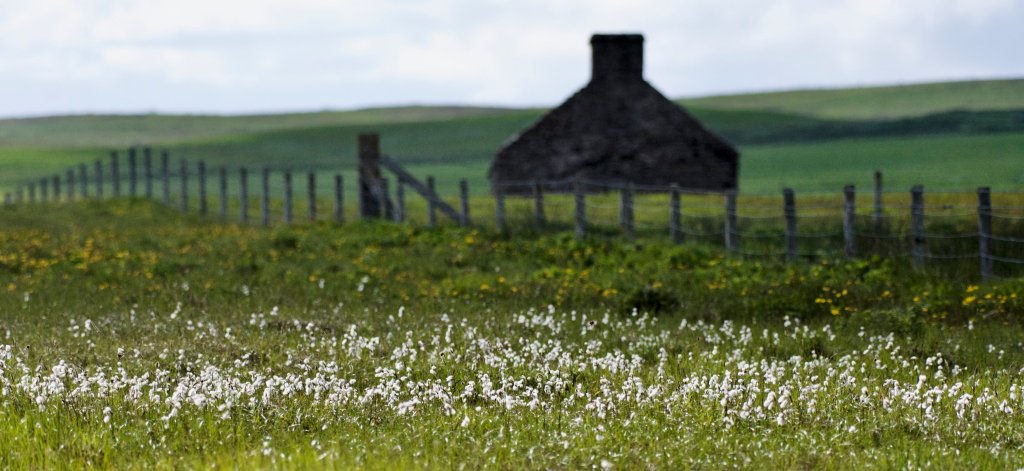
There’s no marked footpath, just a case of picking a route that avoids disturbing ewes with lambs and that takes you around wet spots that will attempt to suck the boots from your feet. At this time of year the boggy areas are an easy spot, given away by the white heads of cotton grass, nodding and swaying in the ever present breeze.

Cotton grass – bog cotton, a lover of wet ground.

The geo is wide and shallow, its shore a tumble of stone. In winter the stone is regularly arranged and rearranged by surging tides. The land above the geo shows the power of a winter sea, for a hundred yards inland the grass is scattered with a shrapnel of wave thrown rocks. Last year, after one particularly bad storm, I paced out the distance from the shore to a slab the size of a pool table bed, 60 paces. Picked up by a wave and dropped cleanly onto the pasture, two tennis courts distant.

In places the shore is a tumble of wave thrown stone.

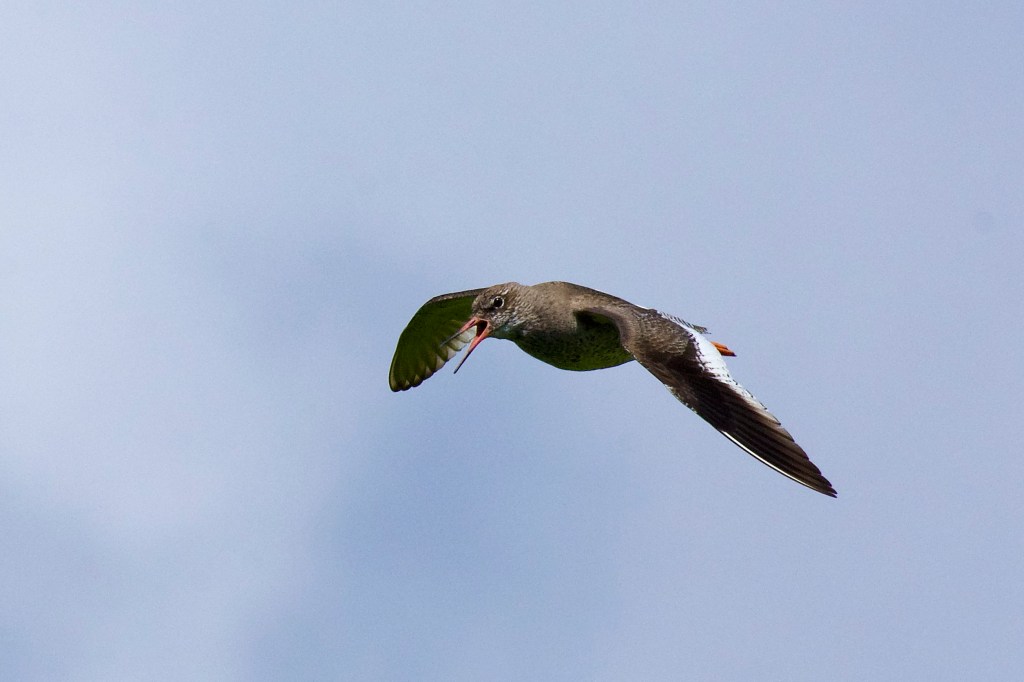
The rough pasture is a mecca for ground nesting birds. At this time of year the air is resonant with the whistled cur-lee of Curlews and the almost mournful peee-wits and wee-oos of Lapwings. Redshank are also heard, pleeping a warning to a mate or hidden chicks.

Redshank.

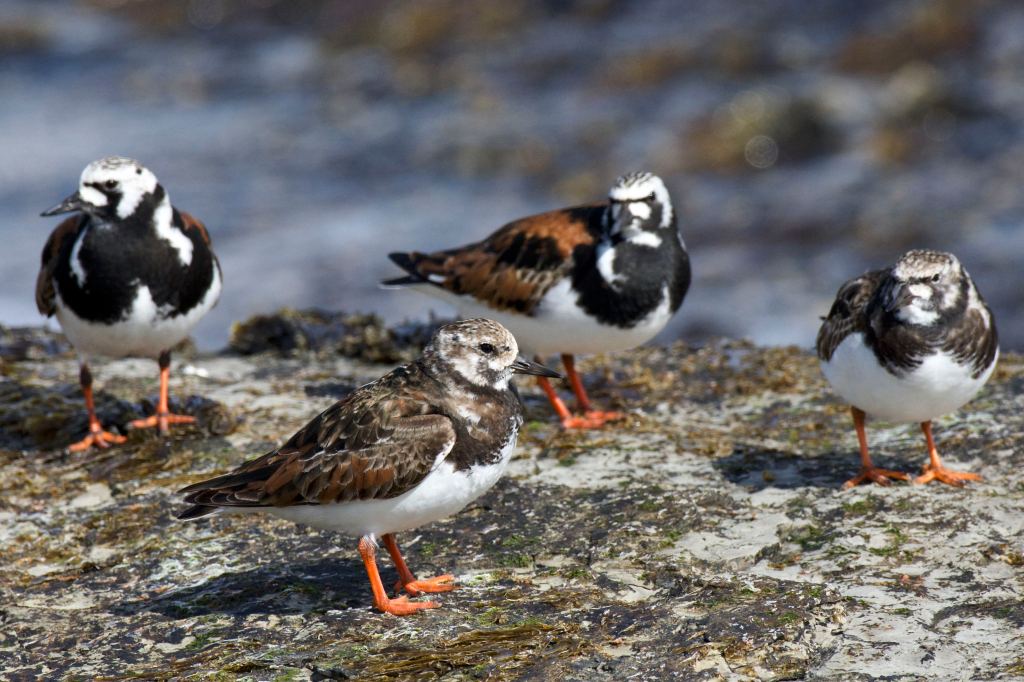
Turnstones were busy exploring the shore. On shingle beaches they live up to their name, on an area of sea smoothed rock, with no stones to flip, they were searching for goodies amongst seaweed left exposed by a retreating tide. Almost missed were two Dunlins, small starling sized birds that belong to the stint family, their name comes from the colour of their backs, dun – dull brown.

Turnstones and a Dunlin.

On the way home a couple of pieces of driftwood were claimed. A bole of pine, perhaps ten feet long and nine inches in diameter, along with a thigh thick piece of what I think is Hawthorn, both were put above the high water mark, left to dry, to be collected at a later date. The pine was dense and heavy, moved a few feet at a time. As I struggled with it a Shetland ram sauntered over to watch my efforts, posing for a quick photo before wandering off.


June the 1st.

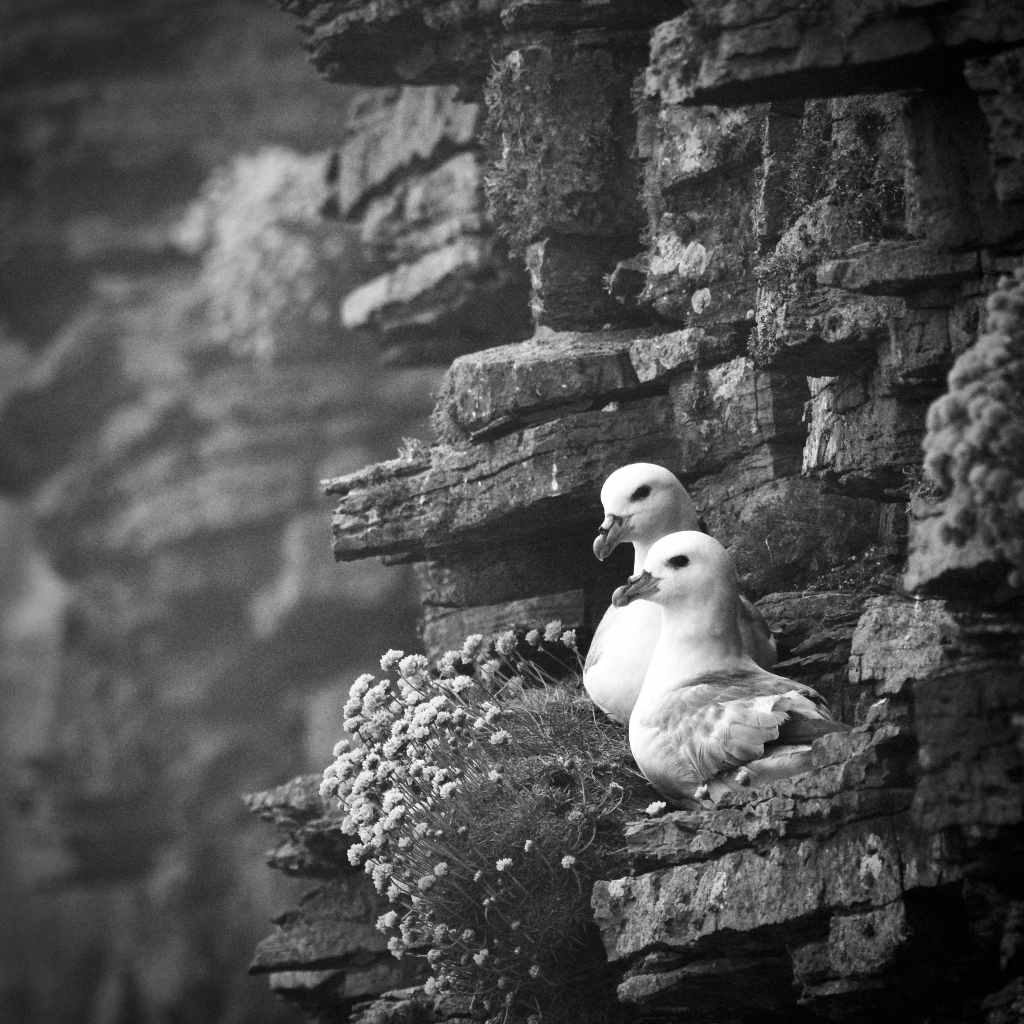
The last week of May brought mostly dry days. Tuesday past was the odd day out, a bright start to the day followed by an afternoon haar. I’d set off to photograph Fulmars in a nearby geo, managing the single frame above before the fog rolled in and stole the light. Tuesday apart, a bright and settled spell. Sunshine and blue sky days.

The past week brought sun and blue skies.

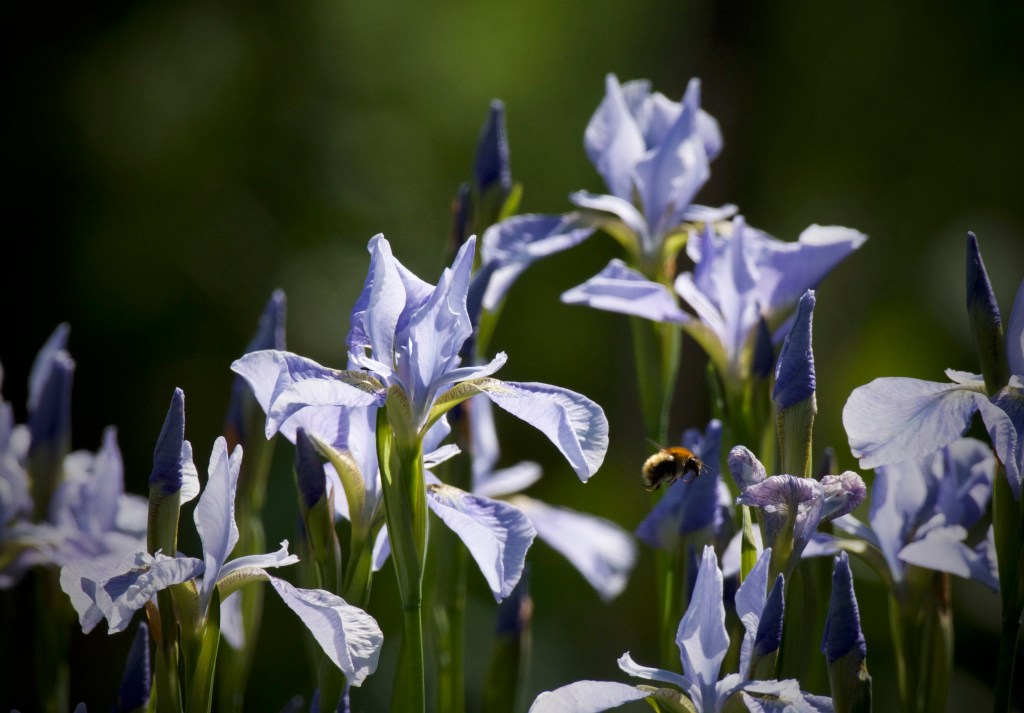
In the garden the flowers of irises are starting to unfurl. On our old patch down in Yorkshire we grew bearded iris, lovers of heat and dry conditions, they were perfect for that gardens sandy soil and south facing aspect. Up here we grow iris sibirica, the Siberian iris, lovers of cooler and damper conditions they have become an early summer mainstay for this island garden.

Iris sibirica, perry’s blue.

At the edge of the garden our old Rowan tree is heavy with dense clusters of creamy white five petaled flowers. At some time in the past it has been felled by a gale, re-rooting and throwing out new growth from its horizontal trunk, anchoring itself back to the earth and refusing to yield to the wind. A great tree for wildlife, the flowers providing pollen and nectar for bees and other insects and in late autumn, the berries, while they last, attract visiting Redwings and Fieldfares. Autumn past brought a bonus, a small flock of Waxwings quietly arriving in the half light of dawn, feasting on the berries and staying for three weeks.

A garden edge Rowan is heavy with flowers.

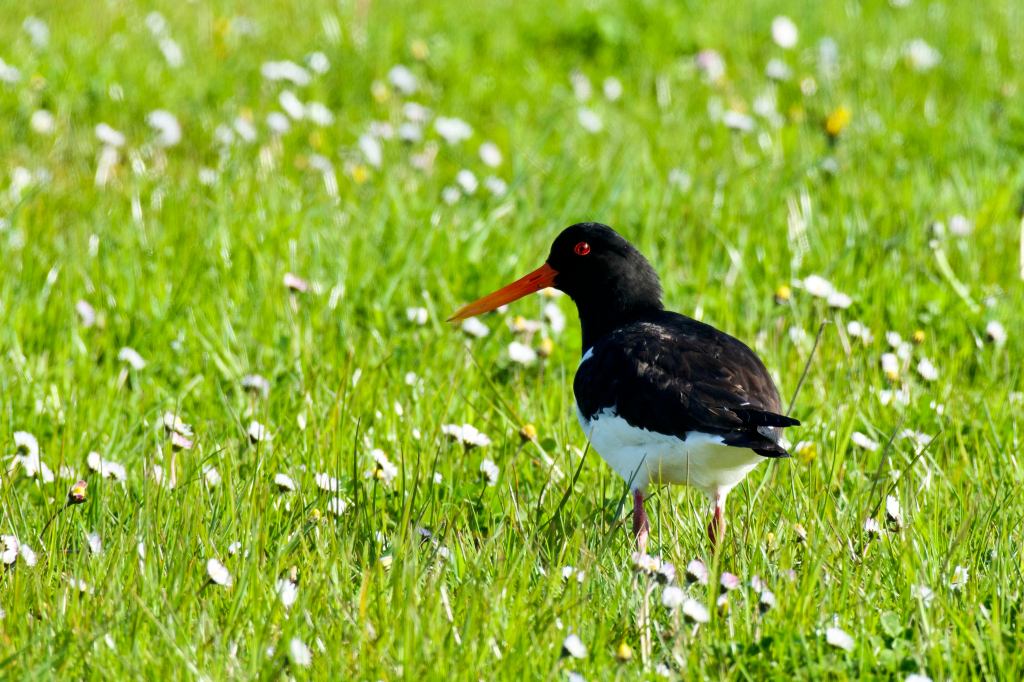
In the wider landscape wildflowers are dusting the fields with colour. On a favourite walk, that at first has the sea to one side and pasture to the other, the low lying fields are white with the flowers of daisies. The pastures, grazed by cattle in the summer months, are a favourite haunt of Curlews and Oystercatchers who prod and poke amongst the short sward, searching for worms and other invertebrates.

Oystercatcher and daises.

 Further along, where the pasture gives way to coastal heath, the clifftops wear a distant haze of pale violet-blue, the short turf shimmering with thousands of tiny flowers of Spring Squill, scilla verna. They grow from a bulb, hence the name in other parts of the country of the sea onion. In Orkney the local name is swines beads, believed to come from the jet black seeds that in autumn are shed from papery seed heads. 

Spring squill.

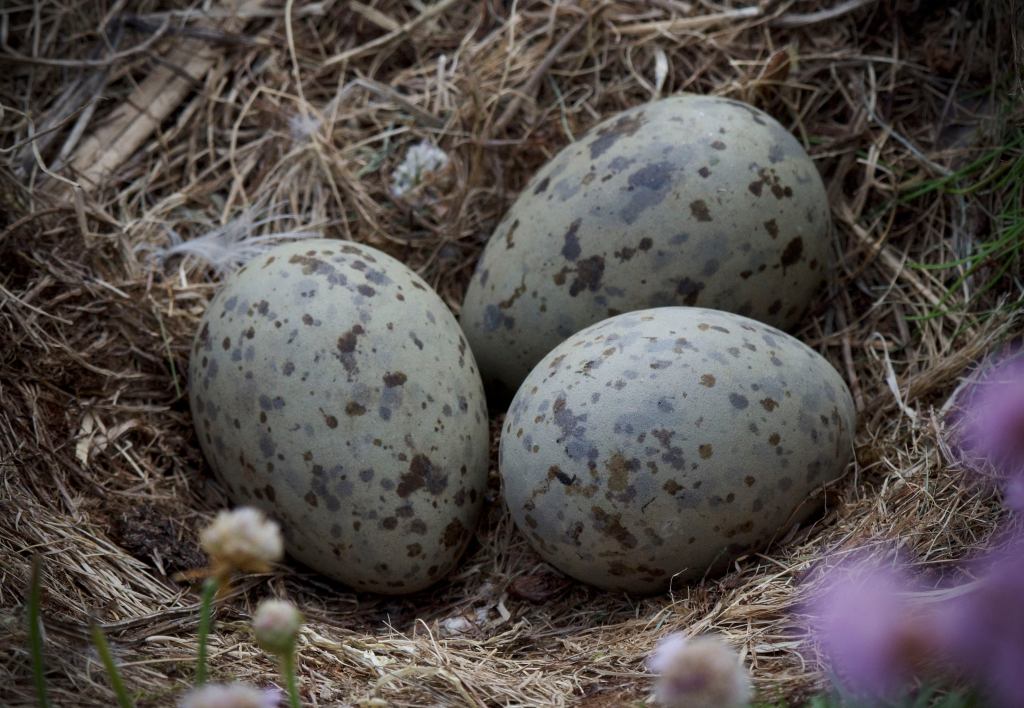
On the same walk, a few yards from the narrow footpath, tucked amongst a patch of bright pink sea thrift, there’s the nest of a Lesser black-backed gull. A simple scrape in the earth lined with a few wisps of grass that holds a clutch of three olive green eggs, each egg dotted with browns and soft blue-greys, as if randomly dabbed with a brush. As you approach, the bird slips quietly from the nest, watching you from atop a nearby lichen silvered rock, returning to the nest just as quietly as you walk on into the distance.

An unusual sight this week was a Greylag Goose with leucistic plumage, a condition where the melanin pigment in the birds feathers is absent or weak, causing normally dark feathers to appear  pale or white. A hereditary condition that can skip generations, only when two birds who both carry the gene for leucism mate, can a chick with leucistic plumage be hatched. 

Leucistic Greylag.

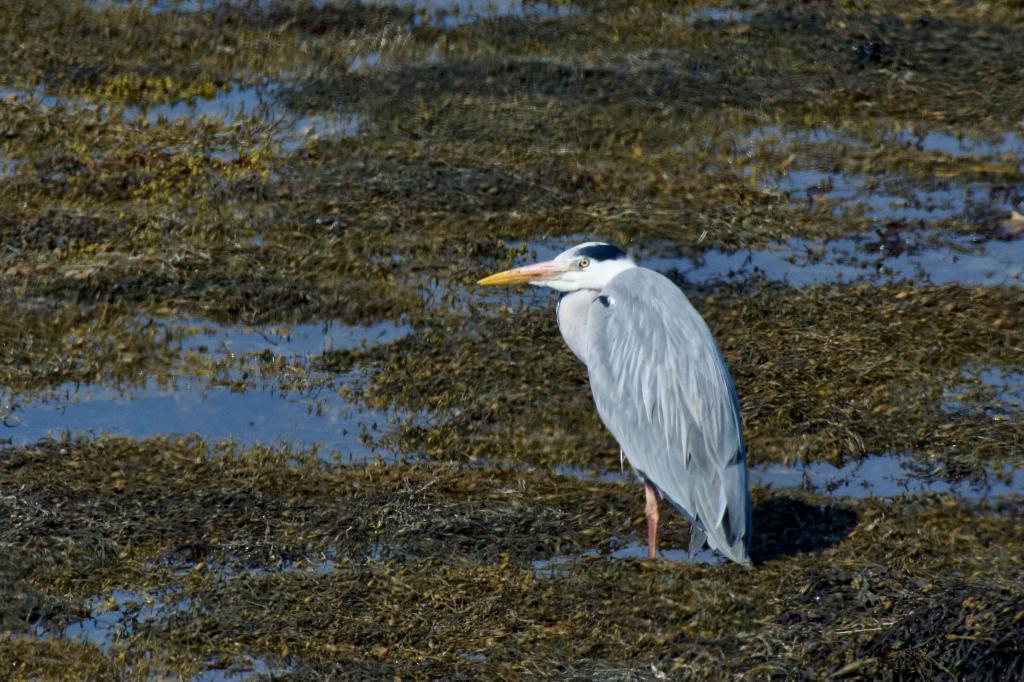
Closer to home the new ponds dug a few weeks ago are seeing more life. Three Mallard drakes have been here most days, passing the time while the females sit tight on hidden clutches of eggs. As the Mallards dabbled in the pond, a Heron flew past, he or she choosing to land on the shore just below the meadow. A rare sight here for this time of year, more common in winter when we see them in small groups of a half dozen or so. On wild and wet winter days they tuck themselves into the lee of the low cliff, stooped and grey, like old men who’ve worked a life too hard.

A Grey Heron visits the shore below the meadow.


May the 26th.

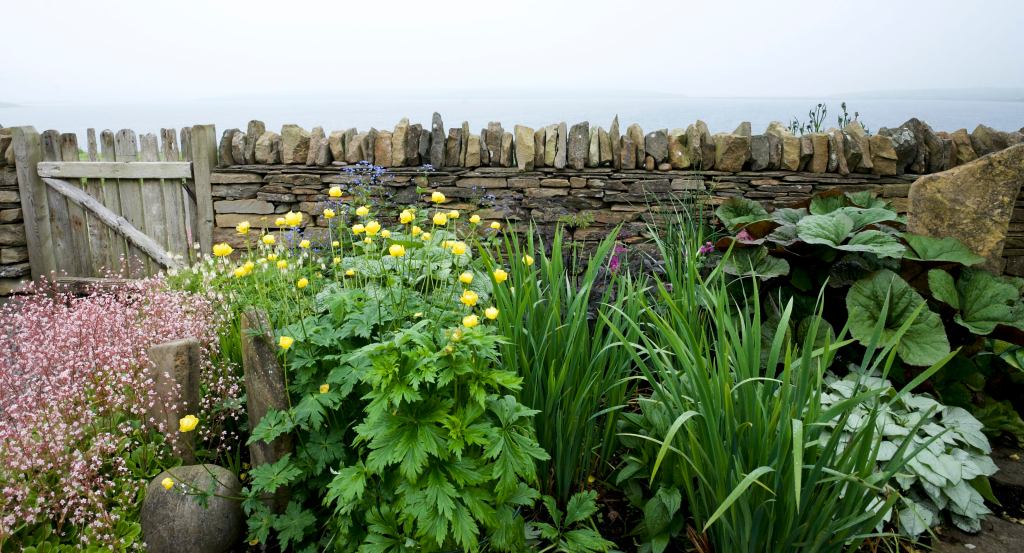
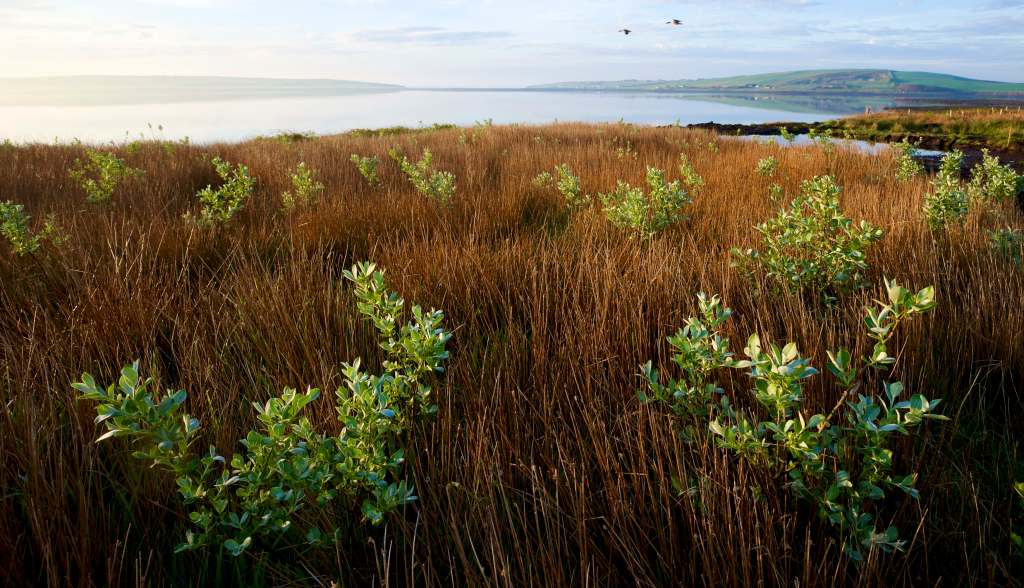
May, so far, has become a month of mists. At the moment haars are seemingly ever present, sometimes so thick they steal the view beyond the garden dykes. The linked  island of South walls, a mere mile or so across the bay, appearing and disappearing as the fogs ebb and flow. On other days they lurk in low banks in the Offing, the point on the sea where the view is lost over the horizon. Whether near or far they are always localised, occasionally, with bright blue skies above us, we’ll still hear the low rolling boom of a distant foghorn.

A haar steals the view, South Walls is just visible.

The garden of course doesn’t care. It’s warm and mild with long hours of daylight. Winter has passed and from a plants point of view there’s work to be done, flowers to open and seed to be set before the end of our short summer. It’s hard to keep up now, each day brings more colour and growth. We noticed yesterday afternoon that alliums had opened, seemingly within hours, sure that in the morning the buds were still tight.

Allium purple sensation.

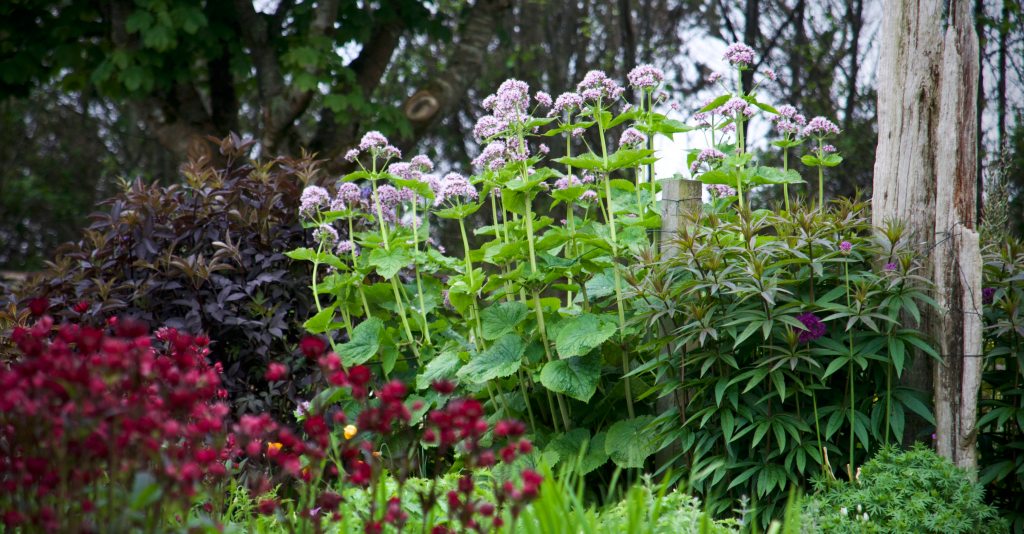
A favourite plant that has just come into flower is valeriana pyrenaica. Bought a few years ago on a visit to a Yorkshire lavender farm. We had seen it in a border near the farm cafe but the onsite nursery proved to be bare. We struck lucky, the lady running the nursery went on a search and a single plant was found. We brought it home to try in Orkney and it has thrived, split and re-split every autumn it’s now dotted throughout the garden. A tall tough as old boots bee magnet that needs little if any staking and is happy in sun or part shade. Definitely a keeper.

Valeriana pyrenaica.

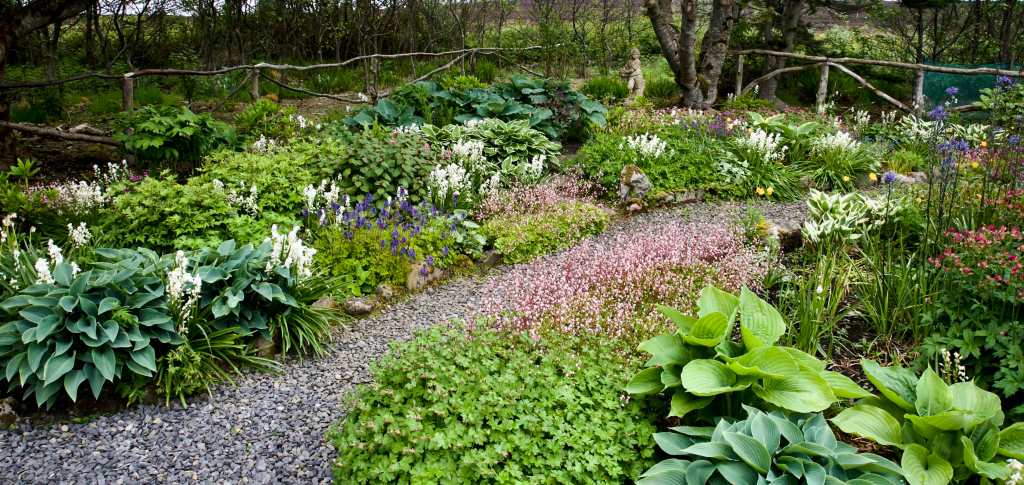
In a shady border, most of our Hostas are up and in full leaf. They share the space with a white form of the spanish bluebell, perhaps not a good plant to have if you already have native bluebells as they hybridise easily but we inherited them and the spanish variety is already common here. In the sycamore woodlands of a grand house along the way, once the lairds pile, the ground at this time of year is carpeted with both the blue and white forms.

A shady border, Hostas and a white form of Spanish Bluebell.

On and off through May, we’ve been adding more plugs to the wildflower meadow. On a warm day it’s an enjoyable job but what you mustn’t do is count the cell trays before you start. This month we’ve planted out 78 x 40 cell trays, over 3000 plugs. To count them all beforehand would be akin to painting the Forth Bridge, a task that would seem to have no end. To buy them in would be financially impossible, but from seed sown in home made cold frames, the price per plug, less your time, is a few pence. They were a mix of species, for wet spots ragged robin and water avens, for drier areas ox-eye daisy, yarrow and lesser knapweed along with a half dozen others. All of them are plants that should have been here but aren’t, lost when the meadow slowly re-wilded itself to an almost monoculture 0f rush.

Ox-eye daisy.

At the very bottom of the meadow, just before the land falls steeply to the shore, there’s an area of ground that never dries out. It’s the spot where we’ve added wildlife ponds. The areas between the ponds are thick with rush. We tried, in the first year of making the meadow, to mow the rush down and thus spent an afternoon digging our old diesel power scythe out of the mud. Since then the area has been planted as a small coppice of willow. We used a grey leaved variety that does well in Orkney, salix hookeriana, the dune willow, a native of western North America. Two feet long broomstick thick cuttings, from a friends garden along the road, were  pushed with ease into the soft ground. In the first year they stood still but  in year two they came to life, growing rapidly and leaving the rushes behind. They’re salt hardy but brittle. In time we’ll coppice them, before the wind does it for us.

A new coppice of grey leaved willow.

Ravens revisited…

At the end of March I posted about a pair of Ravens and their nest. Each Spring, for the past four years, in a geo on the island of South Walls, I have watched them repair a winter wrecked nest of kelp stems and sheeps wool before laying a clutch of eggs.

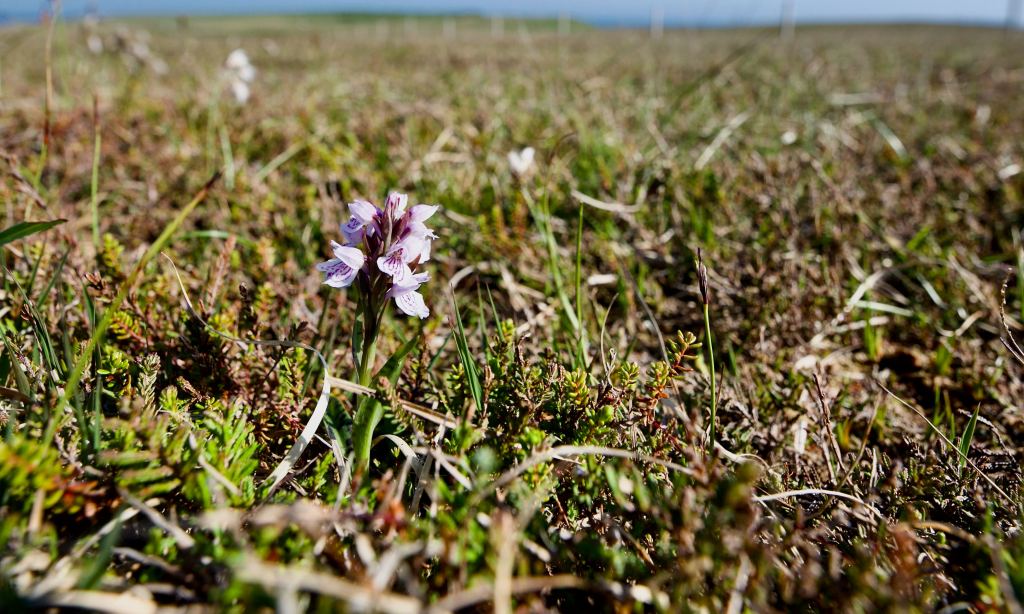
The geo is on a favourite walk, a loop from the farm of Snelsetter, that first takes you out across an area of heath and then brings you back along the coast. The heath is wind cropped, a mix of ankle high heathers and grasses, cut here and there with shallow ditches. At this time of year the ground is dotted with cotton grass and orchids.

Heath spotted-orchid

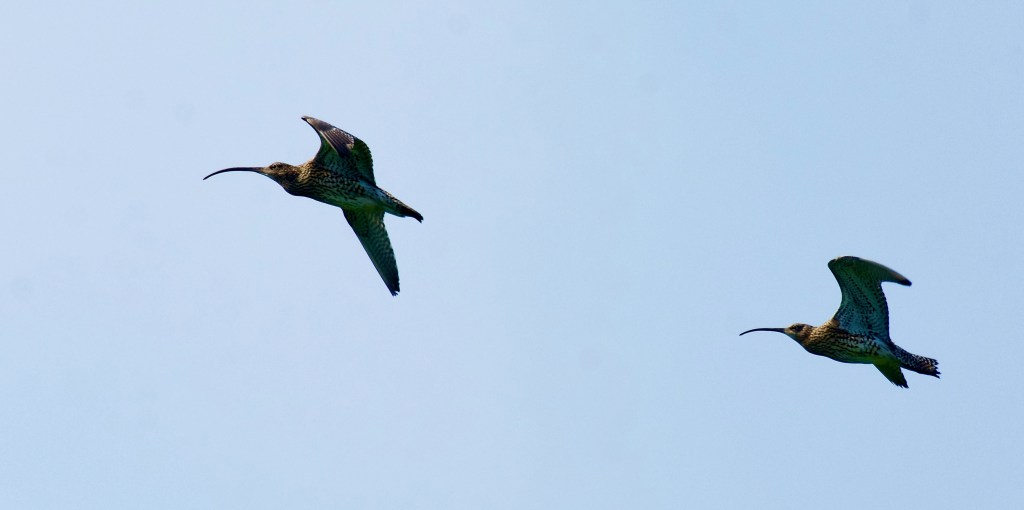
It’s a place where Curlews call and Lapwings tumble in display flight. A spot where, if you are lucky, you’ll catch sight of a Short eared owl quartering the ground. This time there are no Owls but Lapwings are seen and, right on cue, a pair of Curlew rise from a wet spot dusted white with cotton grass.

A pair of curlew rise up from the heath.

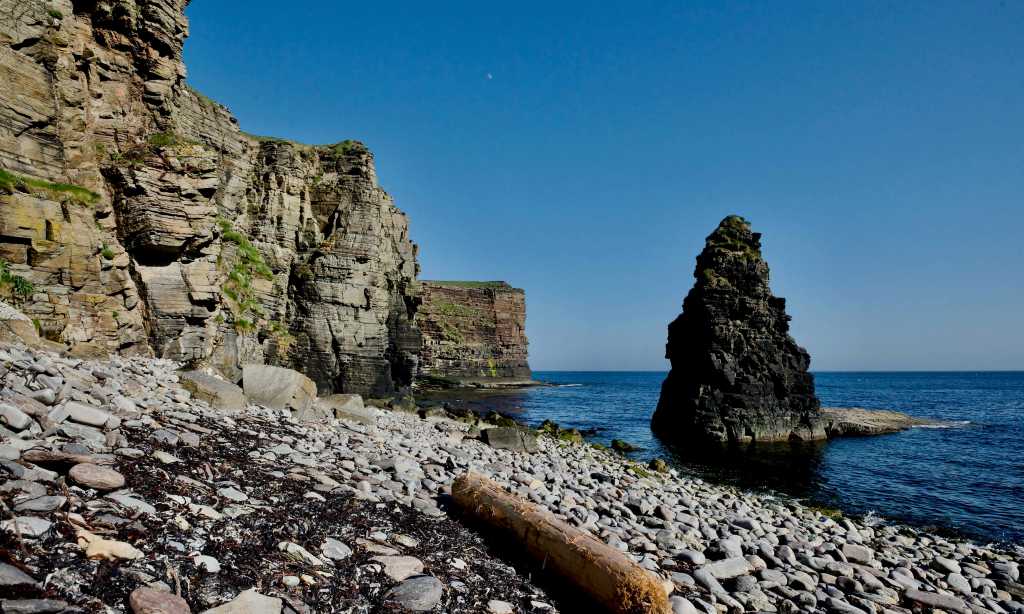
Eventually you come to a fence of silvered stabs and rusting wire, time to turn left and follow it to the coast. The nest is in Birsi geo, a wide bay with near vertical cliffs and a grey beach of sea worn stone. The geo may get its name from the Norn, a now lost language of the Northern Isles, bristle or bristly. A good spot for driftwood but getting your finds out is awkward, a steep zig-zag track, barely a boot step wide, taking you down to the shore and back.

Birsi geo

It had been a few weeks since I’d walked close to the nest site and I wondered how the Ravens had fared. Had the eggs hatched, had the nest been lost to a storm. A quick scan with binoculars gave the answer, a distant group of six Ravens on a headland at one end of the geo, two adults and four youngsters. The collective noun for a group of Ravens is an unkindness. Today, with devoted parents watching over their brood, a kindness might be better.

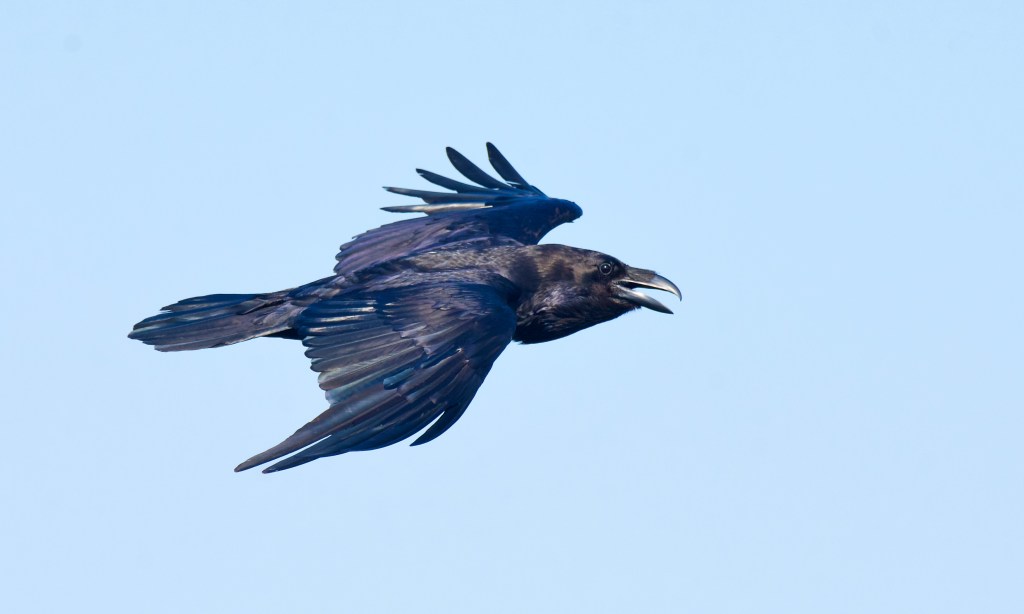
As I got closer the birds moved on, lifting lazily away on the breeze before settling back down again, not too worried by my presence but keeping a distance, always wary. The exception came when I got close to the site of the now empty nest. One of the adults left the group, circling me and kronking a warning, coming so close I could hear the swish of the birds wings through the air.

An adult kronks a warning.

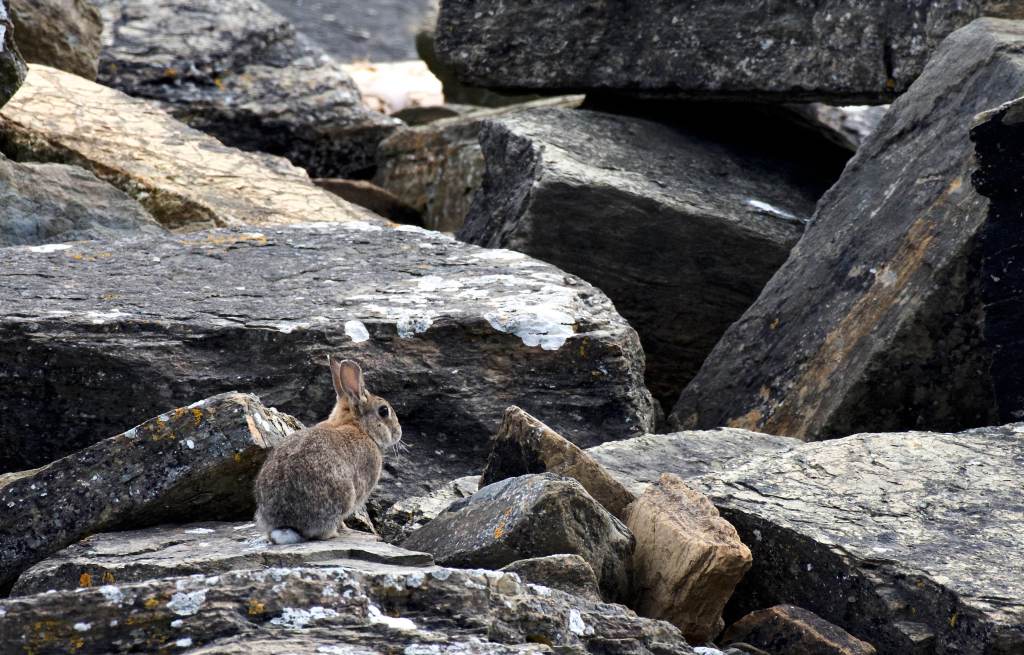
The birds are omnivorous, happy to take a young rabbit or to feed on berries. At this time of year, as seabirds return to the cliffs to breed, stolen eggs make up a large part of their diet. As I reached the spot where I first saw them I came across the egg of a Shag. Newly opened, the grass still wet with the remains of the yolk.

As a family the birds will stay together for the summer, after that the youngsters will leave and form loose flocks with the young from other nests. Four years from now they will find a mate, the start of a partnership that will last for the life of the birds.