
This weeks Six on Saturday is a wander around the garden and its environs – six different spaces. Our weather has been the usual mixed bag, some of the photographs were taken earlier in the month, on drier days than this, a few were taken this morning, with the rain coming down in stair rods. Our home is an ex croft that like pretty much every other house on the island comes with a small parcel of land, most of which is managed for wildlife. The garden is split 50/50, planted for humans and wildlife alike. At this time of year everything is winding down, trees are shedding leaves, flower heads are turning to seed but despite the rain and gales there’s still some colour to be seen.
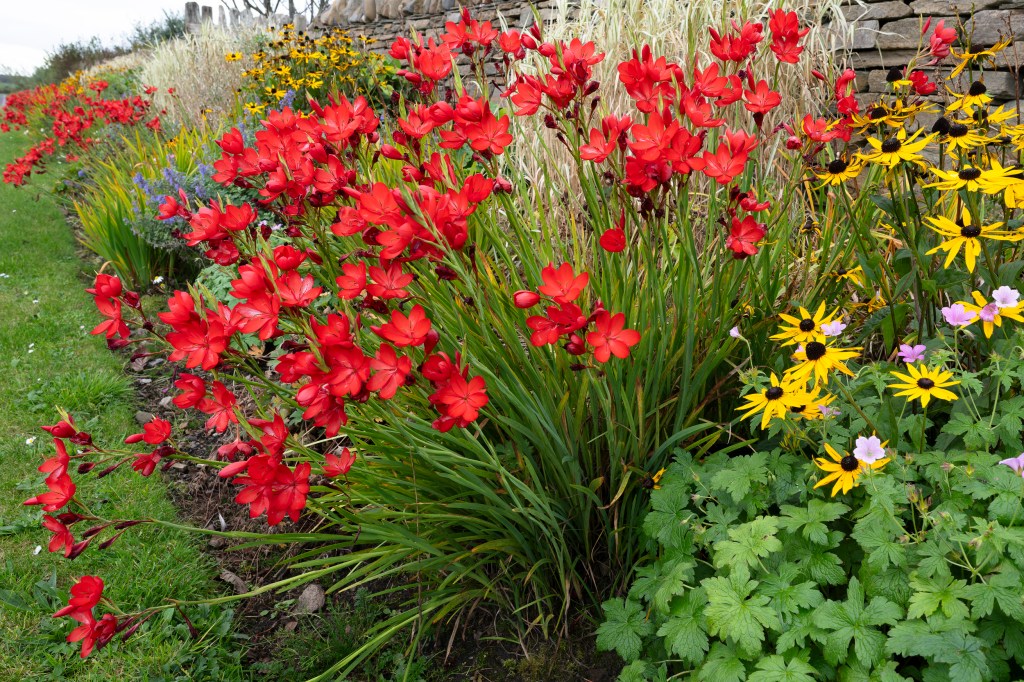
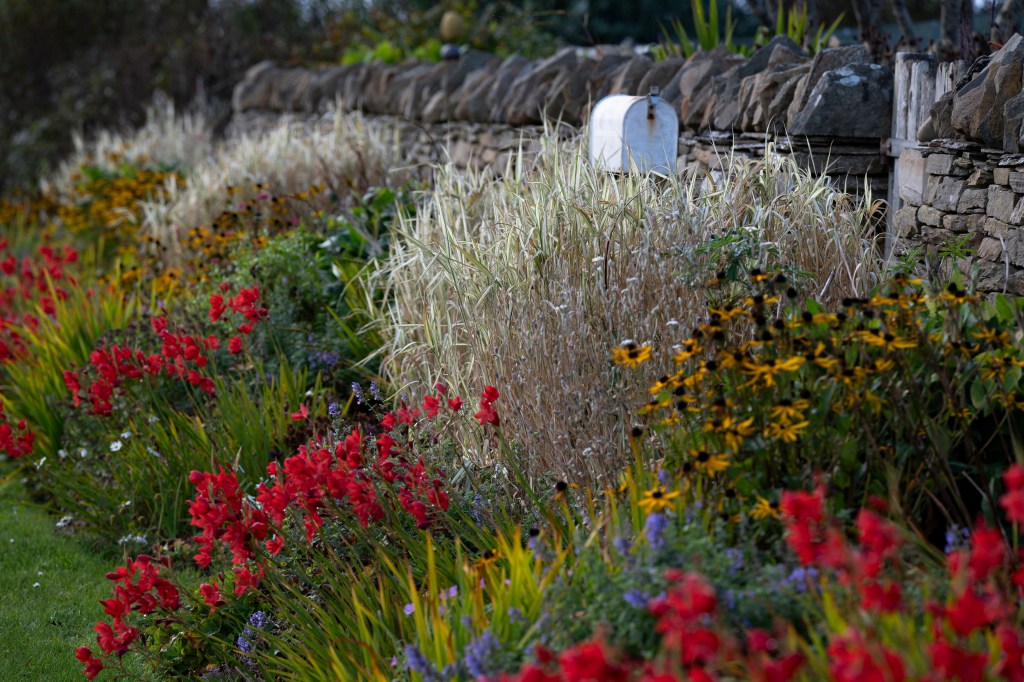
First up is the verge-side guerrilla garden, it gets its tongue in cheek name from the fact that a good slice of it possibly belongs to the county council, it started life as somewhere to put spare plants and has since become a long border that runs the full length of the dry-stone dykes that we rebuilt in 2020, our covid lockdown project. For most of the year it’s a typical cottage garden mix but for Autumn, when most perennials start to fade, Jacqui has simplified the planting down to three main players, Rudbeckia goldsturm, Hesperantha coccinea and Reed canary grass. Summer plants aren’t lifted and a few geraniums and catmints still lurk among them but for this time of year the aim was three main species, chosen for both colour and wind hardiness.
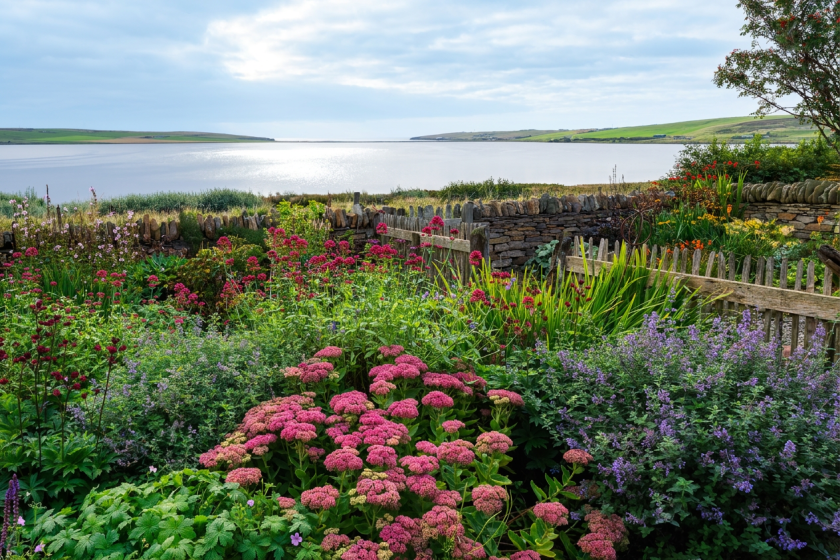
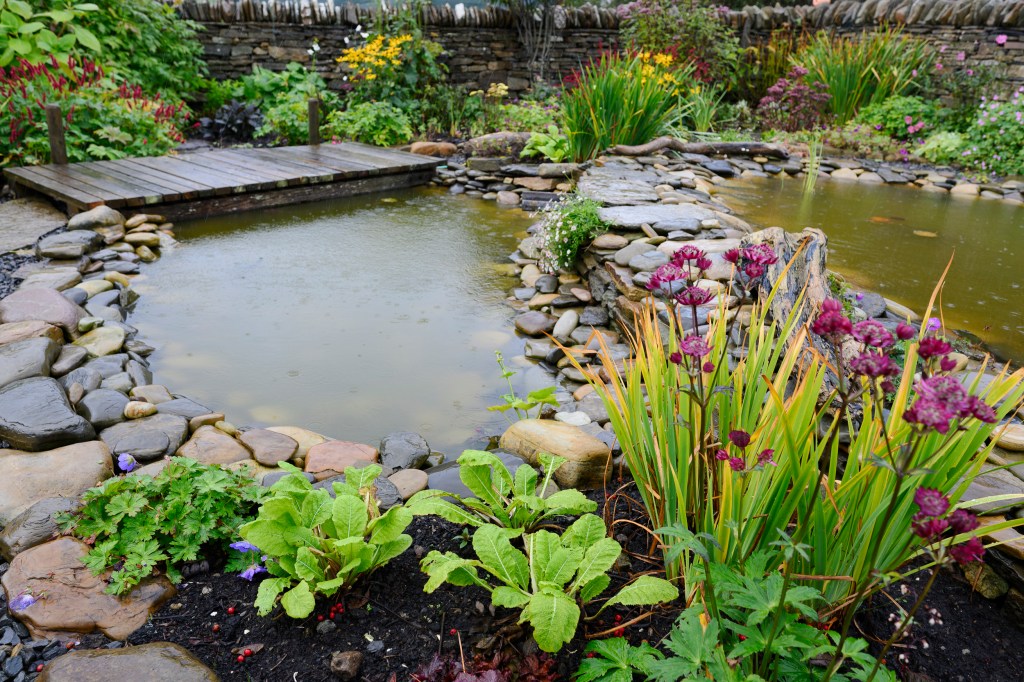
Next we’ll go through the no expense spent driftwood gate and into two thirds of the front garden space. An awkward spot to layout, it didn’t just slope downwards but also sloped right to left. We got around this by terracing the ground to the left and then, to break the right to left slope, we split the space with a simple fence. As with the gate no expense was spent, the fence, like the gate, came from the shore. With the exception of the centre ground Centranthus ruber which seems pretty much gale proof, most of the planting is deliberately kept low, anything tall goes next to the dyke or the fence to be discreetly wired into place. The front garden carries on, following the line of the guerrilla garden and the house, when we rebuilt the dykes the last third of it was enclosed on all four sides with stone, a Kale yard, a nod to this wee houses history, the spot where veg would have been grown. When we first laid it out we made a large central bed with a border on its Southern edge, a few months ago we replaced the central bed with a couple of ponds, something that from a garden wildlife point of view had been sadly lacking. The ponds are young and still murky but they’re planted with native waterlilies and oxygenators and time will eventually clear them. Carry on South and beyond the stone dyke there’s a place between garden and moor that in Spring will be planted with phacelia and mustard, pollen for bees and winter seed heads for finches.
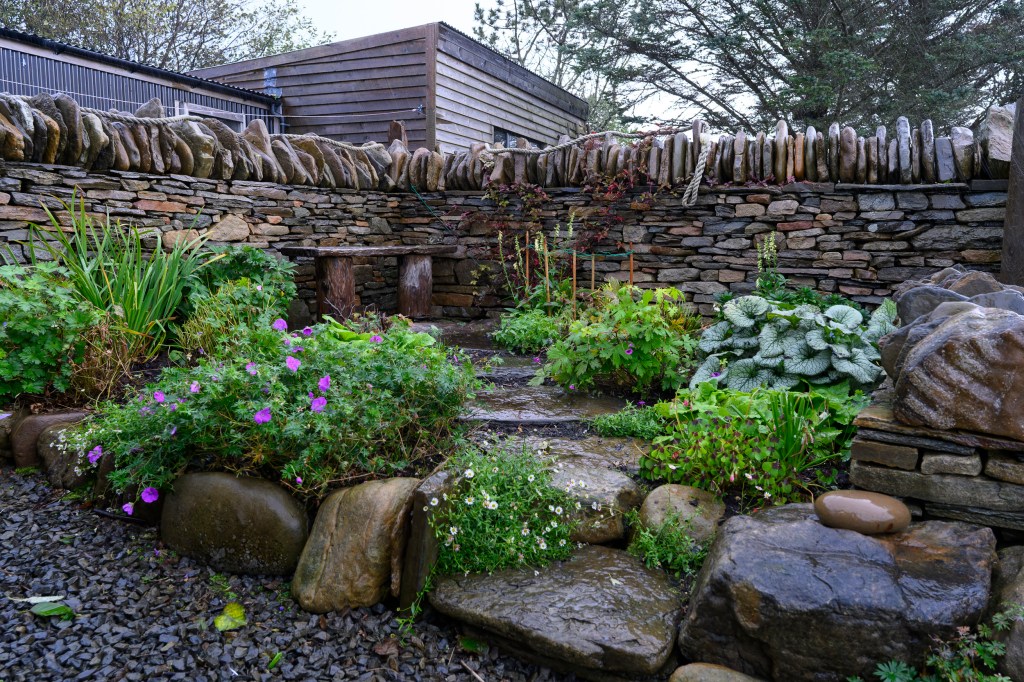
Leave the front gardens, turn the corner of the house and you’ll come to a space that like the ponds is another recent project, a small courtyard enclosed on three sides by stone dykes. The dykes were built with the last of our stone, we were down to the dregs and I had just enough to finish the walls but had to salvage the top stones, the upright “pennies”, from the shore. There’s a simple driftwood bench that one day, when I get around to cutting up a hot water tank, another shore find, will have a copper top. Quicker to dry than timber, no wet backside when you sit down. It’s a project that had been on hold for years, when we were renovating the house we dug the space out with a mini digger so that a concrete mixer could reverse up and pour a new floor, when the house was done we put it all back and built the dykes. It sits in a wind tunnel and has only recently been planted, some plants will thrive, others might struggle with the westerlies and easterlies that funnel through the narrow space between house and outbuildings – to be tweaked as time goes on.
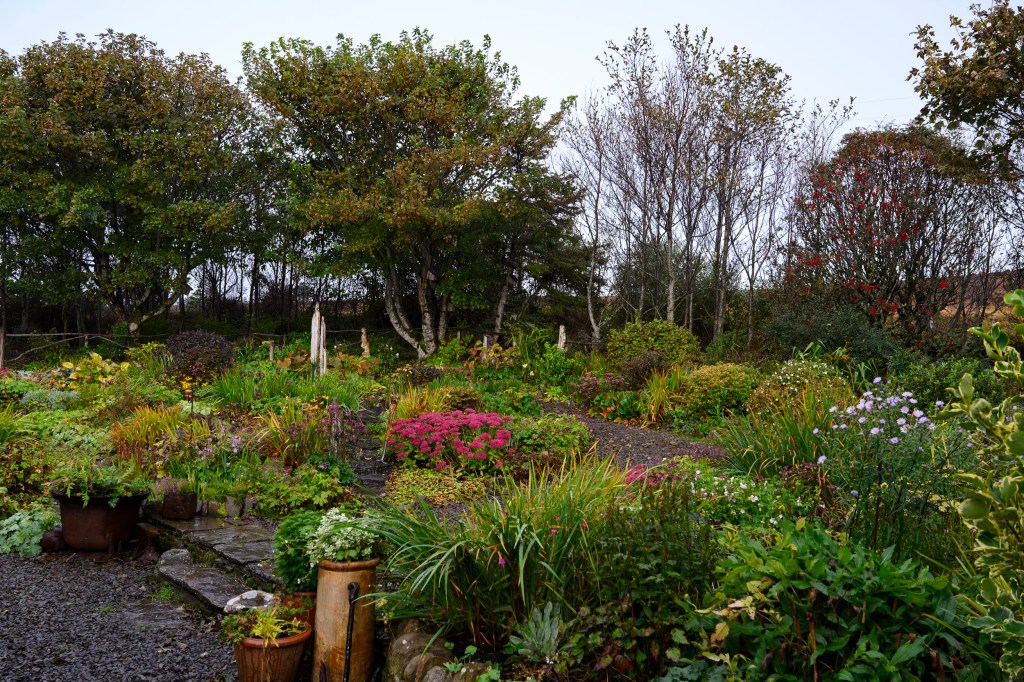
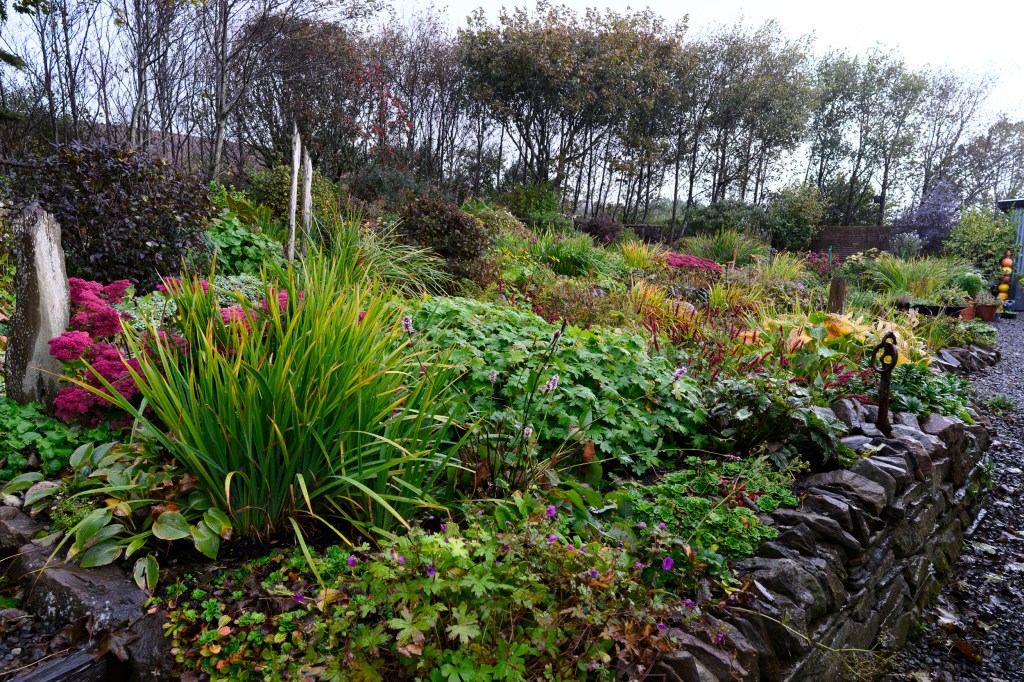
Turn the corner again and you’re in the back garden, another space that because of the slope is better for being terraced. We inherited three Sycamores and topped up their shelter with Red alder, a tree that cleverly fixes its own nitrogen and even in this neck of the woods will grow, when young, by a metre a year. At this time of year the back garden is fading, it paces the trees that protect it from the westerlies that race in from the open moor, as they crisp to brown and shed their leaves, the garden dies back. Reds and soft yellows and marmalade orange, the autumn colours that the trees up here can’t give.
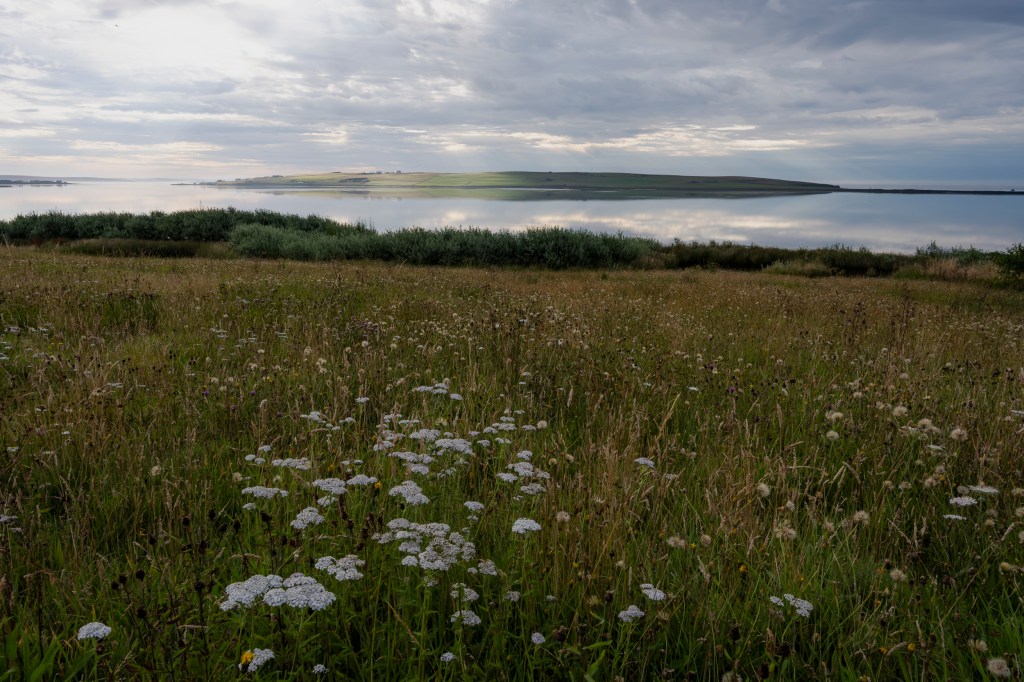
Turn on your heels and go back through the front garden gate and between garden and shore there’s the meadow, a long term project that has seen a duo-culture of Soft rush and Common bent turn into the meadow that decades ago, before it fell into disuse, it once would have been. Like the back garden it’s pretty much over for the year, the Yarrows in the foreground are the last man standing. When they have faded to seed I’ll walk a power scythe over it, raking up the hay and piling it near the shore so that beetles and bugs and Wood mice can bed down in it. When Spring comes, I’ll mow it until the end of April – the Soft rushes that dominated are still there of course but the mowing and cutting keeps them in check, allowing others the space to grow.
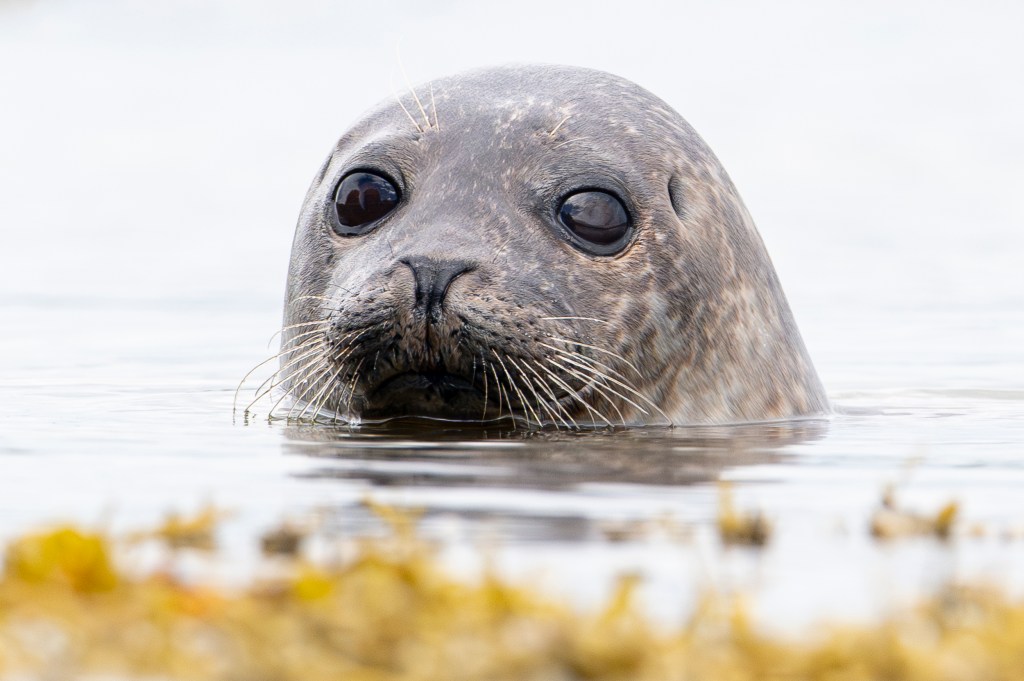
Go beyond the meadow, through the willow coppice mentioned last week and you’re down onto the shore, under ancient Udal law, a throwback to the days of the Norsemen, the shore here belongs not to the Crown but to the deed holder. In reality it belongs to the creatures who live there, the Eiders and the Fulmars, the Harbour Seals and others.
For more Six on Saturday’s head over to Cornwall and Jims blog


I loved the seals in Scotland and around Iona when we visited there, they played and swam amongst tidal pools and sea weed, such gentle sea creatures. Your hesperantha is glorious, as is the entire garden and meadow, and shifting clear light of sea and sky and land — a wee glimpse of heaven in my books.
LikeLiked by 2 people
We have both Harbour and Grey seals here, the Harbour seals tend to favour sheltered spots and the bigger Greys are more sea going, rarely seen in the bays. I love their company, very inquisitive, if you’re walking on the shore here you can pretty much guarantee a posse of Seals will be following you.
The Hesperantha looks far too exotic for Autumn in Orkney!
Mostly heaven – hellish when the midges are out 😈. They must have a purpose but like the Horseflies that follow them I just wish it wasn’t to chew on human skin 😀
LikeLiked by 1 person
My how lovely. I think it was the harbour seals we saw, although we may have caught the greys on the North Sea off shore on a trek to a seaside fortress. 🤨 Oh yes-sss — the nasty midges, forgot about those sneaky biters 😉Not sure how one wards them off, but recall them taking a few rounds out of us on evening walks.
LikeLiked by 1 person
They punch well above their weight, we’ve tried all sorts of sprays and lotions but the best thing by far is long sleeves and a midge hat with a wide brim to keep the netting of your face. Fortunately they’re not as bad as Western Scotland and the highlands, we have about ten or 12 days each year when to ago out without the hat is an act of self harm!
The wind defeats them, anything above 8 mph or so keeps them grounded – which is why in Orkney we only see them for around ten or twelve days a year 😉
LikeLike
What a fabulous garden and amazing views. I have never seen Schizostylis coccinea growing in such floriferous abundance anywhere before. Absolutely gorgeous. Nice to meet somone else who indulges in a bit of guerrilla gardening. I do the same in front of my house in France.
LikeLike
Thank you. Depending who you ask some say that the council own three feet in from the verge, others say six feet, someone suggested eight feet – we’ve gone for option one 😉
The coccinea looks far too exotic and delicate for this part of the world, especially at this time of year. In reality it’s as tough as old boots, never needs staking and in this garden at least, spreads like mad, we started with a single pot full and have been splitting it ever since.
LikeLike
I’m actually gobsmacked by how beautiful your garden is – the guerrilla garden is magnificent. My poor hesperantha only managed one spike this year. With views like you have I can understand why you moved to Orkney. And that seal… what a photo.
LikeLiked by 1 person
We were very lucky that when they put super fast broadband in a few weeks ago they chose the other verge! A lot of digging up and replanting if they hadn’t.
The Hesperantha goes mad up here, all of those plants, plus a few others that are in the back garden, came from a single pack of bulbs that we bought a few years ago. It clearly likes our wet soil.Never tried it but they say they can be used as a pond marginal.
Those doe-eyes! He or she was a pup that would have been born in June.
LikeLiked by 1 person
I’m so jealous of your super fast broadband. Still waiting for mine. I’m lucky if I get 11mbps 😢
LikeLiked by 1 person
With the old copper cable we were down to 1mbps at one point, swapped to a router with a sim and got 10-14 mbps but if we got an aurora, common this far north, or really heavy rain, it would drop. A lot of people up here opted for Starlink but it comes with mixed reviews, very fast though when it works. With the new fibre we’re getting 700mbps, it’s like a breath of fresh air, hope they connect you up soon.
LikeLike
Such a lovely garden, all the more impressive given where you are.
LikeLiked by 1 person
Thank you Helen.
LikeLike
Such beautiful views–they’re so realistic, I feel like I’m there. The scene with the Reed Canary Grass and the colorful blooms is spectacular and should be framed. ❤
LikeLiked by 1 person
Hi Beth, that Reed canary grass is so well behaved up here, in our old sandy soil garden down in Yorkshire we had a constant fight to keep it from running, we ended up planting it in sunken half barrels.
You picked my favourite shot 😉
LikeLike
What a wonderful tour round your garden Gary. It looks spectacular and, against the back drop of the sea, so incredibly special. The result of so much hard work, but so worth it I’ve ordered my tulips and some new recycled pots which are very light, can’t lift terracotta any more. I love doing this, gardeners are continually looking forward and I love my Spring tulips. “Eyelash” is one of my favourites. Look her up she’s gorgeous. Too early to plant of course so I’ll just have to spend time thinking about what has to go, and what can stay. Next Summer gonna be even hottter, apparently. Have a great week. x
LikeLiked by 1 person
Morning Margot, next time we’ll offer tea and cake 🍰😀
We never had any luck with tulips, we tried them down in Yorkshire, a few varieties that all died out after a couple of years. Haven’t tried them here but I’m pretty sure our acidy soil and winter wet would be the kiss of death, are you growing yours in the new pots?
I looked Eyelash up, very nice, had she been available at the peak of Tulip mania in the 1630’s I reckon eyelash would have made quite a pile of guilders at auction!
You’re doing the same as us, making plans for next year, we should always look forward, with that in mind I’ve been potting up seedlings found on the shelter belt floor, when I counted up, along with the usual suspects of rowan and sycamore I had 47 bird sown Fuchsia magellanica seedlings, with more to come, they’ll probably end up as a hedge somewhere but if there’s ever a Fuchsia magellanica mania boom – I’ve got the market covered 😀
Hope the forecasts are wrong for next year, wishing you some rain. We are living in Scary times.
Have a good week x
LikeLike
I’ve loved reading about your garden, Gary, and the photos are fabulous. I’m very envious of the garden but probably not the weather and all the endeavour. Look forward to your next account.
LikeLiked by 1 person
Thanks Martin, apologies for the late reply 🙂
LikeLiked by 1 person
Was away in BC’s fruit growing region for a week, so waited till I could see your pictures on my laptop. The phone just wouldn’t do them justice.
Thank you for taking us all on this lovely narrated walk round your beautiful garden. I know it represents great planning, very hard work and a little magic. And yes please, next time you do this I’d love some tea and cake 😉
You also solved a mystery for me. I now realise the plant that popped up in the 3cm of gravel in a totally shaded strip alongside my fence, was Hesperantha. I assumed it was a gift from the birds. Sadly it departed just as mysteriously, after thriving for 10 years. So now I know what it is I shall buy one (and plant it somewhere more conducive where it can be admired).
LikeLike
Hi Penny
Tea and cake it is 🙂
The hesperantha’s are great for this neck of the woods, late flowering and wind hardy, we’ve just planted alstroemeria with high hopes that it too will do well as a late autumn flower here, also has the benefit of dark purple-black foliage.
I had a google of BC’s fruit growing region, the Okanagan valley came up as a prime spot, is this where you went? I found a page that gave a detailed history from first nations to the current day, a “place of water”.
LikeLiked by 1 person
Yes, that’s exactly where I was. Went on a senior’s organised coach tour there in early May and again this time. It’s my way of compensating for the annual train trips to California I used to take. California is where the US grows 30% of it’s veg and 75% it’s fruit and nuts.
The tour director had just returned from taking a group on a trip named ‘The Railways of Northern Ontario’, which flies to Toronto (4500km) then goes by rail (with a few buses a small skiff in between) the 1100km to Moose Factory on the Moose Cree’s territory in Hudson’s Bay. You might recall that this is where John Rae was the factor for ten years. She was able to show me her videos and pictures and explain the parts I might find hard, given my mobility problems.
Now giving it some thought, as the next tour there will be going in 2028, by which time I’ll be 75. Interestingly, the hardest parts for me would be trying to find space for my legs in these damn leg braces on the 5.5 hour flight, and fitting into the tiny skiff that ferries people on Hudson Bay from Moosonee on the mainland, to Moose Factory Island. Oh, and wheeling my case down a long dirt road from the skiff dock to the only hotel in Moose Factory.
All this of course is as nothing to the journey that John Rae did from Hoy to Moose Factory – but he was a tough Islander and more than 50 years younger than me!
LikeLiked by 1 person
Would the rail part of the journey be the Polar bear express from Cochrane? It looks amazing, I hope you can cope with the flight. For the dirt road I’m sure there’s always someone with a truck or an atv – arriving on the back of a quad would be quite fitting for that neck of the woods. With no roads in I see that the rail line is also a lifeline for the first nations.
JR and his ilk were made of sterner stuff than all of us, I was reading an article a few days ago about one of the islands here, JR and the HBC popped up, I can’t remember the year but at one point four in every five men working there were Orcadian. I’ll see if I can find it again, also learnt that the word factory came from factor, obvious now I’ve been told ☺️
LikeLiked by 1 person
Oops… I meant Kirkwall, not Hoy!
LikeLiked by 1 person
Yes, it is the Polar Bear Express. Here’s the link for the trip so you can see the whole journey: https://www.wellsgraytours.com/tours/scenic-railways-of-northern-ontario/
Our new PM is promising all weather roads to run alongside that railway and also the one from Winnipeg to Churchill (also on Hudsons Bay), as currently, at least for the Churchill route, there is an ice road in winter, but the rest of the time it’s impossible to drive through the muskeg https://thecanadianencyclopedia.ca/en/article/muskeg
And here’s a video the tour director shared with me, made by the Moose Cree of Moose Factory to https://m.youtube.com/watch?v=1AebsVebJAk&ra=m
To manage the journey to the Okanagan, I had to have lidocaine and steroid injections into my arthritic hands so, so there’s more than just the leg braces to cope with for such a trip. It is very tempting though…We’ll have to see if they decide to run it again in 2027 (unlikely), or if it’s going to be 2028.
LikeLiked by 1 person
Thanks for the links Penny, I’ll enjoy watching them. The road running alongside the rail line would be the way to go for the logistics of it all, I doubt it will be an easy task but probably easier than laying the original line, I read that the old platelayers laid down logs and brush topped with tons of ballast and were constantly fighting with track that either twisted or repeatedly sank into the bog.
I hope you can do the trip , we’ll be expecting photos if you do 😉
LikeLiked by 1 person